Categories
Accountability crime and punishment general freedom ideological culture media and media people moral hazard nannyism national politics & policies responsibility Second Amendment rights too much government U.S. Constitution

Killer Inlaudabilis

On the day that Alexander the Great was born, or so the ancients tell us, a man named Herostratus burned down one of the Seven Wonders of the World, the Temple of Artemis at Ephesus.

Why? Just for the infamy.

Which is why the Ephesians proscribed mention of the man’s name. That is called a damnatio.* Obviously, that damnatio didn’t stick, for we know his name now. How? Historian Theopompus recorded it for our . . . edification? Vilification?

I say we should follow Ephesian example and not mention by name the recent Florida school shooter/murderer of students. There should be a widespread damnatio in the press and blogosphere against the young man. Let’s not to give him his infamy, and not encourage copycats — nor in any way normalize his horrible act.

Is this a “solution” to the problem of school shootings? Probably not. But there may be none — at least nothing sure-fire.

Yes, a non-blundering FBI might’ve helped.** But virtue-signaling/grandstanding calls for unnamed gun control measures won’t. And treating “mental health” issues more “professionally,” particularly by easing up involuntary commitment law, is probably a recipe for putting away innocent and unpopular people.

Pre-crime” is itself criminal.

So, what to do? Maybe it is this: “Notice those around you who seem isolated, and engage them,” as Robert Myers advises. It is loneliness, he argues, that “causes these shooters to lash out. People with solid connections to other people don’t indiscriminately fire guns at strangers.”

But that’s not an after-the-fact solution.

This is Common Sense. I’m Paul Jacob.


* FYI, the arsonist’s status as an unspeakable person was called inlaudabilis.

** As if to fit an established pattern, the FBI failed to take seriously enough an early citizen-initiated alert regarding the young man who went on to commit the mass shooting. Prophecy is a tough biz; it is no doubt easier to connect the dots looking back after the fact.

PDF for printing


Categories
First Amendment rights free trade & free markets general freedom initiative, referendum, and recall nannyism national politics & policies privacy property rights Second Amendment rights Tenth Amendment federalism too much government U.S. Constitution

Winning Too Much?

“We’re Number 17!!!”

This lacks a certain triumphant note.

It is nothing like the “We’re Number 1!” the Swiss are now hollering as they pump their arms into the air, waving giant #1 foam fingers against the backdrop of snow-covered Alps.

Actually, knowing the Swiss, they are probably a bit more restrained. Still, you get the point.

Number 1 in what, you ask? Creamy, delicious chocolate, perhaps? Banking? Skiing?

Freedom.

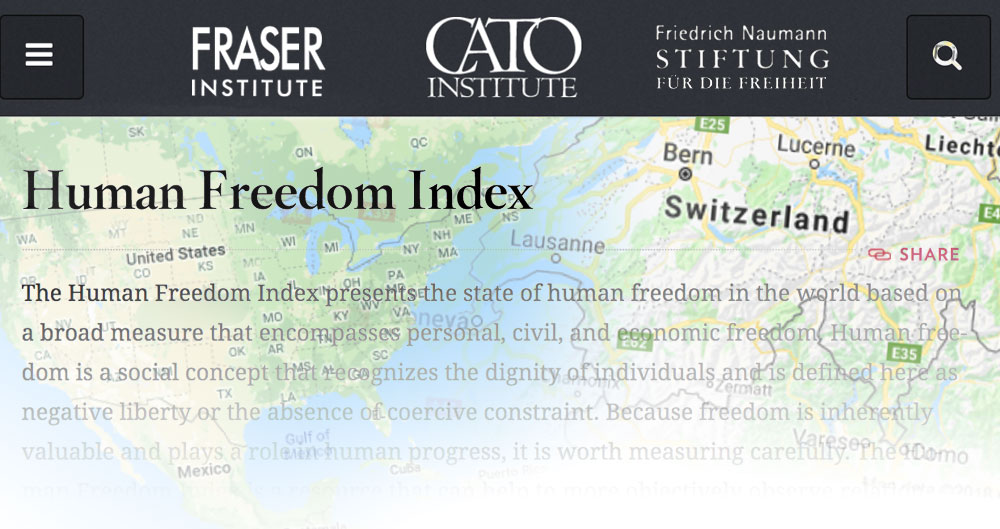
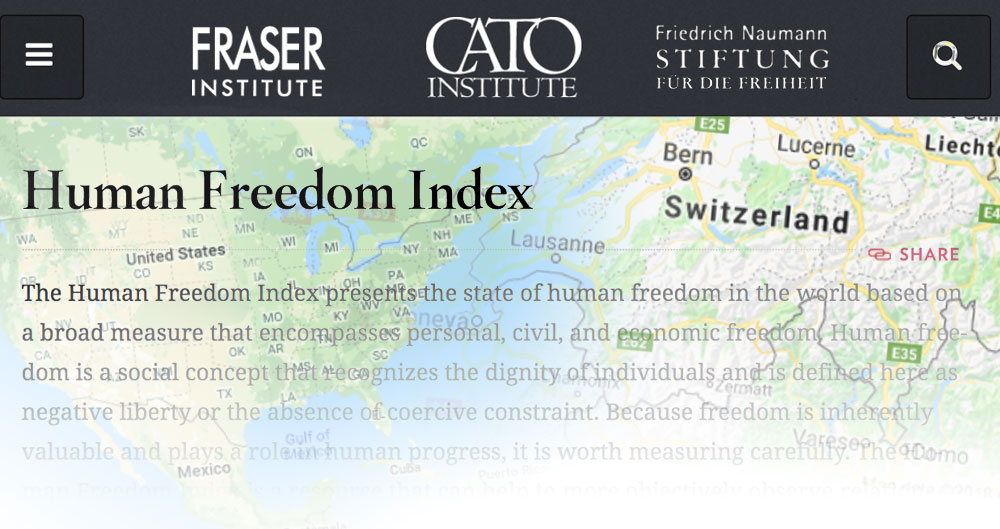
The Human Freedom Index 2017, jointly published by the institutes Cato, Fraser, and Liberales, is hot off the presses. The report ranks the countries of the world on “personal, civil, and economic freedom.”

This year, Switzerland switched places with Hong Kong, which had come in first the year before. The U.S. moved up from 23rd place in 2016, but down from 2008, when we were challenging Top 10 status at Number 11.

“Weak areas [for the U.S.] include rule of law, size of government, the legal system and property rights,” according to a Cato video.

Let’s compare Switzerland to the United States. The 1848 Swiss Constitution creates 26 sovereign cantons (states), greatly influenced by our system of federalism. In the 20th century, Americans in 26 states and most localities borrowed from the Swiss, establishing a system of direct democratic checks on government — what we call ballot initiatives and referendums.

Both countries have constitutional limits on government, protecting individual rights — even from fully democratic tyranny. But in the freest nation in the world, Switzerland, citizens possess a powerful direct democratic check on their government at all levels . . . while we do not.

After all, we’re Number 17.

This is Common Sense. I’m Paul Jacob.


PDF for printing


Categories
Accountability crime and punishment folly government transparency ideological culture media and media people national politics & policies U.S. Constitution

Defiance?

“Once the party of law and order,” screamed the Washington Post’s top-of-the-front-page Sunday headline, “Republicans are now challenging it.”

The story’s lede: “Republican leaders’ open defiance last week of the FBI over the release of a hotly disputed memo revealed how the GOP, which has long positioned itself as the party of law and order, has become an adversary of federal law enforcement as the party continues its quest to protect President Trump from the Russia investigation.”

Huh?

Defiance,* by definition, is “bold disobedience.” But the Constitution tasks Congress with control (by oversight and purse string) of the Federal Bureau of Investigation and the Department of Justice. Because subservient, it is the FBI and DoJ that can disobey. Not Congress.

While some Republicans seemingly switched sides on the appropriateness of criticizing the FBI over the Nunes memo release — congratulations are in order! — the same point, reversed, can be made (even humorously) about some on the Left now condemning such criticism.

Criticizing the government — including law enforcement agencies — has always been as American as apple pie.

The Post supports an ever-increasing role for the federal government, favoring Democrats. But now, Trump Derangement Syndrome has apparently pushed the company-town paper over the edge . . . to Media Madness (the title of Howard Kurtz’s new book, which the paper sophomorically savaged).

How ridiculous to characterize Republicans as enemies of “federal law enforcement” because they believe some within the FBI acted improperly, perhaps unlawfully.**

The Post should remember that its journalistic street cred didn’t come from reporting partisan spin as fact, but from what some saw as “defying” the president and publishing “national secrets” in search of the truth

This is Common Sense. I’m Paul Jacob.


* The Post wasn’t alone. Politico echoed the message in its story, “GOP defies FBI, releases secret Russia memo to partisan fury,” and so did other media outlets.

** Moreover, Republican leaders have been clear that the memo does not impact Special Counsel Robert Mueller’s investigation.


PDF for printing


Categories
Accountability crime and punishment First Amendment rights general freedom government transparency local leaders moral hazard Regulating Protest too much government U.S. Constitution

Lock Her Up

“Who Are We?” I asked Sunday at Townhall.com.

Today’s question: What have we come to?

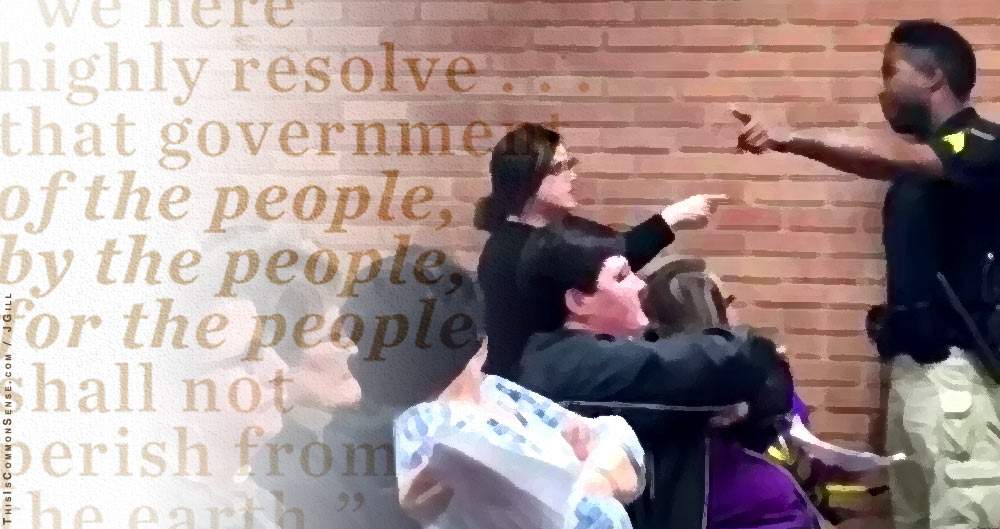
Under a seemingly click-bait headline in The Atlantic, “Can Government Officials Have You Arrested for Speaking to Them?” Garrett Epps examines last week’s outrageous handcuffing and arrest of a Louisiana teacher, Deyshia Hargrave, for speech displeasing to the Vermilion Parish school board at a public meeting.

The elementary school teacher complained about a $30,000 raise the board was giving the superintendent, noting that teachers had not seen an increase in nearly a decade. After asserting that the raise would be “basically taken out of the pockets of teachers,” she was ruled out of order by the school board president and then asked to leave the premises. She calmly left the meeting room . . . only to be forced to the floor, handcuffed and arrested once in the hallway.

Police claimed the arrest was for “remaining after having been forbidden” and “resisting an officer.”

The school district announced it won’t press charges. Very funny. Anyone can see from the video that her treatment was excessive.

Next month, the U.S. Supreme Court will hear oral arguments in Lozman v. Riviera Beach, Florida, where an arrest was clearly retaliatory, but the city is newly claiming another violation it could have used to arrest Mr. Lozman.

Does this after-the-fact adding on of charges provide governments with an escape clause? As Epps argues, a Lozman decision “could either rein in, or embolden, the tiny-handed tyrants who rule county buildings and city halls around the country.”

If respectfully challenging our so-called public servants in meetings designed for that can lead to being arrested, handcuffed and dragged off, we no longer live in ‘the land of the free.’

This is Common Sense. I’m Paul Jacob.


PDF for printing


Categories
general freedom media and media people national politics & policies too much government U.S. Constitution

Happy Birthday, America!

What? Oh, sure, I know the United States of America has its birthday on July 4th, that day in 1776 when the Second Continental Congress adopted the Declaration of Independence.

Let’s agree I’m early. (Oh, how I wish it were July.)

But the interesting thing about history is how we get to those moments wherein the great “we” declare our independence or fill the streets or storm the beaches — or the polls. The many big, important days that lead to THE day.

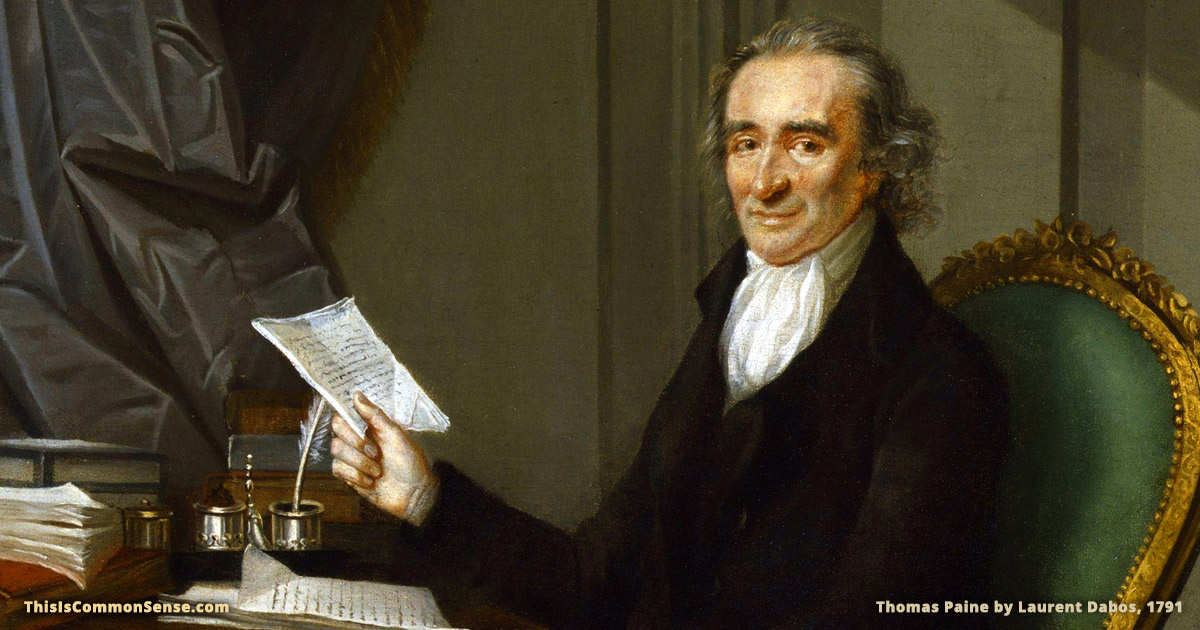
Today is such a date, because 242 years ago on January 10, 1776, Thomas Paine published Common Sense. Without this day 242 years ago, we wouldn’t have had Independence Day six months later.

Using common and direct language, and speaking to all the “inhabitants of America,” Common Sense made the case for both independence from Britain and the establishment of a democratic republic. Boy, did it make the case. On a per capita basis, Paine’s pamphlet is the bestselling American publication in history.

His pamphlet or parts were read publicly, reprinted in newspapers and spread throughout the colonies. This common man — barely an American,* having landed on our shores in November 1774 — used the universal language, speaking truth to power.

“Every spot of the old world is overrun with oppression,” Paine told his fellow Americans. “Freedom hath been hunted round the globe. Asia, and Africa, have long expelled her. Europe regards her like a stranger, and England hath given her warning to depart. O! receive the fugitive, and prepare in time an asylum for mankind.”

The original idea of these United States was freedom.

And that, my friends, is Common Sense. (I’m Paul Jacob.)


* Of course, this makes Paine almost quintessentially American.


PDF for printing


Categories
Accountability crime and punishment folly free trade & free markets general freedom moral hazard nannyism national politics & policies too much government U.S. Constitution

The Ninth and the Tenth of It

When Attorney General Jeff Sessions rescinded the Obama Administration enforcement guidelines regarding the states that have legalized (in their 29 different ways) marijuana, last week, supporters of freedom expressed some worry.

But we had to admit, one excuse for Sessions’s nixing of the mostly hands-off policy seemed to make sense on purely legal grounds. If we want to liberalize drug laws, then our Cowardly Congress should do it.

Definitely not the Executive Branch.

And yet, over at the Volokh Conspiracy, Will Baude argues that “the rule of law” does not require “renewed enforcement of the Controlled Substances Act.”

If anything, he argues, it “requires the opposite.”

Baude mostly rests his case on the Constitution’s Commerce Clause, which does not authorize regulation of intra-state trade. An issue on which the AG does possess a duty to weigh in.*

This rubs against FDR-Era constitutional theory, of course, which treats all commerce as regulate-able interstate trade. But this makes no sense. The Tenth Amendment declares that states possess powers not given to the federal government. An interpretation of the Constitution cannot be justified if it effectively nullifies other parts of the Constitution. (If all trade is “inter” state, what’s left for the states? Powers to do what? And how could there be any constraints on federal power?)

And then there is the Ninth Amendment, which states that the people retain rights not listed in the Constitution.

When citizens assert rights — such as the option to cultivate, sell, buy or ingest a common and quite hardy plant — in their states (largely through ballot initiatives), the federal government should butt out.

This is Common Sense. I’m Paul Jacob.


* “Members of the executive branch have their own obligation to interpret the Constitution,” Baude writes, “and if a federal law is unconstitutional in part then the executive branch, no less than the courts, should say so. It is the Constitution, not the Court, that is the ultimate rule of law in our system.”


PDF for printing


Categories
general freedom U.S. Constitution

Merry Christmas, America

In addition to the religious significance of Christmas, Americans share an excellent historical reason to celebrate this day.

In January of 1776, Thomas Paine published his smash hit, “Common Sense.” This pamphlet galvanized public opinion in favor of the American Revolution, which had begun the previous year at Lexington and Concord with the shot heard ’round the world.

That July, the Declaration of Independence was written, signed and proclaimed to the new nation by the Continental Congress.

But by December of the same year, the prospects for the American cause were looking bleak.

British forces, along with their mercenary Hessian reinforcements, had manhandled the Continental Army. Gen. George Washington’s troops were routed at Long Island, pushed out of Manhattan, forced to retreat across the Hudson to New Jersey, and then run out of Jersey across the Delaware River to Pennsylvania “exhausted, demoralized and uncertain of [their] future.”

Soon, the British believed, the American revolt would be extinguished.

“To compound Washington’s problems,” recounts the EyeWitnesstoHistory.com website, “the enlistments of the majority of the militias under his command were due to expire at the end of the month and the troops return to their homes.”

Yet, on Christmas night, Washington marshaled his ragtag soldiers and crossed the icy Delaware, marching his men nine miles to Trenton. In the wee hours of the morning on Dec. 26, the Continentals attacked, catching more than 1,000 Hessian soldiers by surprise and taking nearly all of them captive.

In strictly military terms, the victory was not terribly significant. But in terms of American morale, as well as the perception of important potential allies such as France, the win was an absolutely perfect Christmas gift to the new Republic.

Our Republic, dedicated to liberty and justice for all, continues to this day.

And today, you and I are left to defend it — just like the barefoot minutemen who walked through the snow to face the most powerful military force of their world.

Merry Christmas, America!


PDF for printing


Categories
Accountability general freedom media and media people moral hazard nannyism national politics & policies porkbarrel politics responsibility too much government U.S. Constitution

A Good Tragedy Not Wasted

No matter how “not as bad as we feared” President Donald Trump may be appearing, as we close out the year let’s remember why some of us did not trust him in the first place: his knee-jerk reactions are too often witlessly statist.

The speeding Amtrak train that derailed over I-5 in Washington State on Monday was a horror show, sure. And we have come to expect the President — any President, either party, all administrations — to provide words of comfort after such events. Trump conformed to expectations.

And, admittedly, his initial Tweet was all very proper. But his verbal response was . . . very . . . Old School. After mentioning the federal government’s role in handling the tragedy — “monitoring” and “coordinating with local authorities” — he used the event as an excuse to expound upon the idea that the event provides “all the more reason why we must start immediately fixing the infrastructure of the United States.”

This is bad, old-fashioned policy opportunism. The worst time to cook up “solutions” is right after a tragedy. That’s when emotions are highest and reason is lowest.

More importantly, the train was going through its initial run over newly upgraded infrastructure!

One could more reasonably surmise that the recent infrastructure upgrade was the cause of the derailment — though, let us be honest, it looks like the train was way above the stretch’s speed limit.

Note to Donald Trump: just because there’s a microphone in front of you doesn’t mean you are required to “make a point.” That’s not the President’s job.

Mister, we could use a man like . . . Calvin Coolidge again.

This is Common Sense. I’m Paul Jacob.


PDF for printing


Categories
folly government transparency media and media people national politics & policies too much government U.S. Constitution

Peel Back the Onion

Yesterday, an Onion title caught my attention: “Hooded Members of Congress Drown Another Love Child in the Potomac to Prevent Affair from Getting Out.” This is not funny because it is true, but because it is so close to the truth. Too close for comfort.

A similar story, the day before, sported a title so sublime that you do not really need to read further: “Al Franken Tearfully Announces Intention To Step Down From Role As Harasser Of Women.” The week before that, another satire gave us this extravaganza: “Paul Ryan Announces New Congress Sexual Harassment Training Will Create Safe Work Atmosphere, Plausible Deniability.

But sex scandals are easy. If The Onion were seriously in the satire biz, the farcical-on-the-surface nonsense of the Consumer Financial Protection Bureau brouhaha that I wrote about on Tuesday would get incisive treatment as well.

My advice to Onion writers? Don’t go halfway into the problem, like David A. Graham does in The Atlantic: “The Fight Over the CFPB Reveals the Broken State of American Politics.” Sure, that’s true. But concluding that “neither party sees the political process as effective in resolving these basic issues is worrying” hardly goes far enough, and the next line — “the fact that they might both be right is worse still” — shies from the full extent of the predicament.

The Constitution was designed to avoid problems like the CFPB nonsense. Start there. Something like this comes close: “Politicians Shocked, Shocked to Discover That an Un-Constitutional, Partisan Bureau Becomes Subject to Constitutional Dispute Along Partisan Lines.”

I have confidence that, if The Onion went there, it’d be funnier.

Even without a sex angle.

This is Common Sense. I’m Paul Jacob.


PDF for printing


Categories
Accountability general freedom government transparency ideological culture insider corruption moral hazard nannyism national politics & policies responsibility too much government U.S. Constitution

Invulnerable Government

As of this week, there are two heads of the Consumer Financial Protection Bureau.

Two claimants to the throne, so to speak.

The bureau’s previous director, Richard Cordray, resigned last week, and as he left he appointed a deputy director, Leandra English. Ms. English sent out a nice Thanksgiving email, billing herself as “Acting Director.”

Meanwhile, in advance of Cordray’s exit, President Trump appointed Mick Mulvaney to fill the role. Mulvaney showed up at work yesterday and took possession of the director’s office. He ordered a hiring freeze . . . and brought donuts.

It gets juicier. English has filed suit against the president and his appointee, claiming to be, herself, the directorship’s rightful heir. She cites the enabling legislation, which allowed for deputization by the director. And she cites her commitment to the agency’s mission, of which Mulvaney and Trump have none.

Republicans generally regard the agency as having gone rogue.

And the squabble over the directorship sure seems to validate that charge.

The legality? Presumably, the legislation that established the agency — which deliberately insulated the CFPB from oversight by funding it from the Federal Reserve — does not void an established law, the Vacancies Act, which does allows the president to fill vacated posts.

Sen. Elizabeth Warren has taken up English’s side in the dispute, because she believes in the agency’s mission.

Now, I get it: to make government as impregnable as a high mountain fortress is an idea that many folks flirt with, from time to time. But the results are always the same: government secure from democratic checks and constitutional balance.

Come on, Democrats! Give democracy a chance.

This is Common Sense. I’m Paul Jacob.


PDF for printing