Categories
deficits and debt national politics & policies

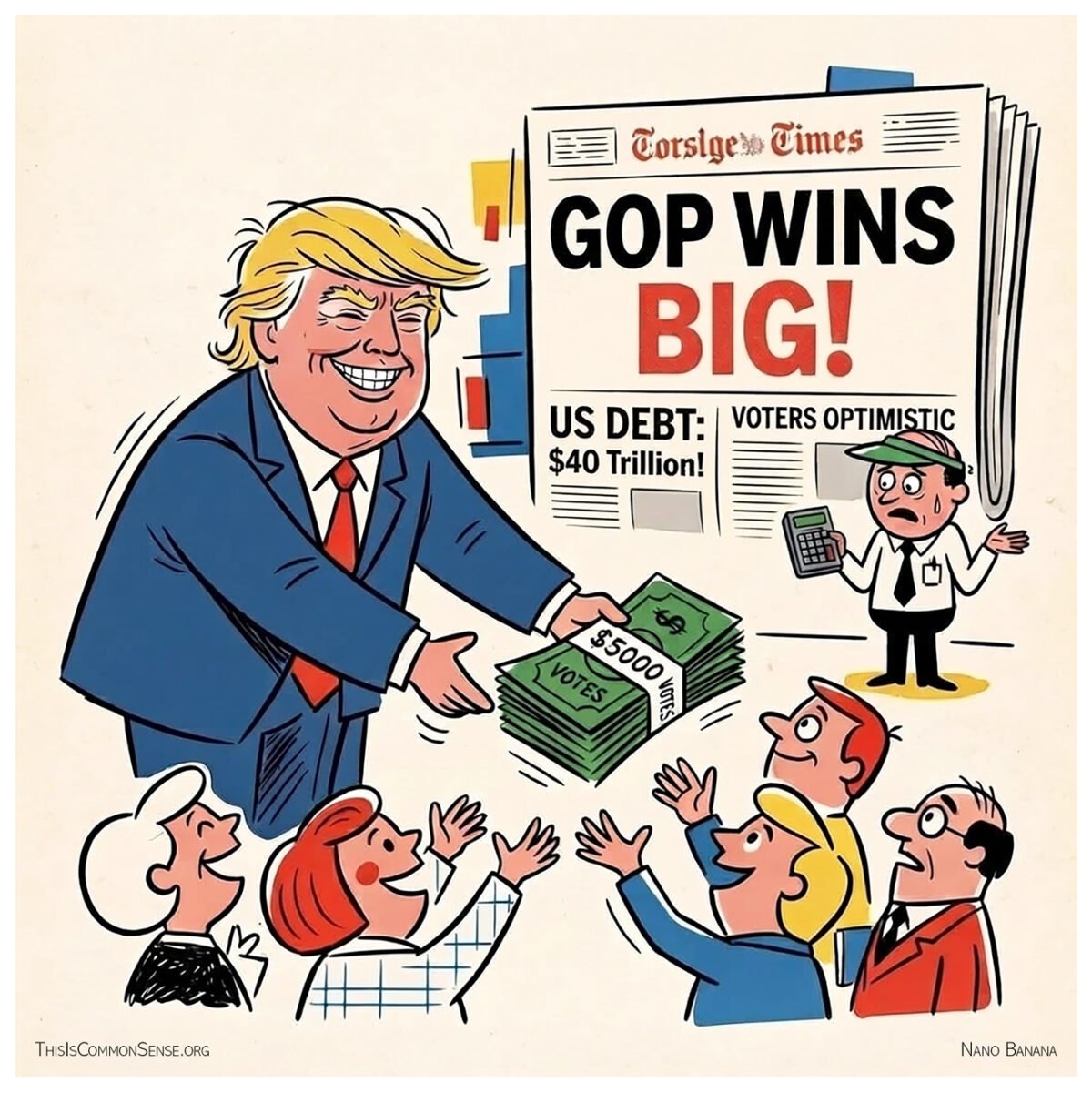
The Forty-Trillionth

When Grover Cleveland — arguably the United States’ last non-“progressive” president — won his second term after a one-term hiccup named Benjamin Harrison, list makers and ordinal number enthusiasts faced a challenge: was Cleveland to be called the union’s 22nd president, or the 22nd and 24th president?

The two-term presidents before him had all served their terms consecutively, but we spoke of each four-year term in office as the presidents’ respective first and second administrations. Historians and archivists chose the clunky 22nd/24th double listing for Cleveland, which brings us to the current president, formerly the 45th and now the 47th.

One presidency was just not enough for Donald Trump.

But what will he be remembered as? It is possible that his tombstone will have a forty-something on it, but the “th” may very well stand for “trillionth” — for under his watch the public debt of the federal government rolled over on Wednesday, past $40 trillion.

I remember when people held signs up emblazoned with “No Trillion Dollar Debt!” How “forty years ago” is that?

There’s an old law of liberty: people out of power demand freedom, people in power demand more power. Trump sounded more libertarian when running for office, and he seems to conform to a very old corollary of the law: politicians running for office protest debt, politicians in office add to it.

FDR is the grand example, yet it is Trump who may come to be identified with it.

“The unprecedented [sic] $40 trillion figure highlights competing administration priorities,” declares The Seattle Times, “from boosting the defense spending that the U.S. relies on to carry out President Donald Trump’s almost-6-month-old Iran war to lowering the cost of gas and groceries.”

Isn’t this mere Trump-bashing? For while Trump may someday receive the blame, in truth it belongs to both parties and almost all politicians.

This is Common Sense. I’m Paul Jacob. 


PDF for printing

Illustration created with Nano Banana

See all recent commentary
(simplified and organized)
See recent popular posts
Categories
deficits and debt national politics & policies too much government

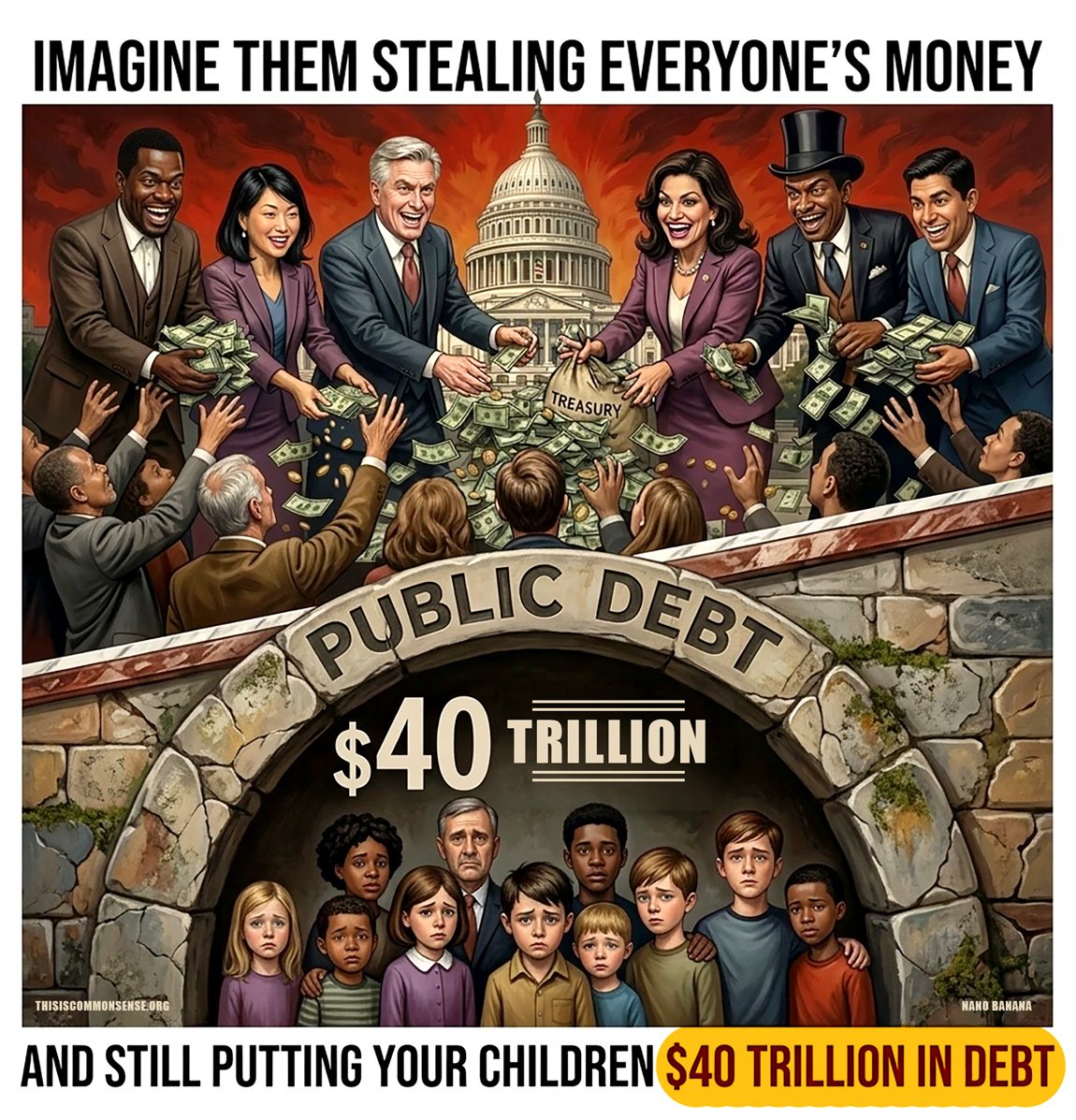
Spending All the Way to the Abyss

Entire categories of federal spending shouldn’t exist.

Now, it would be easy to eliminate budget deficits and to begin to make big and regular dents in the national debt, were it not for one teensy-weensy problem. Just hand me the budget (in electronic form, please) and a red pencil and I’ll hack away at the billions and billions. And trillions.

If that would take too long, I’d enlist a team of like-minded spending cutters to help.

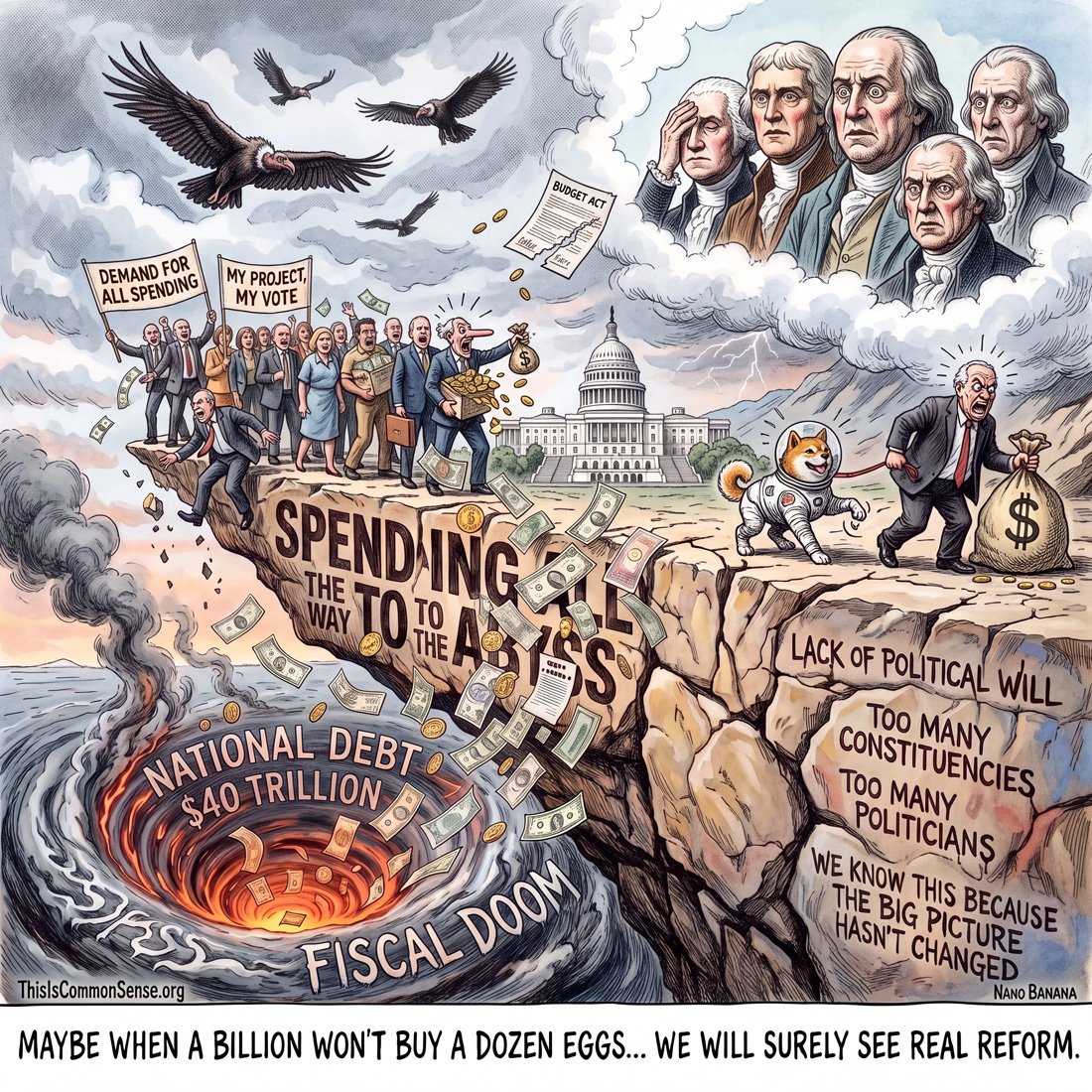
We’d be doing something like what the Department of Government Efficiency, DOGE, tried to do early in the second Trump administration. DOGE didn’t go or wasn’t allowed to go anywhere near far enough, though. We know this because the big picture of runaway government spending hasn’t changed.

That’s what would thwart me and my team too: lack of political will. Or too much political will pulling in the opposite direction. Too many constituencies for all the spending and too many politicians, both parties, catering to the constituencies.

That’s the teensy-weensy problem.

The current U.S. national debt is approaching $40 trillion. This year, the federal government has already borrowed $1.4 trillion. These seem like catastrophic amounts. But somehow the U.S. still teeters on the edge of fiscal doom, yet to fall in.

Maybe when we get to a trillion trillions in federal debt and when a billion dollars won’t buy a dozen eggs, then we will surely see real reform. 

This is Common Sense. I’m Paul Jacob.


PDF for printing

Illustration created with Nano Banana

See all recent commentary
(simplified and organized)
See recent popular posts
Categories
budgets & spending cuts deficits and debt tax policy

The Beast Cometh

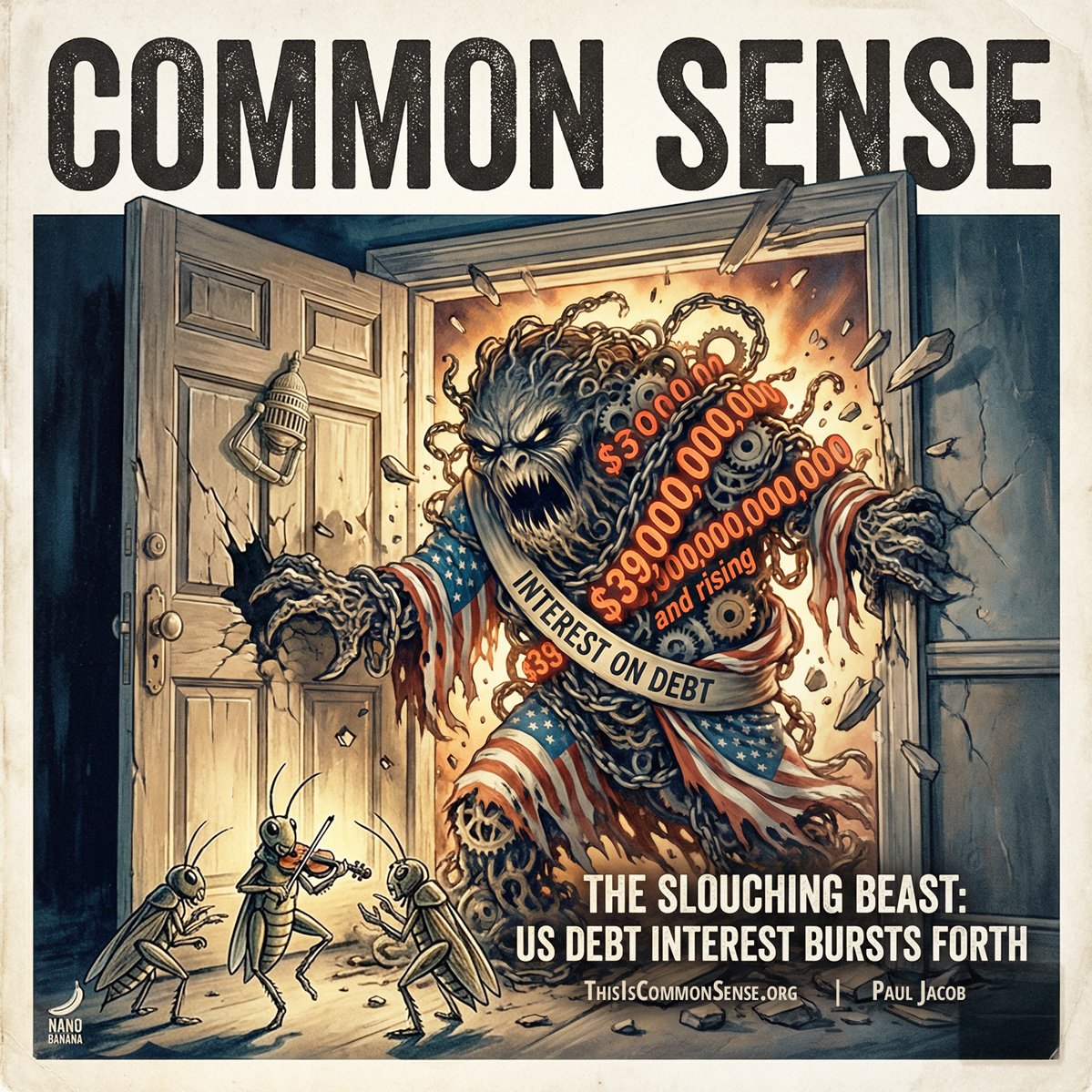
As the U.S. Debt Clock ticks towards $39 trillion, a predictable but horrible beast slouches towards us, ready to knock on the door. Or, rather, burst through.

The federal debt hit $38.8 trillion this weekend: it’s $38,830,051,666,666 as I type these words on Sunday.

But that’s not the beast. 

This year’s annual deficit is $1.9 trillion.

But that’s still not the beast.

The Congressional Budget Office warns that the debt-to-GDP hits 120% by 2036 — above post-WWII peak.

That isn’t the beast either.

The beast is the interest on the debt, and the service charge the government must regularly make merely to keep the borrowing going.

Net interest payments will be over one trillion smackeroos this fiscal year. That rivals or exceeds spending on defense/veterans in many breakdowns — those payments are projected to double to over two trillion per year by 2036. 

It’s the fastest-growing line item. 

It’s non-discretionary. 

And it compounds; the beast only gets bigger.

And with it any hope for tax relief goes out the window. Just last week the president, reacting to the Supreme Court decision in Learning Resources v. Trump, floated what amounts to a revenue-directed tariff, and under normal circumstances voters could not unreasonably demand, say, an offsetting 15 percent reduction in income taxes, across the board.

Nothing like that is in the offing. Not because tax cuts wouldn’t be a big win for the tariffer-in-chief, but because any extra revenue might be more cost-effectively thrown as debt service at the American holders of $31 trillion in federal debt.

This is as bipartisan an issue — and failure — as anything can be, yet the bipartisan response?

Crickets.

This is Common Sense. I’m Paul Jacob.


PDF for printing

Illustration created with Nano Banana

See all recent commentary
(simplified and organized)
See recent popular posts
Categories
deficits and debt partisanship too much government

Upstart?

The spectacular fallout between Donald Trump and Elon Musk over the Big Beautiful Bill in particular (but deficit spending and debt accumulation in general) promises political watchers a big, ugly brawl.*

Now, billionaire Musk appears to be serious about his proposed “third party,” the “America Party.” A name perfectly designed to ruffle Trumpian feathers. It might steal some of the thunder of “America First” and “Make America Great Again.”

The president mocks the notion, saying that third parties “have never succeeded in the United States.”

Well, that is not exactly true. For a long time, it was second parties that had problems. 

The first party, the Federalists, basically lost for a generation, finally withering away against the onslaught of that most American party of all, the Democratic-Republican. 

When the victorious party reformed under the leadership of Andrew Jackson and Martin Van Buren to become the Democratic Party, the Whig Party emerged to counter-act Jackson’s imperial presidency. The Whigs had some success — if with a string of presidents almost no one remembers — only to lose ground to Democrats and then a whiggish replacement, the Republican Party.

Yes, Trump’s own party was a “third” party once.

And it achieved power largely because the Democrats split into two for the 1860 election, leaving a sectional plurality candidate (Abraham Lincoln) to win the Electoral College as a Republican.

In modern times, Republicans and Democrats have ably squelched challenger parties

So Trump’s right — in spirit.

Now enter Andrew Yang, enthusiastic for the upstart. But how can his Universal Basic Income agenda fit with Elon’s fight against over-spending? 

This is Common Sense. I’m Paul Jacob.


* Though, some wonder if the Trump-Musk feud isn’t all an act.

PDF for printing

Ilustration created with Krea and Firefly

See all recent commentary
(simplified and organized)
See recent popular posts


Categories
deficits and debt international affairs

Billions and Billions

While we were going about our business, and maybe even soaking in some summer sunshine, the “US National Debt,” as the federal government’s explicit financial obligation is called, passed the $37 trillion mark. 

As if to mark the occasion, the Chinese government unloaded a whopping eight billion, two hundred million dollars worth of U.S. Treasuries onto the market.

It’s a lot of money.

It’s a lot of debt.

And now China no longer holds it. 

Thus they are not quite as invested in our future.

Is that scary?

Well, everything about our federal debt load should scare us. If we are placid and unperturbed now, how many extra billions and trillions would it take to shake us?

If you are especially concerned about world stability, it might make sense to comfort you with this . . . interesting . . . piece of information: China still holds over $750 billion in United States debt.

A more important piece of information might be what the Chinese central bank has been replacing the U.S. debt with: gold.

Lots of gold.

About 200,000 kilograms of gold!

Nicholas Nassim Taleb, author of The Black Swan, insists that “a single asset has overtaken the US dollar’s position as the world’s de facto reserve currency.” That asset is gold.

We aren’t on the gold standard, but it looks like we may be falling backwards into something like one.

It makes me wonder if there is still gold in Fort Knox . . . and just how much. 

Mr. Trump

Congress? 

This is Common Sense. I’m Paul Jacob.


PDF for printing

Illustration created with Krea and Firefly

See all recent commentary
(simplified and organized)
See recent popular posts

Categories
deficits and debt national politics & policies

Elon’s Out

“Elon Musk says he is ‘disappointed’ by the price tag of the domestic policy bill passed by Republicans in the House last week and heavily backed by President Trump,” explains CBS News. 

The “price tag” is indeed a whopper, if by price we mean what Donald Trump’s ballyhooed “Big, Beautiful Bill” (the One Big Beautiful Bill Act orBBB) added to the debt: an expected $3.3 trillion over ten years.

“I think a bill can be big or it can be beautiful,” Mr. Musk claims, laughing, in an upcoming CBS News Sunday Morning interview — a portion leaked as a teaser by CBS on Tuesday. “But I don’t know if it can be both. My personal opinion.”

An opinion shared by many — just not those “in government.”

Which is apt, since Musk is out. He expressed his “personal opinion” as he was exiting the Department of Government Efficiency (DOGE). The exit isn’t the big story. We knew from the beginning that Musk’s time at DOGE was not going to last forever. 

Which highlights the up-in-the-air aspect of DOGE’s mission and future.

Note that Musk is capable of artful politics. His official statement appeared on X: “As my scheduled time as a Special Government Employee comes to an end, I would like to thank President [Donald Trump] for the opportunity to reduce wasteful spending.” 

This rosy view of his exit may mask much muck. “Musk made himself a total pariah,” first-ousted Trump strategist Steve Bannon told The Free Press. “He had access, admiration, unlimited resources — and by his own actions toward people, blew it all.”

How did he blow it? By actually doing something?

Musk concluded his official exit statement by hazarding that DOGE’s “mission will only strengthen over time as it becomes a way of life throughout the government.” That’s precisely what’s in doubt.

This is Common Sense. I’m Paul Jacob.


PDF for printing

Illustration created with Krea and Fireflly

See all recent commentary
(simplified and organized)
See recent popular posts

Categories
budgets & spending cuts crime and punishment deficits and debt free trade & free markets

The Great Rail Robbery

It’s unclear “what problem Amtrak privatization proposals are intended to solve,” an Amtrak white paper argues.

The authors assert that “giving the United States the passenger rail system it needs will require substantial, assured, multi-year federal funding. . . .”

That flies in the face of experience. But if you are looking for a problem to solve, consider the biggest current story about Amtrak, its thieving employees

Buckle up, for the rail gets bumpy: Sixty-one of 119 Amtrak employees exposed in 2022 for perpetrating a healthcare scam were kept on the job until a recent internal investigation. 

For several years, these employees had collected kickbacks from doctors willing to file fake medical claims. 

Amtrak now promises that it is (finally) cleaning house.

The organization’s inspector general says that the large number of employees “who cavalierly participated in this scheme to steal Amtrak’s funds suggests not only a serious lapse in basic ethics, but a troubling workforce culture . . . in which blatant criminal behavior was somehow normalized.”

A culture that DOGE has been finding in many governmental endeavors.

What governments lack are decent feedback mechanisms that real markets provide. Amtrak operates in a fake reality of “needs” — those infinite “needs” mentioned in the white paper against privatization.

Businesses succeed; businesses fail — and if the latter, they move aside to let others try to do better. But the white paper treats business failure as proof that government funding is mandatory.

For taxpayers, always on the hook for Amtrak failures, privatization is a solution.

Privatization would also mean less tolerance for keeping thieves on payrolls.

This is Common Sense. I’m Paul Jacob.


PDF for printing

Illustration created with Krea and Firefly

See all recent commentary
(simplified and organized)
See recent popular posts

Categories
budgets & spending cuts deficits and debt

The Continuing Crisis

By law, we have one job,” Rep. Tim Burchett (R‑Tenn.) asserted the last time he opposed the continuing resolution” (CR) on the federal budget. 

What is that one job”? It is to pass twelve appropriations bills and a budget. We arent doing that, which is why we are $33 trillion in debt.”

You noticed the typo. But it wasn’t. Sure, $33 trillion isn’t right. Yesterday, the official public debt of the federal government was $36.6 trillion, with just a smidge of rounding up. Those first two paragraphs are from 2023; one can almost cut and paste old copy about Washington’s CR fiascos and place them in new pieces and get away with it, clean. 

On Tuesday, the House passed a continuing resolution to keep the federal government chugging along, with its usual substitute authorization for spending rather than a real budget.

In another old Common Sense column from right before Christmas, I celebrated the possible “torpedoing” of a CR, and its replacement with a more modest one — but what about the CR that now heads for a Friday vote in the Senate?

The resolution cuts $20 billion from IRS enforcement, $7 billion from fiscal year 2024 levels, $13 billion in non-defense discretionary spending but added $6 billion to defense. Last year’s earmarks were nipped, but what’s happening with USAid is less clear. Secretary of State Marco Rubio says that “83% of programs” have been closed in the agency; Elon Musk declares that “the important parts of USAID should always have been with Dept of State” — but that plan is not implemented in this CR.

Meanwhile, Rep. Thomas Massie was the sole Republican No vote, continuing his dissent: “Congress just locked in a large portion of the Biden agenda for the first nine months of Trump’s presidency.” And then Trump threatened to primary him!

Massie is up against Republicans who think the resolution’s cuts are big enough. And Democrats who think they are way too big.

This is Common Sense. I’m Paul Jacob.


PDF for printing

Illustration created with Krea and Firefly

See all recent commentary
(simplified and organized)
See recent popular posts

Categories
deficits and debt meme

Just Imagine

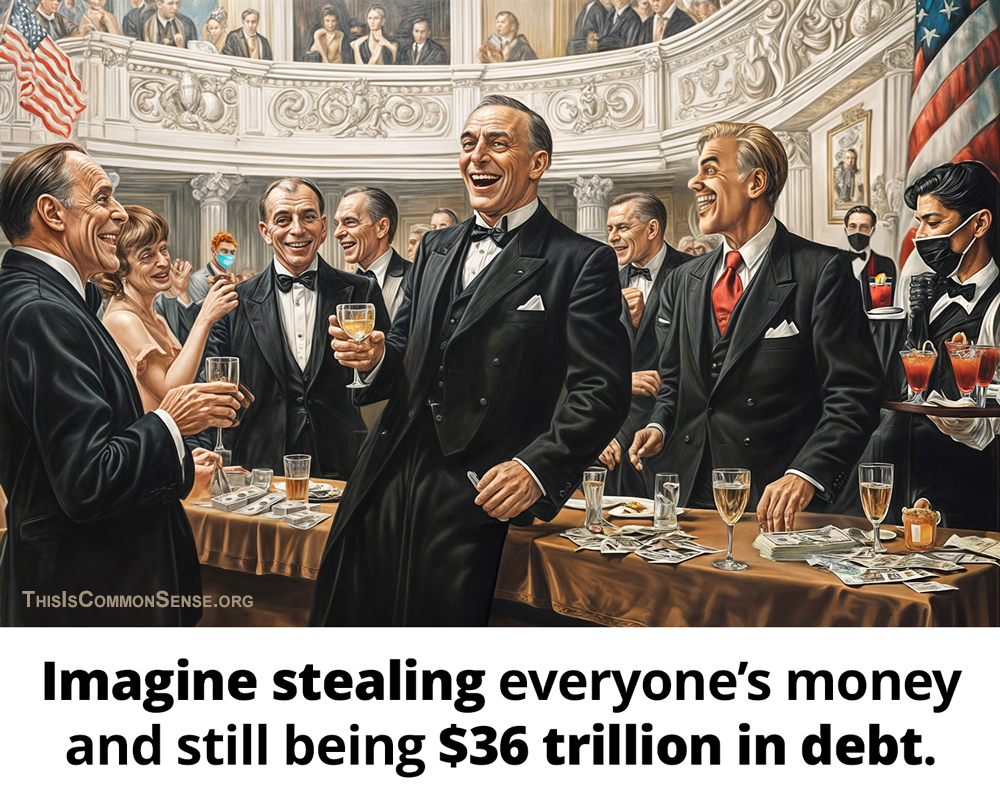
Imagine stealing everyone’s money and still being $36 trillion in debt.

Categories
Accountability deficits and debt general freedom meme

Millionaires

The rich…