
Categories
education and schooling election law

Tellingly Two-Faced

The Attorney General’s office in Washington wants it both ways.

That’s Washington the state, and I’m referring to an important case about the language state officials must use on the ballot to explain initiative measures to voters. The case (Arthur West, a citizen, v. Steve Hobbs, the Secretary of State) is now before the state’s highest court.

Democrats legislated that any initiative decreasing taxes must contain this wording on the ballot: “This measure would decrease funding for public K-12 education, higher education (including universities and community colleges), and human services (primarily healthcare).”

In fact, that assertion, by law, must be placed right before voters are asked to vote: Yes or No? 

Even though it isn’t, well, true.

Consider Proposition 645, the initiative to repeal an income tax hike on “evil” millionaires: it doesn’t specifically cut any of these government service categories that voters are being told it does. That’s not even in dispute. 

What spending legislators cut to compensate for decreased tax revenues is at the discretion of, obviously, those legislators.

Last week, the AG’s office argued in a different case heard in the same courthouse on the same day: “Indicating how funds in the general fund will be allocated in the future would be both inaccurate and misleading to the voters.”

Wait . . . that concedes Mr. West’s whole point in seeking an injunction against the now admittedly “inaccurate and misleading” anti-tax cut language.

On Monday, Citizens in Charge Foundation filed an amicus brief in the Washington Supreme Court explaining that the Evergreen State’s constitution permits only legislative acts “facilitating” the process.

“Misleading the public about the consequence of a ballot measure does not ‘facilitate’ its consideration,” we argue, “it undermines it.”

This is Common Sense. I’m Paul Jacob. 


* As president of Citizens in Charge Foundation, I made a legal declaration in this case, previously, surveying ballot language policies across the ballot initiative states and pointing out that this law makes Washington state an outlier.

PDF for printing

Illustration created with Nano Banana

See all recent commentary
(simplified and organized)
See recent popular posts

Categories
education and schooling ideological culture Internet controversy

A Scandal’s Arc

When did you first hear the story of Jason Arday? 

In 2023, Mr. Arday became something of a public sensation in Great Britain, where his claims to being autistic, mute till age 11, and illiterate till 18 made a striking rag-to-riches/up-from-racism story upon his appointment as Professor of Sociology of Education at the University of Cambridge.

The youngest Black professor at that institution ever.

But few in America heard much about him. 

Last September, Times Higher Education journalist Jack Grove documented what he alleged to be plagiarism in Arday’s 2015 PhD thesis and academic publications. Grove contacted Arday for comment; Arday responded with a letter from his lawyers. The story was not published. 

Then, a month ago, philosopher Nathan Cofnas published his exposé, which began with a litany of Arday’s autobiographical whoppers, not including the one I heard most bandied-about: that at age 7 the young Jason had been interviewed for the famous documentary Seven Up! — a glaring fib because the movie came out 21 years before Prof. Arday was born.

Cofnas compared passages in Arday’s 2018 paper to someone else’s 2012 paper. One sentence can serve to illustrate: “In particular, I seek to make a direct association between the tools of normative Whiteness and the deployment and consequences of racial microaggressions.” The italics indicate the one word Arday added.

A key contribution.

The Telegraph and The Times published stories on July 24th. On August 1, The Guardian got into it; four days later, the university opened an inquiry; the next day, Arday resigned. 

Eight days later, Jason Arday was found dead in his apartment. Suicide? That’s what many surmise, but police have only said his death was “unexpected but is not believed to be suspicious.”

For some, a cause célèbre! Vigils, ongoing. But his mourners downplay the lies and plagiarism. It’s all about racism.

But whose? Could it be those who rushed to promote a man beyond his merit merely because of race?

This is Common Sense. I’m Paul Jacob.


PDF for printing

Illustration created with Nano Banana

See all recent commentary
(simplified and organized)
See recent popular posts
Categories
education and schooling

Grades Versus Feelings

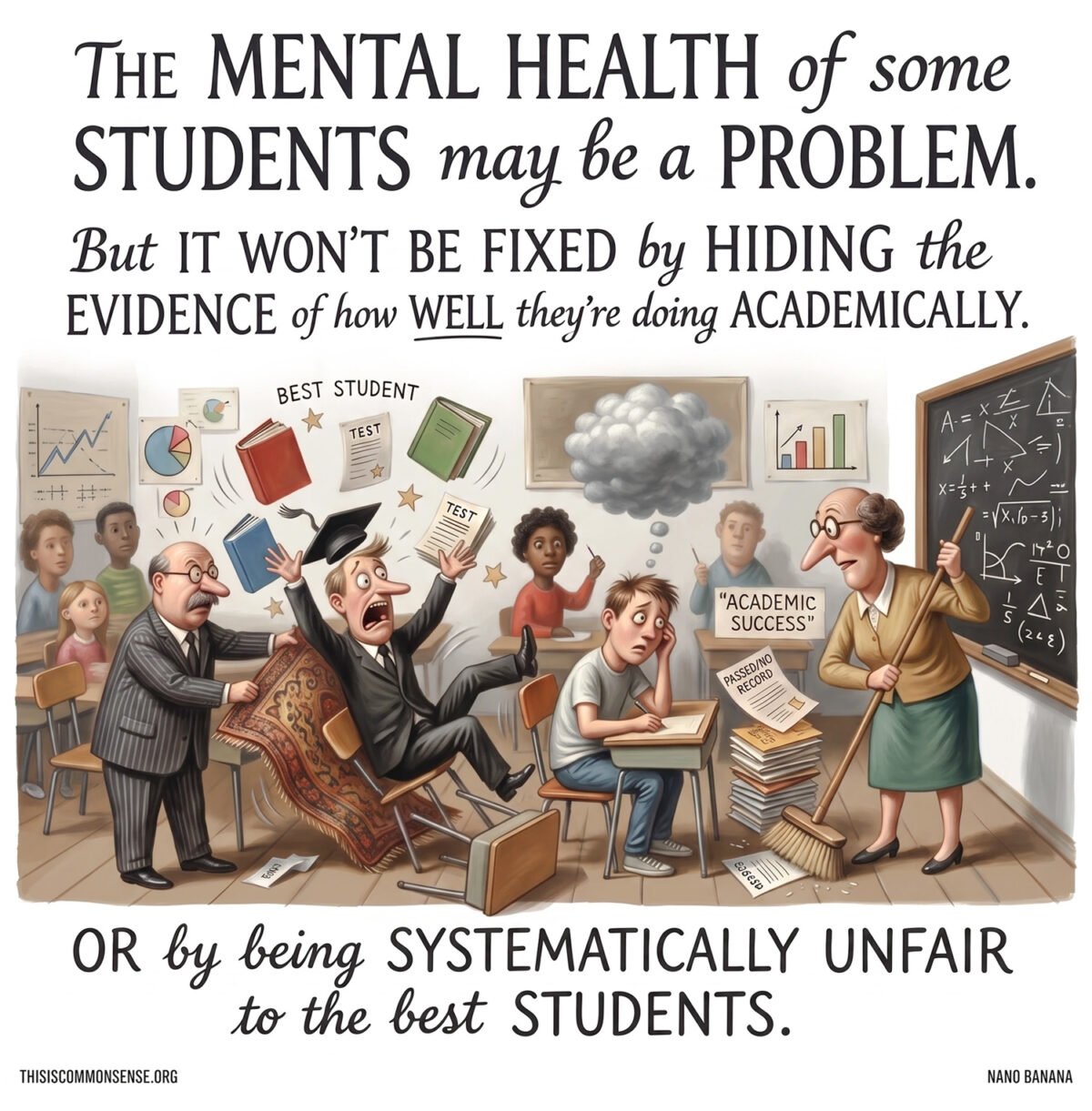
In the 1960s, MIT introduced a “Pass or No Record” system for the first semester of freshman year. The idea? Help students adjust to greater workloads and “variations in academic preparation and teaching methods.”

You’d think that letter grades themselves would help students adjust by providing information about how well they are learning and adjusting — assuming that the grades are at least a roughly objective indication of mastery not yet rendered useless by grade inflation.

Some universities let first-semester freshmen convert a poor letter grade into a pass/no credit “grade.” Only a few have sweepingly replaced letter grades with the pass/no credit system in the first semester.

Now University of Michigan has joined those few. One reason: to “curb the mental health crisis unfolding.”

Why not at least make the pass/no credit “grade” optional for the sake of students who do want their academic achievement to be more specifically recorded on their transcript?

Well, this would “defeat the purpose of facilitating students’ transition to campus.” See, if “covered grades are optional, covering [hiding] an individual’s grades will inadvertently become equated with [their] not doing well in a class.”

Sounds like a reason for keeping letter grades. And what if the mental problems persist into sophomore year? Junior? Senior?

The mental health of some students may be a problem. But it won’t be fixed by hiding the evidence of how well they’re doing academically. Or by being systematically unfair to the best students.

This is Common Sense. I’m Paul Jacob.


PDF for printing

Illustration created with Nano Banana

See all recent commentary
(simplified and organized)
See recent popular posts

Categories
education and schooling First Amendment rights ideological culture

DEI“A” Directive Denied

Daymon Johnson has been fighting to speak freely.

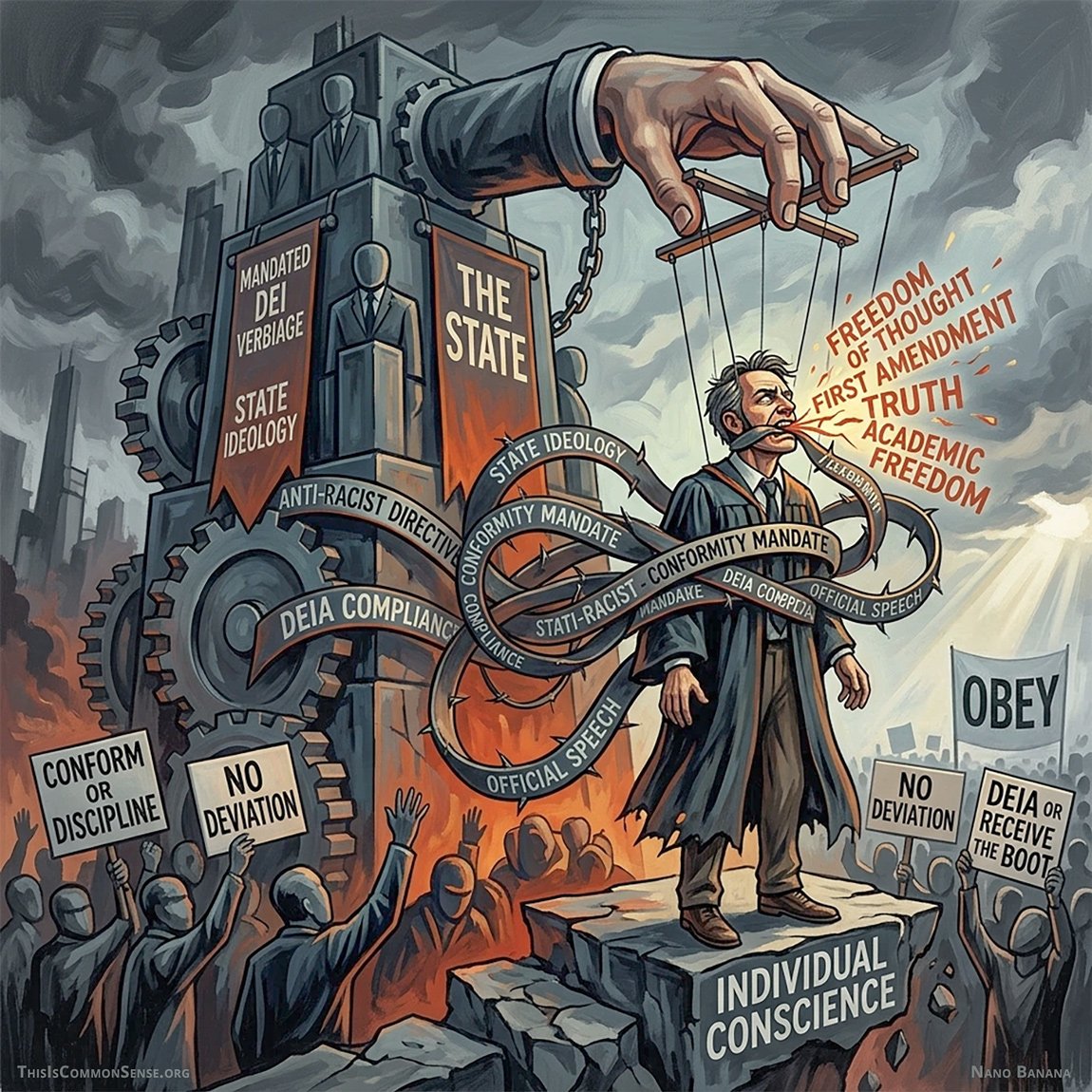
A professor at Bakersfield College, a community college in California, Johnson has for years been bucking a mandate that he parrot the state’s “DEI” and “anti-racist” ideology — well, DEIA now: “diversity, equity, inclusion, and accessibility” — lest he face disciplinary action or receive the boot.

Community colleges, remember, are creations of the state, and Professor Johnson was being forced, by state directive, to mouth specific bureaucratic verbiage as if he were a mere functionary under a central planning board.

Alan Gura, the Institute for Free Speech’s lead counsel in the case, observed that Johnson’s fight has been for the First Amendment right to speak his mind, which American professors should be able to take for granted.

The settlement with Kern Community College District includes payment of $150,000 for attorneys’ fees. But it’s not perfect.

A permanent injunction against harassing Johnson for speech “in the classroom, in his scholarship, or as a private citizen” covers only five years. Government defendants “typically resist injunctions that are open forever,” making time limits in such settlements common, Gura explained. And five years “more than covers Johnson’s anticipated remaining time” at the school.

Nor does the decision address “whether the laws were constitutional as applied to anyone else.” But, said Gura, “the legal principles adopted by the court are persuasive authority that could lead to relief for other professors. . . .

“It’s easy for Sacramento officials to pass insane regulations . . . in their academic fantasy woke universe. . . . Something else entirely for local districts to try to defend them in a real courtroom where the First Amendment matters.”

So this imperfect ruling paves the way for further vindications.

This is Common Sense. I’m Paul Jacob.


PDF for printing

Illustration created with Nano Banana

See all recent commentary
(simplified and organized)
See recent popular posts

Categories
education and schooling

Mississippi Learning

“Thank God for Mississippi” was something I heard a lot in my younger years, after moving to Arkansas. Friends from Alabama and Louisiana also know the saying well. 

Back then, Mississippi was ranked 50th in so many categories by which the states were measured against each other that the Magnolia State saved those inhabiting states near the bottom from occupying that un-coveted dead last place. 

This was still the case in 2005, when Mississippi ranked 50th in fourth-grade reading scores. In 2013, Mississippi students climbed one rung, to 49th. Then things started to change.

“The transformation began in 2013 with the passage of the Literacy-Based Promotion Act, a controversial law that allows schools to hold back students who cannot read by third grade,” WAPT, Jackson’s ABC-TV affiliate, recently reported.

“The curriculum shifted from balanced literacy to a phonics-forward approach,” WAPT explained, “and the state invested millions into phonics-based instruction, strict accountability measures, and instructional coaches who work inside schools daily.”

Imagine going back to the way generations were taught to read and, lo and behold, it still works!!!

“Results from the 2024 National Assessment of Educational Progress showed Mississippi fourth graders ranked 9th in the nation for reading scores and 16th in the nation for math scores,” the TeachMS website informs. “Since 2013, that same category of students ranks No. 1 nationally for gains in reading and math.”

“Mississippi has skyrocketed on national tests, while blue states lag,” acknowledged a New York Times account earlier this year, adding that “adjusted for poverty and other student demographics, Mississippi is No. 1 for fourth grade reading and math, and at or near the top in eighth grade, according to the Urban Institute, a left-leaning think tank.”

Thank God for Mississippi. 

This is Common Sense. I’m Paul Jacob. 


PDF for printing

Illustration created with Nano Banana

See all recent commentary
(simplified and organized)
See recent popular posts

Categories
education and schooling general freedom ideological culture international affairs subsidy

The Price of a Canadian Education?

At a convention of Canadian Liberals, tech executive Patrick Pichette proposed that youngsters eager to escape Canada be charged a half-million dollars for what he apparently regards as a privilege, not a right.

We must remind ourselves that the word “liberal,” here, is used in its modern, anti-liberal sense: of the ideology of ever-increasing restraints on everybody.

Very illiberal.

Even if Pichette means Canadian dollars, that’s still $360,000 in real USD dollars. Hardly a ten-dollar processing fee. More like extortion. He rationalizes that the kids owe that much anyway thanks to Canada’s heavily subsidized education system.

Terry Newman observes that Pichette “is a Canadian who left Canada for better opportunities himself.” He went to California and Google and now lives in London.

But Pichette and his de facto self-exemption are not the problem. The problem is all Liberals who “want to govern as many aspects [of the economy] as possible, pick winners, and unload the tax burden of the massive bureaucracy onto Canadians, the smartest of which understand this clearly and choose to leave.”

While Pichette’s proposal had his audience of Canadian Liberals cheering, sane individuals rightfully express varying degrees of alarm. After all, punishing people for leaving a country is eerily reminiscent of what totalitarian states do: prevent them from leaving altogether.

Pichette’s rationale itself is based on a misunderstanding. Are the half-million per student subsidies really there to educate? More like to placate well-organized lobbies of too-often ideologically driven careerists. 

The idea that Canadian students actually receive half-a-million-dollar educations is not believable.

This is Common Sense. I’m Paul Jacob.


PDF for printing

Illustration created with Nano Banana

See all recent commentary
(simplified and organized)
See recent popular posts
Categories
education and schooling

Equality, Not Excellence

The really socialist mayor of New York City, Zohran Mamdani, the city’s new Handicapper General, wants to prevent the brightest children in the city’s school system from getting any extra training of their gifts and intelligence.

So he’s trying to do what one of his predecessors, the pretty socialist Bill DeBlasio, failed to do: eliminate the public school system’s Gifted and Talented programs.

What benefit could there be to students, their parents, and New Yorkers in general, in preventing gifted children from studying in schools and classrooms that give them the best chance of developing their gifts early in life? 

None whatsoever. 

Killing the more demanding academic work does not thereby improve what the average public-school classroom offers students. It also does not improve the ability of students who are not currently qualified to enter the most advanced programs. The only goal achieved is that of a nearer approach to the egalitarian “ideal,” the world of “Harrison Bergeron.”

If the concern were really to improve the average or below-average classrooms, this could be done — conceivably — by focusing on what could be improved in those classrooms. Are there bad teachers who could be fired? Disruptive students who could be better disciplined or shown the door? Vapid, unchallenging, or politically warped curriculum that could be overhauled?

Under the DeBlasio mayoralty, many parents protested his plan to erase opportunities for the Gifted and Talented, managing to thwart that plan. They’ll have to protest again if they want to stop Mamdani from stomping out excellence.

This is Common Sense. I’m Paul Jacob.


PDF for printing

Illustration created with Nano Banana

See all recent commentary
(simplified and organized)
See recent popular posts
Categories
education and schooling ideological culture

Ugly Surge

Is the ugly surge of antisemitism in the United States — whether homegrown or imported or both — now infecting primary school education?

According to a lawsuit filed against a school in Northern Virginia, an 11-year-old girl was subjected to repeated antisemitic harassment after the October 7, 2023 terrorist attack on Israel.

The bullying grew worse, the accusation goes further, after the proprietor of the school, Kenneth Nysmith, allegedly hung a Palestinian flag in the school gym.

When the parents complained, Nysmith initially told them that their daughter needed to “toughen up.” Then the student and her two siblings were summarily expelled from the school without prior notice or real explanation.

The suit alleges that the three Jewish children were expelled because their parents had objected to “the school’s unwillingness to respond to anti-Semitic harassment of their 11-year-old daughter. The school had allowed anti-Semitism to take root in her class — in, for example, [a] picture of a social studies class project depicting the attributes of a ‘strong historical leader’” — featuring the face of Adolf Hitler.

Right up there with other strong historical leaders, such as Tamerlane, Joseph Stalin, and Pol Pot.

With allegations so over the top, we probably should proceed with care. But it turns out that the 11-year-old was not the one who first told her parents about how she was being treated. In February, a concerned classmate asked his mother to call one of the parents, Brian Vazquez. “With Mr. Vazquez on speakerphone, the classmate described a disturbing pattern of harassment and bullying.”

The lawsuit calls for an investigation of the school, an order that the school enforce its nondiscrimination policies and eliminate its hostile environment, damages, and other remedies.

We will see how the legal battle proceeds. This is a private school, which has a right to “educate” in its own way. However, the school must follow its own rules.

And, if these allegations are accurate, I hope the school will soon experience another aspect of being private: going out of business. 

This is Common Sense. I’m Paul Jacob.


PDF for printing

Illustration created with Krea and Firefly

See all recent commentary
(simplified and organized)
See recent popular posts

Categories
education and schooling litigation U.S. Constitution

Education Function Injunction

When President Jimmy Carter broke his 1976 campaign pledge by adding another Cabinet-level department to the federal roster, he swore that a “separate Cabinet-level department will enable the Federal government to be a true partner with State, local, and private education institutions in sustaining and improving the quality of our education system.”

On March 20, 2025, President Donald Trump signed an executive order aimed at shutting down Carter’s Department of Education, fulfilling his campaign promise to reduce federal involvement in education.

This was popular because everybody who’s not a bureaucrat or a teachers’ union agent knows that federal involvement in schooling, since Carter’s time, has been, not just a waste, but a detriment.

Still, teacher union-dominated Democrats are swiping at the administration with numerous lawsuits. U.S. District Judge Myong Joun in Boston issued a preliminary injunction blocking Trump’s layoffs and transfers, ruling that they amounted to an unlawful attempt to dismantle the department without congressional approval. 

Earlier this month, the 1st U.S. Circuit Court of Appeals upheld Joun’s injunction, rejecting the Trump administration’s request to pause the order while appealing. 

Two days later, the Trump administration, through Solicitor General D. John Sauer, filed an emergency appeal with the U.S. Supreme Court. The plea? Lift the injunction and allow the layoffs and reorganization to proceed. Trump’s team argued that the lower court had overstepped its authority and that the layoffs were a lawful personnel action to streamline the department, not an attempt to abolish it without Congress. 

The injunction sent DOE functionaries back to work. Nothing’s been resolved.

Not even the rationales for Carter’s “greatest achievement” (to quote the title of a USA Today op-ed). Carter had promised to reduce the number of departments, for efficiency’s sake. When creating the DOE, he said the move would increase efficiency. 

Instead, it merely increased education spending while academic achievement has plummeted.

This is Common Sense. I’m Paul Jacob.


PDF for printing

Illustration created with Krea and Firefly

See all recent commentary
(simplified and organized)
See recent popular posts

Categories
education and schooling

Goals, Goals, Goals

Aleysha Ortiz wants to be a writer. There’s a hitch: she says she’s illiterate.

Ya gotta have goals, as teachers used to say in the Seventies.

When goals were still in vogue.

Her near-term goal, however, is suing the school she graduated from, in Hartford, Connecticut, for . . . graduating her with honors!

She has a case. While graduating illiterates has almost become a tradition in America — teachers’ unions are on board — you would think that even a woke administrator might judge graduating an illiterate with honors a step too far.

Now, in truth, the 19-year-old can read and write, a bit. But she’s always had trouble, she says. 

“Ortiz is suing the Hartford Board of Education, the City of Hartford and her special education case manager, Tilda Santiago,” explains The New York Post, “for negligence.” 

The negligence being that the school was too slow in testing for and following up on her dyslexia. “Just one month before graduation, she began receiving the testing, which was not completed until the last day of high school,” the Post clarifies. “The testing concluded that Ortiz was in fact dyslexic and ‘required explicitly taught phonics, fluency and reading comprehension.’”

There is more to the story, of course. She was born in Puerto Rico, came to the U.S. at five, and didn’t speak English at all well when she started school.

A lot of folks raise skepticism about the now-college-freshman (!), more than implying she was just an unmotivated student. And that a multi-million-dollar lawsuit seems a bit much.

But ya gotta have goals.

Pity that our government schools’ goals have so little to do with education.

This is Common Sense. I’m Paul Jacob.


PDF for printing

Illustration created with Krea and Fireflly

See all recent commentary
(simplified and organized)
See recent popular posts