On September 17, 1683, Antonie van Leeuwenhoek wrote a letter to the Royal Society describing “animalcules,” later known as protozoa.
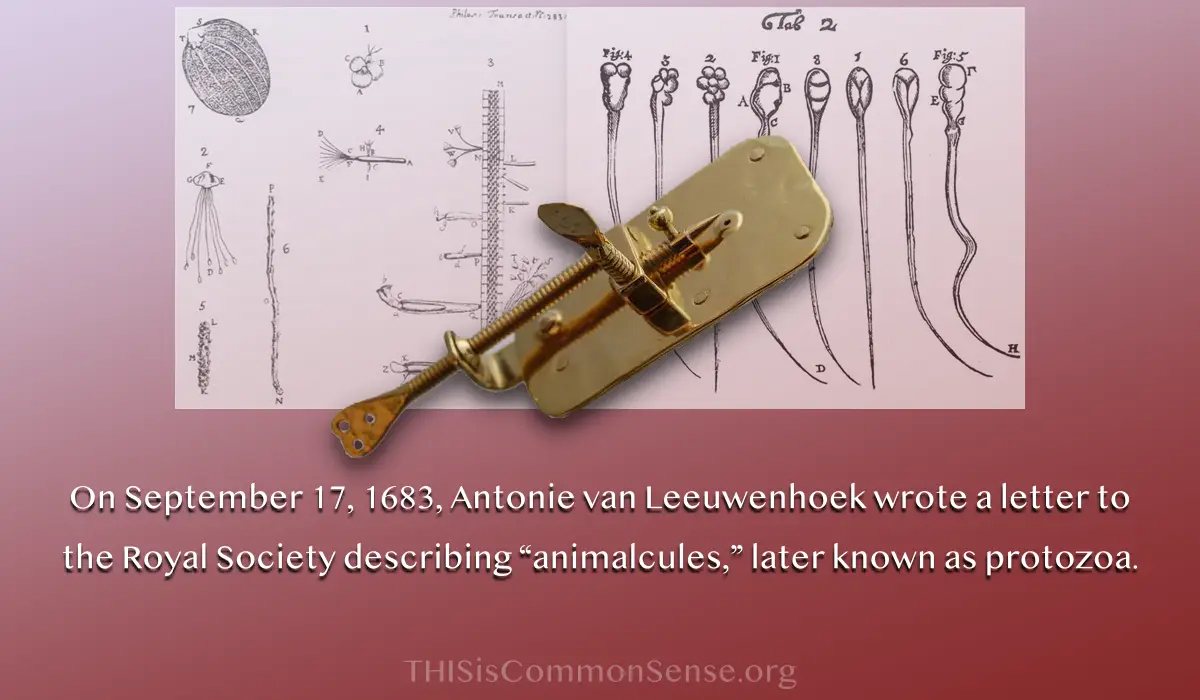
On September 17, 1683, Antonie van Leeuwenhoek wrote a letter to the Royal Society describing “animalcules,” later known as protozoa.

The former director of the NIAID and former Chief Medical Advisor to President Biden made it sound like the Kentucky senator was trying to put him in prison. But what Dr. Paul asked of Dr. Fauci was an apology — not jail-time.
Why, though?
“If we don’t want this to happen again, him acknowledging that he was wrong to fund this research will be a word of caution and warning to the next generation of people to come through,” the senator told Mark Halperin. “And the debate will have ultimately been won on ‘gain of function.’
“The danger of it.”
The point, Rand Paul says, is to stop the madness of this type of research.
Earlier in the interview he had noted that scientists had warned that the results at the Wuhan Institute of Virology should not be published. It would be a blueprint, or recipe, for a never-ending biological warfare by terrorists.
The whole interview is worth listening to. Mark Halperin does what so few journalists do when confronting a contentious issue: formulate each question in epistemically sound terms, for clarity. “Is that an established fact in your mind, or do you need to know more?”
Here are some responses from Sen. Paul:
There’s more. Let’s praise a journalist for asking clear questions and a politician for giving clear answers.
Especially about the coronavirus origin.
This is Common Sense. I’m Paul Jacob.
Illustration created with Nano Banana
See all recent commentary
(simplified and organized)
See recent popular posts

Instead, for the first time in history, the percentage of the human population living in misery and dire poverty declined steadily.
But that did not mean his work was shelved as a bad theory, falsified by evidence.
Everywhere, when I was growing up, I witnessed a rising tide of anti-natalism, the doctrine that young adults shouldn’t have babies, or — if they did — should have only a few. Mankind was a cancer on the planet, we were told, and too many believed it.
Which affected breeding patterns.
And policy.
The current population reality is the opposite of what the Ehrlichs said it would be. All over the world, except for places in Africa, legacy populations are declining. In the United States, our population would be declining were it not for immigration. Elsewhere, the replication rate is plummeting — and it’s not just the West, but in China and Taiwan; both Koreas, as different as they are; and in Japan.
Without growing populations, our modern (if jury-rigged) social safety net pension systems are jeopardized, as is the possibility of finding caregivers to aging-and-dying populations.
We cannot blame it all on Ehrlich of course. There are many factors at work. But is it possible to be more wrong than he was?
What should the young do now, to mark Ehrlich’s passing?
You could do worse than make some more babies.
This is Common Sense. I’m Paul Jacob.
Illustration created with Nano Banana
See all recent commentary
(simplified and organized)
See recent popular posts
Not only do I not want to freak out, I don’t want to use AI very much — though I understand that, these days, sometimes it makes sense to consult the Oracles.
Chilson is reviewing a new book, If Anyone Builds It, Everyone Dies: Why Superhuman AI Would Kill Us All, by Eliezer Yudkowsky and Nate Soares, who argue that “artificial intelligence research will inevitably produce superintelligent machines and these machines will inevitably kill everyone.”
Just like I feared on Friday!
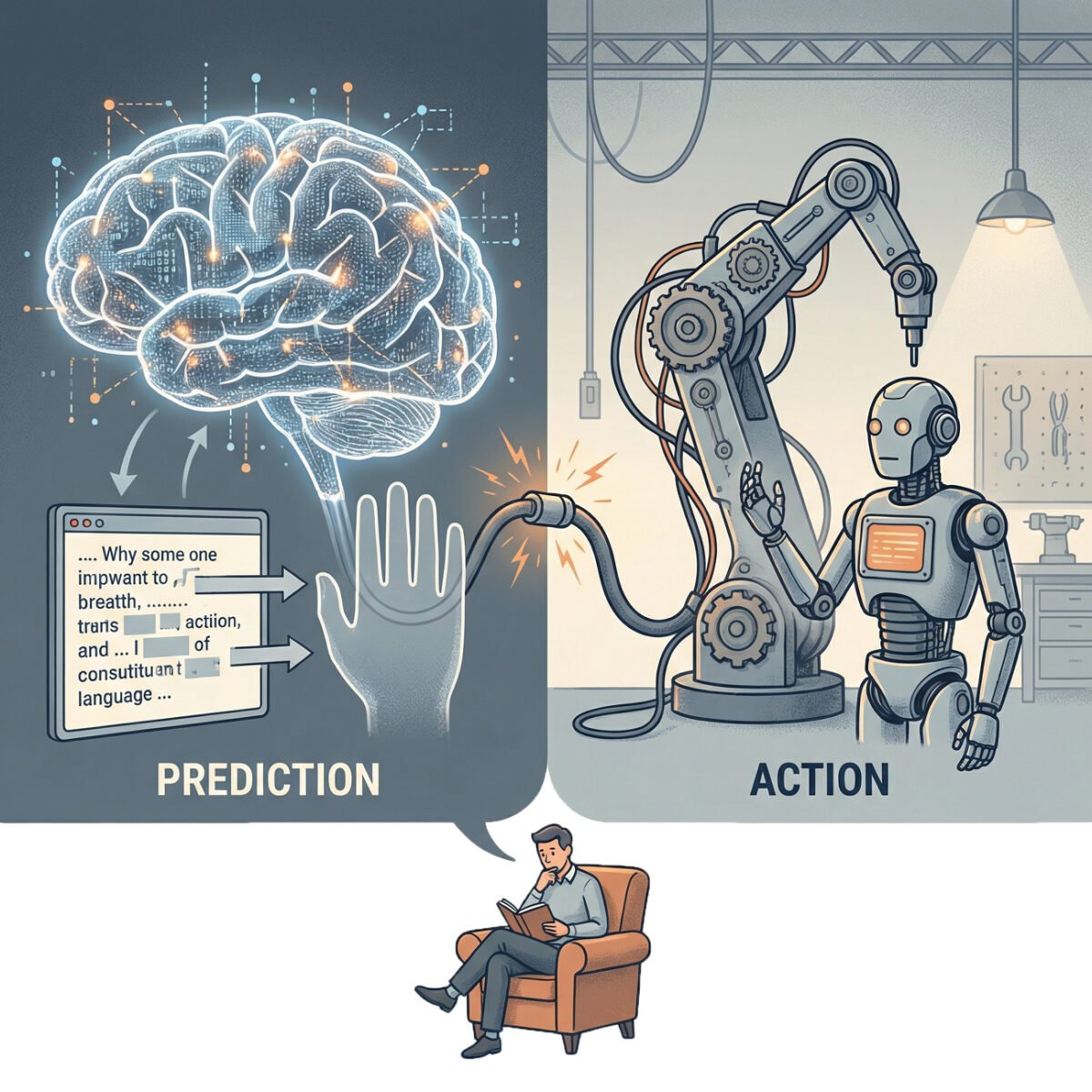
Where the authors go wrong, Chilson argues, is that by “defining intelligence as the ability to predict and steer the world, Yudkowsky and Soares collapse two distinct capacities — understanding and acting — into one concept. This builds their conclusion into their premise. If intelligence inherently includes steering, then any sufficiently intelligent system is, by definition, a world-shaping agent. The alignment problem becomes not a hypothesis about how certain AI architectures might behave but a tautology about how all intelligent systems must behave.”
Today’s AI’s are “fundamentally about prediction. They predict the next element in a sequence.”
They aren’t necessarily taking action.
I hope Chilson’s critique holds true.
But we’ve caught AI lying, “just making stuff up” — though considering the nature of “Large Language Models” (the method by which modern AI works), “lying” may be the wrong word. Still, it just seems to me that at some point somebody’s — everybody’s! — gonna link the predictor to some sort of truly active mechanism.
Like street-ready robots.
This is Common Sense. I’m Paul Jacob.
Illustration created with Nano Banana
See all recent commentary
(simplified and organized)
See recent popular posts

So those of us paying attention came to distrust the scientists.
Especially “scientists” in positions of political power.
Sadly, tragically, more than one scientific discipline has been perverted in shockingly non-scientific ways. A hidebound denialism about new data has crept in. Sure, it is about the money, but often we catch a whiff of ideology.
This is apparently the case regarding astronomy — about which Harvard astrophysicist Abraham “Avi” Loeb offered testimony on a recent podcast.
In 2014, a meteorite (CNEOS 2014-01-08) splashed into the Pacific Ocean — too fast to be solar-system native, says the U.S. Space Command. Without investigating, a published paper dismissed the evidence, discouraging further inquiry; Avi Loeb, on the other hand, led a team to the site, producing evidence from the ocean floor as well as an actual research paper.
Loeb’s first paper on the current obsession, the third officially recognized interstellar object, 3I/ATLAS, was published only on the condition he took out his killer final sentence — about the possibility that the object might be technological in nature (as its anomalies suggested).
Loeb appeased the editor . . . and then wrote a whole new article on that unspeakable (alien tech) possibility — for another journal.
NASA’s also infected. After watching a recent press conference by NASA on 3I/ATLAS, Loeb argued it would have been better to have actual scientists field questions rather than feature NASA bigwigs dutifully reciting the currently acceptable (safe?) determination that the object is “just a comet.”
“The intellectual climate, right now in Academia, is such that any new knowledge is resisted by experts,” Dr. Loeb explains.
That’s the opposite of science.
This is Common Sense. I’m Paul Jacob.
Illustration created with Nano Banana
See all recent commentary
(simplified and organized)
See recent popular posts
On September 17, 1683, Antonie van Leeuwenhoek wrote a letter to the Royal Society describing “animalcules,” later known as protozoa.

“Thousands of scientists are now calling for Musk’s name to be blotted out from that charter’s fine vellum pages,” explains The Atlantic. “The effort kicked off last summer, when 74 fellows (out of roughly 1,600) sent a letter to the Royal Society’s leadership, reportedly out of concern that Musk’s X posts were fomenting racial violence in the United Kingdom and could therefore bring the institution into disrepute.”
But it’s not just the racial issue. “In November, one of the signatories, the neuropsychologist Dorothy Bishop, resigned from the Royal Society in protest of what she saw as inaction; her statement cited Musk’s derogatory posts about Anthony Fauci and the billionaire’s promotion of misinformation about vaccines.”
Of course the “scientists” are lockstep “for vaccines,” rather than express the least bit of caution about a new therapeutic (Pfizer’s and Moderna’s mRNA injections) that was pushed out to the world with subsidy, legal immunity, and government threats — to treat a disease funded by Fauci himself.
Then another letter made the rounds, signed by more than 3,400 scientists. Elon must go!
But to what extent is it really about money? At the latest Royal Society meeting, worry was expressed that Elon’s DOGE efforts may be cutting off science funding in the United States.
Thankfully, at a recent meeting of the Society, fellows decided not to do anything too precipitous.
So the Royal Society’s members will have to eat their anger, continuing to be associated — for a while, at least — with the dread Elon Musk.
This is Common Sense. I’m Paul Jacob.
Illustration created with Krea and Firefly
See all recent commentary
(simplified and organized)
See recent popular posts

Popularizers of science seem to have gone downhill these days. Or perhaps it’s just a few of the most visible ones who are so vile.
In their own day, Carl Sagan and Isaac Asimov espoused some lamentable left-wing views and advanced some dubious propositions as they explained the universe to nonscientists. But you could listen to, read, and enjoy them.
Neither ever suggested, not even once, that persons who disagreed with him on a scientific question might reasonably be incarcerated therefore — inasmuch as the disagreement impaired his quality of life “as a public citizen.” (An argument any totalitarian might use to rationalize violating innocent persons’ rights.)
But Bill Nye, “the science guy,” has expressed the greatest possible sympathy with the proposition that it might be okay to imprison scientists who disagree with him about climate, human impact on climate, or the advisability of trying to centrally plan climate.
In 2016, when asked about a proposal to imprison “climate skeptics,” Nye said that “extreme doubt about climate change is affecting my qualify of life as a public citizen. That there is a chilling effect on scientists who are in extreme doubt about climate change, I think that is good.”
People don’t do their best thinking with a gun pointed at them, Nye guy. That is not good.
Note: it’s the Presidential Medal of Freedom. Not the Presidential Medal of Craven Censorship.
This is Common Sense. I’m Paul Jacob.
Illustration created with Flux and Firefly
See all recent commentary
(simplified and organized)
See recent popular posts

I’m not sure. She sure seemed to be saying that the recent eclipse and climate change were integrally related.
But the banter of the women was so light-hearted that maybe we shouldn’t hold her to
Besides, Whoopi was there to provide rational pedantry — no matter how inaccurate she was. (Contra Ms. Goldberg, there are thousands of cicada species, and you may respectably pronounce the word in a variety of ways). It could be that Sunny was merely trying to be funny about the Sun.
As the man said at the end of Chinatown, “Forget it, it’s
But how hopeless was Rep. Sheila Jackson Lee’s little lecture to the students at Booker T. Washington High School? She was instructing the students and taking credit for their “opportunity” to go outside and see
“A Full Moon is that complete, rounded circle which is made up mostly of gases,” she mis-explained, “and that’s why the question is why or how could we as humans live on the Moon? Are the gases such that we could
Well, no, the Moon is not mostly composed of gases. It possesses the scantest of atmospheres, but does have water — or so I last read.
Even eclipsing The View, sending embarrassing, ultra-ignorant politicians to teach astronomy in the inner cities
This is Common Sense. I’m Paul Jacob.
Illustration created with PicFinder and Firefly
See all recent commentary
(simplified and organized)
See recent popular posts
I would like such a thing not to happen again. I adhere to the radical political doctrine that the world should not be repeatedly ravaged by avoidable pandemics. I especially don’t want to see a pandemic considerably worse than the COVID-19 pandemic.
But politicians and scientists continue to make pandemics more likely by permitting, paying for (with our money), and even defending the gain-of-function research that weaponizes viruses.
Why, oh why? I hear you ask. The reason, they say, is so they can learn how to better combat these more virulent forms.
And if somebody happens to unleash a lab-enhanced virus capable of killing a third of the human race, will words like “sorry” and “oops” and “now we know how to stop it better the next time” undo the damage?
This danger is one theme of a talk given by U.S. Senator Rand Paul last November. As Paul, author of Deception: The Great Covid Cover-Up, puts it, “To think that we can prevent future pandemics even as we continue to seek, catalog, and manipulate dangerous viruses is the height of hubris. . . . We must reform government and rein in out-of-control scientists and their enablers.”
Senator Paul echoes MIT biochemist Kevin Esvelt, who says “Please stop.”
Let us have no more experiments “likely to disseminate blueprints for plagues.”
Policymakers and investigators have no inalienable right to threaten the well-being of us all.
This is Common Sense. I’m Paul Jacob.
Illustration created with PicFinder and Firefly
See all recent commentary
(simplified and organized)
See recent popular posts