Categories
Update

Blame Merkel

In “The AfD’s Rise Is Angela Merkel’s Legacy,” a Wall Street Journal op-ed by Mark Brolin, we witness one of many new think-pieces about the rise of what the Journal calls a “populist right-wing party” and most other journals call a “far-right party.”

Something strange is happening in Germany. On closer inspection, it isn’t so strange.

In two state elections on Sept. 20, Germany’s political center took another beating. In Mecklenburg-Western Pomerania, the far-right Alternative for Germany, or AfD, won a 38.3% plurality, while the center-right Christian Democratic Union managed a mere 4.9%, its worst postwar result in any state election since 1949. In Berlin, the CDU lost first place to Die Linke, successor to the East German communists, while the AfD took more than 16%. Two weeks earlier, the AfD won Saxony-Anhalt. Nationally, it now leads several polls with support approaching 30%.”

This update is an update to a previous update. A lot has happened since early September. But the Journal editorial is looking for explanations. Why is the eastern part of Germany turning “far right”? (I know, groan; what is happening is a turn against the policies of Angela Merkel, her party, and all other parties. And the AfD is not exactly “far right,” though populist is a good word.) Because the center and center-left have gone crazy, perhaps?

All in all, Germany was simultaneously weakening its domestic energy resilience, deepening its dependence on Moscow, and underfunding the military alliance designed to deter Moscow. You hardly needed a doctorate in geopolitics to spot the problem. If anything, a doctorate made it easier to obfuscate the truth. Much of respectable academic and policy opinion was firmly behind Team Merkel.

Read the article online at https://www.wsj.com/opinion/the-afds-rise-is-angela-merkels-legacy-15d277b0, or through some service, like Apple News. A key line from the final paragraph should entice you: “Admitting that the center itself has become unbalanced isn’t an attack on moderation.”

Categories
Update

Trump’s Tricky Nixing

The title of the press release possesses a certain élan. “President Trump Takes Historic Action to Eliminate Wasteful and Harmful Spending,” which, if true, would be welcome news.

But how is the president doing this? That is, if he is indeed doing it.

“Last year, President Trump took the historic step of utilizing long-neglected Presidential authorities provided to him under the Impoundment Control Act to deploy the first ‘pocket rescission’ in 50 years,” the White House press release states. “This year, he is continuing his commitment to the American taxpayer by utilizing a pocket rescission for another nearly $1 billion of the most harmful government spending.”

Use of the pocket rescission technique in 2025 targeted “woke, weaponized, and wasteful spending.” This year the president’s red pen strikes out at quite a number of aid packages to non-citizens living in the United States, and other programs as well, including

  • An HHS Office that Provides Funding Based on Race and Sex ($5 million)
  • HUD Counseling Support for NGOs that Peddle DEI and Discriminate Based on Race ($56 million)
  • Overfunded and Unaligned HHS Research Programs ($28 million)
  • Minority Business Development Agency ($10 million)
  • Debt Relief to Foreign Countries that Fund Climate Change Policies ($9 million)

You may be wondering how legal all this is. It sounds like impoundment, and wasn’t that prohibited in 1974 by and act of Congress?

Well, the Impoundment Control Act of 1974 disallows the president from simply canceling appropriated funds on his own. He can only propose a rescission by sending a special message to Congress, which has 45 days of continuous session to respond. During that month-and-a-half window, Section 1012(b) lets the president temporarily withhold the funds from obligation while Congress decides.

Under President Trump, this rescission is carefully timed to the fiscal year and congressional adjournment. If the president sends his rescission request less than 45 days before the funds’ expiration date (typically the end of the fiscal year on September 30), then the administration simply withholds the money until the clock runs out. The funds expire unspent while Congress still has days remaining in its consideration window. That’s how a rescission request becomes a “pocket rescission.”

You can imagine the objections. And the howls of rage.

This is a tricksy maneuver, for the House is adjourned right now, recommencing at noon on September 28. Not much time to reassert previously passed spending.

Categories
Update

A.I. “Force”?

While the Space Force ramps up and military men say the darnedest things in public, President Donald Trump is now talking about a new “force” — one pertaining to artificial intelligence.

“The president posted on Truth Social that he wanted to appoint an ‘AI czar’ to lead a new ‘AI force,’” explains an article in The Verge. “He made the announcement amid growing calls from across the political spectrum and even within the industry to pump the brakes on AI development. He posted that his administration ‘will not in any way hinder or stifle the Growth of this incredible Industry. Rather, we will cherish it, help it, and watch over it, as it grows!’

So, just to be clear here, this is not the laissez faire president you may have been looking for.

Categories
Update

Social (In)Security

The endless fraud that is Social Security seems eternal to most Americans, and even those who prophesy its demise might feel a bit like Jonah outside the walls of Nineveh, under a gourd, cursing a worm. But the comedy of its seemingly stable instability aside, the basic truth remains quite clear: It was never constructed on a sound basis. There was never investment of funds taken in; that was prohibited by law. It was always pay-as-we-go. Surpluses were sent to Congress where they were spent. What Congress “owes” the program is vast.

And, because of its creaky, half-tontine/half-Ponzi scheme structure, “the deal” so many count on is repeatedly restructured, so to keep it going — each time the tax burden on non-retirement people raises.

None of this should be shocking to readers of Paul Jacob’s Common Sense column. Back in 1999 (that was quite some time ago!) Paul explained why the program has served as a “third rail” in American politics:

Politicians chasing votes have spent every dollar you’ve paid to Social Security. The money’s gone. There is no “trust fund” because Congress couldn’t be trusted. If a private pension fund was run this way, the people would be arrested. Managing your Social Security, Congress spent all the money and the program is headed for bankruptcy.

But why should Congress care? They’ve opted out of Social Security and their congressional pension makes them millionaires.

In 2007, Paul wrote of the first Boomers to apply for Social Security benefits under the standard retirement plan. In 2010, Paul directly contradicted a Nobel laureate economist (Paul Krugman, in case you are interested), calling him a liar. About Social Security.

Telling whoppers about Social Security is almost a national tradition at this point.

In light of this, The Wall Street Journal’s September 17 look at the subject is worth noting. It is called “Republicans’ Pre-Emptive Social Security Surrender” and it is by Joseph C. Sternberg:

The battle over Social Security reform will be among the most consequential economic fights Washington has had in several generations. So why are some Republicans already preparing to surrender?

The issue has taken on new urgency as it becomes clear a legal cliff edge will force reform by 2032 or else. By that date the so-called trust fund for the old-age portion of Social Security will be exhausted. By law, annual benefit payouts then immediately shrink to match annual payroll-tax revenues. That would mean a 22% reduction in Social Security checks in the first year.

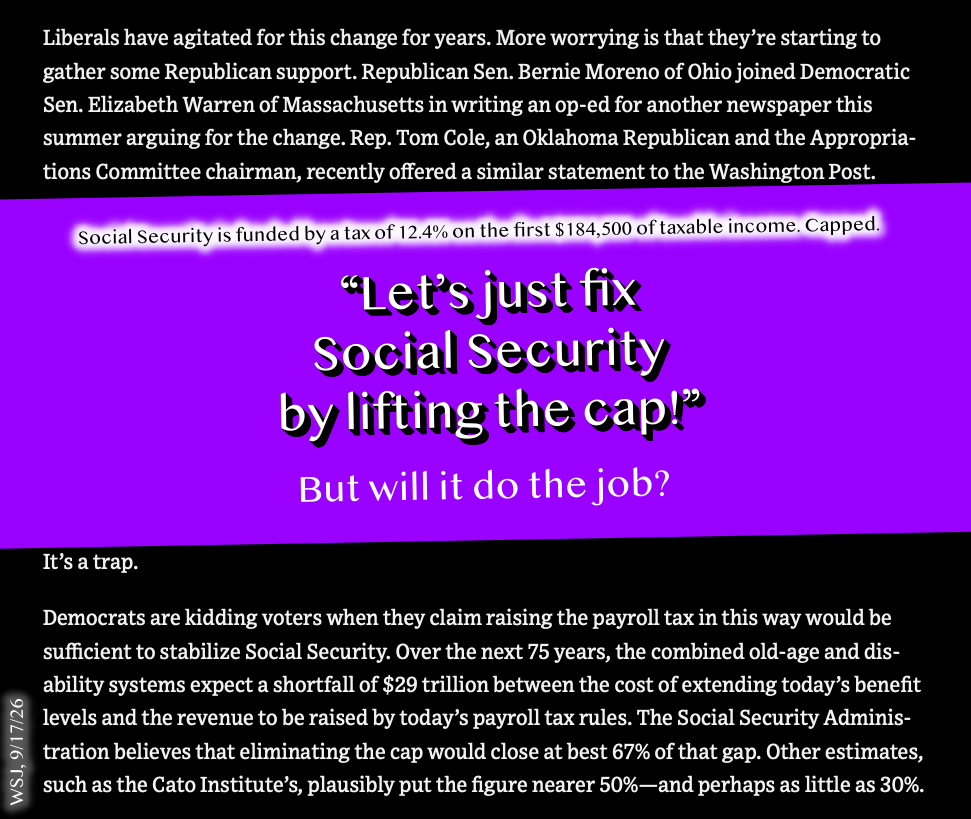
The standard proposal to forestall all this is the focus of Sternberg’s op-ed. And what is that proposal? Nothing other than the notion — beloved by Democrats, because it looks an awful lot like “sticking it to the rich” without saying so directly — of raising the cap on contributions.

The program is funded by a payroll tax of 12.4%, borne equally by employer and employee and applied to the first $184,500 of taxable income. The theory is that if higher-earning households pay the payroll tax on all their income, it removes a regressive element of the existing system and creates a fabulous new revenue stream.

But will that work? Sternberg says No:

This issue will likely gain coverage here at ThisIsCommonSense.org in the near future.

Categories
Update

No Trillion Dollar Deficits!

“The U.S. budget deficit inched closer to $2 trillion after the first 11 months of fiscal year 2026, the Treasury Department reported on Sept. 11.” So begins an article by Andrew Moran, published today in The Epoch Times.

Overall, the fiscal year-to-date budget deficit totaled $1.97 trillion, almost $200 billion higher than the same 11-month span in the prior fiscal year.

Tax receipts were $360 billion last month, bringing this fiscal year’s total to nearly $4.9 trillion. This was slightly lower than the $5.2 trillion posted during the same 11-month span in fiscal year 2025.

Federal spending slowed to $527 billion, with Social Security being the top budgetary item ($141 billion). This was followed by net interest payments ($86 billion), healthcare ($81 billion), and national defense ($72 billion).

Debt-servicing payments overtook Medicare as the federal government’s second-largest fiscal year-to-date expenditure, exceeding $1 trillion in August.

Andrew Moran, “US Budget Deficit Nears $2 Trillion Amid Bond Market Jitters,” The Epoch Times (September 12, 2026).

The largest federal annual deficit in history was $3.1 trillion, recorded in the 2020 budget year. That was the first year of the Covid lockdowns and bailouts.

Categories
Update

The “Far-Right” AfD

Today Germans vote, and the German government does not approve of how the votes in the former East Germany are likely to turn out.

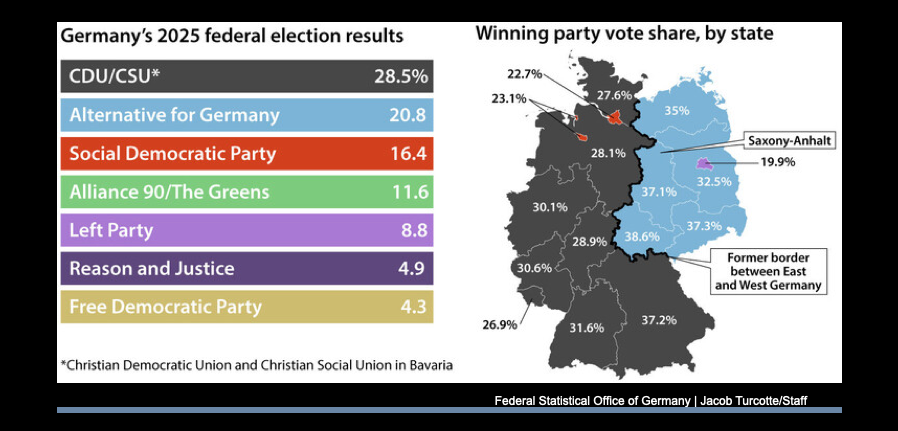
The far-right Alternative for Germany (AfD), which has been declared extremist by the German government, will almost certainly win the most votes. It is polling at over 40%, with the closest party in the low 20s. In some scenarios, it could win an outright majority of seats.

It would be the first far-right party to control a German state since World War II. This matters not just because of the historical echoes, but because it would represent a dramatic failure of the postwar German order. German government, culture, and education have been carefully crafted in recent decades to prevent precisely this scenario.

Mark Sappenfield, ”Why one state election could rattle modern Germany,” The Christian Science Monitor (September 04, 2026).

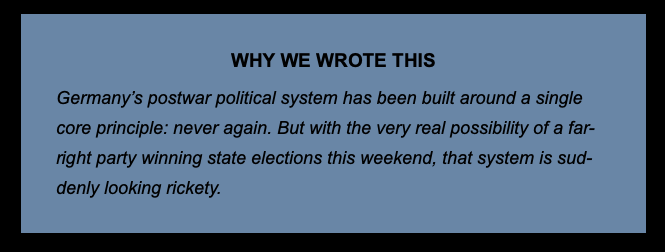
The Christian Science Monitor takes special pains to tell you why the election is important, and why it covers it in the manner it does:

The paper does understand that the AfD is not on board with the common characterization of it as being “far right,” much less fascistic and against democracy: “The AfD denies it is antidemocratic, but it relishes the idea of putting Germany on a new path.”

The party, it should be observed, calls itself an Alternative for Germany, not to the still-universally valorized democracy. Paul Jacob, in his coverage (see, for example, here), of the party, has noted that some of the government’s handling of the organization has itself been anti-democratic.

The fear is “nationalism,” a term variously used, but embarrassing for Germans because of the imperialistic nationalism of the Nazi period. According to the Christian Science Monitor:

At the AfD’s final preelection rally Thursday in the state capital, Magdeburg, a crowd of 6,000 is buzzing. For many Germans, flying the national flag brings a sense of discomfort — a fear of nationalism run amok. At the rally, German flags fly everywhere.

Is it worth noting that the United States, which in World War II sided with the totalitarian Soviet Union to defeat totalitarian Germany, did so as a nationalist enterprise with much waving of flags.

Perhaps there is more than one intention behind flag-waving.

At issue in this fascinating article is what it calls “remembrance culture,” the hyper-focus on Germans being bad because of Nazism. AfD supporters are less than thrilled about the pall this culture casts upon the country’s politics, and are amused by the “firewall” approach of all the other parties uniting against the AfD:

For Ronald Gläser, Saxony-Anhalt is just the beginning. The AfD member of parliament from Berlin sees the scales tipping — and the firewall is helping, in a way.

“The firewall made us the only real opposition in Germany,” he says. “Anyone who is upset turns to us.”

The question is whether the party is a threat to German democracy. Mr. Gläser rejects the charges against his party as an attempt to unfairly control the political discourse. “The AfD is just a party like all the others — more libertarian and more conservative, but not fascist,” he says. 

The article can be read on Apple News, and on the paper’s own website.

Categories
Update

Kavanaugh Balks

Last Wednesday, Paul Jacob wrote, in “Maddened in Michigan,” of a group he chairs, Americans for Citizen Voting – Michigan, and its problems with that state’s Board of State Canvassers. The board consists of “two appointed Democrats and two appointed Republicans.” The four members “deadlocked repeatedly, 2-2” — on partisan grounds — “on counting petition signatures even when they agreed that the signer was a registered Michigan voter, and then, on whether to certify the issue” for the November ballot.

What was going on in Michigan was an attempt to throw out perfectly acceptable petition signatures. Why? Apparently to make sure that a ballot measure would not be voted on by Michigan voters. The measure would require that only citizens vote in elections.

“Two unelected members of an obscure state board,” [Sen. Ruth Johnson] concluded, “cannot be allowed to strip away the constitutional rights of nearly one in 10 adults in our state who signed a petition to place this issue before voters.”

That’s why we and the 700,000 Michiganders who signed our petition want our day in court. Left without any response at all from Michigan’s Democrat-dominated Supreme Court, on Monday we filed an emergency petition with the U.S. Supreme Court. 

Paul closed his report by noting that Supreme Court Justice Brett Kavanaugh had “ordered the Michigan Secretary of State, Bureau of Elections and Board of State Canvassers to respond to our appeal by noon today.”

Were the corrupt decisions of Michigan countered with by Justice Kavanaugh? He did review them to some extent.

But no.

What happened next is explained by Joseph Lord in an Epoch Times article from yesterday:

The U.S. Supreme Court declined to grant an emergency request from a group seeking to put a proof-of-citizenship measure on Michigan’s November ballot.

Supreme Court Justice Brett Kavanaugh on Thursday rejected the request from Americans for Citizen Voting. The group has been pushing for a state vote on a constitutional amendment requiring state officials to confirm that voters in the state are U.S. citizens.

Kavanaugh provided no explanation of the decision.

A few hours later, the Michigan Supreme Court also rejected a bid from the group to place the measure on the November ballot.

The required date for Michigan election officials to finalize the ballot in the state is Sept. 4, leaving the petitioners with little hope of getting judicial approval before the deadline.

Americans for Citizen Voting claimed in its emergency petition that it was making the request because state officials refused to certify that the measure had received enough signatures to move forward.

“The Michigan Board of State Canvassers refused to certify a petition for Michigan’s November 3, 2026 election despite the petition garnering more than 700,000 signatures and needing only 446,198,” the group wrote.

The group has concentrated its effort against instances of noncitizens voting in municipal and school board elections. These elections, with the agreement of local legislators, allow voting by some noncitizens—often requiring a green card or lawful residency.

Note that two-thirds of the 24 cities that allow noncitizens to vote do not require the noncitizen to be legally present in the United States.

The article then makes a dutiful nod to the official story about non-citizen voting: “Outside of these exceptional elections, outcome-altering voting by noncitizens is practically nonexistent in the United States, according to the American Immigration Council.”

Wait, should people wait until enough noncitizens are voting to alter the outcome of the election before making reforms?

The Michigan campaign for requiring citizenship for voting and checking the voter list for noncitizens and requiring voter ID has never claimed that noncitizens are voting in massive numbers.

The idea that precautions should be taken to prevent such influences on elections — you might call it “election integrity” — never seem to be accepted among the ruling class.

Relevant VIDEOS on Facebook:

Holding Voters Hostage

Board Member Refuses to Read

Bureau Admits Another Error in Invalidating Signatures

Board Ignores Sworn Notarized Voter Affidavit 

A Fair Process?

Handwriting Expert Ignored & Unqualified Bureau Staff Invalidates

Categories
Update

Finding Fraud

“Enforcement actions carried out by the Centers for Medicare & Medicaid Services (CMS) have stopped over $1.6 billion in potentially improper Medicare lab payments so far under the Trump administration,” an Epoch Times report authored by Naveen Athrappully begins.

The CMS says that “$732 million was saved by revoking 157 fraudulent lab providers from the Medicare program. . . .”

That seems not insignificant.

In March last year, CMS launched its Fraud Defense Operations Center (FDOC), which has become a key tool to combat fraud, waste, and abuse in Medicare, according to the agency.

FDOC assembles investigators, data analysts, health policy experts, law enforcement, and legal advisors to crack down on fraud. It uses data-driven intelligence to detect threats in real time and shut down inappropriate Medicare billing, CMS said.

In its latest statement, CMS attributed the savings generated from the crackdown on fraudulent Medicare payments to advanced tools, such as machine learning and artificial intelligence. These tools look for indicators such as unusual billing patterns to identify potential fraud, abuse, and waste.

Hotbeds of fraud are the states of Minnesota and California — something readers of this website already knew: Paul Jacob has reported on several major cases in the past year.

Further, Minnesota Governor Tim Walz objects to the money not sent to his state because of the patterns of fraud detected.

Make of that what you will.

Categories
Update

What’s Up?

The Wall Street Journal published a Free Expression column by James B. Meigs this week, entitled “Our UFO Obsession Is a Distraction From National-Security Reality.” The title says it all, really, along with the tagline: “The skies are full of drones, not flying saucers.”

The key passage, really, is this:

I’m a skeptic about UFOs. I think the chances that we’ve been visited by extraterrestrials are infinitesimally remote. But for that very reason, I strongly support opening the government books. As Journal columnist Holman Jenkins argues, the U.S. military and intelligence establishments have long sidestepped legitimate questions about unexplained sightings and sometimes deliberately fomented “UFO hysteria.” That kind of gamesmanship simply invites more conspiracy theories. And if one of these UAPs turns out to be something truly out of this world, well, they ought to tell us that too.

This deflates the whole thesis. Most thoughtful folk marshal some doubt when presented with claims about things with which they have no experience. But the conclusion of this passage does show that transparency on the subject is an area of broad agreement — at least among people who know next to nothing.

But bringing “extraterrestrial” aliens into the conversation about UFOs is itself a standard distraction. While it is true that most people who have seen something bizarre in the skies or coming out of (and going into) bodies of water leap to the ET hypothesis, it is not the sole conjecture to explain the phenomena, and even among ufologists it appears to be decreasing in popularity. Other explanations? They include:

  1. Plasmoids (“life-like” systems of plasma, the fourth state of matter) 
  2. Cryptoterrestrials (they’re from here, are much older than us, and probably reside in the oceans)
  3. Ultraterrestrials (they’re from “other dimensions”)
  4. Breakaway civilizations (human tech but far more advanced than our civilization’s drones)

So having a theory about how difficult it would be for “aliens” to get here — as Mr. Meigs floats — border on the disingenuous. Besides, such Difficulty Objections are based on our currently rickety physics.

Meigs, who is associated with the Manhattan Institute, also observes that the War Department’s tranches of released historical UFO files “have yet to include any bombshells supporting the claims made by retired intelligence officer David Grusch in his explosive 2023 congressional testimony.” Well, yes. No evidence has been disclosed of crashed UFO retrievals or “biologics” (both staples of science fiction). But it has been widely observed that elements in the Pentagon and the information agencies have worked mightily to pooh-pooh UFO talk — even while also using disinformation to encourage belief in UFOs among targeted individuals and groups. (What if the actual psy-op is planned confusion and a divided-and-conquered populace?)  Also, it may be worthwhile to note a fact about the files so far released: they’ve been mostly stripped of telemetry and investigative reports, consisting mostly of raw data unadorned by context, seeming more designed to appease disclosure advocates than actually disclose anything.

This is a widely noted judgment of the files even among their enthusiasts.

More importantly, the files do show behavior of flying objects that is far beyond what our civilization has yet publicly produced. Many of these sightings are outré enough not to warrant being classified as mere “drones.”

But there are drones out there. One reason to disclose all aspects of the files is to allow the Navy (which appears to encounter UAP with the most frequency) to distinguish enemy reconnaissance objects from whatever the truly outré UFOs are.

Interestingly, UFO historian Richard Dolan has commented on the op-ed.

Let’s end this by taking the above-mentioned Plasmoid theory seriously: The Navy, which has been studying plasmas for sixty years, has used lasers to create and control “plasma ‘UFOs.’” It has been written up in reputable sources, including Forbes.


Feature image taken from “Observations of Ball-Lightning-Like Plasmoids Ejected from Silicon by Localized Microwaves (2013).”

Categories
Update

Ivermectin Redux

Ivermectin was one of the drugs medically deprecated during the pandemic (sometimes called the “plannedscamdemic”) that had to be repudiated because, by U.S. law, if a traditional drug could treat a new contagion, no new drug could be rushed through the regulatory system. So a huge psychological operation went underway to repudiate the promising alternatives, such as HCQ and, yes, Ivermectin.

Paul Jacob has covered this at ThisIsCommonSense.org — this very website. In September 2021, for example, the “horse dewormer” propaganda was discussed in “Ingested Invective Rejected.” One of this site’s “Thought” features quoted from The War on Ivermectin (2024):

In 2022, Paul wrote about Dr. John Campbell’s reporting on Ivermectin, in “This Is Just Huge.” In that spirit, consult Dr. Campbell after that:

John takes Ivermectin (nine months ago):

“New positive Ivermectin evidence” (eight months ago):

“Ivermectin and mebendazole, 84% benefit in cancer” (four months ago):

And, three weeks ago, Dr. Campbell laid out the damage done by suppressing Ivermectin during the pandemic:

And Campbell is not alone in noticing the researched benefits of the drug: