Categories
First Amendment rights initiative, referendum, and recall

Freedom of Organizational Speech

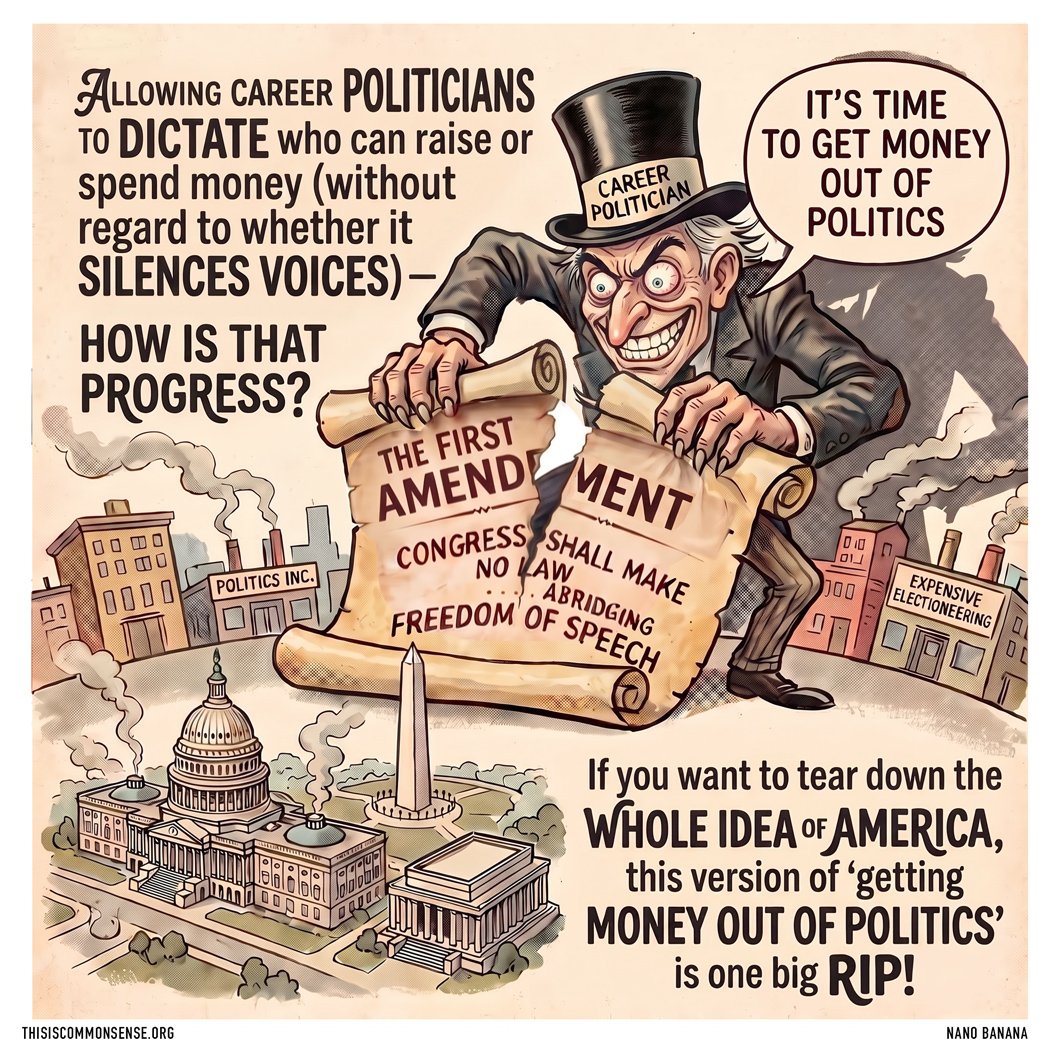
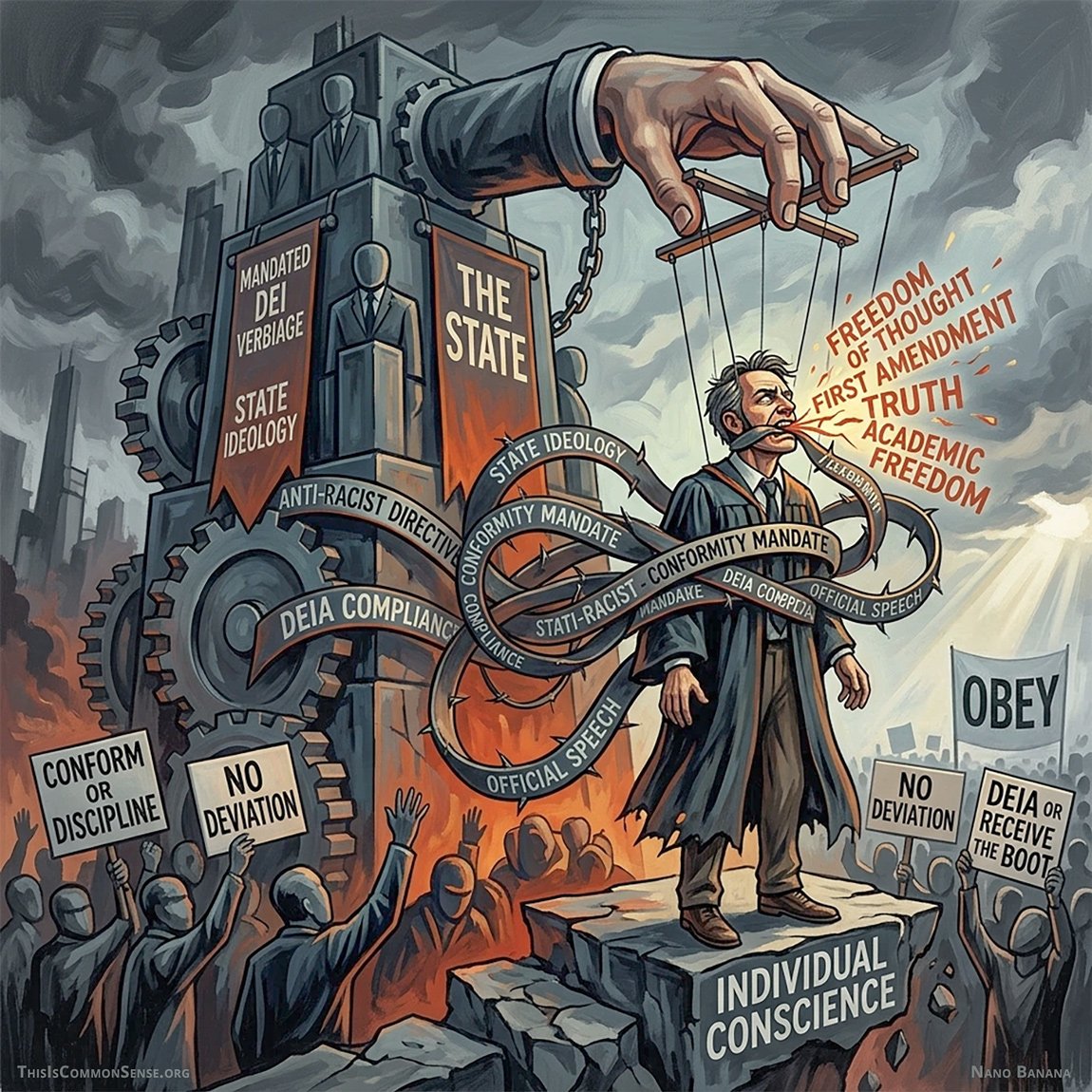
Is it okay to speak freely when you’re just one person but wrong when you’re organizationally cooperating with others?

The latter speech is the target of a Center for American Progress “Plan to Beat Citizens United” launched in 2025.

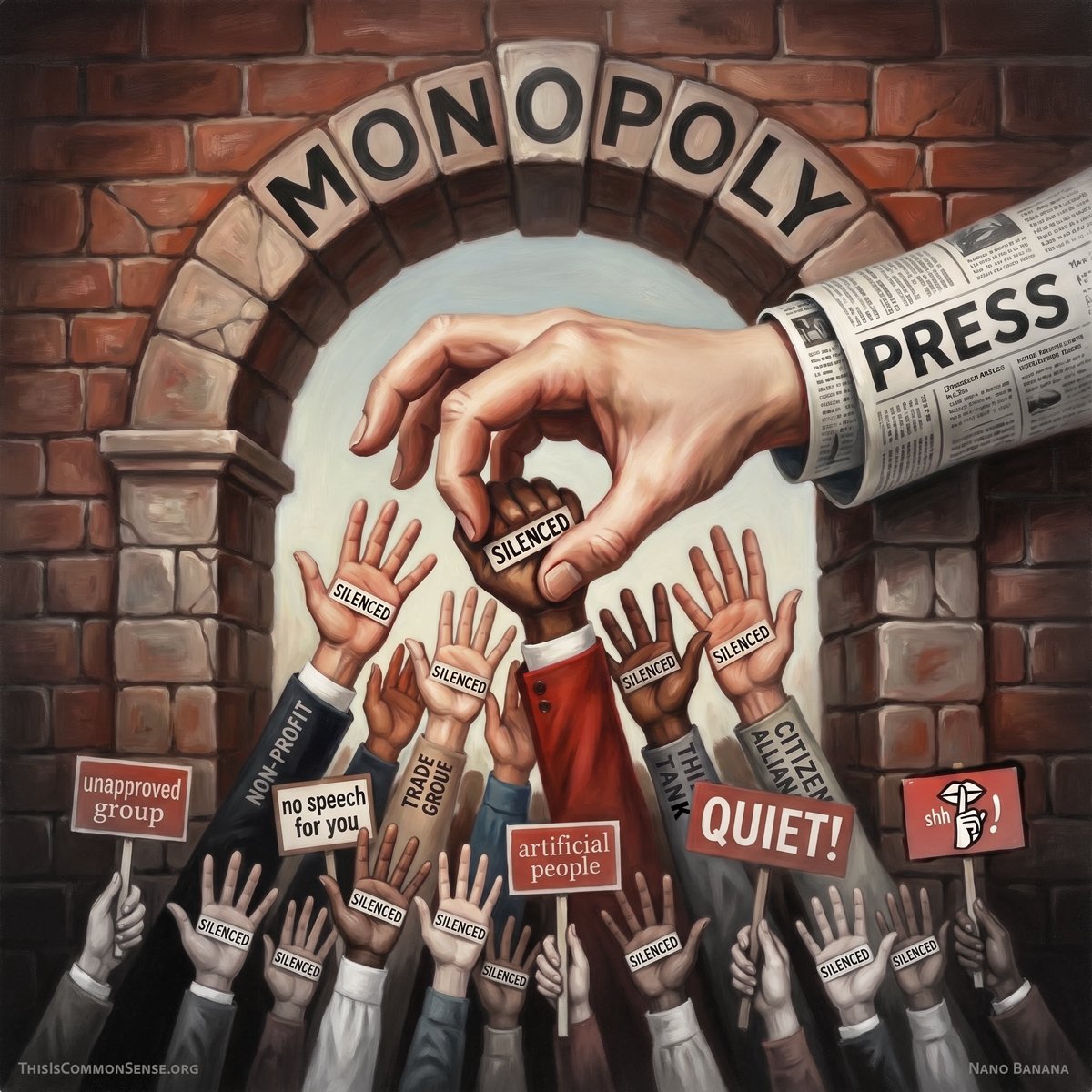
The hope is to stomp our freedom of speech when we speak as members of incorporated entities — unless the corporation is a news media company. Think tanks, trade groups, and others would be prohibited from using funds to engage in election or ballot-issue activity. They would enjoy little scope to discuss issues or legislation “that may be associated with candidates or ballot measure campaigns.”

Sounding the alarm is People United for Privacy, which reports that CAP’s proposal is being promulgated in 15 states. One state, Hawaii, has already enacted a CAP law. It is being challenged in court.

People United for Privacy has successfully challenged a CAP ballot question in Colorado; officials decided that the measure violated a single-subject requirement.

The bumped ballot title: “Shall there be an amendment to the Colorado Constitution removing the power of artificial persons to spend money or anything of value to influence the outcome of an election, and, in connection therewith, defining ‘artificial person’ as an entity, including a corporation, whose existence is conferred by Colorado law or that otherwise transacts business . . . in Colorado. . . ?”

The troublemaking phrase “artificial person” simply refers to a legally constituted organization formed by real people with a real right to freedom of speech.

This is Common Sense. I’m Paul Jacob.


PDF for printing

Illustration created with Nano Banana

See all recent commentary
(simplified and organized)
See recent popular posts
Categories
First Amendment rights general freedom national politics & policies regulation

Mandatory Internet IDs

An assault on your freedom to use your computer without having to “verify your age” has migrated from states like California, Colorado, and New York to the United States Congress.

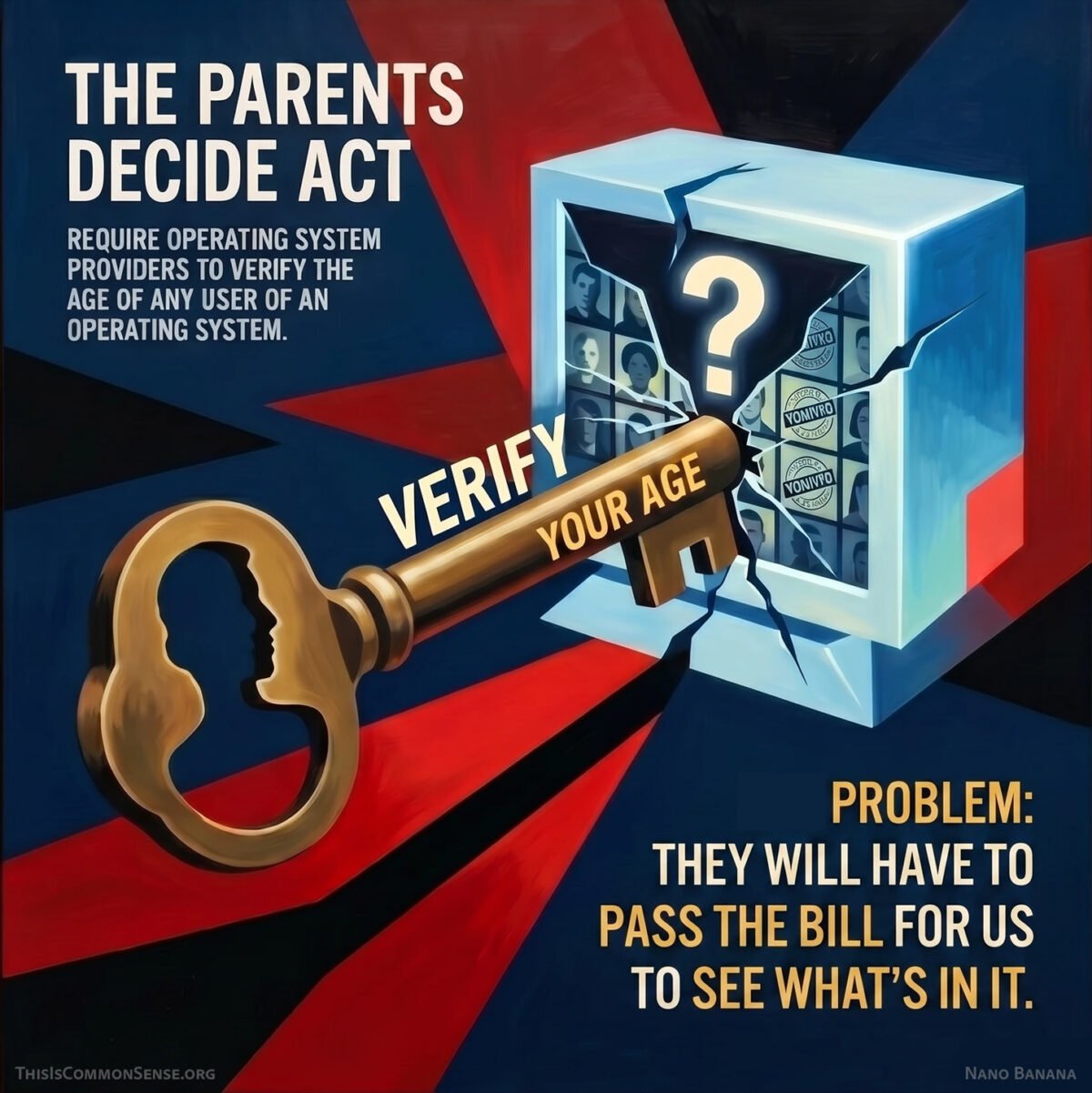
This is the so-called Parents Decide Act, which would “require operating system providers to verify the age of any user of an operating system.”

The honor system, the for-now method of the California law, doesn’t stop ten-year-olds from claiming to be 35. For such laws to “work,” the PC would have to require you to verify your age before you can use it.

That method cannot help but be invasive, like scans of your ID card or your face. Sure, many users of mobile computing devices have private security using their faces or fingerprints, but those users do not intend to share this secret information to third parties — which sure seems like what’s going on here.

PC Gamer observes that, although the method of age verification is crucial “in terms of privacy and data security,” the Energy and Commerce Committee will be deciding such things after passage. 

They’d have to pass the bill for us to see what’s in it.

Whatever the method, many users would obey, conscientiously giving the PC — and the PC or OS maker — ID or facial info that might be linked to purchase info in the company’s database.

Could such databases be hacked and provide criminals with new information with which to commit their crimes? Only if the umpteen stories per day on successful hacks of the databases of major companies are any clue.

“Save the children” is the familiar sales pitch, but if government is in charge of saving the children, our children are in trouble.

This is Common Sense. I’m Paul Jacob.


PDF for printing

Illustration created with Nano Banana

See all recent commentary
(simplified and organized)
See recent popular posts
Categories
First Amendment rights national politics & policies

First Amendment Needs Help!

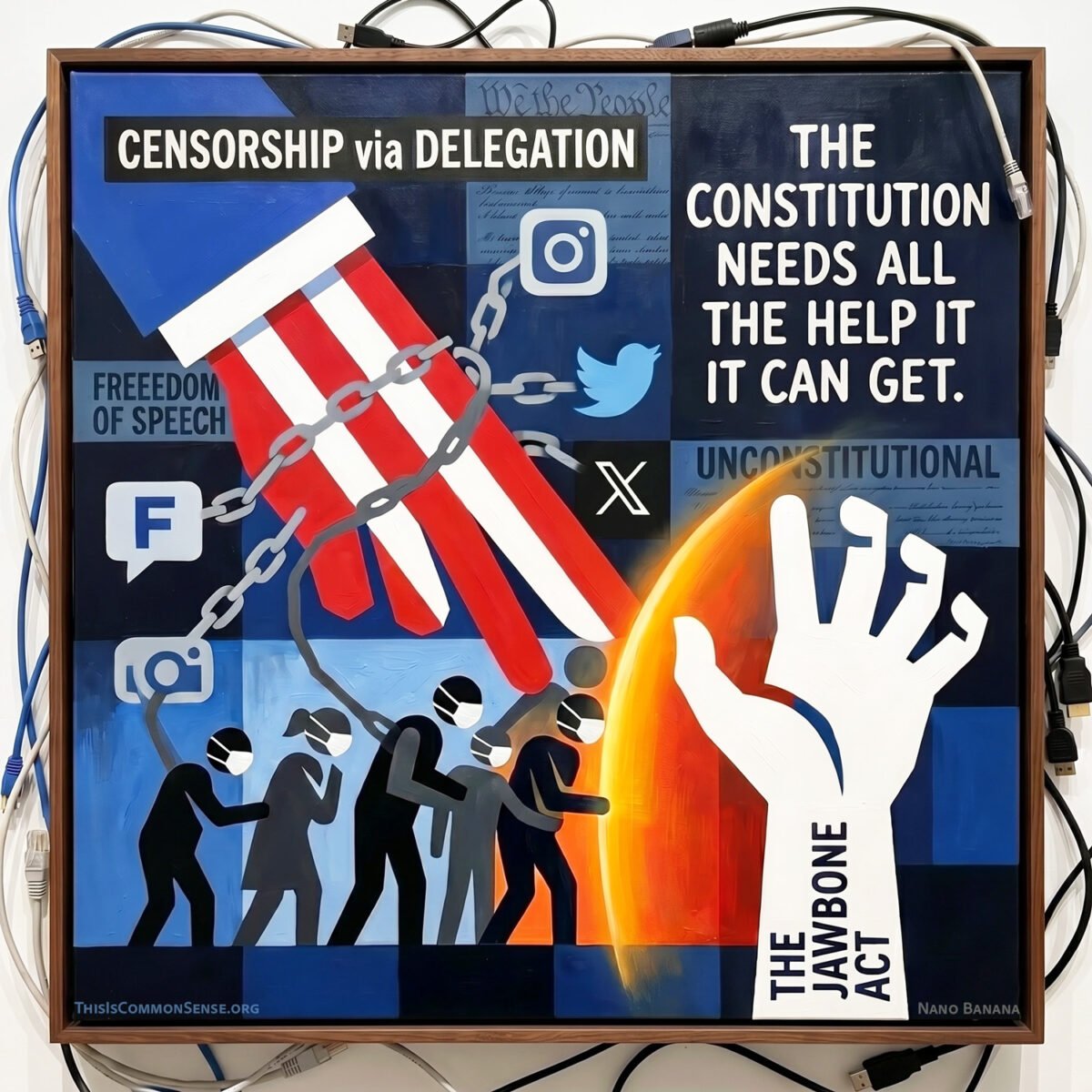
Newly proposed legislation would make it harder for federal officials to censor speech by pressuring third parties to censor speech.

The bipartisan bill has been dubbed the “Justice Against Weaponized Bureaucratic Overreach to Networked Expression Act”— the JAWBONE Act — introduced by Senators Ted Cruz (R.-Tx.) and Ron Wyden (D.-Ore.). 

“Government coercion of such private speech intermediaries [like social media platforms] threatens freedom of speech and open inquiry,” it asserts, “particularly for users who have no say in, or knowledge of, how their speech or access to information is affected.”

Such censorship-delegation had been brought to light by lawsuits as well as by the willingness of a reconstituted Twitter — X, under the ownership of Elon Musk — to publicize communications between the federal government and Twitter employees during the COVID-19-era assaults on freedom of speech.

The JAWBONE act would prohibit federal agencies from coercing or threatening online and other services into changing content and would give victims the right to seek damages.

Now, you might be thinking, doesn’t the Constitution already prohibit the federal government from censoring us? Well, yes. It provides no exemption for government censorship implemented via plausibly (or implausibly) deniable delegation of the task. 

But we have had many legitimate debates about constitutional meaning. Further, we have also always had many illegitimate ones, in which people — including Supreme Court justices — seek to circumvent even the plainest and most unmistakable import of constitutional provisions. 

So the Constitution needs all the help it can get.

This is Common Sense. I’m Paul Jacob.


PDF for printing

Illustration created with Nano Banana

See all recent commentary
(simplified and organized)
See recent popular posts
Categories
First Amendment rights social media too much government

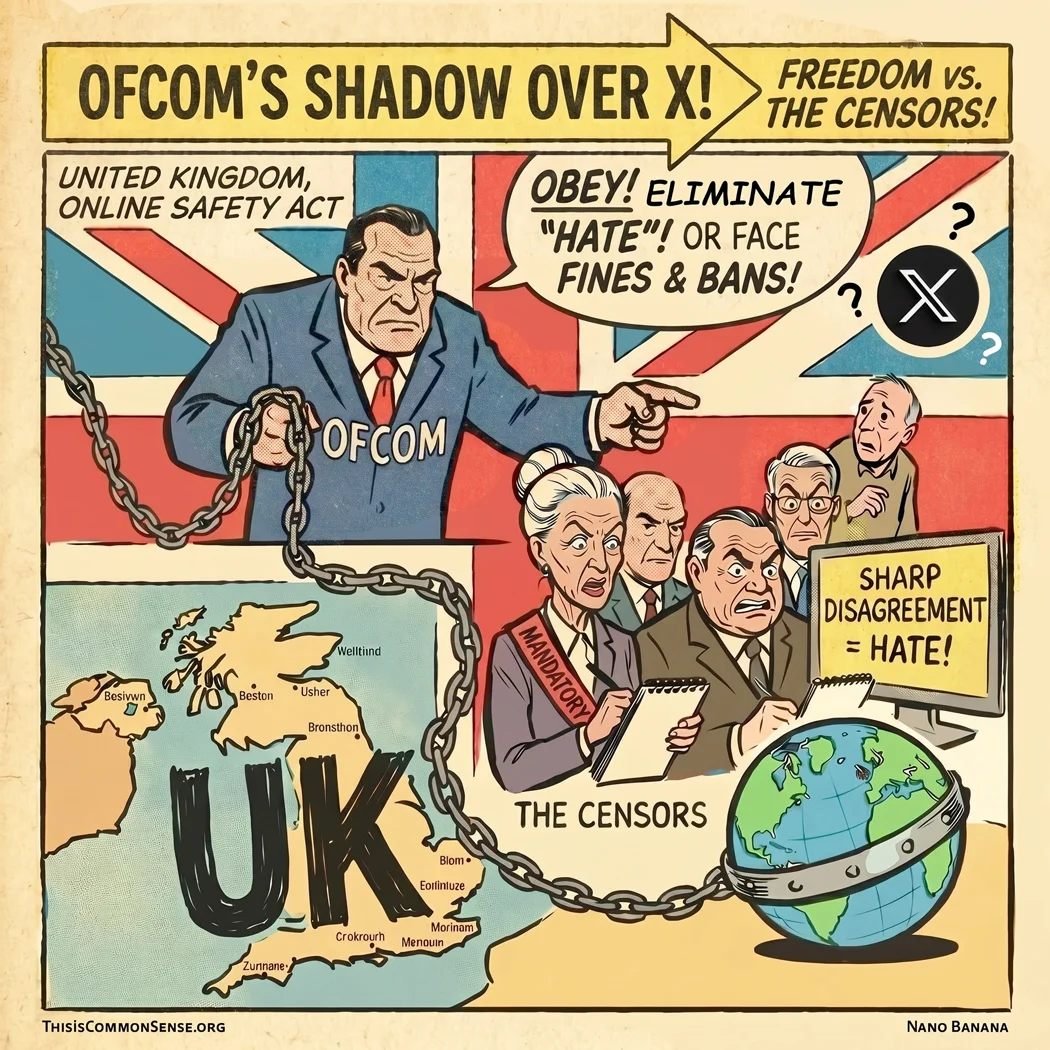
Are British Censors Winning?

An outfit in the United Kingdom called Ofcom, the main enforcer of the U.K.’s Online Safety Act, is requiring social platforms to implement onerous procedures to censor “hate,” including stripping users of anonymity — or face mammoth fines, bans in the U.K., and other draconian penalties.

Nobody would object to compelling the removal of content that is clearly criminal. But is that what most so-called “hate” content really is? Of course not. Much of what irks censors and the merely censorious is merely vituperative, and no small part of what gets their goat is nothing other than sharp disagreement with those authorities who decide what “hate” is — that is, the censors themselves. 

Last year, the social media platform X formally decried Ofcom’s demands as “overreach” even as it tried to comply with the new regulations. The platform objected to U.K. mandates that would “prevent adults from encountering ‘illegal’ content” and impose “steps to ensure age verification that limit adults’ anonymity online.”

But X has now caved. It has agreed to review most content flagged as illegal “hate” within two days. All the language of that earlier remonstration is “gone now,” Reclaim the Net observes. What remains is only an agreement to comply with an organization and a system known to be militantly hostile to freedom of expression — and to Elon Musk’s X.

What could X do instead? 

Fight. 

Pull out of the United Kingdom and tell UK users, “Sorry. You’re just going to have to use a VPN to disguise your location in the UK if you want to keep using your X account,” with links to free VPNs.

This is Common Sense. I’m Paul Jacob.


Further Reading:

PDF for printing

Illustration created with Nano Banana

See all recent commentary
(simplified and organized)
See recent popular posts
Categories
crime and punishment First Amendment rights national politics & policies

Prosecutorial Shell Game?

The Department of Justice’s case against the egregious former head of the Federal Bureau of Investigation, James Comey, is as weak a case as he could hope.

Comey had shared an image on social media — a photo of shells on a beach gathered together to markout “86 47” — and, when people interpreted it as a possible threat, he deleted it. “He said he thought it was a political message, not a threat,” an NPR story summarizes, “but now a grand jury in North Carolina has made a federal case out of this. It’s charged Comey with two felonies, including allegedly threatening the life of the president.”

So why do I call it weak? While “86” may have originally meant “kill” or “delete,” amongst gangsters, real or Hollywood, it’s often used colloquially to mean “get rid of.” And though “47” is the number of Trump’s second administration, it’s possible — indeed likely — that Comey didn’t mean “Kill Trump.” He could have meant “impeach Trump” or “prosecute Trump” or any other politically acceptable way to force the president out of office. 

Don’t get me wrong. Was it a dumb thing for the disgraced former government official to share? Sure. But even outstandingly horrible former FBI heads have freedom of silly speech.

This is not the first time Comey’s been prosecuted by the Trump DOJ. The last time it fizzled. And, considering the First Amendment, this one will fizzle.

Bringing forward dumb charges looks bad, like Democrats looked prosecuting Trump. The political persecution of enemies is not all that popular. 

And in a country filled with political corruption, it sets the cause of “draining the swamp” back, not forward.

This is Common Sense. I’m Paul Jacob. 


PDF for printing

Illustration created with Grok Imagine

See all recent commentary
(simplified and organized)
See recent popular posts

Categories
First Amendment rights regulation

Operation Choke Point Choked

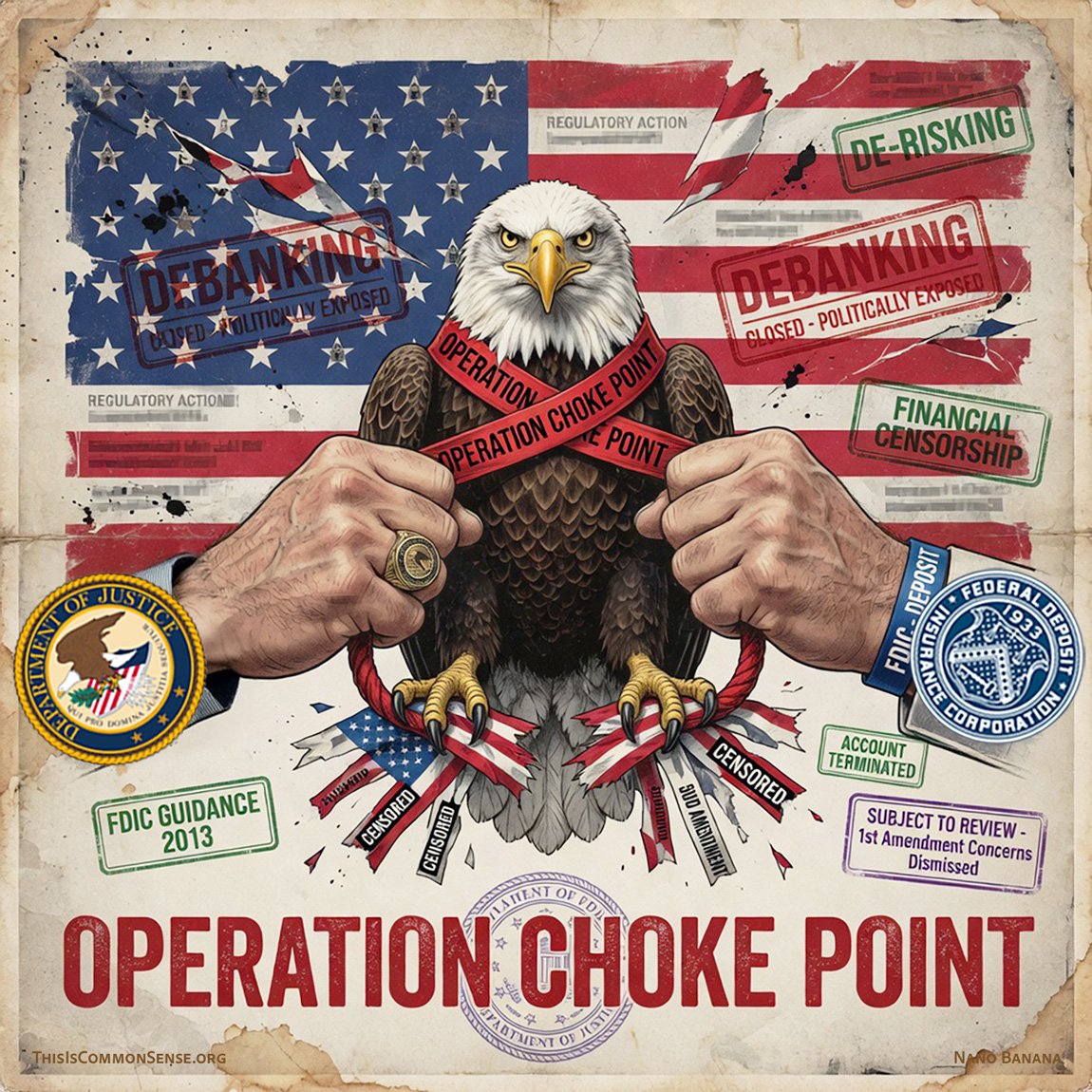
The government should not be pushing private firms, including banks, to sever relationships with customers on ideological grounds. 

Nevertheless, in 2013 the Department of Justice and FDIC began pressing banks to cut off services to certain “high risk” industries, like the gun industry. The initiative was called — with laudable candor — Operation Choke Point. The pressure was an expression of the Obama administration’s hostility to Second Amendment rights and various views and advocacy, not a response to alleged lawbreaking by the debanked customers.

The Trump administration first sought to end this practice in 2017. But the urge to censor and punish viewpoints, including by debanking, resurged during the Biden administration.

In 2025, President Trump, in his second shot at heading the executive branch, issued a new executive order directing federal agencies to review the situation and issue new regulations to protect customers. It was to be made clear to banks that despite the impression conveyed by other administrations, so-called “reputational risk” — which boils down to hostility to certain views and enterprises — is not a warrant to fire customers.

A finalized and, one hopes, truly final rule has just been issued. It prohibits relevant agencies from criticizing or penalizing a supervised institution based on “reputation risk” or from instructing institutions to kill accounts because of customers’ constitutionally protected speech or activities.

The proper functions of government do not include acting to punish people directly or indirectly for their speech . . . or other exercise of their rights. The fact that just such a squarely improper (and illiberal) policy endured through several administrations shows just how shaky constitutionally guaranteed freedoms are in the current ideological climate.

This is Common Sense. I’m Paul Jacob.


PDF for printing

Illustration created with Grok Imagine

See all recent commentary
(simplified and organized)
See recent popular posts

Categories
First Amendment rights international affairs

Fecklessly Fining 4chan

You host a website. Users can say whatever they want on this site. Next thing you know, a UK regulatory agency is sending you, an American organization based in the United States, a letter announcing a trillion-dollar fine for failure to comply with UK censorship demands. How much do you panic?

If you’re 4chan, not much.

4chan hasn’t been fined a trillion dollars yet. But some day the ever-increasing meaningless fine may reach that level.

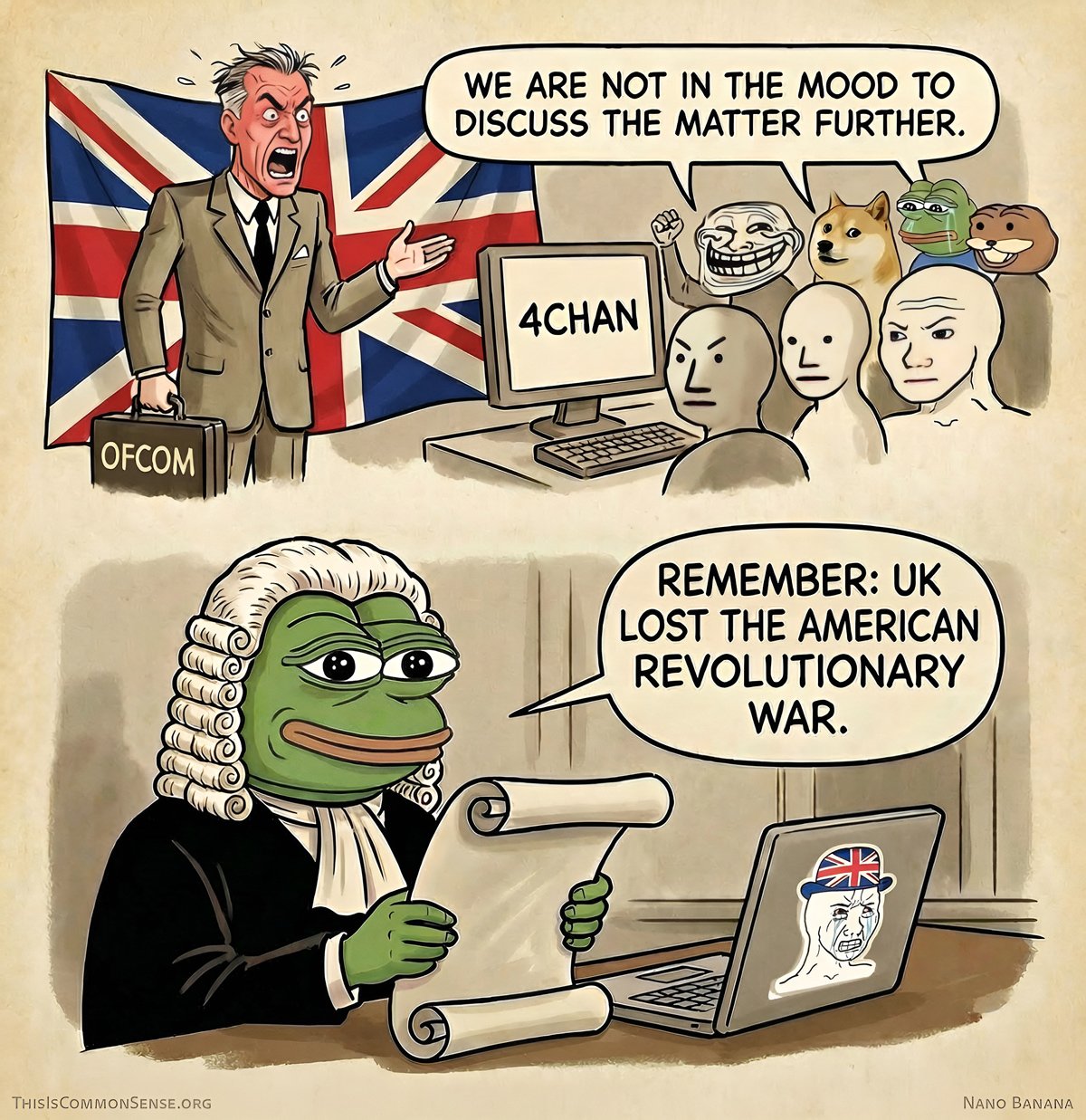
The redcoat-staffed regulatory agency is called Ofcom. It has fined 4chan £520,000 — in dollars that’s about $693,000 — “Under a Law That Doesn’t Apply in the US.” The bulk of the fine is for failing to implement age verification — that is, failure to force users who are by and large anonymous to identify themselves.

The back-and-forth between Ofcom and 4chan started in April 2025. Ofcom isn’t getting the message. 4chan’s lawyer says the company “has broken no laws in the United States, my client will not pay any penalty. Increasing the size of a censorship fine does not cure its legal invalidity in the United States. . . . As has been explained to your agency, ad nauseam, the United Kingdom lost the American Revolutionary War. We are not in the mood to discuss the matter further. . . .”

The only problem for 4chan I see on the horizon is the struggle in the U.S. to impose a similar regulatory regime here. Fortunately, our own courts still somewhat recognize the relevance of our First Amendment.

This is Common Sense. I’m Paul Jacob.


Illustration created with Nano Banana

PDF for printing

See all recent commentary
(simplified and organized)
See recent popular posts

Categories
First Amendment rights Internet controversy social media

Modern Tech Irrelevant

“I’ve never been more pleased by ‘losing’ in my life,” tweeted Jay Bhattacharya.

What makes the Director of the National Institutes of Health a “loser”?

Well, the doctor (who also serves as current Acting Director of the Centers for Disease Control) has not always served in the federal government. In his days between Trump administrations he’d run afoul of censors on social media. Now he’s jubilant that a major case against censorship has come to a freedom-of-speech conclusion.

Aptly, he started that post on X with “Huzzah!”

The actual news? “The New Civil Liberties Alliance, on behalf of its clients Jill Hines and Dr. Aaron Kheriaty,” reads the official press release of the lawyers, “has reached a settlement agreement and Consent Decree concluding the landmark Missouri v. Biden lawsuit against government-induced social media censorship.”

This follows an executive order by President Trump on the first day of his new administration. The president had declared that the federal government, under President Joe Biden, had “infringed on the constitutionally protected speech rights of American citizens across the United States in a manner that advanced the government’s preferred narrative about significant matters of public debate.”

This not a judicial ruling. It’s an agreement, the key point being, “The Parties agree that modern technology does not alter the Government’s obligation to abide by the strictures of the First Amendment.”

Specifically, the agreement (in the lawyers’ words) “prohibits the U.S. Surgeon General, Centers for Disease Control and Prevention (CDC), and Cybersecurity and Infrastructure Security Agency (CISA) from threatening social media companies into removing or suppressing constitutionally protected speech on Facebook, Instagram, X (formerly Twitter), LinkedIn and YouTube.” And more.

Director Bhattacharya calls it a “huge win for all Americans.”

You bet Huzzah!

This is Common Sense. I’m Paul Jacob.


PDF for printing

Illustration created with Nano Banana

See all recent commentary
(simplified and organized)
See recent popular posts
Categories
defense & war First Amendment rights

Iran and the Rubicon

Last weekend, Cenk Uygur, of the alternative news commentary show The Young Turks, focused on the Iran war, including one of its stranger developments, rumors that the Trump Administration is planning to arrest a different news commentator, Tucker Carlson. 

And try Mr. Carlson for treason.

“If @TuckerCarlson is actually arrested, the government will have crossed the Rubicon,” Mr. Uygur posted to X. “Whatever ridiculous charges they bring up, everyone will know real reason was that he opposed the war and Israel. He’ll be considered [the] first American political prisoner within our own country.”

A factual corrective to this was provided Sunday, on this site, at least about the historical background of imprisoning journalists critical of a U.S.-involved war: Woodrow Wilson did that. He “crossed the Rubicon” over a hundred years ago. And he wasn’t the first president to do so.

But is there any real push to try Tucker Carlson for treason?

Robbie Soave, writing on Tuesday, surmised that, considering Carlson’s connections with the administration, the commentator is not likely paranoid or making things up.

And you can certainly find arguments pushing a treason case, and worse — for example, Israeli journalist and historian Yair Kleinbaum wrote in JFeed that “Carlson, Fuentes and Owens Must Be Jailed Inside a WWII-Style Internment Camp.”

At least, apparently, “while America is locked in a struggle against the dark forces of Shia Islam.” (Note that one consequence of the Iraq War was to attack Sunni Islam and install Shia Islam in Mesopotamia.) “Once the war is won and the threat is neutralized, we can release them,” Kleinbaum concludes.

Let’s hope this treason talk is all rumor. Arresting Tucker Carlson won’t improve the popularity of the Iran War.

This is Common Sense. I’m Paul Jacob.


PDF for printing

Illustration created with Nano Banana

See all recent commentary
(simplified and organized)
See recent popular posts
Categories
First Amendment rights Internet controversy privacy

Think of the VPNs

It’s for the kids. Let’s remember that. If bureaucrats and politicians get massive amounts of new power to lord over us, this is just a happy side effect.

Reclaim the Net reports that during recent debate in the U.K.’s House of Commons about a Children’s Wellbeing and Schools Act, lawmakers rejected proposed amendments that would have required age verification to use virtual private networks (VPNs) and certain other services. 

That’s good. People use VPNs to avoid being tracked and identified by such tyrannical governments as those of China or the United Kingdom.

And any ID requirement would increase the chances that governments discover the identity of users no matter what rules VPN providers are supposed to follow to prevent this.

But Brits cannot relax just yet. Amendments that lawmakers did approve would compel Internet service providers to “restrict children’s access to specific online platforms, impose time-of-day limits on when services can be used, and mandate age verification across nearly any platform that enables users to post or share content.”

Time-of-day limits? Aren’t parents the ones who tell their kids when it’s bedtime?

If we do descend into a dark totalitarian night with no freedom, no privacy, a telescreen in every room, we’ll have to look on the bright side: It was for the kids. The kids needed to be protected from algorithms, choice, freedom, the deficiencies of merely parental oversight, and books with pages addictively connected to adjacent pages. 

Those kids. Always causing trouble.

This is Common Sense. I’m Paul Jacob.


PDF for printing

Illustration created with Nano Banana

See all recent commentary
(simplified and organized)
See recent popular posts