Categories
free trade & free markets litigation U.S. Constitution

Punish Energy Producers?

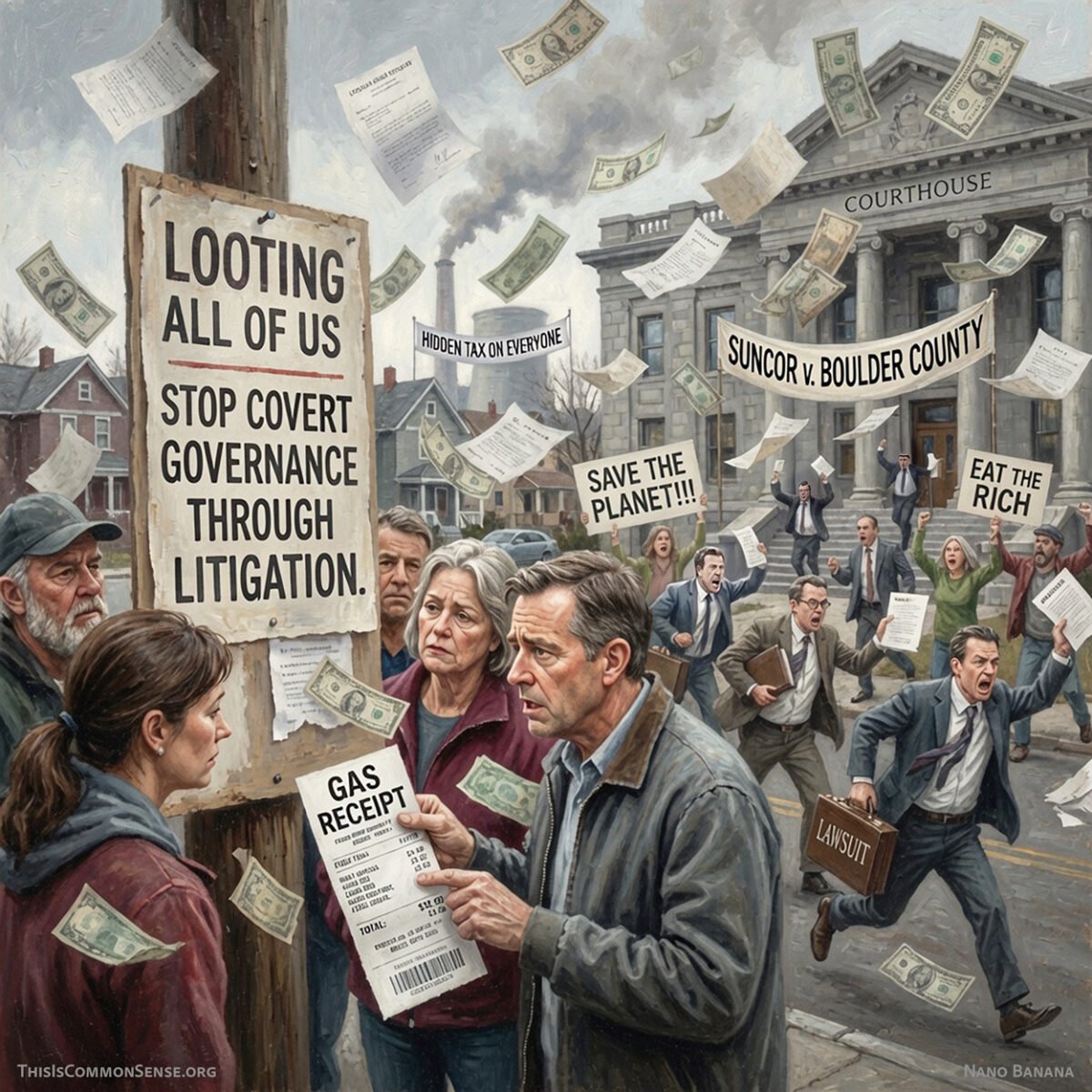
The latest attempt to hamper our ability to do things? A series of lawsuits against oil companies for allegedly committing global warming. The plaintiffs want billions and billions to be extracted from these companies for fueling civilization.

Litigation before the Supreme Court, Suncor v. Boulder County, is “one of the most consequential energy cases in decades,” argue Michael Toth and Sarah Harbison in the New York Post

Boulder County is just one of many seeking to make oil and gas companies fork over massive damages. 

To whom? Entities like Boulder County.

The high court’s response will help determine the viability of future such litigation and “whether the United States remains an energy superpower.”

Energy superpower status is not what people trying to drive their cars and heat their homes at a reasonable cost are worried about. If the court accepts the plaintiffs’ reasoning, the sky’s the limit as far as the liability of the energy industry. 

And those new sky-high liability costs for gas and oil providers will result in new sky-high costs for you and me.

Looting all of us is fine with lawsuit supporters like David Bookbinder of Environmental Integrity Project. “This is a rather convoluted way to achieve the goals of a carbon tax,” Toth and Harbison claim. “The people who use the products pay for the damage that they cause.”

The Post’s authors urge the Supreme Court to “shut down” this attempt to circumvent the Constitution. And confirm that U.S. energy policy “can’t be dictated by local lawsuits.”

This is Common Sense. I’m Paul Jacob.


PDF for printing

Illustration created with Nano Banana & Grok Imagine

See all recent commentary
(simplified and organized)
See recent popular posts

Categories
litigation Second Amendment rights

The 26-Year Assault Is Over

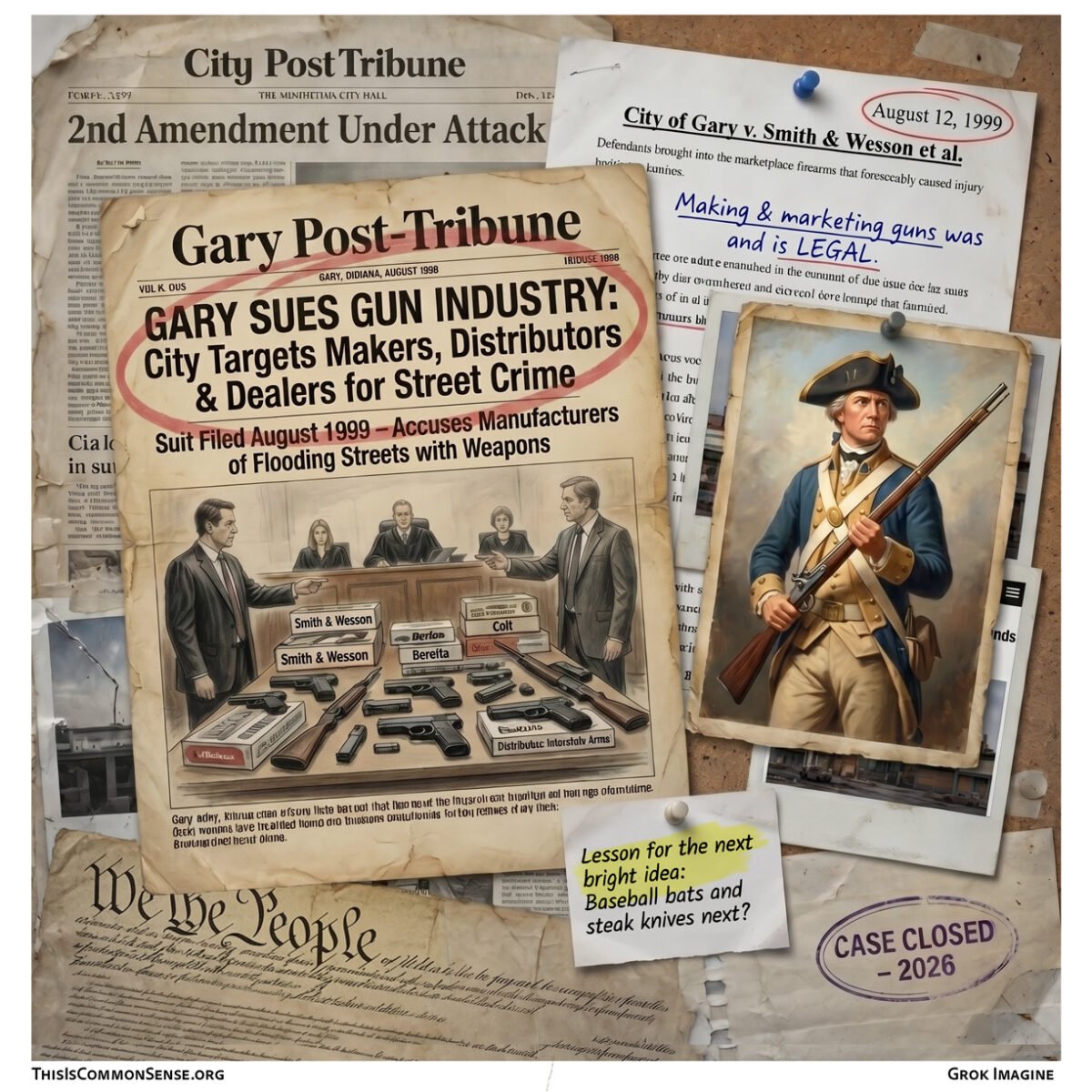
After more than a quarter century of litigation against gun makers, it’s over. The Indiana Supreme Court has called a definite halt to the town of Gary’s long streak of legal harassment by dismissing its lawsuit in a 4-1 ruling.

Gary’s petition to transfer jurisdiction of the lawsuit had been made in order to keep it alive. The court had to decide the fate of that maneuver. After stating briefly that all materials had been reviewed that needed to be reviewed and all parties heard that needed to be heard, the court announced that it “DENIES the petition to transfer,” affirming the decision of an appeals court. The USACarry story about the case links to the appeals court’s lengthy decision.

Both rulings had been preceded by a state law passed in 2024 stipulating that only the state itself — basically, the attorney general — can file such a suit on behalf of cities or counties. The incumbent is uninterested in doing so.

Gary, Indiana, initiated its action against a laundry list of gun makers, distributors and dealers in August 1999. The suit accused them of culpability for crimes committed with the weapons they had brought into the marketplace. At the time, making and marketing guns was legal; still is. 

So the suit was manifestly absurd from the outset.

Perhaps cities contemplating litigation against baseball bat makers and steak knife vendors will accept the lesson.

So it’s finally finished. At least this particular attempt to nullify our Second Amendment rights is finally over.

This is Common Sense. I’m Paul Jacob.


PDF for printing

Illustration created with Grok Imagine

See all recent commentary
(simplified and organized)
See recent popular posts

Categories
election law litigation partisanship

Un-Redistricting Virginia

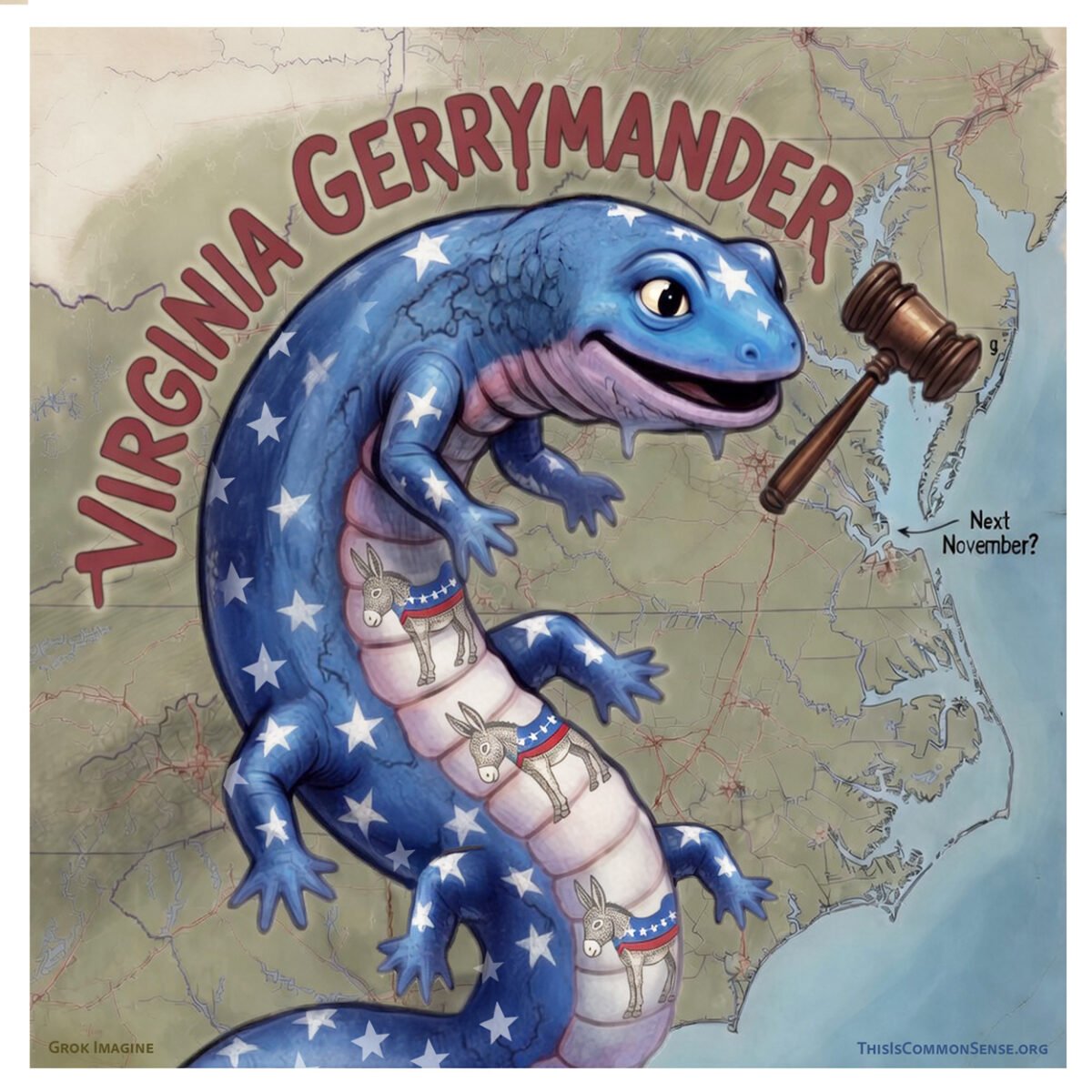
A circuit court has ruled that Virginia’s new voter-passed congressional map, gerrymandered to give Democrats in the state a prohibitive advantage in the next congressional election, is unconstitutional.

Judge Jack Hurley, of the Circuit Court of the Commonwealth of Virginia for the 29th Judicial Circuit, Tazewell County, denied a motion to stay his injunction blocking certification of the election using the new districts. Former Virginia attorney general Ken Cuccinelli reports that once a final order is drafted and entered, “it will be immediately appealed.”

If the rejiggering survives the challenge, it could be the factor that tips the balance in the House of Representatives toward the Democrats next November.

Cuccinelli, who is now national chairman of the Election Transparency Initiative, had been saying that passage of the gerrymander would not be the last word. In their rush to get the measure to voters and enacted before November 2026, lawmakers ignored sundry constitutional requirements.

The 2024 special session that took up the redistricting measure had been convened to legislate about the budget. “Its governing resolution limited the session’s scope. Expanding it to include a constitutional amendment on redistricting required a two-thirds vote that never occurred.”

Also, says Cuccinelli, the state constitution requires that “an election must intervene between first and second passage” of a proposed constitutional amendment. “Here, first passage occurred during an election cycle — not before an intervening one.”

Among other problems is the constitutional stipulation that “every electoral district shall be composed of contiguous and compact territory.” The proposed map violates this requirement “badly.”

When you’ve got to go, you’ve got to go, and this partisan map must go.

This is Common Sense. I’m Paul Jacob.


PDF for printing

Illustration created with Grok Imagine

See all recent commentary
(simplified and organized)
See recent popular posts

Categories
Fourth Amendment rights litigation

The C-word in Surveillance

Is unconstitutionality like obscenity? — we can’t define it, but know it when we see it.

Take San Jose, California, and its automatic license plate reader system. I might not win an argument explaining how San Jose’s public surveillance relates to the Fourth Amendment to the United States Constitution. But. . . .

That amendment insists that people have a right “to be secure in their persons, houses, papers, and effects, against unreasonable searches and seizures,” and that governments may not search and seize property without a warrant “upon probable cause, supported by Oath or affirmation, and particularly describing the place to be searched, and the persons or things to be seized.”

How does one’s public goings-about in cars that are drivable only with a state-mandated license plate amount to something that must not be searched or surveilled? Our driving on roads is all out in the open, after all, not private. 

Maybe we should stress the Fourth’s narrow guideline: warrants must describe the place to be searched, and the persons.

Broad-based tracking flouts that narrow stricture.

But really, I’m biased: mass surveillance is Orwellian. Do we want our government keeping track of us that much?

Especially as in San Jose, where not only can over a thousand police department employees scour the data sans any legal warrant, but the department also shares this resource with over 300 agencies across the state.

Creepy. That’s the word for it.

And that’s the word used by Institute for Justice lawyers who filed a lawsuit against San Jose’s practice.

Jacob Sullum’s article in Reason explains the legal arguments carefully as well as the many ways the information can be weaponized to, for example, retaliate against protesters. 

Information is power, after all. And in the wrong hands . . . creepy.

This is Common Sense. I’m Paul Jacob.


PDF for printing

Illustration created with Grok Imagine

See all recent commentary
(simplified and organized)
See recent popular posts

Categories
judiciary litigation regulation

Justice Delayed Forever

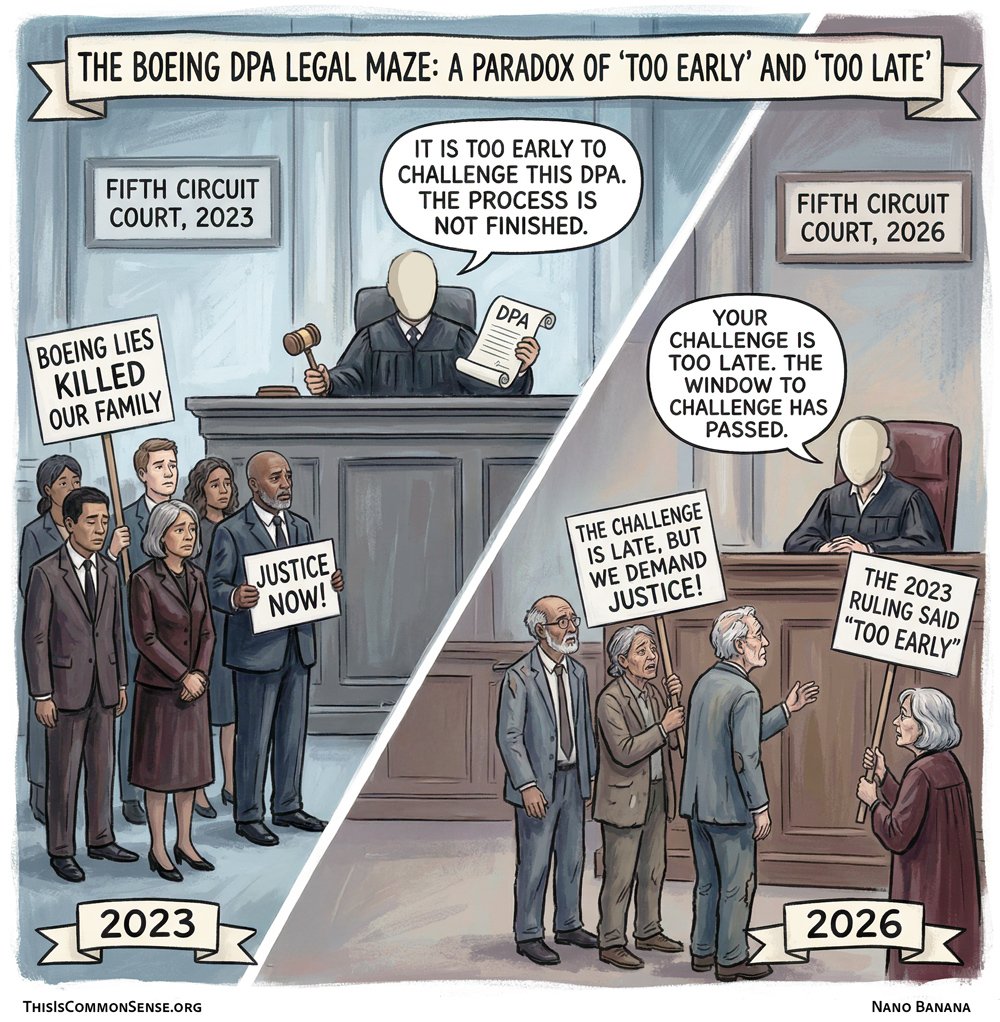
In 2023, the families of persons who had died because of Boeing’s lies about safety were told that it was too early to challenge the Justice Department’s deferred prosecution agreement (DPA) with Boeing. Now, in 2026, the same Fifth Circuit says that their challenge is too late.

When was the perfect Goldilocks moment? When was lawyer Paul Cassell supposed to challenge, on behalf of his clients, “the Justice Department’s 2021 deferred prosecution agreement and 2025 non-prosecution agreement (NPA) with Boeing”?

Cassell reports that several years ago, Boeing “lied to the FAA about the safety of its new 737 MAX aircraft.” After Justice investigated, it charged Boeing with a criminal conspiracy — yet immediately signed a “sweetheart DPA” that let Boeing avoid a criminal conviction so long as it paid penalties and compensation to the families. 

And promised to do better.

In court, the families proved that the Justice Department had hidden the agreement from them even though legally obliged to consult with them. The same judge who acknowledged this in 2022 went on to rule, in 2023, that there was nothing he could do.

Appealing that decision, Cassell was next foiled by the Fifth Circuit, which ruled in December 2023 that any relief for the families was “premature.” Now, many complications later, the Fifth Circuit has “simply ignored its previous promises.”

With Boeing suffering no proportionate consequences for its incompetence and dishonesty about safety, it is just a matter of time before similar cases are repeated.

This is Common Sense. I’m Paul Jacob.


PDF for printing

Illustration created with Nano Banana

See all recent commentary
(simplified and organized)
See recent popular posts

Categories
Internet controversy litigation

Sony’s Scam Scuttled

The U.S. Supreme Court has ruled that Internet Service Providers (ISPs) can’t be forced to deprive customers of Internet access on the basis of an unverified complaint about copyright violation. And can’t be held liable for refusing to kill a customer’s access.

The ruling holds that a service provider “is contributorily liable for a user’s infringement only if it intended that the provided service be used for infringement. . . .”

The plaintiff? Sony. 

The defendant? Cox Communications. 

According to the ruling, Sony “alleged that Cox contributed to its users’ infringement by continuing to provide Internet service to subscribers whose IP addresses Cox knew were associated with infringement.”

Of course, Cox cannot “know” that a user had infringed some copyright merely because it got an automated notice that a user had done so. Cox is just an Internet service provider, not a judge, jury, or hander-out of penalties for unestablished crimes.

Had the high court ruled otherwise, the consequences would have been dire.

“Under the legal standard the labels wanted,” Reclaim the Net observes, “an ISP that received enough of these automated complaints and didn’t disconnect the account could face catastrophic financial liability. A Virginia jury bought that theory in 2019 and hit Cox with a verdict of over $1 billion.”

The decision bodes well for rulings on other attempts to transform ISPs — or PC operating systems, satellites, or any other gateway to modern life — into instant wielders of crippling punishment . . . no trial, no judgment, no justice allowed. 

This is Common Sense. I’m Paul Jacob.


PDF for printing

Illustration created with Nano Banana

See all recent commentary
(simplified and organized)
See recent popular posts

Categories
free trade & free markets litigation regulation

Free to Advise

People should be free to talk to each other about whatever they want as long as they’re not thereby conspiring to rob and murder and so forth. They should even be able to give advice.

Including legal advice. 

New York State disagrees. 

The Institute for Justice is asking the U.S. Supreme Court to let the non-lawyer volunteers of a company called Upsolve keep giving advice to people facing lawsuits to collect debt.

As IJ explains, New York State is trying to “protect people from hearing advice from volunteers” who have relevant training. The point is that the First Amendment “doesn’t allow the government to outlaw discussion of entire topics . . . by requiring speakers to first obtain an expensive, time-consuming license.” (That Upsolve’s advisors have relevant training is relevant but also superfluous. Even untrained talkers have the right to talk, obviously.)

In 2022, a federal district court agreed with the plaintiff that its volunteers have a First Amendment right to speak and let Upsolve operate as litigation continued. Then a court of appeals ruled against Upsolve. Now IJ and Upsolve hope that the U.S. Supreme Court will step in and put an end to the nonsense. 

We know what this is about: politicians catering to lawyers who don’t want less expensive sources of legal advice out there competing for customers. 

It’s certainly not about protecting those who would have one fewer resource to turn to were this one taken away.

This is Common Sense. I’m Paul Jacob.


PDF for printing

Illustration created with Nano Banana

See all recent commentary
(simplified and organized)
See recent popular posts
Categories
ideological culture judiciary litigation

Trouble with Definitions

Is it time to push for a complete wall of separation between Sports and State?

The First Amendment helped the United States — together and separately — protect religion from the ravages of regulation, taxation, suppression, and favoritism. Maybe it’s time to extend the concept. 

This came to mind as I skimmed through the transcript to a current case before the Supreme Court, Little v. Hecox (Docket No. 24-38), which involves a challenge to Idaho’s law restricting “transgender women and girls” from participating in women’s and girls’ sports.

I doubt the forthcoming ruling will get government out of sports generally, much less out of sports in public schools — which is what this is all about, Idaho’s law applying only to athletic teams sponsored by public educational institutions (or certain nonpublic ones competing against public ones), not to purely private teams. 

One lawyer for the respondents, Kathleen R. Hartnett, Esq., got stuck with the “tough” job. She was asked by Justice Alito if an understanding of what men and boys are, and what women and girls are, was relevant to the Equal Protection Clause. She said yes, but then confessed to lacking a definition of the sexes for the Court.

Then “how can a court determine that there’s discrimination on the basis of sex,” Alito inquired, “without knowing what sex means. . . . ?”

Her answer started out on a most unpromising note: “I think here we just know . . .” immediately pivoting to the statute’s applicability. Alito went on to challenge her on a key notion in trans ideology, that one becomes trans just by saying so.

I see a lot of people online chortling on the comedy of it all.

But I think here we just know it’s … seriously troublesome.

This is Common Sense. I’m Paul Jacob.


PDF for printing

Illustration created with Nano Banana

See all recent commentary
(simplified and organized)
See recent popular posts
Categories
litigation property rights

Miami’s Property-Grabbing Vice

All Chad Tausch wanted to do was add a few rooms to his Miami home.

In many cities, homeowners need a permit to make such additions. But although the city had no problem with his proposed construction, it required something more than a permit fee: half of Tausch’s front yard — without even offering to pay for it. No land surrender, no permit.

The city has been making the same demand of other homeowners who need alteration permits. 

The city has a plan, a goal: Pile up land that the city might one day use to widen roads. The Institute for Justice (IJ) has identified “more than 1,000 homes threatened by this scheme across 66 streets.”

“The right to prevent the government from unlawfully taking your property is a right recognized from the very start of this nation,” says Suranjan Sen, an attorney with IJ. “The city of Miami cannot simply decide to take your property away because it wants it.”

Well, thus far, the city has thus simply decided. It’s been operating the scheme for years. The question is whether it’s constitutionally entitled to do so; obviously, no.

Tausch didn’t submit to the extortion. Instead, he turned to IJ for help in challenging Miami’s practice in court. As a result of the litigation, the city has waived the land-for-permit requirement in his case.

Victory! But what about all those other homes on the 66 streets, which remain in jeopardy?

Well, the Institute for Justice is continuing the lawsuit, seeking to liberate all Miami homeowners from the city’s sneaky scheme.

This is Common Sense. I’m Paul Jacob.


PDF for printing

Illustration created with Nano Banana and Firefly

See all recent commentary
(simplified and organized)
See recent popular posts
Categories
litigation Tenth Amendment federalism U.S. Constitution

Planned Parenthood Gets the Boot

Medicaid is a huge handout and also a massive burden, straining resources and tax revenues, and (of course) adding to the debt. It is also known for its complexity, a federal program run by the states. 

Some reformers, seeing the program as an over-complicated mess, yearn to “simplify” it by providing medical care as a “free” federal program. Others, concerned about the dangers of centralization and the obvious incompetence of bureaucracies far removed from taxpayers, advise collapsing Medicaid completely back to the states, to be organized and funded locally.

In this context, the Supreme Court’s ruling yesterday allowing South Carolina to remove Planned Parenthood from its Medicaid program is instructive.

“The majority opinion in the 6–3 decision in Medina v. Planned Parenthood South Atlantic was written by Justice Neil Gorsuch,” explains Matthew Vadum in The Epoch Times. “The new ruling reverses a federal appeals court decision that blocked South Carolina from excluding Planned Parenthood from the program.”

The key issue in the litigation regards a supposed right to choose medical providers: South Carolina, by dropping Planned Parenthood, was alleged to be abridging the right of recipients to choose their medical providers.

Remember that choosing your doctor was falsely promised by President Barack Obama in his medical insurance scheme — so, obviously, the option is highly valued by Americans. But is it a “right”?

“New rights for some mean new duties for others,” Justice Gorsuch wrote, elucidating a basic principle of legal philosophy. 

Applying the idea of rights to government handouts (in which taxpayers are on the hook) is a recipe for disaster. 

Applying federalism, on the other hand, makes not only constitutional sense, but — because the states are closer to both taxpayers and those in need — Common Sense.

I’m Paul Jacob.


PDF for printing

Illustration created with Krea and Firefly

See all recent commentary
(simplified and organized)
See recent popular posts