Categories
international affairs

Sharing Power with Evil

“What does America do next?” Tucker Carlson recently asked Jiang Xueqin, the Chinese Canadian known for his Predictive History YouTube channel.

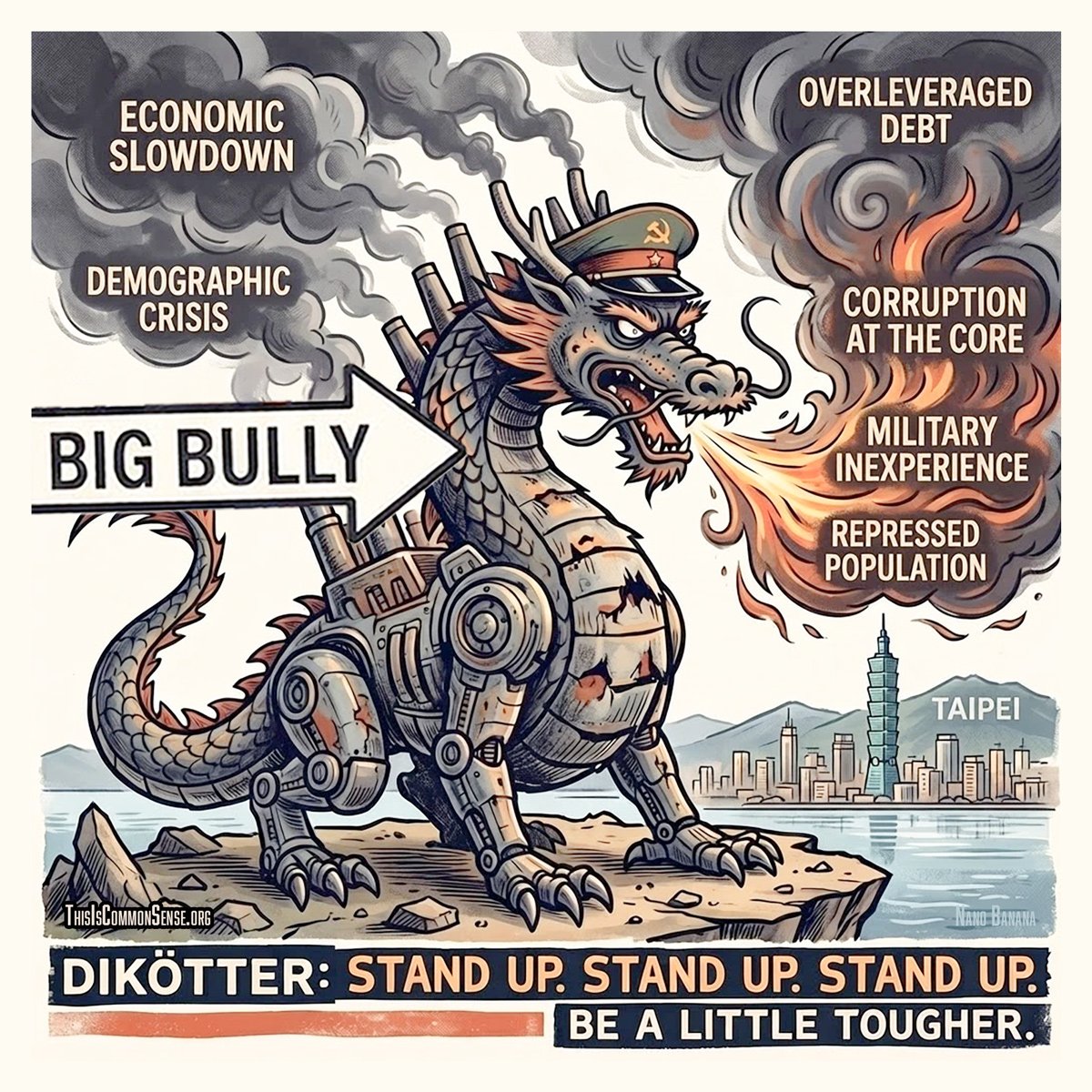
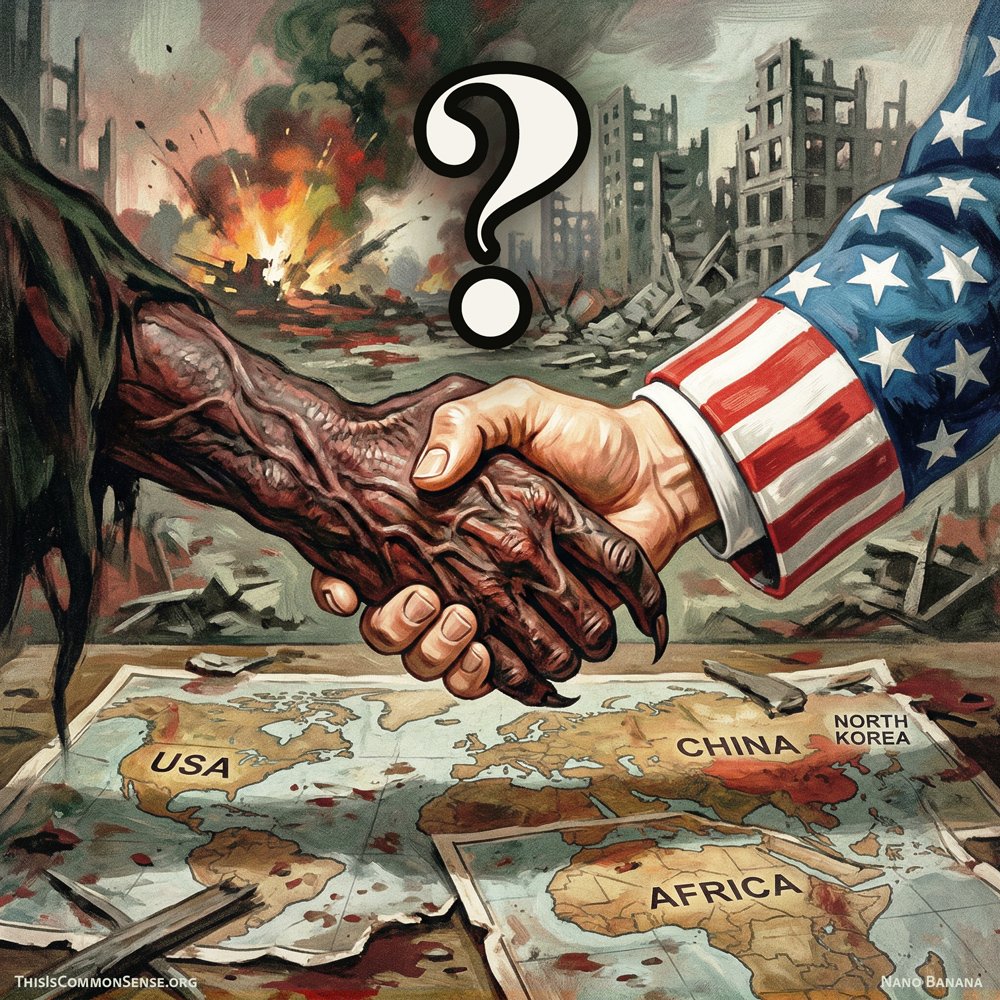
“So, what I would do is basically sit down everyone, okay, including Russia, China, Iran, and say, ‘it’s time for a new world order where we are partners in this relationship,’” explained ‘Professor’ Jiang. “Before America was a hegemon, before the U.S. dollar was a world reserve currency, but now what we want to do is open a dialogue where everyone is respected, where America is no longer the bully but a willing partner in creating a new economic order that benefits everyone and not just a few.”

To which, Mr. Carlson responded: “I think that’s the wisest possible advice and probably the only path that preserves civilization.”

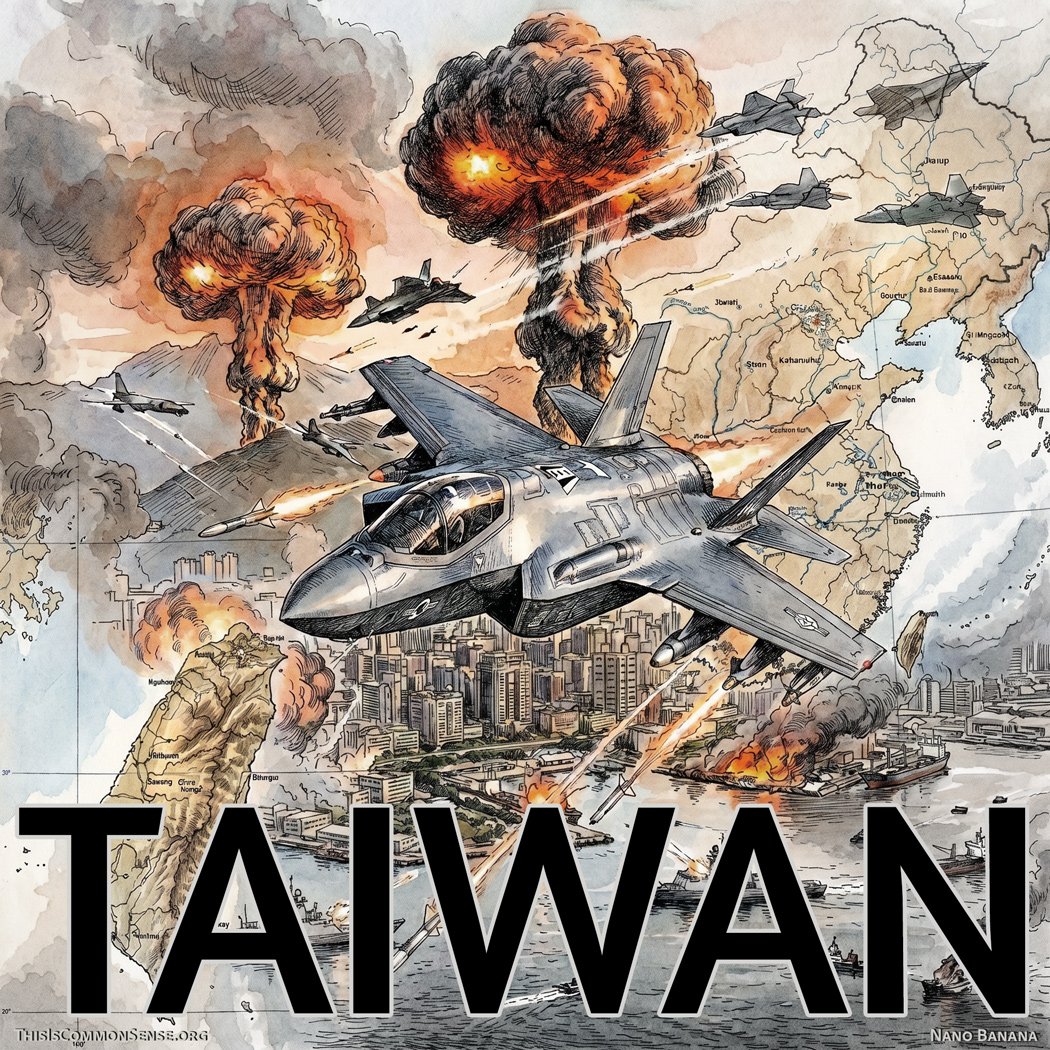
The previous day, he declared, “The U.S. is not going to defend and cannot defend Taiwan.” 

After informing Zanny Minton Beddoes, The Economist’s editor-in-chief, that “we’ve reached the limits of our power and power has limits,” she inquired, “What about Japan and South Korea?” 

“Oh, man, it’s hard,” acknowledged Tucker. “I don’t understand exactly how that’s going to go . . . But, in the end, big powers want to and get to control their regions . . . hopefully in a non-brutal, enlightened way, but they want some influence over their neighbors. 

“We can no longer be the sole author of terms, of commerce, of anything,” he offered. “We have to share power.” 

“With China?” injected Beddoes.

“Of course,” he shot back, “because of their scale. And so, there’s got to be a non-destructive way to do this.”

The Chinese Communist Party’s regime is the most destructive in world history. Let’s not partner.

This is Common Sense. I’m Paul Jacob.


PDF for printing

Illustration created with Nano Banana

See all recent commentary
(simplified and organized)
See recent popular posts
Categories
international affairs national politics & policies

What, We Worry?

For many decades, U.S. presidents have cited national security as a reason for this or that exercise of power . . . and spending. 

Watching CBS’s 60 Minutes two weeks ago, it became painfully obvious that “national security” are simply two words our past leaders spat out when politically convenient and not at all a concept to which they have paid serious attention.

The first story in the popular TV news magazine’s March 22nd episode concerned rare earth metals. 

“Right now, China holds a near-monopoly over these strategic metals that are key components in so much that makes the modern world go: smartphones, robotics, EV’s; also fighter jets, drones and radar technology,” explained correspondent Jon Wertheim. “That is, China controls materials essential to America’s ability to wage war.”

Quite a problem, especially considering that China is our most powerful and aggressive adversary. 

Shipbuilding, or the lack thereof, was the subject of the segment that followed. 

“The war in Iran is highlighting the importance of ships — not just warships but cargo vessels — like those carrying oil or gas trapped near the Strait of Hormuz,” Lesley Stahl reported. “But American shipbuilding is in shambles, due to decades of shortsighted policies and neglect.

“Our submarine building program is sluggish. And our commercial shipbuilding is nearly extinct,” she continued. “China makes roughly 1,000 cargo ships a year. The U.S.? Maybe three. The Trump administration has called this a national security crisis.”

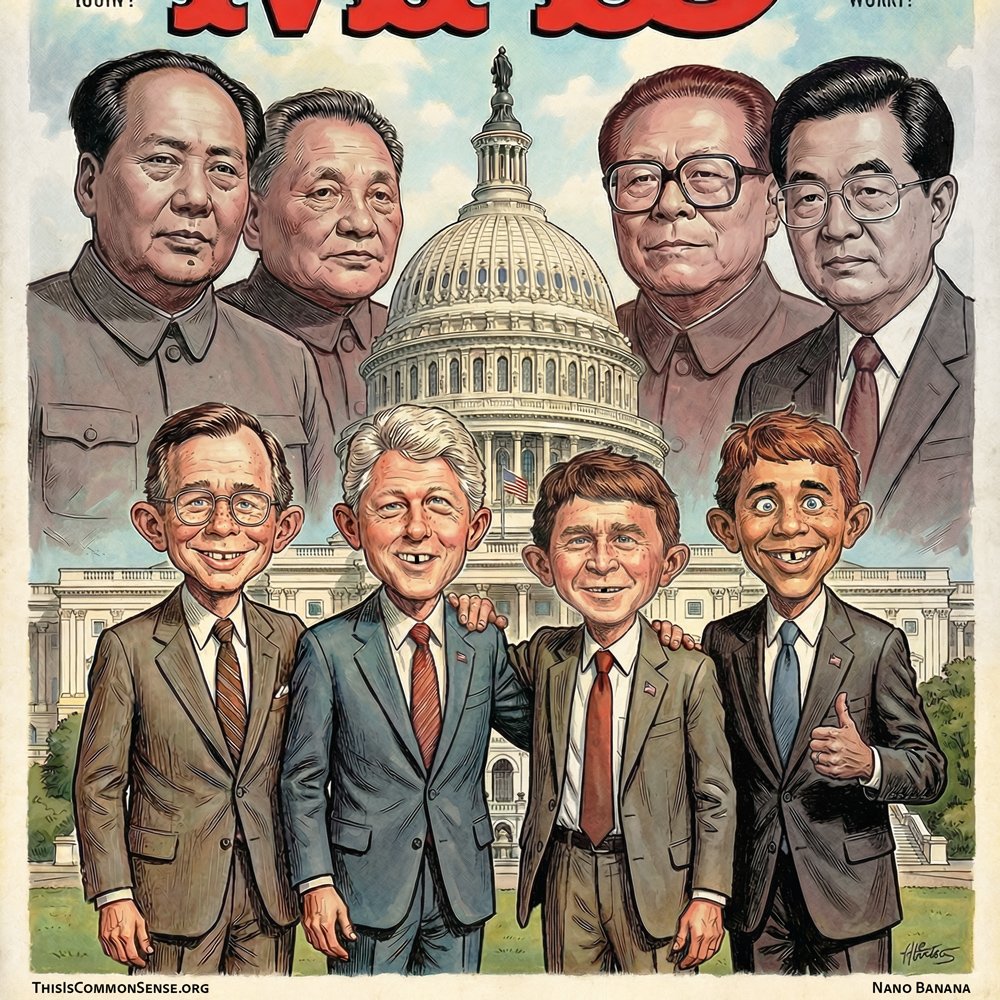
Had presidents George H.W. Bush, Bill Clinton, George W. Bush, and Barack Obama been awake and competent, and not lapdogs for Beijing, I wonder what they would have called it. 

This is Common Sense. I’m Paul Jacob.


PDF for printing

Illustration created with Nano Banana

See all recent commentary
(simplified and organized)
See recent popular posts
Categories
defense & war First Amendment rights

Iran and the Rubicon

Last weekend, Cenk Uygur, of the alternative news commentary show The Young Turks, focused on the Iran war, including one of its stranger developments, rumors that the Trump Administration is planning to arrest a different news commentator, Tucker Carlson. 

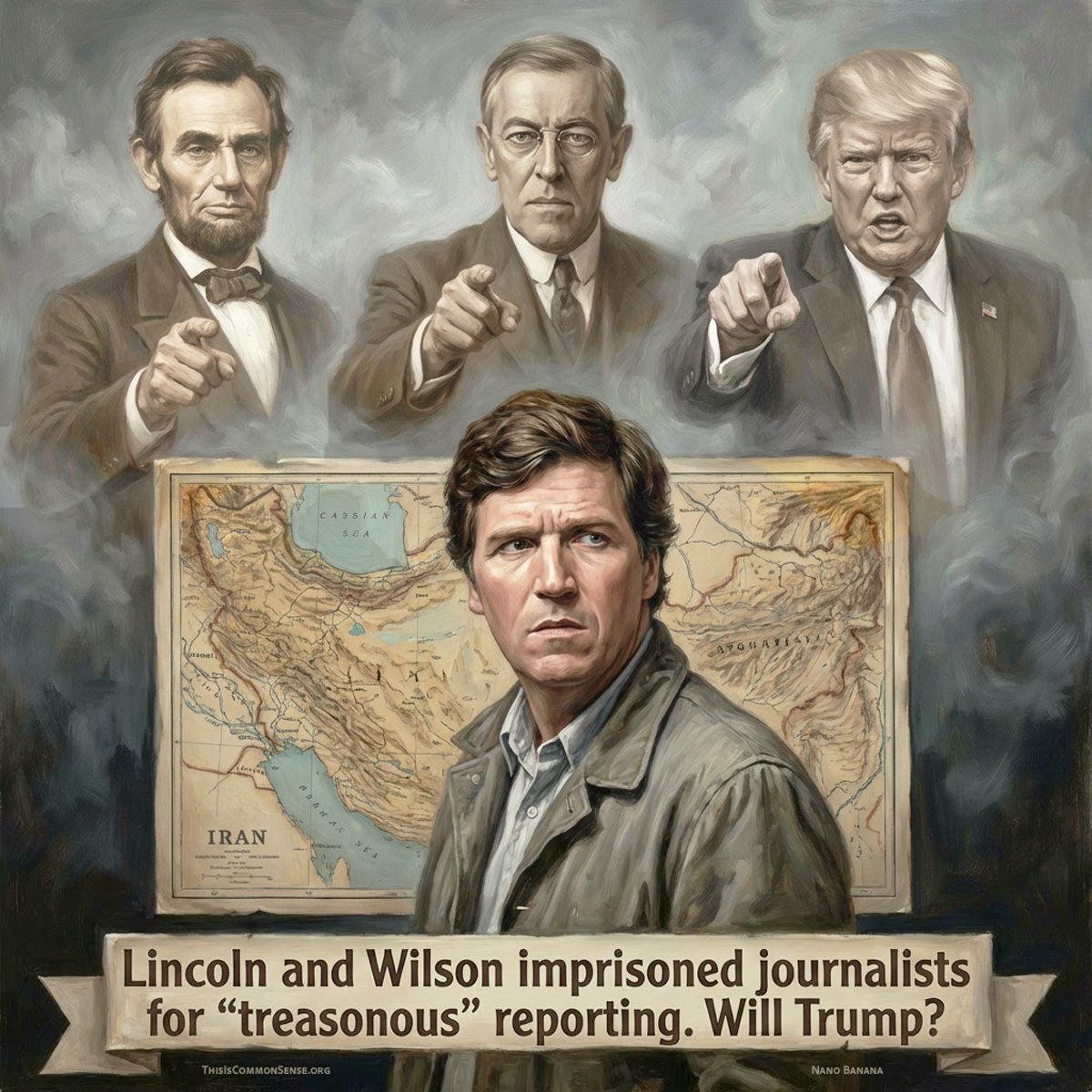
And try Mr. Carlson for treason.

“If @TuckerCarlson is actually arrested, the government will have crossed the Rubicon,” Mr. Uygur posted to X. “Whatever ridiculous charges they bring up, everyone will know real reason was that he opposed the war and Israel. He’ll be considered [the] first American political prisoner within our own country.”

A factual corrective to this was provided Sunday, on this site, at least about the historical background of imprisoning journalists critical of a U.S.-involved war: Woodrow Wilson did that. He “crossed the Rubicon” over a hundred years ago. And he wasn’t the first president to do so.

But is there any real push to try Tucker Carlson for treason?

Robbie Soave, writing on Tuesday, surmised that, considering Carlson’s connections with the administration, the commentator is not likely paranoid or making things up.

And you can certainly find arguments pushing a treason case, and worse — for example, Israeli journalist and historian Yair Kleinbaum wrote in JFeed that “Carlson, Fuentes and Owens Must Be Jailed Inside a WWII-Style Internment Camp.”

At least, apparently, “while America is locked in a struggle against the dark forces of Shia Islam.” (Note that one consequence of the Iraq War was to attack Sunni Islam and install Shia Islam in Mesopotamia.) “Once the war is won and the threat is neutralized, we can release them,” Kleinbaum concludes.

Let’s hope this treason talk is all rumor. Arresting Tucker Carlson won’t improve the popularity of the Iran War.

This is Common Sense. I’m Paul Jacob.


PDF for printing

Illustration created with Nano Banana

See all recent commentary
(simplified and organized)
See recent popular posts
Categories
First Amendment rights general freedom ideological culture international affairs regulation social media

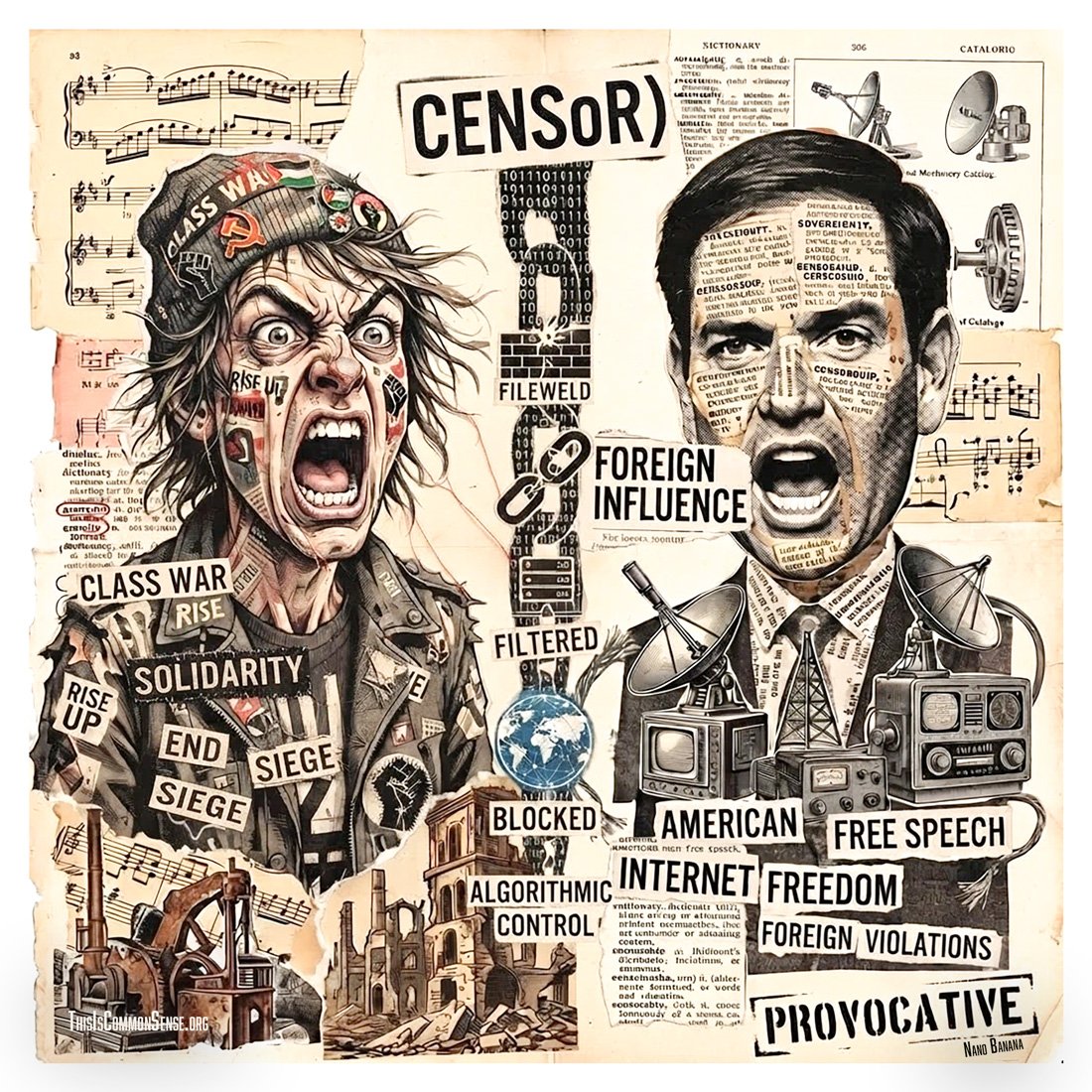
U.S. Bans EU Censors

European leaders are condemning American use of visa bans to penalize European enemies of American freedom of speech.

Which is understandable, since the U.S. State Department more than merely condemned the European Union.

In the words of Marco Rubio, the five just-sanctioned persons “have led organized efforts to coerce American platforms to censor, demonetize, and suppress American viewpoints they oppose.”

Thierry Breton. Former EU commissioner and top proponent of the Digital Services Act, which seeks to force U.S. tech giants to “police illegal content more aggressively” or face big fines. “Illegal” here doesn’t mean speech deployed to commit bank robberies; it’s speech EU censors dislike.

Josephine Ballon and Anna-Lena von Hodenberg. Leaders of HateAid.

Clare Melford. Leader of Global Disinformation Index, which, the State Department observes, exhorts “censorship and blacklisting of American speech and press.”

Imran Ahmed. Leader of Center for Countering Digital Hate, described by Breitbart as the “deplatforming outfit which defined its central mission as ‘Kill Musk’s Twitter.’ ” CCDH also worked hard to get Breitbart and other sites blacklisted from social media.

Maybe none of these villains was planning a trip to the United States anytime soon.

And, doubtless, much more could be done to combat overseas attempts to censor Americans. But at least this much action against enemies of our First Amendment rights is warranted, even if mostly symbolic.

Just give us a little more time, European leaders. We’ll do more to oppose and thwart your obnoxious global censorship agenda. 

This is Common Sense. I’m Paul Jacob.


PDF for printing

Illustration created with Nano Banana

See all recent commentary
(simplified and organized)
See recent popular posts

Categories
defense & war international affairs Internet controversy

Decapitation Diplomacy

The Chinese Communist Party has presided — is presiding — over the largest peacetime military buildup in history. 

And China’s “wolf warrior” diplomats constantly reflect this fact.

Earlier this month, during a parliamentary session, Japan’s new Prime Minister Sanae Takaichi was pressed by an opposition lawmaker on scenarios that could trigger the clause in Japan’s constitution concerning “survival-threatening situations,” thus allowing collective self-defense. Takaichi explicitly stated that Chinese military action against Taiwan — such as a naval blockade, invasion, or interference with U.S. forces — could qualify. 

No “strategic ambiguity” there!

But as scandalous as Takaichi’s answers were to the Communist Party in China, it was the response of Xue Jian, consul general of the People’s Republic of China, in Osaka, Japan, that raised more than eyebrows: “I have no choice but to cut off that filthy head that barged in without hesitation — are you ready?” This was followed by a red emoji, an angry icon.

It has since been deleted.

Last Friday, lawmakers from both Takaichi’s party and Komeito (a centrist, socially conservative party) demanded Xue’s immediate recall; a petition with more than 50,000 signatures circulated online. 

But Takaichi herself is under pressure to apologize.

I agree with the Scribbler’s take over at StopTheCCP.org: “It would be disappointing if instead of ‘muddling through,’ the Japanese government as led by its new prime minister, Sanae Takaichi, submitted to China’s malicious demands and formally retracted her very reasonable statement about Taiwan.”

The only apologies should come from the CCP’s Osaka Decapitator.

This is Common Sense. I’m Paul Jacob.


PDF for printing

Illustration created with Krea and Firefly

See all recent commentary
(simplified and organized)
See recent popular posts
Categories
budgets & spending cuts international affairs political economy

Was Milei Bailed Out?

You saw it on the news, newscasters almost gloating: Argentina’s peso plunged — triggered by  low reserves and political defeats for President Javier Milei.

Then the U.S. Treasury under Secretary Scott Bessent finalized a $20 billion currency swap line with Argentina’s central bank. This was on top of direct U.S. purchases of pesos in the market and plans for another $20 billion from private sources. The deal was seen as a U.S. strategic play to counter instability in Latin America.

Some called it a bailout.

Were Milei’s radical reforms saved at the expense of the U.S. taxpayer?

Bessant was asked this, yesterday, directly on MSNBC, and had a response: “Do you know what a swap line is?”

I had to brush up on it. (I don’t engage in any cross-currency swaps, understandably, not being a major corporation, a central bank, or a sovereign state.) A currency swap is a financial agreement between two parties to exchange principal amounts and interest payments in different currencies over a set period — a temporary loan in one currency backed by collateral in another, designed to provide liquidity, hedge exchange rate risks, or access cheaper funding without the full risks of outright borrowing.

“In most bailouts you don’t make money,” Bessent said. “The U.S. government made money.”

In an exchange, both parties gain. But in any exchange involving extended spans of time, there is risk, so any initial win for Treasury could be wasted by a failure of Milei’s course.

Unlike American politicians opposing inflation, Milei’s been quite honest with Argentinians: “To cure inflation, you have to go through a recession. There is no way around it.” So why Milei didn’t just peg the Argentine peso directly to the U.S.; why a “crawling peg” rather than strict? Milei has been clear: he lacked political clout.

Milei insists that his crawling peg reform isn’t gradualism (which he despises), and that the swap isn’t a bailout; Bessant agrees, saying the swap’s “a profitable move for America.”

This is Common Sense. I’m Paul Jacob.


Note: Milei’s party gained in the most recent election.

PDF for printing

Illustration created with Krea and Firefly

See all recent commentary
(simplified and organized)
See recent popular posts
Categories
defense & war international affairs

Strongly Stated Ambiguity

“Because they know the consequences,” President Donald Trump told Norah O’Donnell on CBS’s 60 Minutes the Sunday before last, after meeting with Chinese leader Xi Jinping in South Korea. 

“The Chinese military is encroaching on Taiwan’s sea lanes, its airspace, its cyberspace. I know you have said that Xi Jinping wouldn’t dare move militarily on Taiwan while you’re in office. But what if he does?”asked O’Donnell. 

“Would you order U.S. forces to defend Taiwan?”

Mr. Trump’s reply was ambiguous: “You’ll find out if it happens.” 

Labeled “strategic ambiguity,” U.S. policy regarding a threatened Chinese invasion of Taiwan has long been undeclared, designed to keep China guessing as to our intentions without giving Taiwan a military guarantee.

But then the president added, “And he [Xi Jinping] understands the answer to that.”

The Chinese regime “knows,” Trump explained to O’Donnell, “they understand what’s gonna happen.” He further declared that Xi “has openly said, and his people have openly said at meetings, ‘We would never do anything while President Trump is president.’” 

Mr. Trump’s most surprising disclosure was that Taiwan “never came up” in his two-hour talk with the Chinese ruler, with the president insisting that Xi “never brought it up” “because he understands” “very well” “what will happen.” 

Indeed, military might is the only thing that Xi and the Chinese Communist Party understand

As I argued on Around the World With Dane Waters last week, a Chinese takeover of Taiwan would be economically and strategically catastrophic for Asia and the world. Not to mention, disastrous for freedom.

This is Common Sense. I’m Paul Jacob. 


PDF for printing

Illustration created with Krea and Firefly

See all recent commentary
(simplified and organized)
See recent popular posts
Categories
deficits and debt international affairs

Billions and Billions

While we were going about our business, and maybe even soaking in some summer sunshine, the “US National Debt,” as the federal government’s explicit financial obligation is called, passed the $37 trillion mark. 

As if to mark the occasion, the Chinese government unloaded a whopping eight billion, two hundred million dollars worth of U.S. Treasuries onto the market.

It’s a lot of money.

It’s a lot of debt.

And now China no longer holds it. 

Thus they are not quite as invested in our future.

Is that scary?

Well, everything about our federal debt load should scare us. If we are placid and unperturbed now, how many extra billions and trillions would it take to shake us?

If you are especially concerned about world stability, it might make sense to comfort you with this . . . interesting . . . piece of information: China still holds over $750 billion in United States debt.

A more important piece of information might be what the Chinese central bank has been replacing the U.S. debt with: gold.

Lots of gold.

About 200,000 kilograms of gold!

Nicholas Nassim Taleb, author of The Black Swan, insists that “a single asset has overtaken the US dollar’s position as the world’s de facto reserve currency.” That asset is gold.

We aren’t on the gold standard, but it looks like we may be falling backwards into something like one.

It makes me wonder if there is still gold in Fort Knox . . . and just how much. 

Mr. Trump

Congress? 

This is Common Sense. I’m Paul Jacob.


PDF for printing

Illustration created with Krea and Firefly

See all recent commentary
(simplified and organized)
See recent popular posts
Categories
defense & war international affairs

Still a Big Advantage

In all the talk of America First — and of the United States as the indispensable nation — we Americans sometimes forget this doesn’t mean “America Alone.” 

“Ultimately, a strong, resolute, and capable network of allies and partners is our key strategic advantage,” U.S. Secretary of Defense Pete Hegseth recently informed the Shangri-La Dialogue in Singapore. “China envies what we have together. And it sees what we can collectively bring to bear on defense.”

Hegseth was speaking directly to Indo-Pacific allies, whom he reminded: “it’s up to all of us to ensure that we live up to that potential by investing” to “quickly upgrade [our] own defenses.”

Our alliances of free nations in Europe and Asia constitute a huge edge against a bullying, totalitarian China.

My entire life, these past six decades, Big Daddy America was by far the biggest, best military on the block. Still is the best. But it’s no longer the biggest: China now has a bigger navy, much greater shipbuilding capacity, and many more soldiers in uniform. Technological and other strategic advantages have been diminished as well.

The defense secretary acknowledged that — after “a lot of ongoing conversations with our military leadership in the Indo-Pacific” — “there is something to be said for the fact that China calculates the possibility and does not appreciate the presence of other countries . . . as part of the dynamics or decision-making process, and, if that is reflected in their calculus, then that’s useful.”

We cannot afford to squander our “ally advantage.” We need each other.

This is Comon Sense. I’m Paul Jacob.


PDF for printing

Illustration created with Krea and Firefly

See all recent commentary
(simplified and organized)
See recent popular posts

Categories
international affairs public opinion

An Independent Nation

Our leaders have been surprisingly expressive in signaling U.S. military support for the defense of Taiwan. 

Ironic, considering that official U.S. policy is dubbed “strategic ambiguity,” meaning we don’t say one way or the other about our defensive intentions for helping the island nation against a regularly threatened and rehearsed-for Chinese invasion or naval blockade. 

Four separate times during his term, however, former President Joe Biden publicly pledged American military help to counter a People’s Republic of China assault on Taiwan. As for the Trump 2.0 Pentagon, weeks ago it leaked (or suffered a leak of) a global defense strategy memo that said preventing a PRC takeover of Taiwan was the “sole pacing scenario” engaging our armed forces. 

Surprising unanimity for the two parties in Washington. But has anyone asked what the American people think?

Well, Humanity for Freedom Foundation conducted a poll, released yesterday.*

Informed that “China claims Taiwan as its own territory,” 82 percent of respondents agreed that “Taiwan is an independent country.” Only 3 percent felt “Taiwan is part of China.”

A 58 percent majority favored full U.S. diplomatic recognition for Taiwan. When it comes to American military defense, a plurality of 39 percent wanted to continue the status quo of not saying (“strategic ambiguity”), while 32 percent of Americans preferred their government make a clear commitment to Taiwan. Only 2 percent supported ending arm sales and adopting a neutral stance.

The above results are thoroughly — and surprisingly — non-partisan, with arch conservatives and far-out progressives finding common ground to defend Asia’s freest society against the world’s most maniacal totalitarian state. 

Could the specter of a future dictated by the Chinese Communist Party be bringing the world closer together?

This is Common Sense. I’m Paul Jacob. 


* In full disclosure, I’m on HFF’s board of directors. As for the national poll, it had 800 respondents, giving the results a 3.5 percent margin of error with a 95 percent confidence level. Full results are here.

PDF for printing

Illustration created with Krea and Firefly

See all recent commentary
(simplified and organized)
See recent popular posts