Categories
litigation Tenth Amendment federalism U.S. Constitution

Planned Parenthood Gets the Boot

Medicaid is a huge handout and also a massive burden, straining resources and tax revenues, and (of course) adding to the debt. It is also known for its complexity, a federal program run by the states. 

Some reformers, seeing the program as an over-complicated mess, yearn to “simplify” it by providing medical care as a “free” federal program. Others, concerned about the dangers of centralization and the obvious incompetence of bureaucracies far removed from taxpayers, advise collapsing Medicaid completely back to the states, to be organized and funded locally.

In this context, the Supreme Court’s ruling yesterday allowing South Carolina to remove Planned Parenthood from its Medicaid program is instructive.

“The majority opinion in the 6 – 3 decision in Medina v. Planned Parenthood South Atlantic was written by Justice Neil Gorsuch,” explains Matthew Vadum in The Epoch Times. “The new ruling reverses a federal appeals court decision that blocked South Carolina from excluding Planned Parenthood from the program.”

The key issue in the litigation regards a supposed right to choose medical providers: South Carolina, by dropping Planned Parenthood, was alleged to be abridging the right of recipients to choose their medical providers.

Remember that choosing your doctor was falsely promised by President Barack Obama in his medical insurance scheme — so, obviously, the option is highly valued by Americans. But is it a “right”?

“New rights for some mean new duties for others,” Justice Gorsuch wrote, elucidating a basic principle of legal philosophy. 

Applying the idea of rights to government handouts (in which taxpayers are on the hook) is a recipe for disaster. 

Applying federalism, on the other hand, makes not only constitutional sense, but — because the states are closer to both taxpayers and those in need — Common Sense.

I’m Paul Jacob.


PDF for printing

Illustration created with Krea and Firefly

See all recent commentary
(simplified and organized)
See recent popular posts

Categories
education and schooling national politics & policies Tenth Amendment federalism

Nixon & Trans Athletes

The President of the United States clashed with the governor of Maine over transgender participation in government-​organized athletics. Quite a hoot.

Behind this fracas looms the legacy of … Richard M. Nixon.

First, the fracas: “In a tense exchange with Maine Democratic Gov. Janet Mills, President Donald Trump threatened to strip Maine of its federal funding,” explains CNN, “if the state refuses to comply with his executive order banning transgender women from competing in women’s sports.”

The brief volley of promises (threats) between the governor and the president made other governors “uncomfortable.” Yes, that’s a news story.

“Is Maine here?” he wondered aloud. “The governor of Maine?”

“Yeah,” Gov. Janet Mills answered from across the room. “I’m here.”

And then came a testy political exchange, the kind you don’t often see, culminating in this from Trump: “You better comply, you better comply, because, otherwise, you’re not getting any federal funding.” 

“See you in court,” she promised.

“Good; I’ll see you in court. I look forward to that. That should be a real easy one. And enjoy your life after governor, because I don’t think you’ll be in elected politics.”

Trump may not be wrong. He may have the better legal case.

But doesn’t it seem weird that the president of the United States can extort compliance from the states on matters that are not enumerated in the Constitution?

Well, back in his first term Trump signed an executive order to direct a new devolution process of turning back education to the states. But the transgender issue is a big deal, and most Americans (around 80 percent) are against “biological” “men” competing with girls and women in sports, and since much of sports in America takes place in state-​directed/​taxpayer-​funded contexts, Trump is leveraging federal bloc grants against states that balk at his agenda.

Thank Nixon and his “New Federalism.” While an attempt to give power back to the states, it also tied federal money to the devolution, which has effectively turned states into welfare queens begging big bucks off Washington, severely compromising the states’ … basic competence.

It’s this policy that Trump should be fighting.

But that would make governors even more uncomfortable.

This is Common Sense. I’m Paul Jacob.


PDF for printing

Illustration created with Krea and Firefly

See all recent commentary
(simplified and organized)
See recent popular posts
Categories
national politics & policies Tenth Amendment federalism

The Great Weed Fake-Out

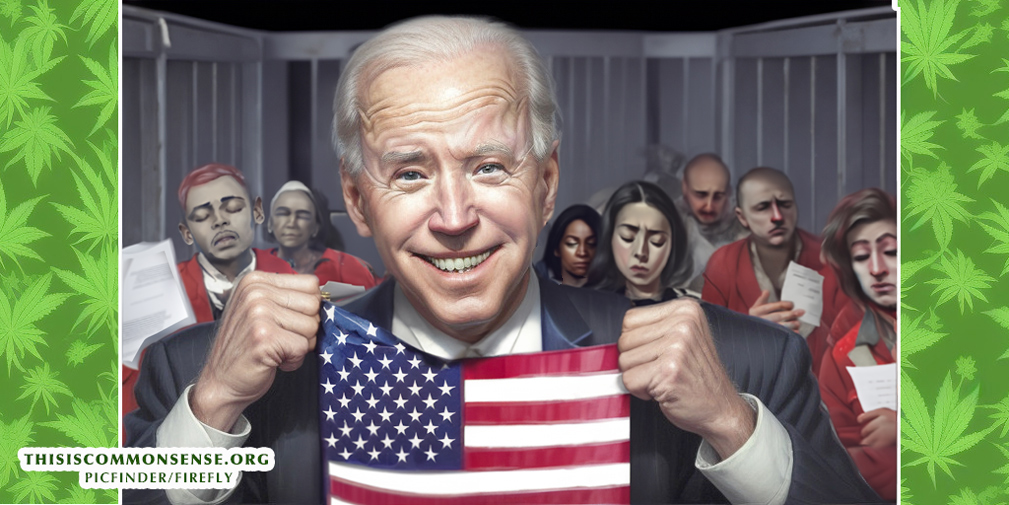
When, in the last State of the Union political rally, Stumbler-​in-​Chief Joe proclaimed that his administration had been “expunging thousands of convictions for the mere possession” of cannabis, did you believe him? Previously, when Second Banana Kamala set the theme, claiming to have “changed federal marijuana policy, because nobody should have to go to jail just for smoking weed,” how confident were you of her boast?

“Neither claim was accurate,” explains Jacob Sullum, in the June issue of Reason. They are exaggerations at best. For their voting bloc.

Remember Biden’s 2020 campaign promise to “decriminalize the use of cannabis” and “expunge all prior cannabis use convictions”?

They were undelivered because these moves would require new legislation.

Biden’s not a dictator. As much as he tries.

He still needs Congress.

When he announced, last October, to much ballyhoo, a mass pardon for simple marijuana possession convictions, directing a review of the drug’s classification under the Controlled Substances Act, neither move “actually ‘changed federal marijuana policy,’” Sullum insists. Not one prisoner was freed, and — more startling yet — no record was expunged … for while the president can pardon, he cannot legally expunge records. 

The question to ask ourselves is this: does Biden or anyone now in power really want to do anything more than yammer about drugs? 

After all, any substantive reform would require, as Sullum points out, addressing the tension in the union: a federal government claiming powers to regulate and prohibit (not found in the Constitution), and 38 states that have effectively nullified federal law.

Confronting that might lead to ceding a whole lot of power back to the states … on more matters than just weed.

This is Common Sense. I’m Paul Jacob. 


PDF for printing

Illustration created with PicFinder and Fireflly

See all recent commentary
(simplified and organized)
See recent popular posts

Categories
general freedom local leaders Tenth Amendment federalism

Utah and the Tenth

The trouble with the Ninth and Tenth Amendments to the Constitution — the last two items in the Bill of Rights — has not been lack of clarity. The Tenth, at least, is extremely clear: “The powers not delegated to the United States by the Constitution, nor prohibited by it to the States, are reserved to the States respectively, or to the people.”

The problem has been one of enforcement. How do the States prevent the federal government from overreach? Especially when the federal government acts as if no objection to a federal law could be brooked? Especially when the Supreme Court is, ahem, wrong, or hasn’t yet been approached with a challenge.

Utah has rediscovered an old technique. And revived it. Governor Spencer Cox signed into law the “Utah Constitutional Sovereignty Act”: “The Legislature may, by concurrent resolution, prohibit a government officer from enforcing or assisting in the enforcement of a federal directive within the state if the Legislature determines the federal directive violates the principles of state sovereignty.”

Ultra clear. And by old precedent — the non-​enforcement of The Fugitive Slave Act by some northern states — it provides teeth to the Tenth. If the federal government were to enact (just stretch your mind a bit!) something obviously unconstitutional, like, say, a gun confiscation, the state legislature would simply vote to prohibit any state employee, or subsidiary of the state (county, municipality) from working with federal agents. Federal government agencies don’t have enough manpower to enforce all the rules. The feds rely on the states.

CNN quotes a Democrat representative running against Governor Cox suggesting that the use of this technique would be overruled by the Supreme Court using “the Supremacy Clause.”

No. The Supremacy Clause only applies to the federal government regarding specified (“enumerated”) powers. 

Regarding matters not explicitly stated in the Constitution, it is the States that are supreme.

Or the People.

This is Common Sense. I’m Paul Jacob.


PDF for printing

Illustration created with PicFinder and Firefly

See all recent commentary
(simplified and organized)
See recent popular posts

Categories
Accountability election law Tenth Amendment federalism

States Still Have a Role

When asked what kind of government had been proposed at the Constitutional Convention in Philadelphia, Benjamin Franklin famously responded: “A republic, if you can keep it.”

But Old Ben did not clarify the nature of the republic. 

It was to be a federal republic. 

In the new Constitution — which was adopted by the states over the next few years — the States were sovereign, the general government given a concise and limited list of tasks to perform.

Since then, nationalism has won most of the big battles, but federalism remains vital as a principle, re-​asserting itself in interesting ways.

Most recent? “Texas Attorney General Ken Paxton receives huge win with court ruling delivered on Tuesday deeming the $1.7 trillion omnibus spending package passed in 2022 unconstitutional,” as Leading Report explained on Tuesday. “This victory marks a pivotal moment in Paxton’s challenge against the legislation, highlighting concerns over the bill’s approval process.”

At issue is Consolidated Appropriations Act of 2023, which President Biden signed in December 2022, with the U.S. District Court for the Northern District of Texas, Lubbock Division, concluding that “by including members [of U.S. Congress] who were indisputably absent in the quorum count, the Act at issue passed in violation of the Constitution’s Quorum Clause.”

As Paxton gleefully summarized, “Former Speaker Nancy Pelosi abused proxy voting under the pretext of COVID-​19 to pass this law, then Biden signed it, knowing they violated the Constitution.”

The story, as Leading Report argues, “showcases the role of state attorneys general in upholding constitutional principles and ensuring adherence to legal frameworks within the realm of federal governance.”

The States have some say. Still.

This is Common Sense. I’m Paul Jacob.


PDF for printing

Illustration created with PicFinder and Firefly

See all recent commentary
(simplified and organized)
See recent popular posts
Categories
Common Sense Fifth Amendment rights First Amendment rights Fourth Amendment rights general freedom Second Amendment rights Tenth Amendment federalism

July 4, 2022 Independence Day

Independence Day

Those core ideas of independence and liberty still matter — perhaps now more than ever.

And to help take Common Sense with Paul Jacob beyond 2022, join …

Thanks for your contribution!


See all recent commentary
(simplified and organized)
See recent popular posts
Categories
Tenth Amendment federalism too much government

Not Nitpicky

Austin, woke capital of Texas, may have some difficulty keeping its mask mandates going in the face of Governor Abbott’s lifting of the statewide mask orders. 

Abbott formulated this new policy last week, to nationwide controversy. Officials in Austin and Travis County responded by announcing their intent to keep the old orders in full effect until April 15. 

At least.

“Texas Attorney General Ken Paxton said on Wednesday that his office will take Austin officials to court,” explains The Epoch Times, “if they continue to refuse to comply with an order lifting mask mandates across the state.” 

Austin officials may think that the pandemic gives them a special license.

It doesn’t.

In these United States, the primary governmental entities are the states.

The federal government is built on top of the union of states, supreme only regarding the limited number of explicitly defined powers given to it in the Constitution. But beneath that, government entities are creatures of the states. Cities, counties, and metro governments are incorporated by their respective states, which retain overriding authority.*

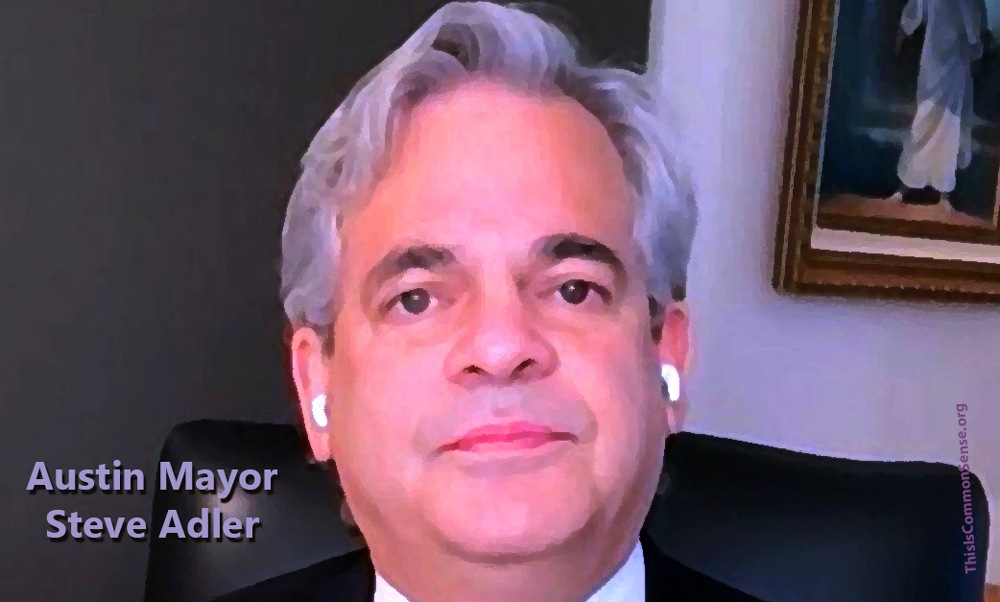
Yet, perhaps as a sign of the general lawlessness of trendy tyranny, a spokesperson for Austin Mayor Steve Adler told Forbes yesterday that the city does not intend to rescind the order and that officials “will continue to do everything within our power, using every tool available to us to reduce the spread of the virus.”

Is it nitpicky to demand that our public servants not do “everything in their power” — but only things within their authority?

No, it is Common Sense. I’m Paul Jacob.


* Under Abbott’s new policy, Texas businesses and individuals remain free to determine mask policies on their property. 

PDF for printing

See all recent commentary
(simplified and organized)
See recent popular posts
Categories
general freedom Tenth Amendment federalism too much government

Feds Not Wanted

For those arguing for drug reform for decades, Oregon’s successful ballot measures 109 and 110 are hugely hopeful signs in sensible drug policy.

They may, however, prove better signs of a general trend beyond just drug policy.*

The best reason to oppose drug prohibitions is not to maximize our freedom but to inculcate a culture of responsibility while getting government out of the business of interfering in our lives.

And while Measure 109 is about psilocybin mushrooms, what it actually does is establish a government board to set up a regulatory system to distribute and license possession of consumable psilocybins.

May work out great. It may also turn out very badly.

As one would expect from this sort of government program.

Measure 110, which also passed on Tuesday, made “personal non-​commercial possession of a controlled substance no more than a Class E violation (max fine of $100 fine) and establishing a drug addiction treatment and recovery program funded in part by the state’s marijuana tax revenue and state prison savings.” 

Both are very “liberal” programs, based on notions of state aid and government program-​building rather than traditional, more “conservative” prohibit-​and-​punish models. Both the old and the new approaches skirt around personal responsibility.

What the measures show, though, is that Oregonians are effectively defying federal laws on “controlled substances.” The new approach is very old: federalist, more about local rather than national control.

As such, it shows the current tide turning away from making a federal case out of everything.

The next President of These United States, and both houses of Congress, should take notice.

On drugs, they are not only not needed. They are not wanted.

Apply that to health care in general, I say.

This is Common Sense. I’m Paul Jacob.


 * These Oregon measures were the only two “hard drug” ballot measures this year. There were quite a few marijuana ballot measures around the country. All passed.

PDF for printing

See all recent commentary
(simplified and organized)
See recent popular posts
Categories
media and media people Tenth Amendment federalism

California Secedes?

“California this week declared its independence from the federal government’s feeble efforts to fight Covid-​19 — and perhaps from a bit more.” So begins a hyper-​partisan, slightly unhinged Bloomberg opinion piece.

“Governor Gavin Newsom said that he would use the bulk purchasing power of California ‘as a nation-​state’ to acquire the hospital supplies that the federal government has failed to provide,” writes one Mr. Francis Wilkinson. “If all goes according to plan, Newsom said, California might even ‘export some of those supplies to states in need.’”

Highlighting two concepts, “nation-​state” and “export,” Wilkinson makes much of California’s governor contracting with manufacturers to deliver face masks to his state, arguing that the Trump administration had failed to deliver.

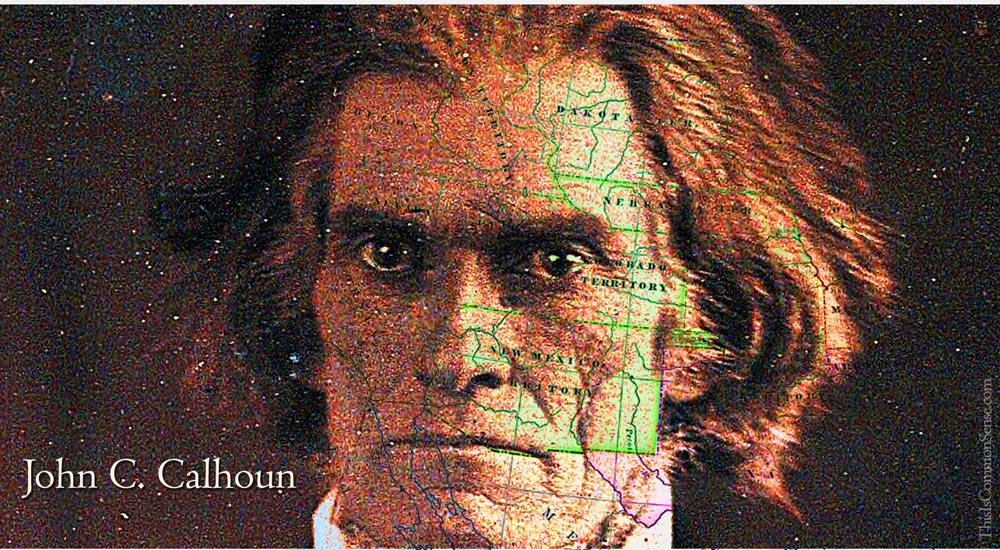
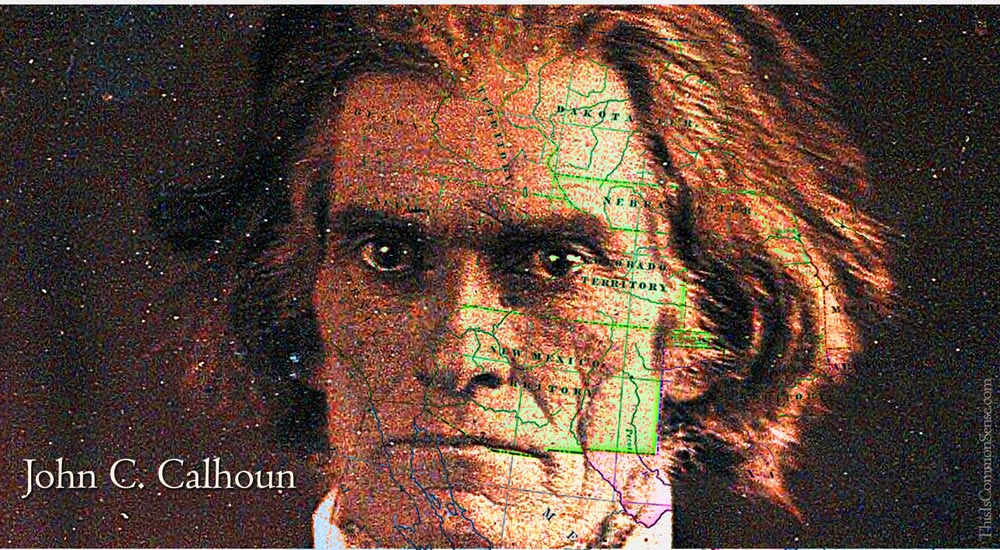
“John C. Calhoun, who used the theory of states’ rights to defend the institution of slavery, is not generally a philosophical lodestar for liberal Democrats such as Newsom,” Wilkinson plunges ahead. He suspects Republicans are hell-​bent on subverting democracy come November, making “Calhoun’s theory of nullification … ripe for a comeback on the left coast.”

Calhoun’s “theory” of nullification, as Wilkinson puts it, was called by James Madison “interposition,” and flows directly from the Virginia and Kentucky Resolutions of 1798. It has been used by states for reasons other than defending slavery most often defending states from unconstitutional taxation.

Indeed, it was used by Northern states to resist federal attempts to reclaim fugitive slaves.*

While it is instructive to watch advocates of huge government flirt with federalist ideas, and the compact theory of the union, one has to wonder how nullification fits with resisting a lack of federal action on face masks. 

This is Common Sense. I’m Paul Jacob. 


* And free people who merely looked like slaves. For the slavery issue, and more on nullification, see Thomas E. Woods, Jr., Nullification: How to Resist Federal Tyranny in the 21st Century (2010).

PDF for printing

John C. Calhoun, nullification, federalism, states rights,

See all recent commentary
(simplified and organized)
See recent popular posts
Categories
Popular Second Amendment rights Tenth Amendment federalism

Assault on Second Amendment Ricochets

Were gun owners expected to roll over and play dead?

After the November 2019 election, Democrats took over the Virginia statehouse. A slew of gun-​control bills were soon in the works, including proposals for expanded background checks, a ban on “assault” weapons, limits on magazine capacity, and seizure of legally owned guns if the owner should be deemed “dangerous.”

Defenders of the right to keep and bear arms expect that the precedents lawmakers are working to establish would soon be expanded. And not without reason. After all, many advocates of gun control regard all private ownership of guns as “dangerous.”

In response, more than 100 Virginia counties have passed resolutions declaring themselves Second Amendment Sanctuaries, with many sheriffs voicing their support. In response to the response, the gun grabbers pledge to call in the National Guard if law enforcers don’t grab guns on command. 

The state’s attorney general has declared the Second Amendment resolutions null and void.

This sanctuary movement began before November’s election. Indeed, it began elsewhere.

Last January, I wrote about sheriffs in 25 out of Washington State’s 39 counties that have pledged not to enforce a citizen-​passed gun control measure while it is being challenged in court. David Campbell, on the board of Effingham County in Illinois, reports that his county was among the first in the country to pass a Second Amendment Sanctuary resolution — in April 2018. Seventy Illinois counties have also passed such resolutions. Kentucky counties are following suit. Locales in Colorado, Oregon, and New Mexico are also on board.

Something has started.

As with state nullification of federal marijuana laws, the story isn’t over: a major  constitutional conflict approaches.

This is Common Sense. I’m Paul Jacob.


PDF for printing

guns, 2nd Amendment, Virginia, Washington, gun rights,

See all recent commentary
(simplified and organized)
See recent popular posts