Categories
initiative, referendum, and recall tax policy too much government

The New Property-Tax Revolts

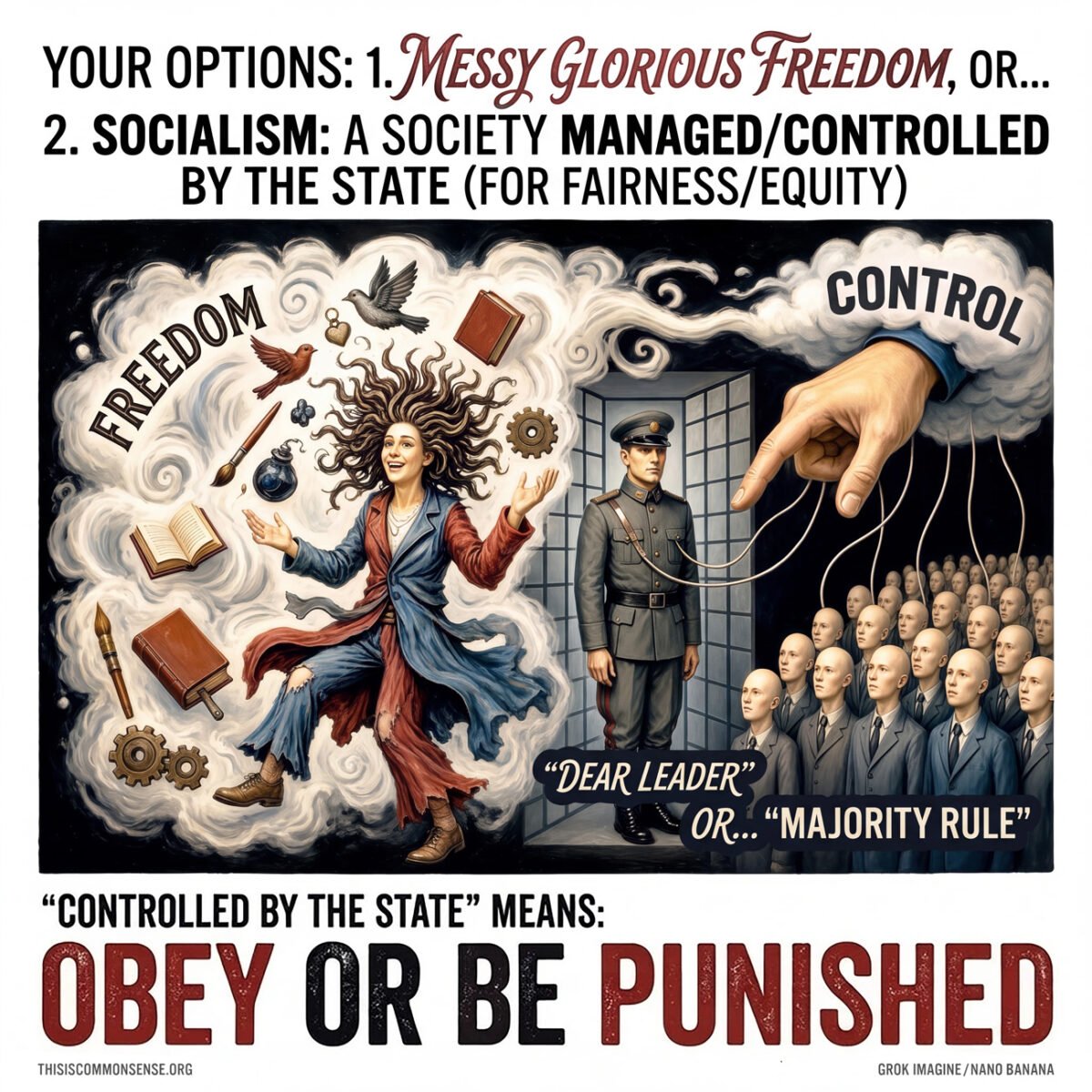
Decades after a famous revolt by California homeowners led to the relief provided by Proposition 13, taxpayers acting to resist sky-high property taxes are making waves throughout the country.

Just a few of the many examples reported by The Epoch Times:

Ohio. The elderly couple who paid off the mortgage on their home long ago but cannot now afford the property taxes is one reason that people are signing a statewide petition to eliminate local property taxes. It will take about 413,000 signatures, collected by a July 1, 2026 deadline, for the measure to reach the November ballot.

Florida and Texas. Legislators in Florida and Texas hope to limit the “flexibility” that local governments enjoy in how they raise revenue.

Minnesota and North Dakota. Lawmakers are pushing a cap on property tax increases tied to inflation and population growth. Voters would have to agree to any change in the cap. Recent school-board driven increases of 8 or 9 percent would be limited to 3 or 4 percent in typical scenarios.

Montana. Lawmakers want a two-percent limit on tax hikes for “local government spending but not for schools, which consume about 55 percent of property tax revenues.” A fatal flaw? Public schools are better at bloating costs than improving education.

The author observes that 46 states and D.C. already impose some sort oflimits on local property tax increases — though “their designs and restrictiveness differ widely,” adds the Tax Foundation.

Let’s improve those designs and increase the restrictiveness ASAP.

This is Common Sense. I’m Paul Jacob.


PDF for printing

Illustration created with Nano Banana

See all recent commentary
(simplified and organized)
See recent popular posts
Categories
ideological culture political economy too much government

Super Under-Blown

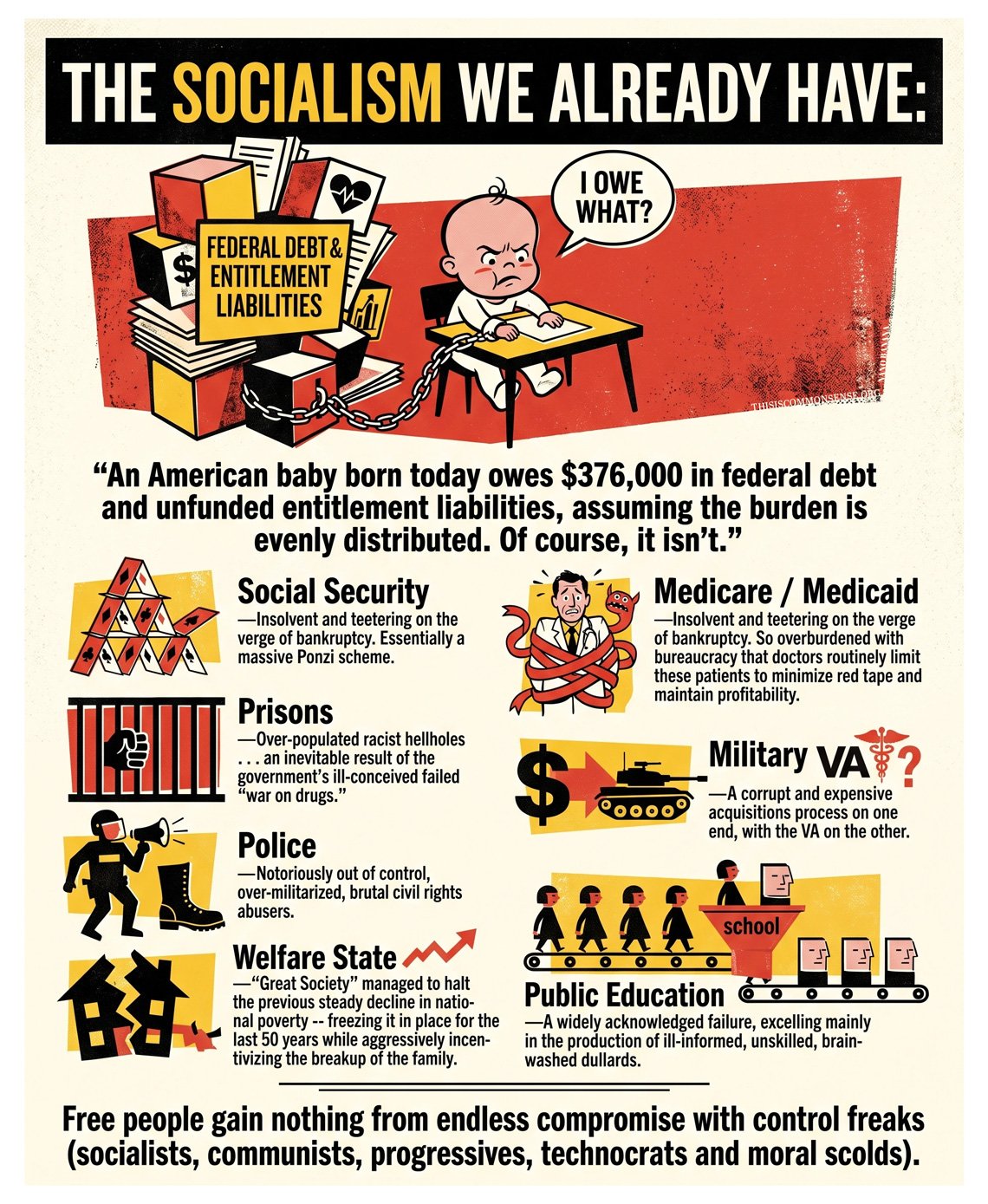
Just 60 years ago, we were talking the end of ideology. Thirty years ago, we were talking about the end of socialism — and of history itself! — as capitalist democracies seemed triumphant after the fall of the USSR.

But here it’s A.D. 2026 and we have socialist mayors in New York and Seattle and . . . we don’t need to argue about definitions. They call themselves socialist.

While New York’s Mamdani has grabbed much of national attention, let’s not forget the Evergreen State’s Emerald City. Seattle Mayor Katie Wilson showed her defiance of economic common-sense in her defenses of many anti-business, anti-rich tax and regulation policies by her city and the state.

“I think the claims that millionaires are going to leave our state are,” she asserted, “like, super overblown.”

Her notion being that, since Washington State has a sales-tax-dominated “regressive tax system,” adding a progressive layer wouldn’t matter. New high-income-focused taxes would only make things better!

Not to those targeted by the tax, though. Not with socialists in charge. After all, she’s showing her true colors, taking photos with antifa terrorists, pooh-poohing welfare fraud (and refusing to investigate), expressing solidarity with Somali immigrants accused of fraud in Washington, and pushing for non-citizen voting.

Mayor Wilson’s response to those who have exited the soviet of Washington has been a chuckle, a wave, and a cheerful “bye.”

But then a major Democratic funder in the state, Nick Hannauer, wrote a think-piece for GeekWire suggesting that both the city, Seattle, and the state, Washington, were going too far. “Making the total tax burden here 5–10 times the alternatives isn’t progressivism; it’s stupidity.” The Daddy Warbucks, who’d promoted capital gains taxes and opposed Tim Eyman’s tax limitation measures, wants to put the brakes on Evergreen State spoliationplundering— noting that “virtually every wealthy friend I have has either left or is planning to.”

Seattlites and Washingtonians sure seem stuck with “the usual Socialist disease — they’ve run out of other people’s money.” For the “other people” are fleeing fast.

This is Common Sense. I’m Paul Jacob.


NOTE (first paragraph references): Daniel Bell, The End of Ideology (1960), Francis Fukuyama, The End of History and the Last Man (1992), and Robert Heilbroner, “The Triumph of Capitalism,”The New Yorker (January 23, 1989). Concluding allusion: Maggie Thatcher on socialism.

PDF for printing

Illustration created with Nano Banana

See all recent commentary
(simplified and organized)
See recent popular posts
Categories
free trade & free markets ideological culture too much government

Unhealthy Kid Stuff

Julian Shapiro-Barnum is the host and creator of Recess Therapy, where he regularly records conversations with kids. Recently, Rep. Alexandria Ocasio-Cortez (D-New York) joined his program to discuss healthcare policy. 

“The children agreed with AOC,” a Washington Post editorial noted, “and brought the same level of sophistication to political and economic questions that Americans have come to expect from the four-term congresswoman.”

AOC and the youngsters shown think healthcare should be free, which The Post used as a jumping off point to have an adult conversation about government-run healthcare, specifically the National Health Service in the United Kingdom.

“Despite the government funding and running a universal health care system, private hospital admissions in the United Kingdom reached their highest level ever in 2024,” readers were informed. 

“The number of people opting to buy private health insurance rose to 6.5 million in 2024, the highest number in a quarter-century, according to the Association of British Insurers.”

The Brits “have learned the hard way that the promise of ‘free’ care is only as good as their ability to get an appointment,” wrote the editors. 

The editorial further explained that “government systems can only stay afloat when they are rationed, often with backlogs that can leave people waiting months for serious procedures.”

“America’s health system is a mess,” The Post concluded, “but the belief that a full government takeover would lead to better outcomes is just childish.”

One of the nation’s largest newspapers appears to be growing up. 

AOC? 

Not so much

This is Common Sense. I’m Paul Jacob. 


PDF for printing

Illustration created with Nano Banana

See all recent commentary
(simplified and organized)
See recent popular posts

Categories
ideological culture subsidy too much government

The Government Store to Nowhere

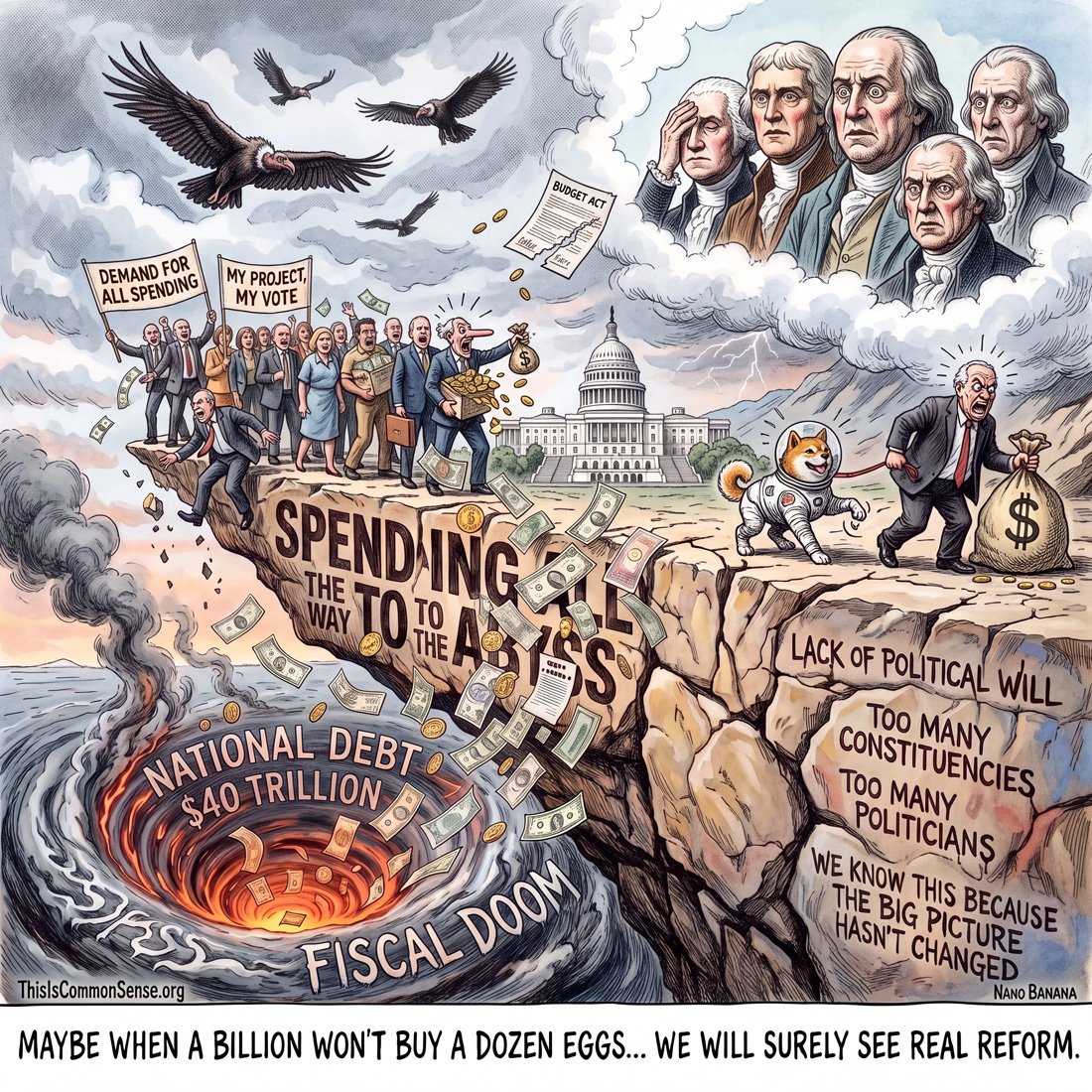
New York City Mayor Commie Mamdani is putting into action, sort of, his plan to introduce government-run grocery stores and bring down grocery prices.

Renting a Brooklyn storefront may cost anywhere between $60,000 to $600,000 a year depending on location and square footage. And there are other costs. Investors profit when they’re right about the opportunity and revenue exceeds costs. This means that they must satisfy customers.

Or . . . taxpayers can fund everything regardless of success or failure.

One goal a city official mentioned about the government-run stores: “We will listen to the community, so the food on the shelves will reflect what people in this neighborhood eat.” Meanwhile, stores catering to ethnic-food preferences of neighborhoods abound in New York City. Mission accomplished.

“Listening to the community” means that neighborhood people have to talk. In markets, they need only buy or not buy. Money talks, businesses already listen.

When nobody buys Product X, vendors stop selling it. When many buy Product Y, more units get stocked. Of course, customers can ask a store to carry some product. And the store can either oblige or explain that unfortunately nobody else wants to buy it.

Mamdani’s government-run stores will follow practices that either emulate the market — unnecessary, as plenty of private grocery stores and supermarkets already exist — or interfere with market processes and make everything more cumbersome and expensive. But the government subsidies will make everything seems cheap to the customer waiting in the long line. 

The real costs will be the ever-suffering taxpayers’ job to pay.

This is Common Sense. I’m Paul Jacob.


PDF for printing

Illustration created with Nano Banana

See all recent commentary
(simplified and organized)
See recent popular posts
Categories
insider corruption too much government

Gov’t Pushing Gov’t

Why, asks the MacIver Institute, “is the government lobbying the government?”

MacIver calls itself Wisconsin’s “free-market voice.” It is a privately funded outfit that makes the case for less government in the Badger State. It has to earn its funds from donors who can, at any moment, stop donating money.

One of the things the MacIver Institute found itself up against are other think-tanks and apparently donor-funded organizations advocating for more government in the state, for more programs, bigger programs, and more taxes to feed all the great new stuff.

And it turns out that several of these advocacy organizations are themselves funded by government! I mean, taxpayers.

I know, it’s not unheard of. It’s too common, existing in probably every state of the union.

And it is thoroughly corrupt.

The MacIver Institute identifies three outfits that receive tax money to promote more tax-funded programs: the Wisconsin Counties Association, the Wisconsin Towns Association and the Wisconsin League of Municipalities. These outfits promote more transportation funding and higher taxes. Comparing these outfits’ core pitch to “a swindler selling gullible buyers submerged swampland,” MacIver makes it quite clear how easily local leaders are bamboozled: “Your supervisors — at least many of them — are clueless that they are being used as patsies in a coordinated scheme by a taxpayer-funded lobbying machine, one that exists not to represent the public, but to represent government itself.”

People who want fewer government services and a smaller tax burden often wonder why government size always ratchets up, never down. Well, this is one reason: the government takes your money to give to groups that will push for more government.

Sadly, this ratchet racket is a part of government that works too well.

This is Common Sense. I’m Paul Jacob.


PDF for printing

Illustration created with Nano Banana

See all recent commentary
(simplified and organized)
See recent popular posts

Categories
too much government

Homelessness Costs

“Spending tripled,” shows the graph, but the “population grew 26 percent.”

Charlie Smirkley (@charliesmirkley) provided the graph, deriving the numbers from official state reports, just out.

New York City, writes Mr. Smirkley, “spends more per homeless person than the median NYC household earns.” And that “$81,705 per person in FY2025,” he explains, “is a floor.” Excluded? Supportive housing (about a half a billion per year), mental health response teams; the costs of police department dealings with homeless encampments. 

Shocking? Yes and no. We expect increasing costs in government “charity,” in part because governments centralize and standardize methods, discouraging innovation and adaptation. It’s not a market. Government bureaucrats and operatives try to coordinate increasing staffs (along with market costs in housing, etc.) while necessarily dealing with clients as objects of pity and bother rather than, as in markets (where people exchange valuable goods), subjects whose responses immediately affect the “business” at hand.

This year, the city projects to spend about $97,000 per person.

Some of the articles on the subject are better than others, naturally enough, and at least one had great graphs, too. But this sentence in Meagan O’Rourke’s Reason contribution caught my eye: “The most alarming part of the comptroller’s report is that the state cannot assess whether tax dollars are being spent effectively.”

It’s a typical problem governments have — which points to a problem not with the homeless but with government.

And of course this is not just a Big Apple thing: while spending per homeless individual since 2019 is up 187 percent in New York, spending’s up 190 percent in San Francisco, 430 percent up in Portland, and 480 percent up in L.A.

Homelessness is expensive.

This is Common Sense. I’m Paul Jacob.


PDF for printing

Illustration created with Nano Banana

See all recent commentary
(simplified and organized)
See recent popular posts
Categories
free trade & free markets regulation too much government

Thought Deserts

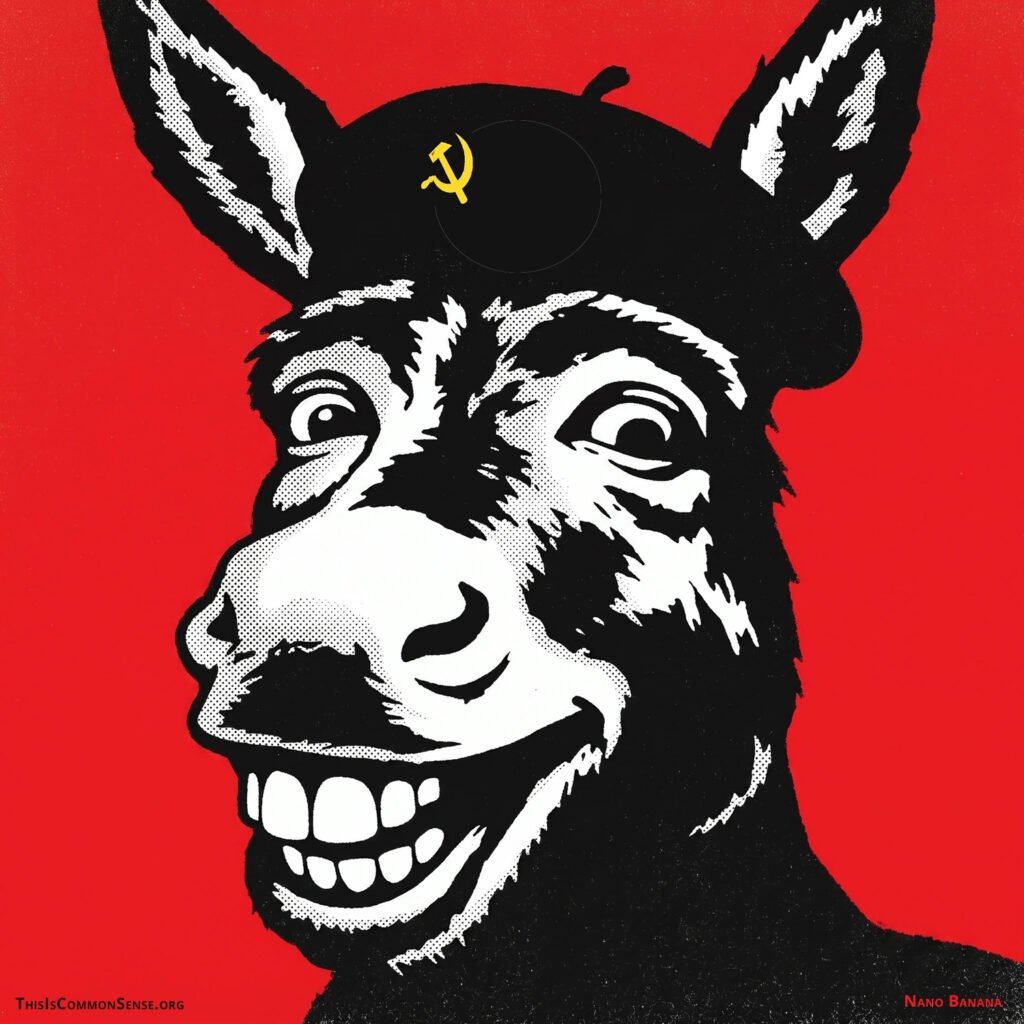
The U.S. is at war — a war that Trump had warned against; and UFOs/drones are again seen over New Jersey. But Senator Ben Ray Luján (D-N.M.) has something else on his mind, something a little closer to home: regulating grocery store pricing and marketing.

He has co-sponsored S. 3892, dubbed the “Stop Price Gouging in Grocery Stores Act of 2026.”

What is price gouging? Selling or offering items at a “grossly excessive price,” which the Federal Trade Commission is tasked with defining. But Luján’s real focus seems to be his distrust of surveillance in stores, which he fears will be used to adjust prices individually.

He somehow doesn’t mention why stores have increased surveillance of customers.

One word: thievery.

But Lujan isn’t alone, fecklessly fighting the food-market market. In Washington State and elsewhere, socialists and other politicians are trying to force grocers to stay open, even if their corporate owners have good reason to shut down a specific store. Seattle’s new mayor, Katie Wilson, says Seattle must not “allow giant grocery chains to stomp all over our communities, close stores at will, and leave behind food deserts.”

A south Tacoma neighborhood Safeway closed, so a state senator cooked up a bill to “give communities time to respond to grocery store closures.”

Truth is, of course, that grocery stores operate on slim margins. The more regulations piled on, and the more criminals you throw at them, the fewer groceries your community will have.

And the “liberals” who vote for such nonsense? They will not like the Mamdani stores they are left with — the subsidized product deserts that only now look good . . . 

In socialist dreams.

This is Common Sense. I’m Paul Jacob.


PDF for printing

Illustration created with Nano Banana

See all recent commentary
(simplified and organized)
See recent popular posts

Categories
privacy regulation too much government

All Your OS Are Belong to Us

The always-wrong California legislature has unanimously passed — and the state’s always-wrong governor has signed — legislation to compel makers of computer operating systems to verify the owner’s age. The information from Linux, MacOS, Windows, iOS and Android would then be transmitted to the software (“apps”) running on each respective platform.

Reclaim the Net observes that in a “different timeline, wiring an age-surveillance layer into the boot sequence of every computing device in California is an idea that would have died in committee.”

AB1043 doesn’t require any upload of government ID or facial scan, just that the user report age when setting up the OS. I am not relieved.

All the shmexperts eager to erode our privacy say that requiring web surfers to type a number into a box to report age is insufficient. If California’s new law is allowed to stand, perhaps in part because it seems fairly innocuous — any plucky 12-year-old could type “89” when ordered to report age — would the politicians stop there?

Some kind of ID verification would be mandated sooner or later. Then use of fake IDs would lead to calls for biometric confirmation. Etc.

Reclaim the Net explains that Linux distributions don’t even have a way to comply with the silly California law. Decentralized Linux exists for people who don’t want to be surveilled when doing their computing, and “there’s no entity to mandate, no account system to modify, no API to build.”

These and many more objections appear to me to be just common sense — now illegal in California.

I’m Paul Jacob.


PDF for printing

Illustration created with Nano Banana

See all recent commentary
(simplified and organized)
See recent popular posts
Categories
defense & war privacy too much government

AI Within Limits

I’ve never consulted “Claude.” It’s an artificial intelligence (AI), and these things give me the creeps. But I must soldier on.

Anthropic, the maker of Claude, is in a special position: it’s currently the only frontier AI model cleared for use on classified U.S. military systems. But Anthropic limits use of Claude by the government: no mass domestic surveillance of U.S. citizens (such as tracking protesters or political opponents) and no development of fully autonomous weapons (where AI makes lethal decisions without human oversight).

Two cheers for Claude?

Regardless of your Huzzah level, being in a special position puts Anthropic in the crosshairs: The Pentagon demands unrestricted “all lawful use” access, rejecting any such safeguards or limits. 

According to Elizabeth Nolan Brown, writing in Reason, the “U.S. Department of Defense is in a standoff with artificial intelligence developer Anthropic over the company’s refusal” to play along with the federal government’s willingness to press beyond the limits of the Constitution. 

“This refusal hasn’t gone over well with the Trump administration,” explains Ms. Brown, going on to write that Secretary of War Pete“Hegseth has reportedly demanded that Anthropic remove its restrictions on certain military uses or else face consequences.”

In recent years we’ve witnessed too many companies complying with out-of-control government. And while it has become common to “lash out at big corporations, we should focus our anger on the actual root of these problems: the government,” the Reason article concludes. 

As it turned out in the social media de-platforming scandal, “the real enemy of civil liberties here is the government actors who are doing the bad deeds, demanding that tech companies go along with them. . . .” 

As our previous president used to say, “Don’t.”

This is Common Sense. I’m Paul Jacob.


PDF for printing

Illustration created with Nano Banana

See all recent commentary
(simplified and organized)
See recent popular posts

Categories
ideological culture too much government

DC Stench No Longer Metaphorical

Matt Walsh says that “one of the worst ecological disasters in American history is currently unfolding. A river of sewage is flowing into the Potomac. When you dig into this story, and who is responsible for it, you start to see why the media doesn’t want to talk about it.”

He’s not wrong, the disaster began January 19th but we’ve heard little about it. On his podcast, No. 1736; Mr. Walsh goes all into a “Diversity, Equity and Inclusion” explanation.

According to The Daily Wire’s most socially conservative host, the responsible agencies are filled with hires based not on qualifications or competence or conscientiousness, but based on their color. 

He highlights, specifically, two individuals in the current muck: one, DC Water CEO David L. Gadis, partly responsible for the Flint, Michigan, water crisis, and the other, the current head of DC Water Board of Directors, Dr. Unique N. Morris-Hughes, a doctor in philosophy. Walsh regales us with her inanities and her over-spending on departmental entertainment junkets. 

While there may be a detectable odor to Walsh’s relentless critique of hiring blacks, specifically, under DEI, the odor from the Potomac, right now, is much less metaphorical.

In between retches, ask the question: Why would there be a general incompetence rising in public utilities now? 

Is it race as such? Of course not. 

Is it DEI putting race over competence? Maybe in part. 

But the general trend for a long time has been to put more and more domains of everyday life under direct government control. There’s a principle lost on the Mamdanis of this world: the more tasks set for government to govern, the less capable it becomes to manage even its core tasks. And, as that capacity declines, so goes even the will to bother trying.

Besides, if there is any apter metaphor for Washington, DC, than hundreds of millions of gallons of untreated sewage sloshing into the Potomac . . . I can’t think of it.

This is Common Sense. I’m Paul Jacob.


PDF for printing

Illustration created with Nano Banana

See all recent commentary
(simplified and organized)
See recent popular posts