Categories
Accountability subsidy

SNAP Accountability

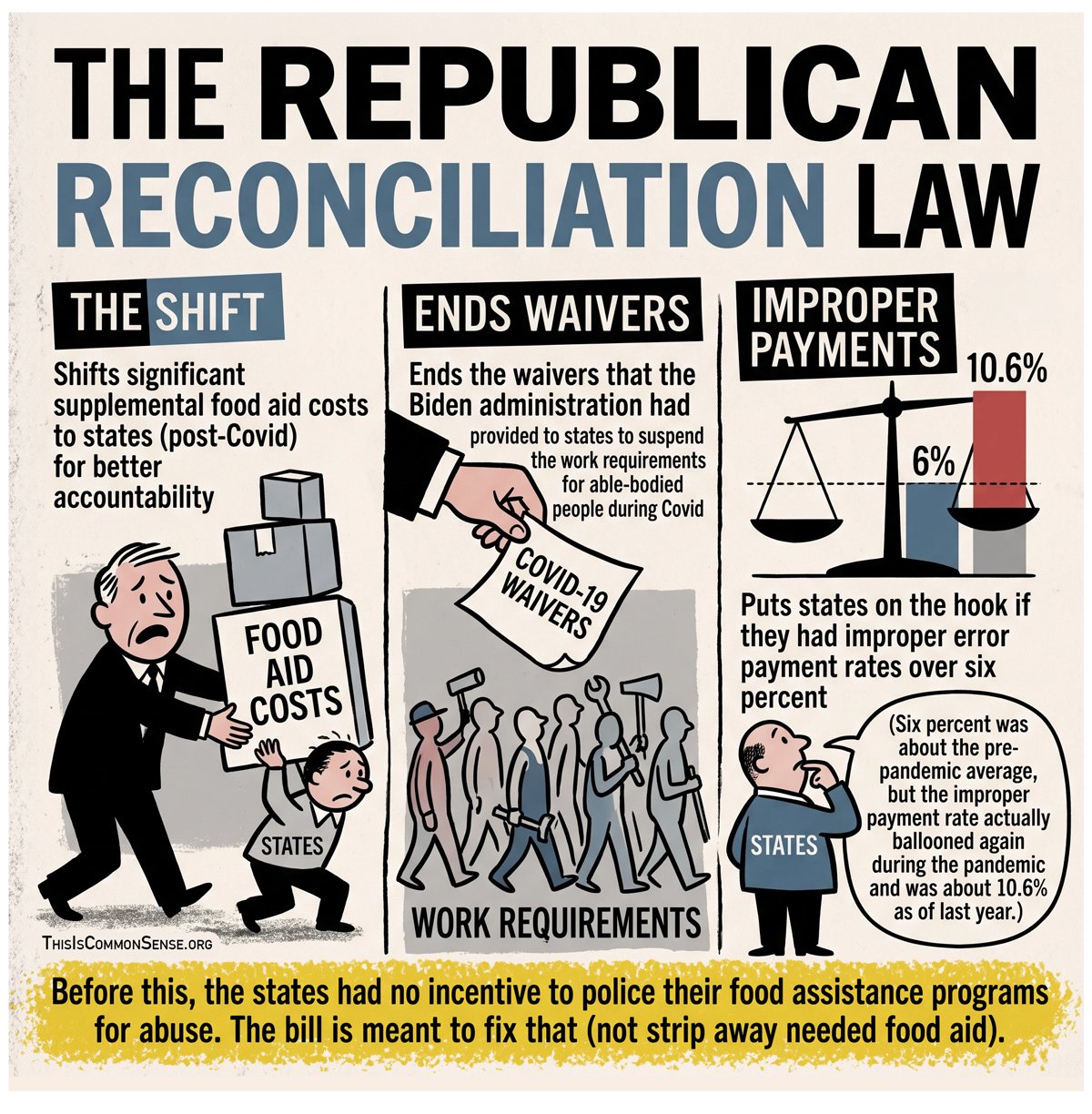
“The harmful Republican reconciliation law enacted July 4, 2025, poses great harm to families, including higher food costs, poverty, and hunger. It makes deep cuts to federal funding for food assistance through the Supplemental Nutrition Assistance Program (SNAP), shifting significant new costs to states,” the progressive Center on Budget and Policy Priorities warned, two weeks ago. “It dramatically expands SNAP’s already harsh and ineffective provision taking away people’s benefits for not meeting a work requirement.”

The Wall Street Journal’s Potomac Watch podcast highlighted this shift from a different perspective.

“[O]ne reason why food stamps ballooned during the pandemic and then still didn’t decline even as unemployment declined is because states didn’t have an incentive to actually police their roles and pare back people who were ineligible . . . because of their incomes or for other reasons,” explained Allysia Finley, a member of the Journal’s Editorial Board.

“The second component” of the law, Finley continued, “was that it ended or banned these waivers that the Biden administration had provided to states to suspend the work requirements for these able-bodied people.

“Now, the third thing that the bill did was put states on the hook for a share of the benefits if they had improper error payment rates over six percent,” Finley elaborated. “Six percent was about the pre-pandemic average, but the improper payment rate actually ballooned again during the pandemic and was about 10.6% as of last year.”

“But that’s the whole point,” offered columnist Kimberley Strassel “because the feds traditionally pay a hundred percent of the benefit costs of SNAP, it’s free money. . . .”

The point being, what incentive could states have to police the program’s abuse? None. Until “this bill came along. . . .”

Disincentives matter. 

A whisper of accountability.

This is Common Sense. I’m Paul Jacob.


PDF for printing

Illustration created with Nano Banana

See all recent commentary
(simplified and organized)
See recent popular posts
Categories
national politics & policies subsidy tax policy

The New Hollywood?

It may be the president’s goofiest idea yet.

His Monday brainstorm was for the federal government to get into the movie business. In a Truth Social post, Mr. Trump floated the notion of creating a “Federal Production Incentive to create Entertainment Jobs in America.” So this isn’t exactly a socialist proposal — where the government would seize the means of production and go about making movies — it’s a subsidy proposal: tax breaks; to “benefit ALL of America.”

Trump posts as if he has worked the math out, where the booty the government loses in direct taxation “will be made up tenfold by the money pouring into the Treasury’s coffers.”

A familiar rationale. But does it work? Do tax credits incentivize producers so much that taxes downstream of the productions make up for all the bother and paperwork?

Well, no need for theory. States already have such programs.

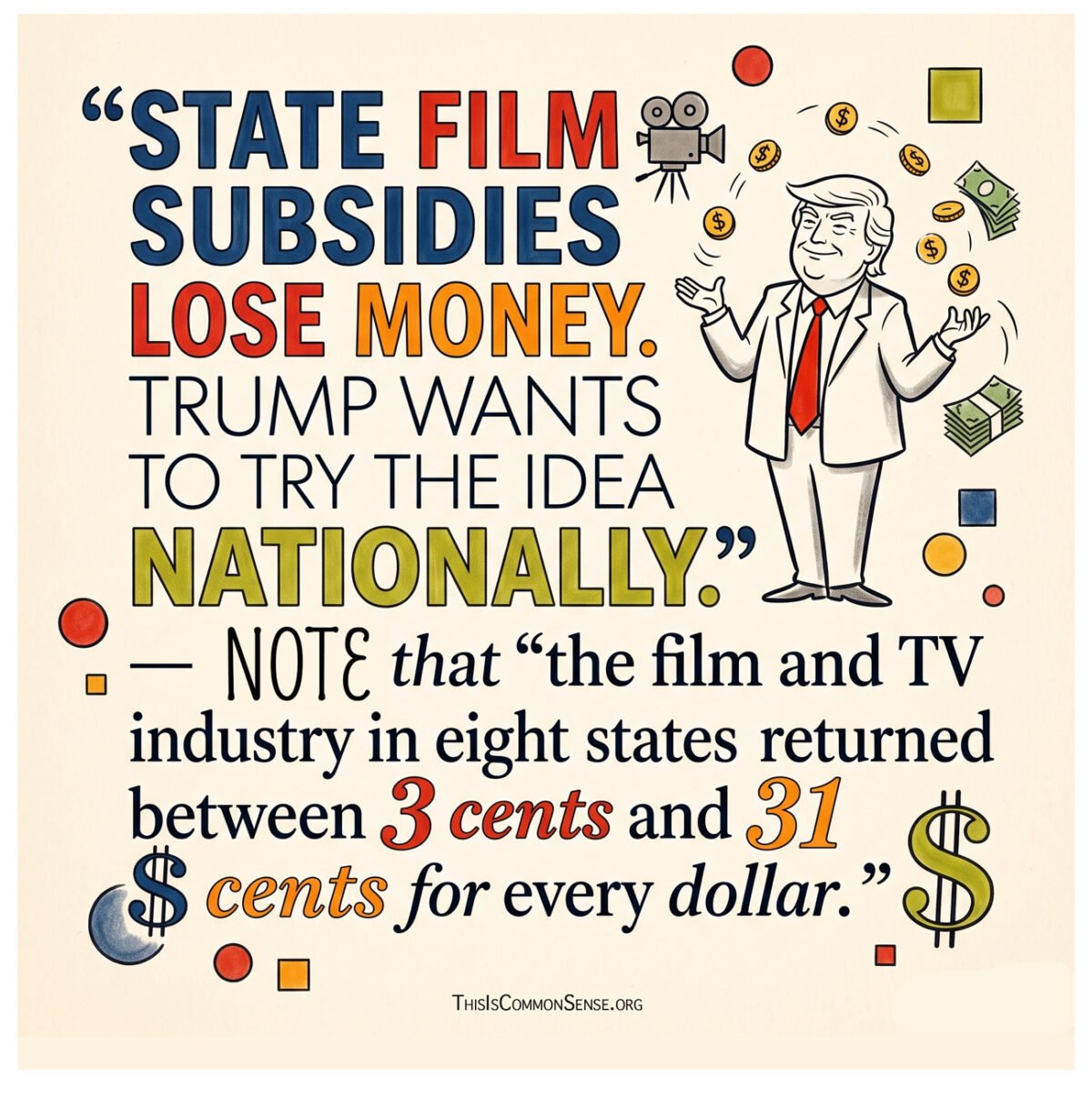
Tosin Akintola, in his Reason article — “State Film Subsidies Lose Money. Trump Wants To Try the Idea Nationally.” — found that “the film and TV industry in eight states returned between 3 cents and 31 cents for every dollar.” 

Entertainment projects do not create that many jobs.

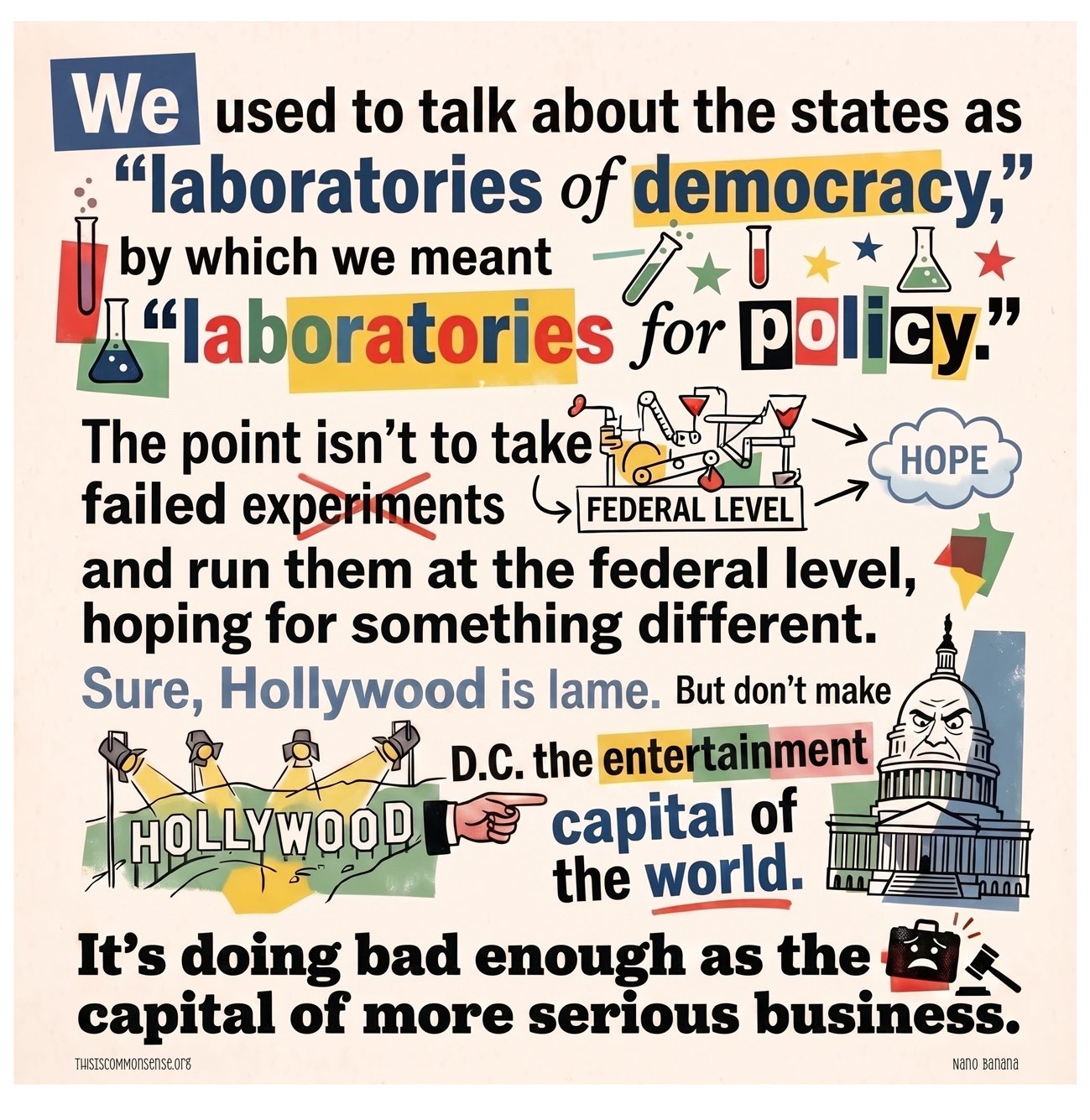
We used to talk about the states as “laboratories of democracy,” by which we meant “laboratories for policy.”

The point isn’t to take the failed experiments and run them at the federal level, hoping for something different.

Sure, Hollywood is lame. But don’t make Washington the new entertainment capital of the world. It’s doing bad enough as the capital of more serious business.

This is Common Sense. I’m Paul Jacob.

Hollywood, entertainment, Washington DC, democracy, subsidy, tax break

PDF for printing

Illustration created with Nano Banana

See all recent commentary
(simplified and organized)
See recent popular posts
Categories
crime and punishment fraud national politics & policies subsidy

$100 Billion Stolen

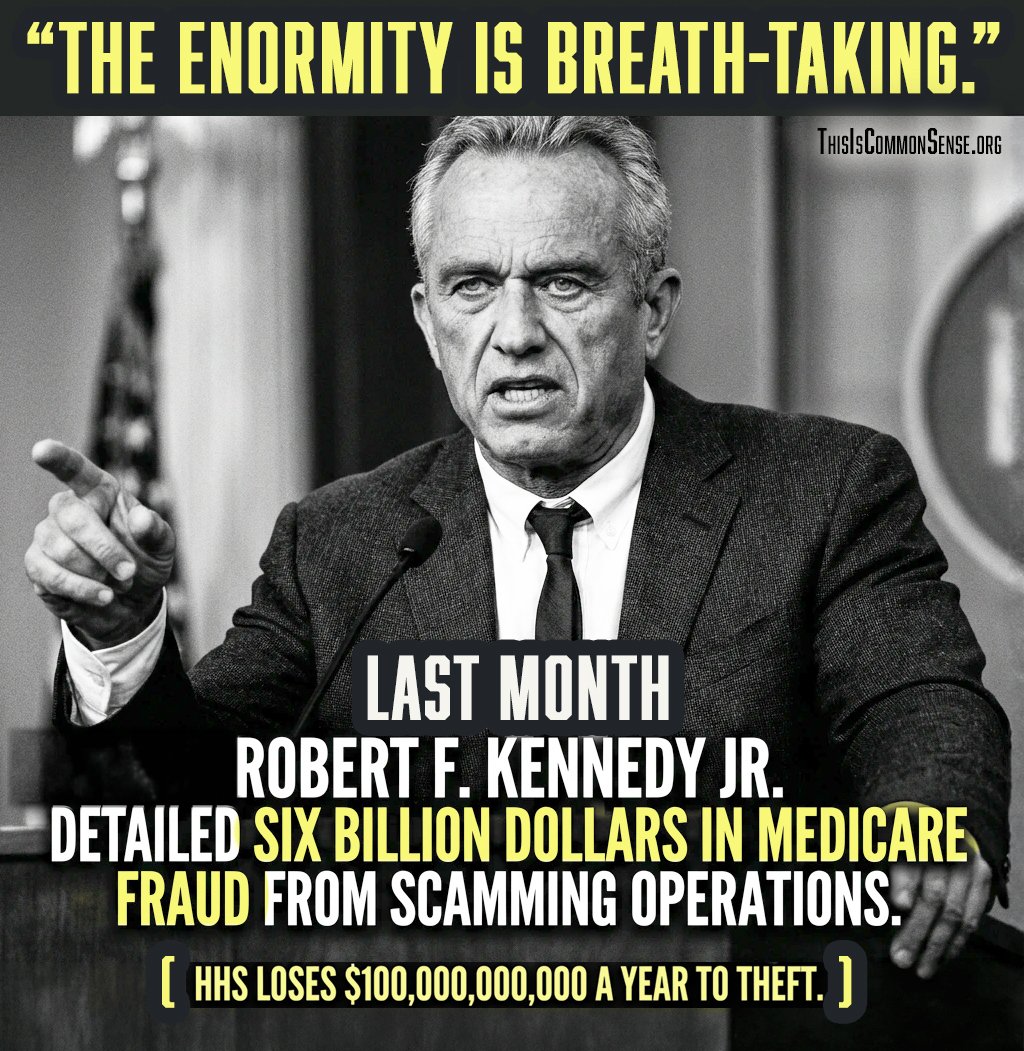
Last month, Secretary of the Department of Health and Human Services Robert F. Kennedy Jr. detailed six billion dollars worth of Medicare fraud, where scamming operations were caught “chasing money from our agencies.” 

Some while willfully neglecting patients.

On Friday, he estimated that the HHS “loses $100,000,000,000 a year to theft.” This was from an interview on the Fly Zone Podcast, widely shared by conservatives on X.

“We shut down 800 hospices,” Kennedy explained. “You know what a hospice is? Where you’re going to die. Typically, if you go to a hospice, you leave within 18 days because your dying is terminal.” This is the context. Yet, when HHS investigated taxpayer-funded hospices in Los Angeles, “the people never died. Two or three years later they were there, and we’re paying $6,000 a month.”

The enormity is breath-taking: “We found a hotel room with 29 hospices in it. I mean a hotel, every room was a hospice, and none of them had any patients.” Some of the scams were more ambitious, involving bribery of patients and worse.

“Estonians and Armenians and people from Eastern Europe . . . were getting the patient numbers . . . stealing them from doctors’ offices.” And there were more scams, too, from members of other ethnic groups — remember Minnesota’s Somali fraudsters

Tellingly, after closing down the operations, the HHS did not receive “a single call from a congressman or from a business owner saying, ‘Oh, you shut down my hospice and all these patients are on the street.’ None of them, because they were all crooked and they knew they were crooked.”

Folks on the left seem oddly silent. Have you heard any denunciations of, say, greed? Or is that vice only attributable to corporations and “the millionaires and billionaires”?

This should be a non-partisan issue.

This is Common Sense. I’m Paul Jacob.


PDF for printing

Illustration created with Nano Banana

See all recent commentary
(simplified and organized)
See recent popular posts
Categories
free trade & free markets subsidy

Feed America, Cut Government

“More people in the United States are going hungry now than during the depths of the COVID-19 pandemic six years ago,” a National Public Radio report tells us, citing a new survey by the Federal Reserve Bank of New York. 

The New York Fed “periodically asks Americans whether they’re having to skip meals, having to rely on food donations or receiving federal assistance to buy groceries.” Ten percent of families nationwide reported missing meals because their cupboards were bare.

This isn’t the result of a breakdown in production and distribution of food, for “food insecurity” rates are two times higher in “families earning less than $50,000 a year.”

NPR notes that inflation — especially the rapid increase in prices at the gas pump — has made everything harder for everybody.

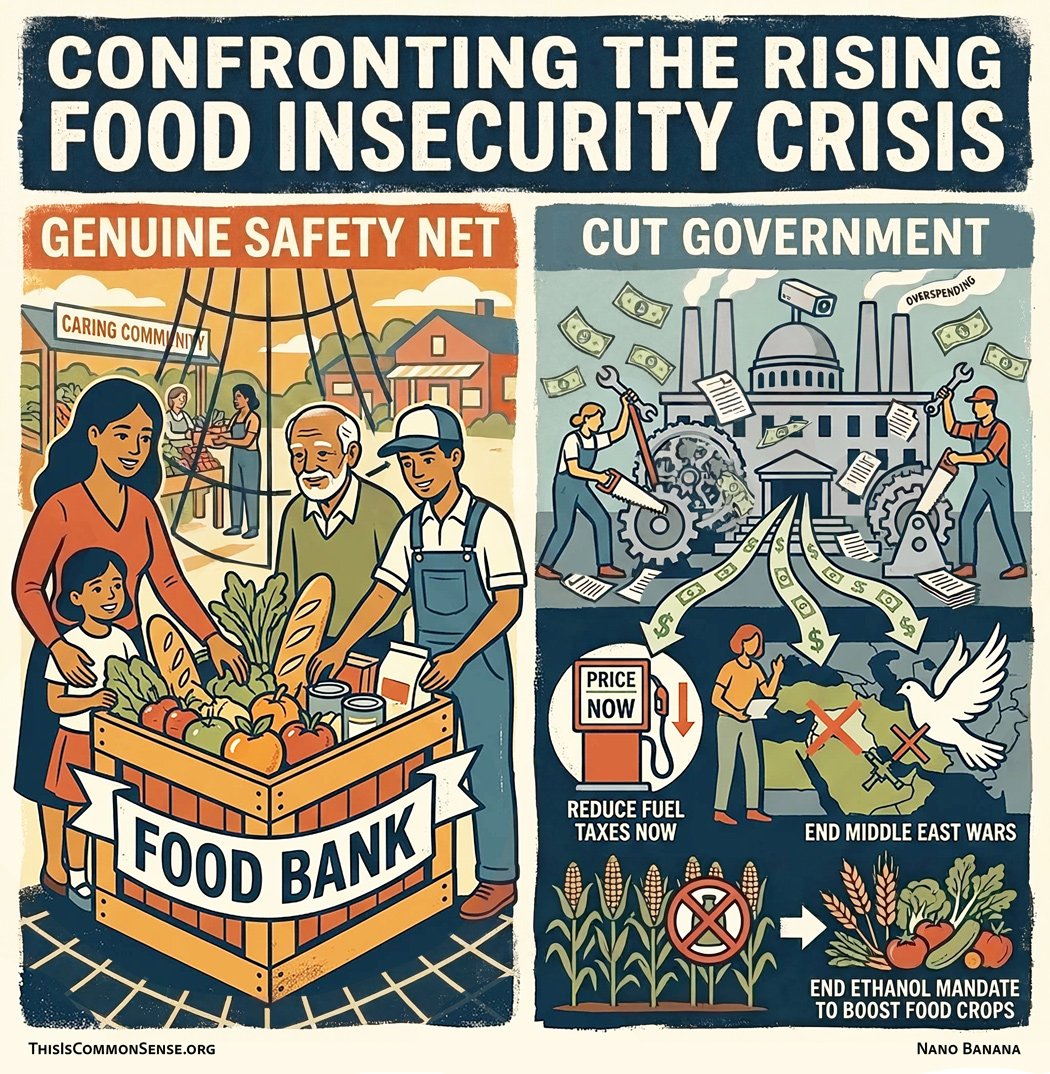
Gas prices are even higher than during COVID. Reduce fuel taxes now. To really lower prices, end the wars in the Middle East. And ending the ethanol mandate would nudge farmers back to actually feeding people, at the very least reducing corn prices.

Finally, SNAP program subsidies are being reduced over the next decade, a result of the Big Beautiful Bill. To help these “food stamps” actually feed folks during this period, SNAP should be further reduced.

That is, in scope . . . across all states. 

This is about trade-offs: Restricting these subsidies from paying for sugary soft drinks, candy, and the like, are underway, state by state, but by the end of the year, fewer than half of these United States will have done so. Taxpayers in all states should demand subsidies that actually help folks, rather than sending them on a slow train to the hospital. 

This is Common Sense. I’m Paul Jacob. 


PDF for printing

Illustration created with Nano Banana

See all recent commentary
(simplified and organized)
See recent popular posts
Categories
ideological culture subsidy too much government

The Government Store to Nowhere

New York City Mayor Commie Mamdani is putting into action, sort of, his plan to introduce government-run grocery stores and bring down grocery prices.

Renting a Brooklyn storefront may cost anywhere between $60,000 to $600,000 a year depending on location and square footage. And there are other costs. Investors profit when they’re right about the opportunity and revenue exceeds costs. This means that they must satisfy customers.

Or . . . taxpayers can fund everything regardless of success or failure.

One goal a city official mentioned about the government-run stores: “We will listen to the community, so the food on the shelves will reflect what people in this neighborhood eat.” Meanwhile, stores catering to ethnic-food preferences of neighborhoods abound in New York City. Mission accomplished.

“Listening to the community” means that neighborhood people have to talk. In markets, they need only buy or not buy. Money talks, businesses already listen.

When nobody buys Product X, vendors stop selling it. When many buy Product Y, more units get stocked. Of course, customers can ask a store to carry some product. And the store can either oblige or explain that unfortunately nobody else wants to buy it.

Mamdani’s government-run stores will follow practices that either emulate the market — unnecessary, as plenty of private grocery stores and supermarkets already exist — or interfere with market processes and make everything more cumbersome and expensive. But the government subsidies will make everything seems cheap to the customer waiting in the long line. 

The real costs will be the ever-suffering taxpayers’ job to pay.

This is Common Sense. I’m Paul Jacob.


PDF for printing

Illustration created with Nano Banana

See all recent commentary
(simplified and organized)
See recent popular posts
Categories
education and schooling general freedom ideological culture international affairs subsidy

The Price of a Canadian Education?

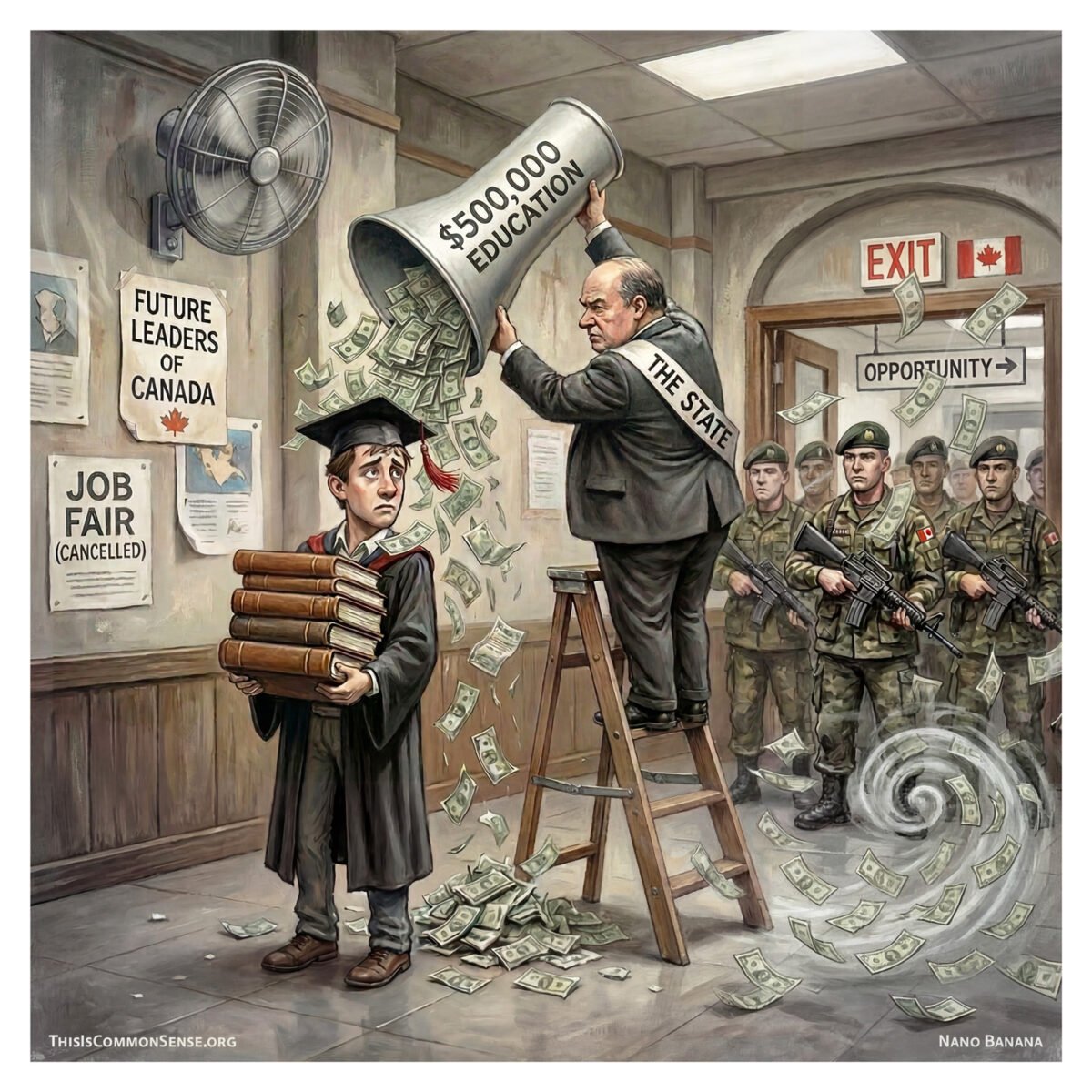
At a convention of Canadian Liberals, tech executive Patrick Pichette proposed that youngsters eager to escape Canada be charged a half-million dollars for what he apparently regards as a privilege, not a right.

We must remind ourselves that the word “liberal,” here, is used in its modern, anti-liberal sense: of the ideology of ever-increasing restraints on everybody.

Very illiberal.

Even if Pichette means Canadian dollars, that’s still $360,000 in real USD dollars. Hardly a ten-dollar processing fee. More like extortion. He rationalizes that the kids owe that much anyway thanks to Canada’s heavily subsidized education system.

Terry Newman observes that Pichette “is a Canadian who left Canada for better opportunities himself.” He went to California and Google and now lives in London.

But Pichette and his de facto self-exemption are not the problem. The problem is all Liberals who “want to govern as many aspects [of the economy] as possible, pick winners, and unload the tax burden of the massive bureaucracy onto Canadians, the smartest of which understand this clearly and choose to leave.”

While Pichette’s proposal had his audience of Canadian Liberals cheering, sane individuals rightfully express varying degrees of alarm. After all, punishing people for leaving a country is eerily reminiscent of what totalitarian states do: prevent them from leaving altogether.

Pichette’s rationale itself is based on a misunderstanding. Are the half-million per student subsidies really there to educate? More like to placate well-organized lobbies of too-often ideologically driven careerists. 

The idea that Canadian students actually receive half-a-million-dollar educations is not believable.

This is Common Sense. I’m Paul Jacob.


PDF for printing

Illustration created with Nano Banana

See all recent commentary
(simplified and organized)
See recent popular posts
Categories
ideological culture subsidy

Ÿnsect Repellent

You vill eat ze bugs!

Sorry, Klaus. Not interested.

When the World Economic Forum (WEF) began trending a few years back, the world’s normal folk became somewhat alarmed at what we were hearing. (Notice how I include myself among “the normal”?) Witnessing a German player at the game of non-governmental organizations pitch “the Great Reset,” as WEF’s founder Klaus Schwab dubbed it, and boast about how he had snuck his acolytes into major governments across the world (especially in Justin Trudeau’s administration) was alarming enough. Seeing him dress up in Bond-villain garb and talk like a Hollywood caricature of a Nazi leader? Chilling. 

But perhaps worst of all: ze bugs.

Yes, he was trying to get us to eat insects. Great source of protein, he said; the food of the future, he said.

Looking the part, he inspired . . . revulsion, just as did the bugs he wanted us to consume. We were all ready to drop him into a remake of Soylent Green when his star faded; it had become clear that Americans, at least, were not copacetic with the creepy-crawly eatery plan.

And, as if to prove that Schwab’s Great Reset of our diet will not be driven by cartoonish elitists, Ÿnsect — Europe’s largest insect farm — has officially gone bankrupt.

The hundreds of millions in public and private funding, including nearly €200 million in taxpayer money from French and EU sources, could not stave off collapse. The mealworm producer, hailed as a sustainable protein pioneer for animal feed and pet food, entered judicial liquidation in December amid soaring costs, dismal revenue (just €656K in 2023 vs. €80M losses), and market rejection

Industrial-scale bug farming looks like a no-go.

Despite subsidies.

A win for civilization.

And this is Common Sense. I’m Paul Jacob.


PDF for printing

Illustration created with Nano Banana

See all recent commentary
(simplified and organized)
See recent popular posts

Categories
crime and punishment ideological culture subsidy too much government

Tip of the Socialism-berg 

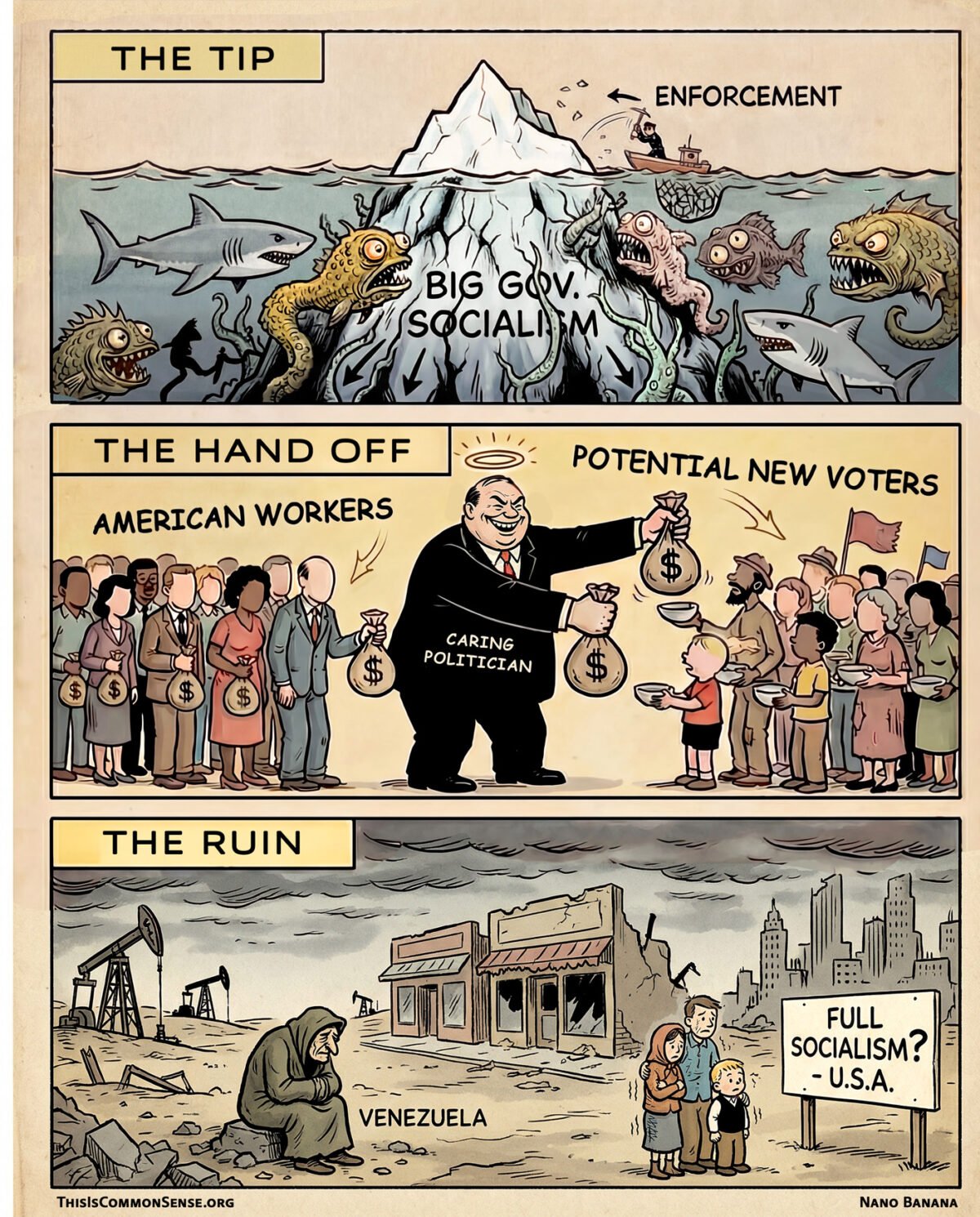
“In 2024 alone, state Medicaid Fraud Control Units reported more than 1,151 convictions and more than $1.4 billion in civil and criminal recoveries,” writes Veronique de Rugy at Reason. “Federal enforcement recovers a tiny share of what is stolen. Fraud that goes undetected never appears in the data.”

And then she makes a claim that increasing numbers of astute observers make: “That’s only the tip of the iceberg.” She goes on to suggest that Medicare, the Supplemental Nutrition Assistance Program (SNAP), and “many other welfare programs” constitute a huge hunk of fraud.

The solution? “If we want less fraud,” she argues, “we need less government.”

Fraud and big government seem to go hand in hand. At least this kind of big government, which resembles the biggest kind of government imaginable. For taking wealth from many productive American citizens and giving it to a small but growing population of refugees from distant lands, that’s not necessarily fraud, I suppose, but it is something close to socialism.

We see in Venezuela just how devastating rule by thieving socialists can be. (Hugo Chavez nationalized oil industry infrastructure and then ran it into the ground.) In Minnesota and in other states of the union, we see a similar ethic. When done on a limited basis, we could call it “helping the poor,” the folks who just cannot produce what they need. That’s how transfer socialism was sold to us.

And they could say, truthfully, that’s not full socialism.

But extending the beneficiary class from our most needy friends and neighbors to the less-and-less needy, and then to waves of refugees from other countries, that’s a recipe for disaster. Like socialism when “full.”

How far should Americans go to help “others”? To our own ruin?

This is Common Sense. I’m Paul Jacob.


PDF for printing

Illustration created with Nano Banana

See all recent commentary
(simplified and organized)
See recent popular posts
Categories
crime and punishment government transparency subsidy

Learing in Minnesota

These days, we are apt to see the “meme” (joke) about the news before the news itself.

Take “Learing.” If you haven’t seen Nick Shirley’s YouTube video blowing the lid off what has quickly become the biggest fraud story of our time, you may not get the joke.

Some 30 days ago, my “Red-Flagged Welfare Fraud” decried “the more than $1 billion in fraud” conducted mostly by Somalis in Minnesota, taking taxpayer money and siphoning it off for personal and perhaps even terrorist benefit. Two weeks later, a weekend update — “Walz Waltzes, Spins” — discussed the Governor of Minnesota’s lame attempts to seem “in charge.”

Now, the fraud total is estimated to be over nine billion!

A new element of the story is young Mr. Shirley’s reporting. He went to “day care centers” all over Minneapolis, confronting “workers” and noticing there were no children actually being fed or taught. These were sham programs. 

In a partly funny moment, he appeared in front of one alleged day care that had misspelled its own name on the building’s sign: “Quality Learing Center.” 

A whole lot of folks on X — but not on BlueSky — thought this was funny-haha. 

The rest of us shake our heads. It may not even be funny-peculiar, as inquiries into more states have begun, with Washington and Ohio receiving the most attention so far.

We’ll need more Nick Shirleys to cover it all, for the mainstream press has shown . . . some reluctance to put in much elbow grease.

Meanwhile, there is a silver lining, expressed last night on Hannity by Terry Schilling of the American Principles Project: “It actually kind of makes me relieved that there were no children in these obviously corrupt and probably dangerous daycare facilities.”

This is Common Sense. I’m Paul Jacob.


PDF for printing

Illustration created with Nano Banana

See all recent commentary
(simplified and organized)
See recent popular posts

Categories
Accountability ideological culture subsidy

Red-Flagged Welfare Fraud

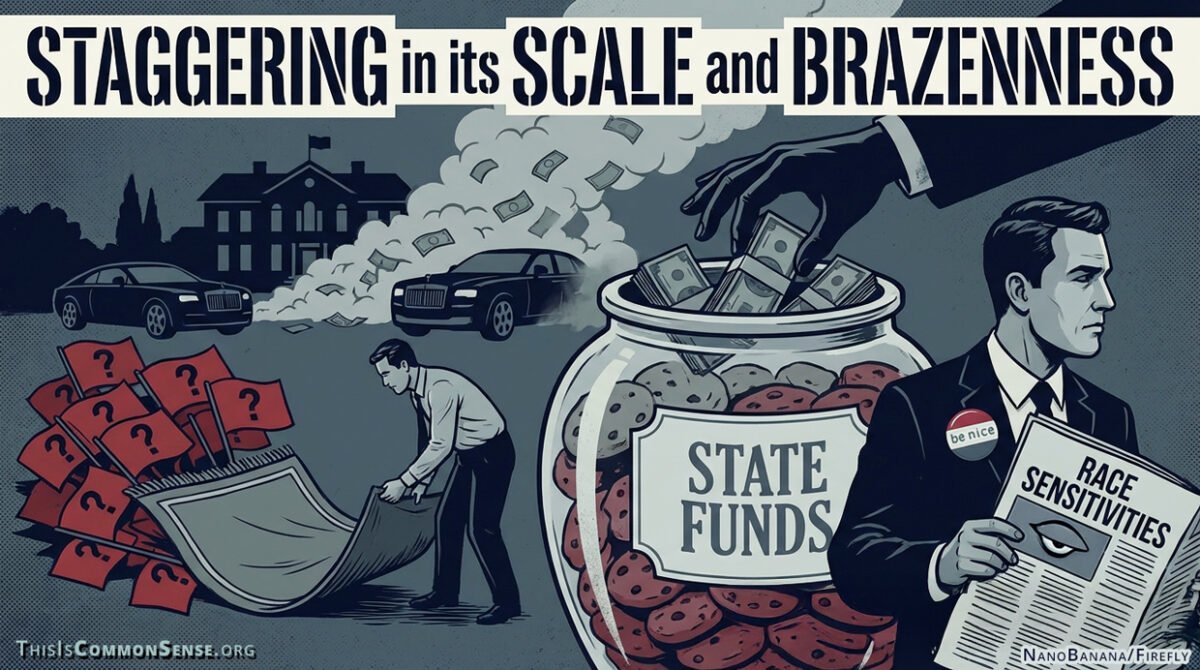
“Staggering in its scale and brazenness.” 

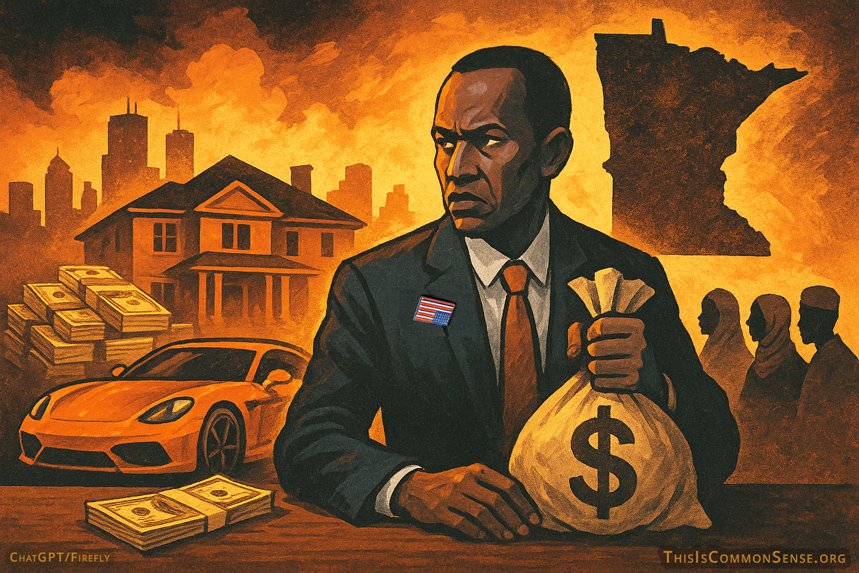
That’s how The New York Times describes the more than $1 billion in fraud that “took root in pockets of Minnesota’s Somali diaspora as scores of individuals made small fortunes by setting up companies that billed state agencies for millions of dollars’ worth of social services that were never provided.”

Quite a lucrative business model: Stealing from programs to prevent homelessness and keep children fed during the pandemic, the crooks instead “spent the funds on luxury cars, houses and even real estate projects abroad.” 

So far, prosecutors have convicted 59 people, with “all but eight of the 86 people charged” of “Somali ancestry.”

According to Ryan Pacyga, an attorney representing several defendants, The Times reports that “some involved became convinced that state agencies were tolerating, if not tacitly allowing, the fraud.”

What?

“No one was doing anything about the red flags,” argues Pacyga. “It was like someone was stealing money from the cookie jar and they kept refilling it.”

Why was nothing done?

Well . . . the federal prosecutor contends that what The Times calls “race sensitivities” (read: fear of being called racist) were “a huge part of the problem.” 

One former fraud investigator, a Somali American named Kayseh Magan, blames “the state’s Democratic-led administration” which was “reluctant to take more assertive action in response to allegations in the Somali community.”

“There is a perception that forcefully tackling this issue might cause political backlash among the Somali community,” Magan explains, “which is a core voting bloc.” 

For Democrats.

Very expensive votes.

This is Common Sense. I’m Paul Jacob.


PDF for printing

Illustrations created with ChatGPT, NanoBanana and Firefly

See all recent commentary
(simplified and organized)
See recent popular posts