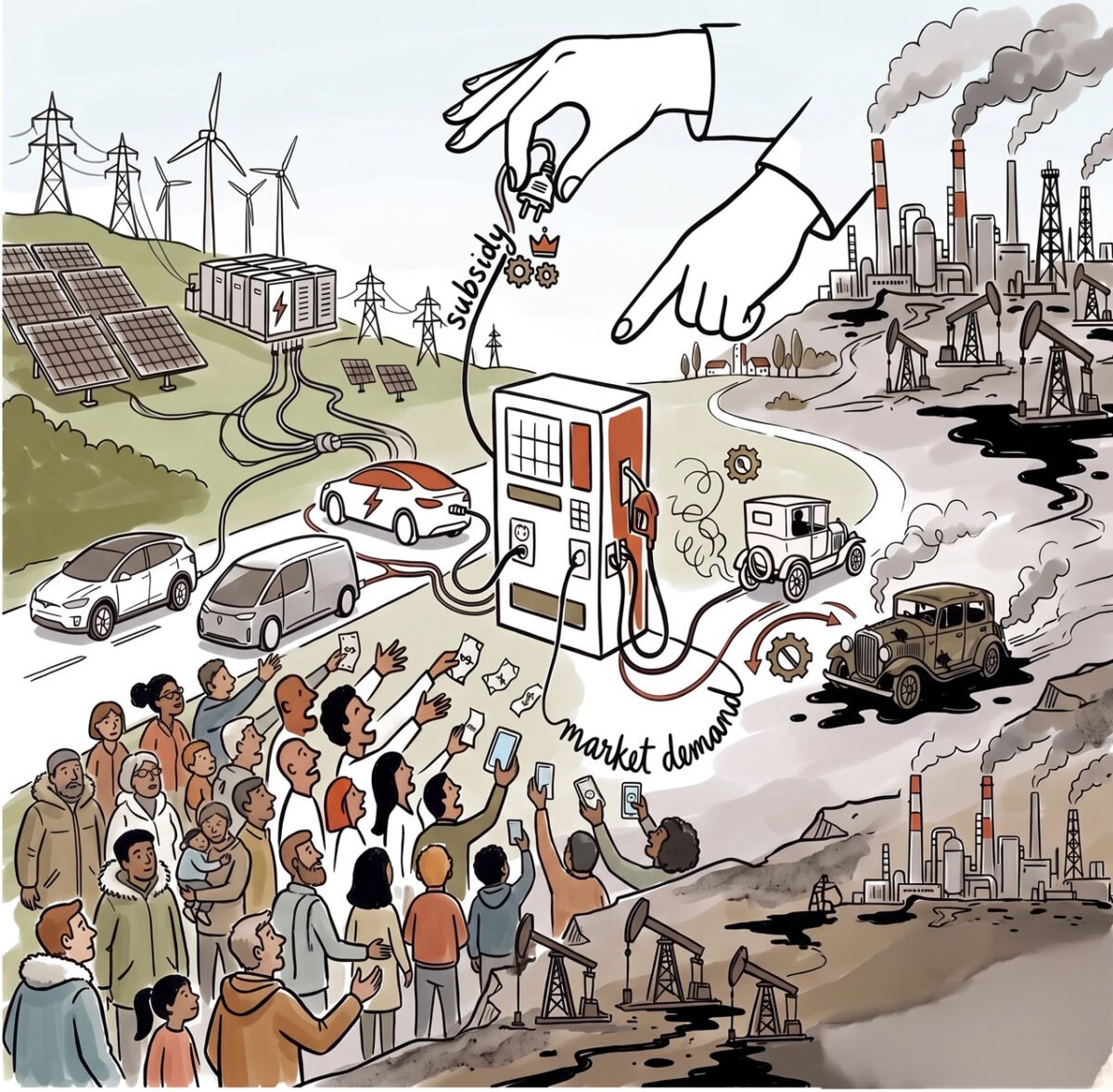
There’s an easy way to know when people want various products and services: they pay for them using their money. It’s true! We have markets, and people buy and sell on these markets, even often risky investments as sellers and spending their own money as buyers.
Goods aren’t always procured this way. But market exchanges are common in any country containing even much-
One feels a need to remind the world of such truths whenever one, for example, peruses The New York Times.
According to a recent Times article on how “E.V. Road Trips Went From Impossible to Easy,” this transition to ease happened even despite alleged Trumpian hostility to electric vehicles!
Huh? Yawp! “E.V. fast-charging stations in the United States have soared in number from around 1,000 a decade ago to 12,000 today. . . . And despite the Trump administration’s hostility toward electric vehicles, and its attempts to end federal funding for public chargers, new stations are still going up — around 2,000 so far this year.” [emphasis added]
The correct wording is “despite reversal of federal hostility to gas-powered vehicles.”
Those fast-charging stations may be going up for a variety of private and public reasons. But no industry that emerges to meet persistent consumer demand requires any impetus to succeed beyond the desire and ability of capable producers to earn profits by satisfying that demand.
In the early days of automobiles, gas stations didn’t spring up by government edict or subsidy.
Let consumers decide which mode of transportation, gas, electric, hybrid, if any, will triumph.
This is Common Sense. I’m Paul Jacob.
Illustration created with Nano Banana
See all recent commentary
(simplified and organized)
See recent popular posts
One reply on “Progress Regardless”
Charging electric vehicles has become less onerous, but still we see that the market for electric vehicles has contracted.
Like everything else, the adoption of a technology comes with costs as well as benefits; and the costs and benefits of electric-powered motor vehicles as opposed to petroleum-powered vehicles have not evolved to a stage at which most personal, powered transportation should primarily use electric motors. Knowing now that, in the eventual future, nearly all vehicles will be electric is like knowing in the late 19th Century that motor vehicles would almost entirely displace horses. Any subsidies or penalties to change the incentives faced by individuals must drain resources that would be better put to other use at the time.
Attempting to make some part of the future the present will delay some other part of the future — indeed, the CPEs provide cases in which attempting to hurry the future could cause a society to move technologically backward.
A solid theory and a large body of evidence shows us that markets generally propel activity towards economic efficiency; meanwhile, no theory has coherently explained how administrators could acquire the dispersed information necessary to efficient planning, and a large body of evidence illustrates that state intrusion stifles what activity it does not drive towards chaos.