Categories
free trade & free markets national politics & policies political economy regulation subsidy

Progress Regardless

There’s an easy way to know when people want various products and services: they pay for them using their money. It’s true! We have markets, and people buy and sell on these markets, even often risky investments as sellers and spending their own money as buyers.

Goods aren’t always procured this way. But market exchanges are common in any country containing even much-hampered markets.

One feels a need to remind the world of such truths whenever one, for example, peruses The New York Times.

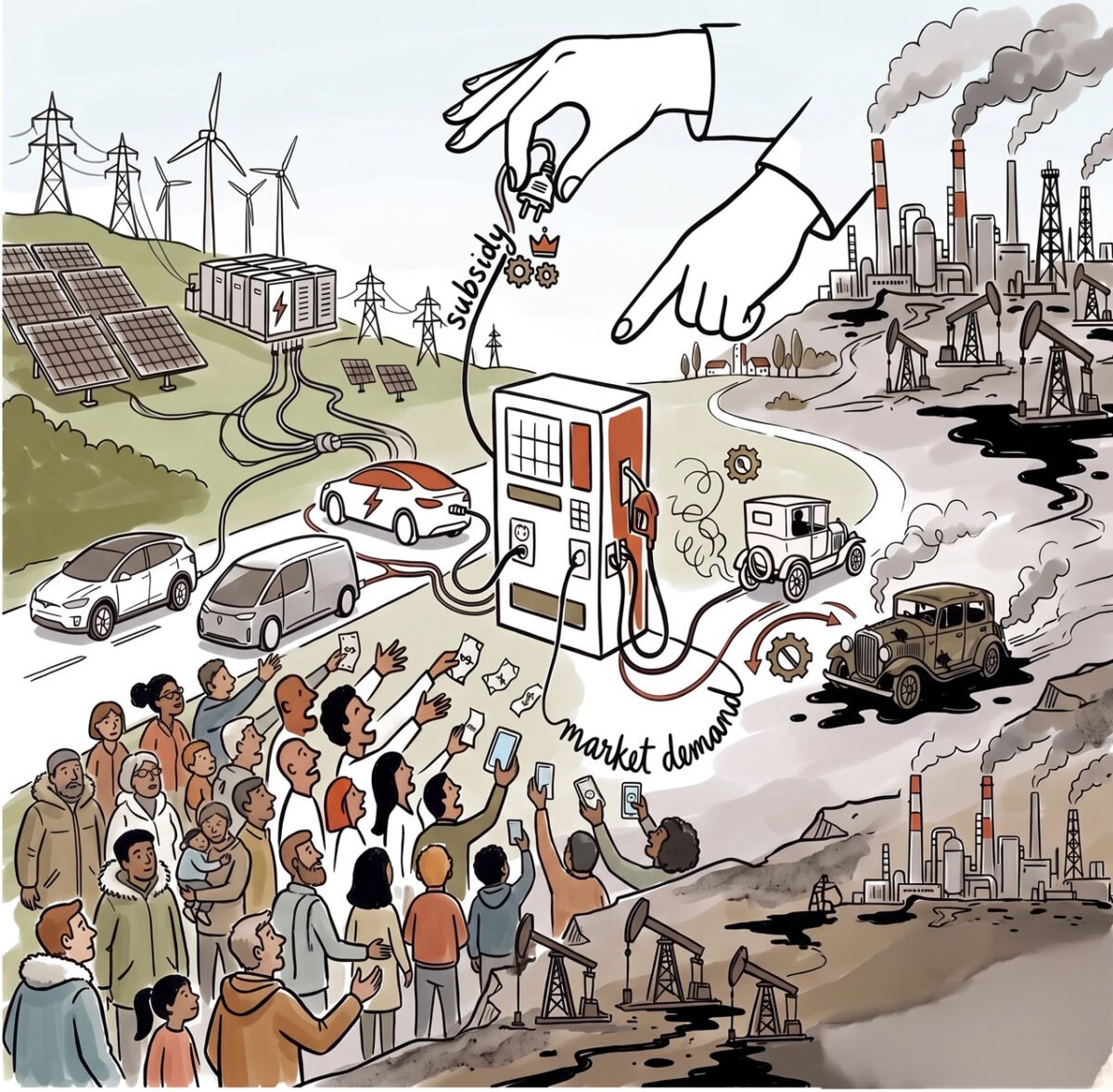
According to a recent Times article on how “E.V. Road Trips Went From Impossible to Easy,” this transition to ease happened even despite alleged Trumpian hostility to electric vehicles!

Huh? Yawp! “E.V. fast-charging stations in the United States have soared in number from around 1,000 a decade ago to 12,000 today. . . . And despite the Trump administration’s hostility toward electric vehicles, and its attempts to end federal funding for public chargers, new stations are still going up — around 2,000 so far this year.” [emphasis added]

The correct wording is “despite reversal of federal hostility to gas-powered vehicles.”

Those fast-charging stations may be going up for a variety of private and public reasons. But no industry that emerges to meet persistent consumer demand requires any impetus to succeed beyond the desire and ability of capable producers to earn profits by satisfying that demand. 

In the early days of automobiles, gas stations didn’t spring up by government edict or subsidy.

Let consumers decide which mode of transportation, gas, electric, hybrid, if any, will triumph.

This is Common Sense. I’m Paul Jacob.


PDF for printing

Illustration created with Nano Banana

See all recent commentary
(simplified and organized)
See recent popular posts

Categories
ideological culture national politics & policies too much government

Warren’s No Socialist

Senator Elizabeth Warren knows that when people trade, both sides gain. She made that clear last year, in a fascinating interview in The Atlantic. But then she went blithely on, saying that she could fix markets by creating a “level playing field.”

Markets create value, but Mrs. Warren asserts that “when the markets are not level playing fields, all that wealth is scraped in one direction.” 

How? People are still trading, even in bumpy playing fields. 

She turns to the crisis of 2008, when many people discovered that they had entered into unsustainable mortgages. She explains how her shiny new regulatory program leveled that playing field.

But her scheme did not even out the bumps in the mortgage industry that existed before the crash:

  • the moral hazard of Fannie Mae and Freddie Mac, 
  • the previous congressional “fix” that pushed banks to accept poor people as good loan risks when they were not (in the name of racial justice, of course), 
  • the regulatory rule that created ratings agencies sans competitive market incentives, and
  • the Federal Reserve policies that fed the whole housing bubble mania.

She just added another burdensome layer of government.

Politicans sure love to pile on.

Now she offers a new scheme, a child-care program that Reihan Salam, this week again in The Atlantic, says “risks increasing the federal deficit, driving up the cost of child care, and squeezing stay-at-home parents.” 

And Mr. Salam says that last risk is one Warren should understand particularly well, since she had “made her reputation as a public intellectual by warning against it.”

Warren’s no socialist — she wants to “save capitalism”! Yet by only adding to government kludge, she might as well be one.

This is Common Sense. I’m Paul Jacob.


PDF for printing

Elizabeth Warren, housing bubble, crash, regulations, finance

See all recent commentary
(simplified and organized)
See recent popular posts