Categories
free trade & free markets litigation U.S. Constitution

Punish Energy Producers?

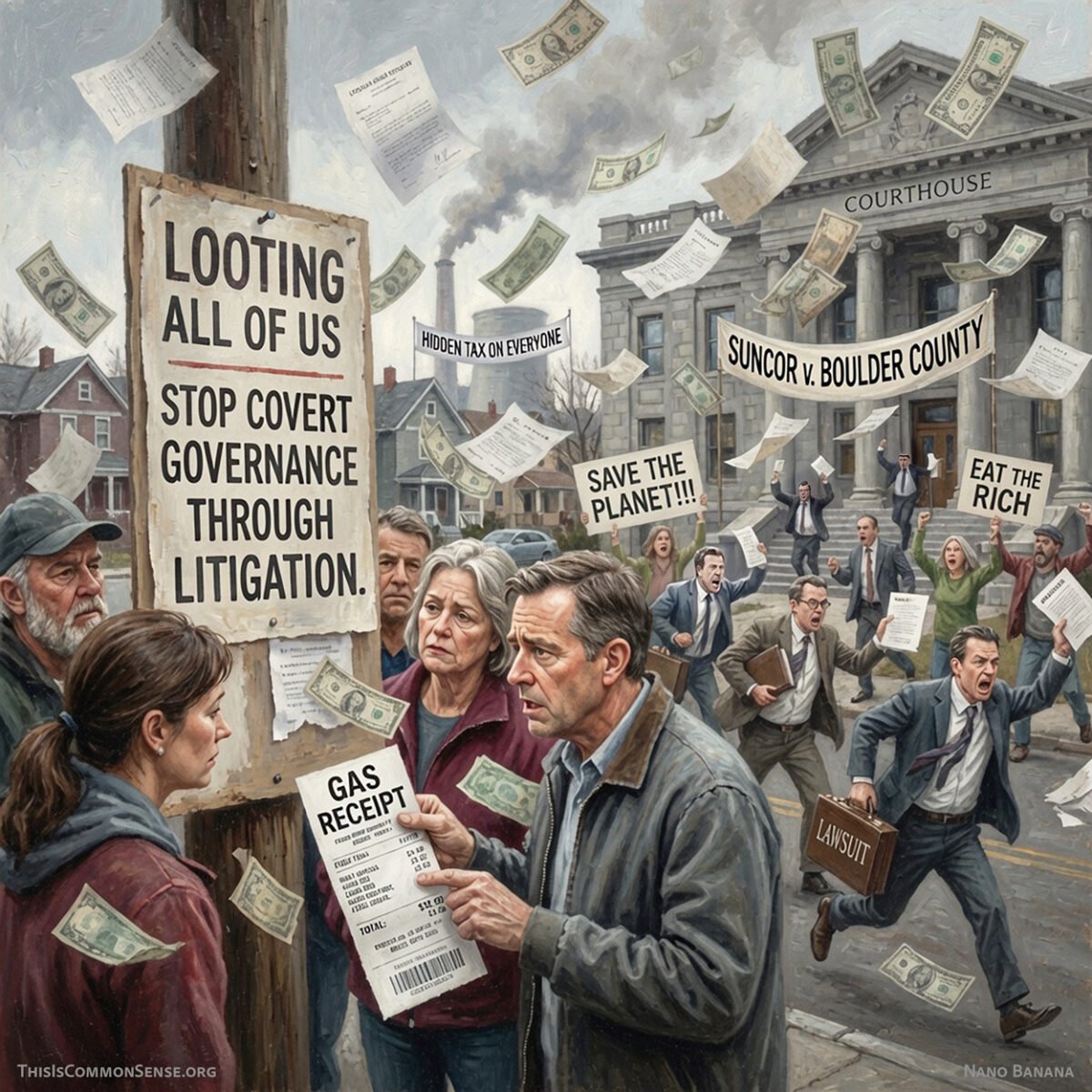
The latest attempt to hamper our ability to do things? A series of lawsuits against oil companies for allegedly committing global warming. The plaintiffs want billions and billions to be extracted from these companies for fueling civilization.

Litigation before the Supreme Court, Suncor v. Boulder County, is “one of the most consequential energy cases in decades,” argue Michael Toth and Sarah Harbison in the New York Post

Boulder County is just one of many seeking to make oil and gas companies fork over massive damages. 

To whom? Entities like Boulder County.

The high court’s response will help determine the viability of future such litigation and “whether the United States remains an energy superpower.”

Energy superpower status is not what people trying to drive their cars and heat their homes at a reasonable cost are worried about. If the court accepts the plaintiffs’ reasoning, the sky’s the limit as far as the liability of the energy industry. 

And those new sky-high liability costs for gas and oil providers will result in new sky-high costs for you and me.

Looting all of us is fine with lawsuit supporters like David Bookbinder of Environmental Integrity Project. “This is a rather convoluted way to achieve the goals of a carbon tax,” Toth and Harbison claim. “The people who use the products pay for the damage that they cause.”

The Post’s authors urge the Supreme Court to “shut down” this attempt to circumvent the Constitution. And confirm that U.S. energy policy “can’t be dictated by local lawsuits.”

This is Common Sense. I’m Paul Jacob.


PDF for printing

Illustration created with Nano Banana & Grok Imagine

See all recent commentary
(simplified and organized)
See recent popular posts

Categories
election law U.S. Constitution Voting

Expanding the Electorate

Who should vote? Ought we expand the electorate? 

To everyone . . . on the planet?

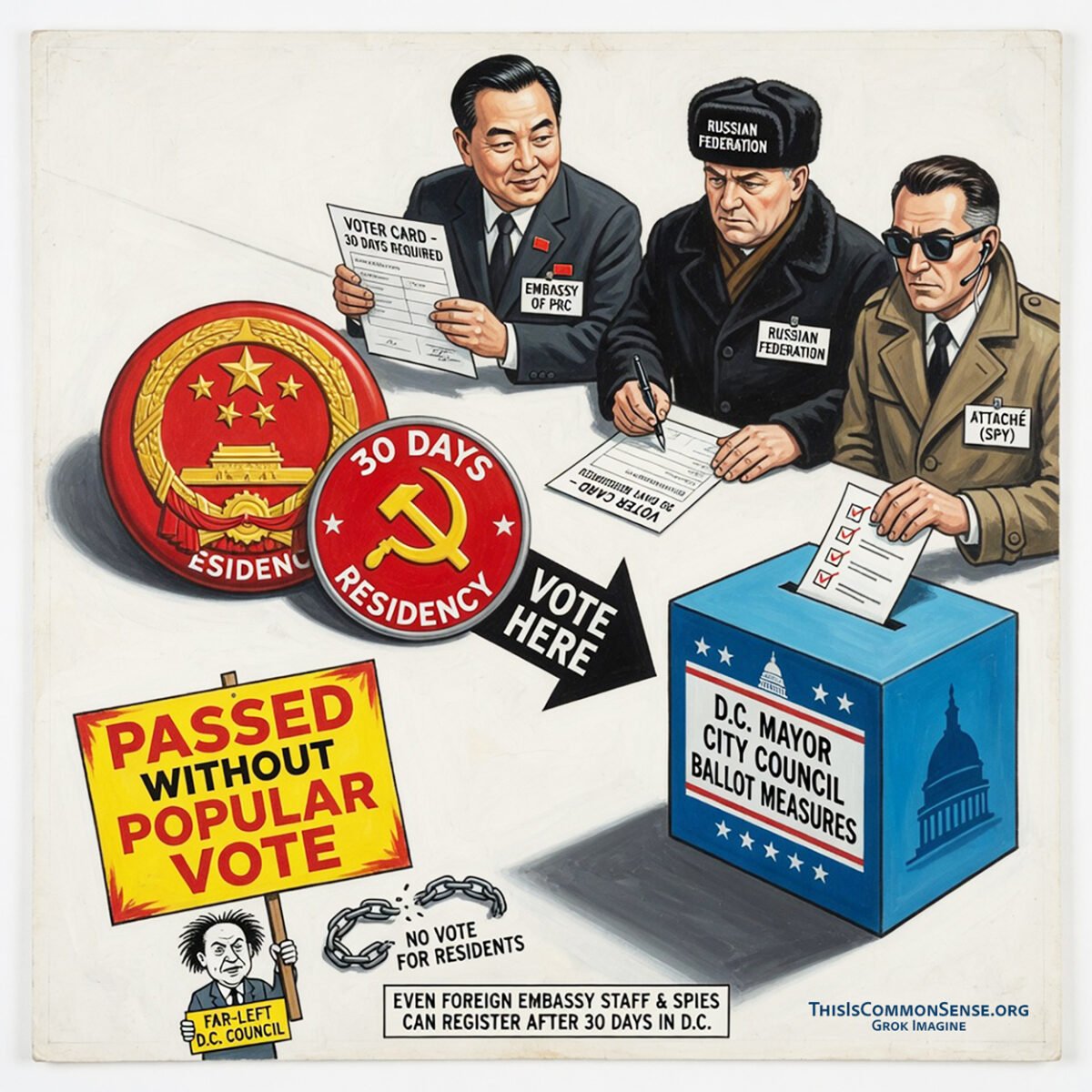
Do folks from other countries, who have come to America, legally or not, and reside in a community for 30 days, have a right to vote?

Well, they do under a crazy law in our nation’s capital. Even the ambassadors and embassy workers (and spies) that China and Russia send to represent their regimes, could, if they so desired, register and vote for the next mayor, city council-member and ballot measure in the federal capital . . . if those foreign nationals have been here (working for another country) for 30 days. 

The far-left-of-sanity Democrats on the D.C. City Council passed it — without a popular vote. 

At least in Los Angeles there will be a public vote — should the push by Democratic Socialists of America-backed Democrats on that City Council advance a measure to allow noncitizens in L.A., legally or not, to vote in local elections. 

Citizenship seems a wiser qualifier at all levels of government.*

“Federal law prohibits noncitizens from voting in federal elections,” The Los Angeles Times reports. “However, states are allowed to set their own local and statewide election rules.”

Note that The Times does not inform readers that states, such as California, determine who is qualified to vote in federal elections in those states. Were California to allow noncitizens to vote in its state legislative elections — not too giant a leap from noncitizen voting in L.A. and San Francisco — those noncitizens would be legally qualified to vote for California’s representatives in Congress and the U.S. Senate. 

The U.S. Constitution’s “Qualifications Clause” is clear.

This state “loophole” is something worth closing through Florida Rep. Laurel Lee’s constitutional amendment

Locally, statewide, nationally: let the people decide.

This is Common Sense. I’m Paul Jacob. 


* I serve as chairman of Americans for Citizen Voting. We have worked to pass Citizen Only Voting constitutional amendments in 15 states and to place these measures on six more state ballots this November. We now ask Congress to consider and propose a federal constitutional amendment, HJR 152, the U.S. Citizens Vote Amendment.


PDF for printing

Illustration created with Grok Imagine

See all recent commentary
(simplified and organized)
See recent popular posts

Categories
election law U.S. Constitution Voting

Noncitizen Voting Q&A

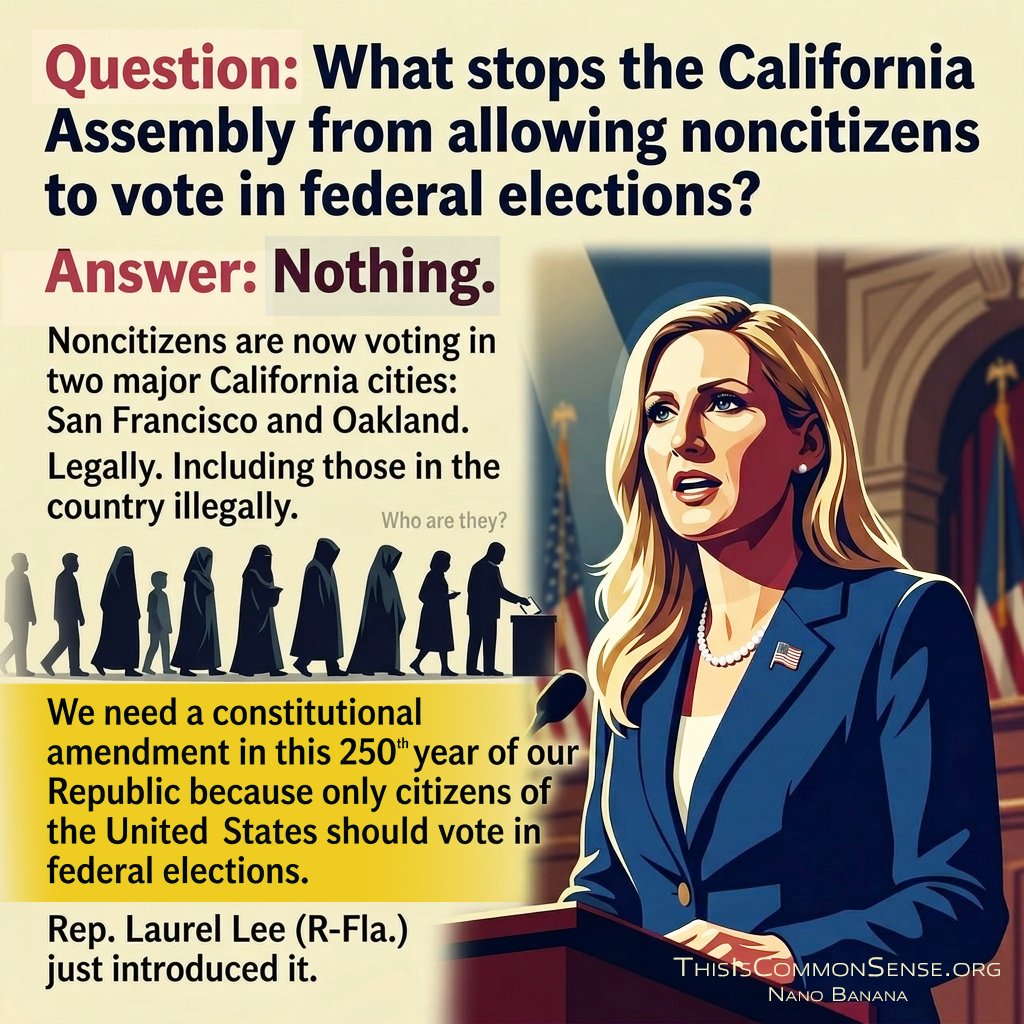
Question: What stops the California Assembly from allowing noncitizens to vote in federal elections?

Answer: Nothing. 

Noncitizens are now voting in two major California cities: San Francisco and Oakland. Legally. Including those in the country illegally.

And California courts have upheld the constitutionality, after San Francisco’s law was challenged. 

Voting in the Golden State doesn’t have to be limited to U.S. citizens.

So, it’s not all that far-fetched to think California’s legislature might one day pass a statute allowing noncitizens to vote in state legislative elections. Maybe in Maryland, too, where 16 cities now have legal and illegal aliens voting. Or Vermont, where a legislative supermajority overrode the governor to say yes to three cities giving the vote to noncitizens. Legislation has been introduced in both New York and Connecticut, in recent years, to give noncitizens the vote in those states’ legislative elections.  

“The Constitution is clear,” law professor Bradley Smith wrote Monday in The Wall Street Journal, “Under Article I and the 17th Amendment, any person who is allowed to vote in a state legislative election is automatically also allowed to vote for members of Congress.” 

In other words, the federal statute that purports to ban noncitizen voting in federal elections has a hole in it big enough to drive, say, the state of California through. 

“A federal statute can’t trump the Constitution’s explicit, exclusive grant of power to each state to determine who is eligible to vote,” explained the professor. 

. . . “even if the SAVE America Act were passed. . . .

“Although no state allows noncitizens to vote for its legislature,” Smith said, “that could change.” 

We need a constitutional amendment in this 250th year of our Republic because only citizens of the United States should vote in federal elections. Rep. Laurel Lee (R-Fla.) just introduced it.

This is Common Sense. I’m Paul Jacob. 


PDF for printing

Illustration created with Nano Banana

See all recent commentary
(simplified and organized)
See recent popular posts
Categories
defense & war tax policy U.S. Constitution

The Emergency Tariff Question

As is often the case in Supreme Court decisions, in Learning Resources v. Trump it is the dissenters’ views that are most interesting. 

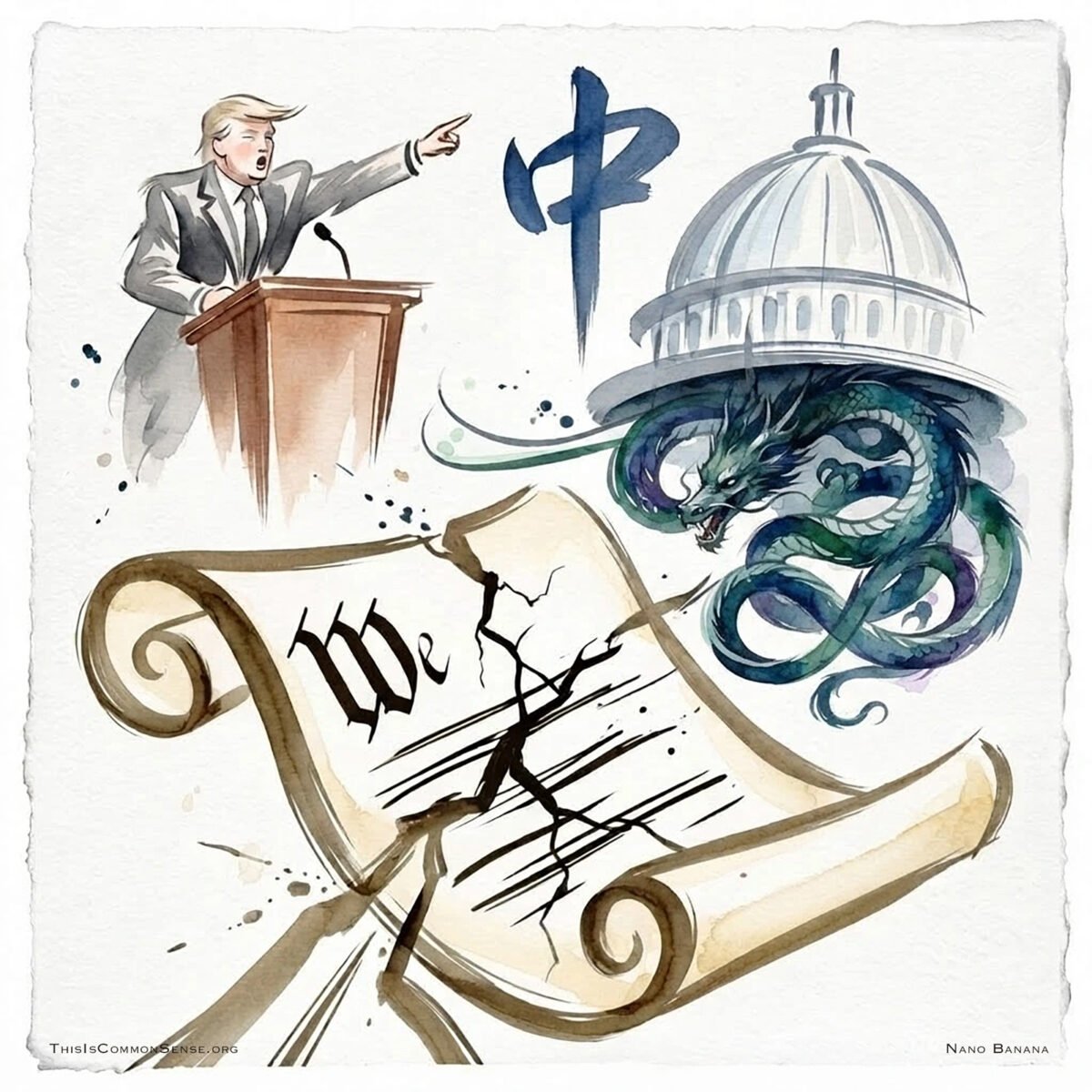
At issue? The president’s authority to impose tariffs, or alter them. Donald Trump — a life-long tariff proponent — took the International Emergency Economic Powers Act (IEEPA) as an excuse to levy broad new duties on imports from multiple countries. That act delegated to the executive the power to use tariffs as emergency foreign policy measures.

On February 20, the majority on the court gave a decisive No to the President’s use of IEEPA to impose tariffs.*

I generally oppose Congress delegating powers to the executive branch and support free trade. But what does the Constitution actually say? Could dissenters Kavanaugh, Thomas and Alito have a point?

Kavanaugh’s humungous written opinion claims that tariffs are a traditional, common, and lawful means of “regulat[ing] . . . importation” in foreign-policy crises; he says the majority’s narrow reading ignores text, history, precedent, and the special deference due the President in external affairs. “The text of IEEPA authorizes the President to regulate importation,” explains Kavanaugh, “and tariffs are a means of doing so.”

Thomas stresses that IEEPA’s emergency-declaration process provides political accountability, so judicial second-guessing is unwarranted. Further, he argues that from the Founding, “regulate importation” has always included duties; early Congresses and Presidents (Monroe, Jackson, etc.) routinely delegated and adjusted tariffs. While matters of rights cannot be delegated, Thomas argues that privileges can, and have, and that this has long been recognized in constitutional law.

The key question, as Kavanaugh advances, is the balance of power. “Congress retains the ultimate authority to clarify, amend, or repeal IEEPA,” he reasonably asserts, “if it believes the President’s exercise of emergency powers has gone too far.”

This issue became a federal court case because Congress is dysfunctional.

Which puts the issue back in our lap. Where voters can have some control. How? Through elections, pressure, or pushing . . . term limits.

This is Common Sense. I’m Paul Jacob.


* Other avenues may remain open. And Trump is jumping on them.

PDF for printing

Illustration created with Nano Banana

See all recent commentary
(simplified and organized)
See recent popular posts
Categories
election law national politics & policies U.S. Constitution

Federal Election Takeover?

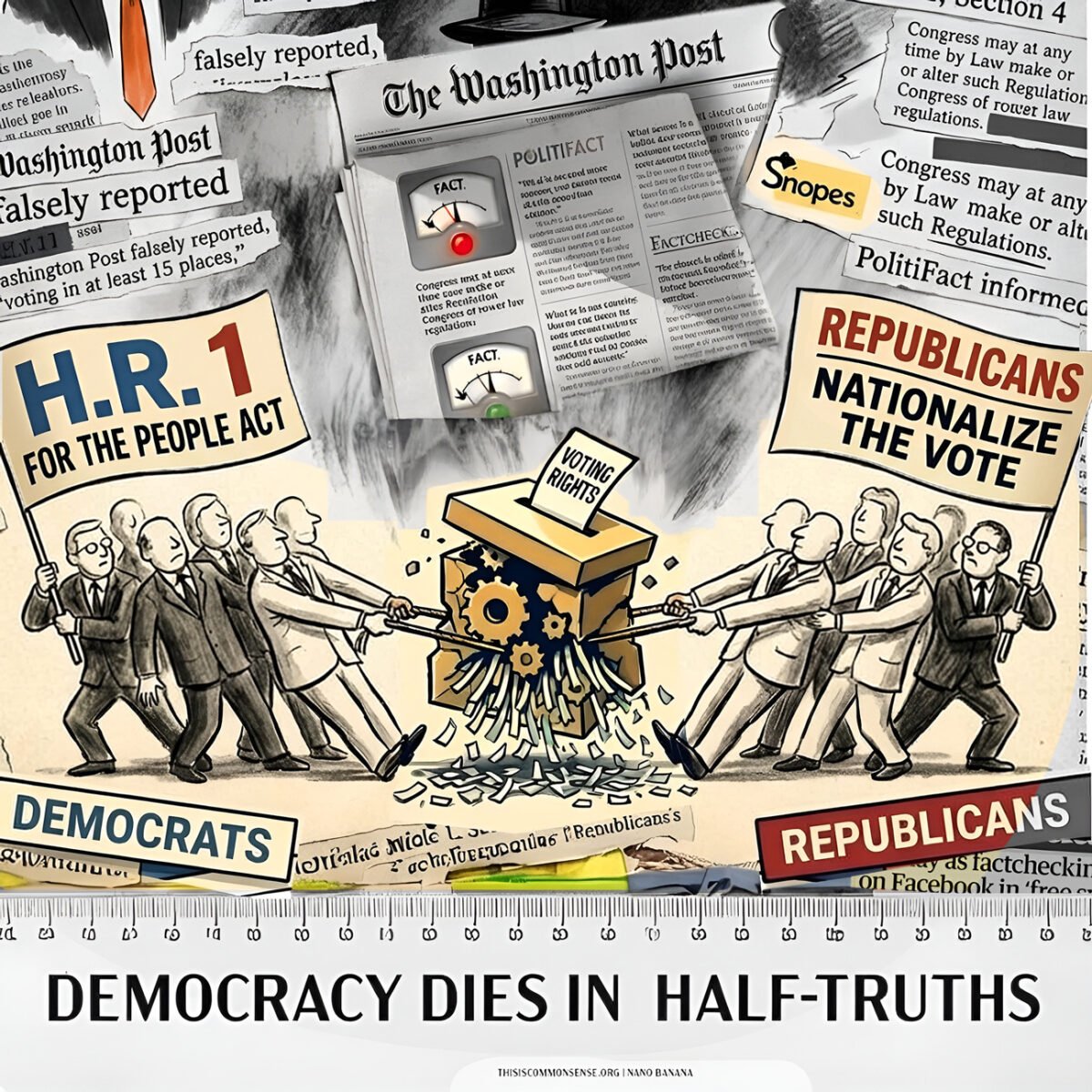
“We should take over the voting, the voting in at least 15 places,” President Donald Trump declared on former FBI deputy director Dan Bongino’s new podcast. “The Republicans ought to nationalize the voting.”

That’s just what Democrats in the U.S. House attempted to do back in 2021 with their H.R. 1. I know well because I worked with a large coalition of groups and individuals to oppose that dishonestly labeled “For the People Act.” 

For the people who are Democratic Party hacks maybe.

A 2021 Heritage Foundation analysis argued the legislation would “Seize the authority of states to regulate voter registration and the voting process.”

“The Democratic bill is indeed sweeping,” PolitiFact informed at the time. “At 791 pages, the bill does everything from prohibiting states’ voter ID laws to breaking the gridlock of the Federal Election Commission by removing a member.”

Luckily, H.R. 1 did not pass the Senate. 

Have you ever noticed that in the tug of war between federal and state power, politicians of all stripes support the Constitution’s balance when it suits them and ignore it when it doesn’t?

Same goes for news media. The Washington Post falsely reported on Monday that by urging “Republican lawmakers” to act, the president was “claiming a power explicitly granted to states in the U.S. Constitution.” 

Well, Article 1, Section 4 of the U.S. Constitution does say “The Times, Places and Manner of holding Elections . . . shall be prescribed in each State by the Legislature thereof,” but it explicitly adds that “the Congress may at any time by Law make or alter such Regulations . . .”

Democracy dies in half-truths.  

This is Common Sense. I’m Paul Jacob.


PDF for printing

Illustration created by Nano Banana

See all recent commentary
(simplified and organized)
See recent popular posts

Categories
election law judiciary regulation U.S. Constitution

Fifty Years After Buckley

Congress began regulating campaign finances in the 1960s.

In 1976, the Supreme Court’s ruling in Buckley v. Valeo reined in such regulation . . . in part.

This month, at a symposium marking the 50th anniversary of the ruling, John Samples — a former Vice President at the Cato Institute and currently a Member of Meta’s Oversight Board — compared what happened after the 1976 ruling to what might have happened had the ruling been better or worse.

The alleged point of campaign finance regulation was to “level the playing field.” The actual point, Samples observed, has been to “protect the political status quo” by making it harder “to spend enough money to effectively challenge congressional incumbents.”

In Buckley, the court ruled that contribution limits were indeed valid (they aren’t) for the sake of combatting corruption or the “appearance of corruption.” But it also ruled that limits on campaign spending are limits on speech, hence invalid — thereby saving democracy, argued former Federal Election Commission chair Bradley Smith, in the Wall Street Journal a few weeks ago: “The Buckley court understood that effective political speech requires resources.”

The Court also upheld compulsory disclosure of donors and donations. This led to chronic calumniation of donors, helping to poison public discourse.

Samples suggeststhat a more libertarian Buckley might have enabled major reform, even perhaps privatizing of New Deal and Great Society spending programs in the 1980s.

On the other hand, had the decision been worse, “validating spending limits” as well, Congress would likely have continued to hobble challengers. And thus, perhaps, prevented the ascendancy of Ronald Reagan and the emergence of a GOP majority in the U.S. Senate.

Unwarranted restrictions on freedom of speech should be removed completely. Substantially removed is better than not at all, sure. But now let’s finish the job.

Something Brad Smith’s Institute for Free Speech works on every day.

This is Common Sense. I’m Paul Jacob.


PDF for printing

Illustration created with Nano Banana

See all recent commentary
(simplified and organized)
See recent popular posts
Categories
ideological culture judiciary property rights too much government U.S. Constitution

Who’ll Oppose the Quasi-Commie?

Should we expect a four-year pitched battle?

I see one brewing between the new communist mayor of New York City and those judges who respect law and the U.S. Constitution.*

Some say that Zohran Mamdani, though on record admitting his goal of seizing the means of production, is technically not a communist. Well, if allowed to fully impose all he wants on New Yorkers, maybe that would amount to going straight to a fascist model of totalitarian governance — bypassing the Maoist-Stalinist stage.

Giving him the benefit of the doubt.

But we do know that Mamdani was quick to hire such advisors as housing czarina Cea Weaver, who has lamented home ownership as a “weapon of white supremacy” and declared property as such to be something regrettably long treated as “an individualized good” that now must be treated as a “collective good.”

If you don’t own your house as an individual and have a spare room (or half a room), and somebody needs a place to live, could a Mamdani-and-Weaver-run Big Apple compel you to give space to a stranger that you don’t want around? If property becomes a “collective good” and all must cuddle in the warm bosom of the state-managed collective, the answer must be: yes.

But New Yorkers may not be quite doomed.

Not, anyway, if there are enough judges like David Jones, who recently interfered with an attempt by the Mamdani administration to interfere in the sale of many rental properties owned by Pinnacle Group.

Mamdani’s office says they’ll keep trying. 

Of course they will.

This is Common Sense. I’m Paul Jacob.


* Or the New York State Constitution, for that matter: see §7 (a), which clearly states that “Private property shall not be taken for public use without just compensation.” 

PDF for printing

Illustration created with Nano Banana

See all recent commentary
(simplified and organized)
See recent popular posts
Categories
crime and punishment international affairs U.S. Constitution

The Dictator’s Arrest

The U.S. military captured Venezuela’s dictator, Nicolás Maduro, and his wife, Cilia Flores, on Saturday; a lot of people who hate Donald Trump are complaining about the president’s decision to “arrest” the foreign head of state. 

Sure, it’s an act of war. 

Authorized by Congress? Not really, but that’s hardly unusual. 

There is that 2020 indictment, unsealed by the U.S. Department of Justice during Trump’s first term, accusing Maduro and senior Venezuelan officials of conspiring with Colombian guerrilla groups (like the FARC) to traffic massive quantities of cocaine into the United States. This was updated in a superseding indictment unsealed over the weekend, which added Maduro’s wife, son, and others as defendants.

Specifically, the charges are:

  • Narco-terrorism conspiracy.
  • Conspiracy to import cocaine. 
  • Possession of machine guns and destructive devices.
  • Conspiracy to possess machine guns and destructive devices.

Considering that Venezuela is a sovereign state and can have whatever drug policies or gun laws it wants, all this might seem a tad . . . ridiculous.

Most people, however, will likely be moved by two very different lines of thinking:

  • Maduro was an evil tyrant, and it’s good that his murderous regime has been (sorta) toppled; and
  • The operation was skillfully done, demonstrating U.S. military strength.

Is the effort coherent and compatible with other international military stances of the United States? Debatable.

How does it affect, say, the U.S. position on Taiwan? Will this encourage or discourage the People’s [sic] Republic [sic] of China?

One could argue both ways. As a successful demonstration of military might, it will likely dissuade the Chinazis. But if it turns world opinion against the U.S., the opposite will likely prove true.

Still, isn’t it hard to side with a dictator? I mean Maduro.

This is Common Sense. I’m Paul Jacob.


PDF for printing

Illustration created with Nano Banana

See all recent commentary
(simplified and organized)
See recent popular posts
Categories
Accountability defense & war national politics & policies responsibility U.S. Constitution

The Irresponsible vs. The Unaccountable

Six Democrats in Congress — Arizona Sen. Mark Kelly, Michigan Sen. Elissa Slotkin, U.S. Representatives Jason Crow of Colorado, Maggie Goodlander of New Hampshire, and Chris Deluzio and Chrissy Houlahan of Pennsylvania — caused quite a stir, recently, producing a video “to speak directly to members of the Military and the Intelligence Community.” 

What did these former military and intelligence agency vets-turned-congressmen tell our current soldiers and spooks?  

“You can refuse illegal orders.”

While that’s true, and important . . . what orders are they talking about? 

Perhaps the continued bombing of ships in the Caribbean and killing of crews, all on accusations by the White House that these are drug smugglers — without any check or real accountability — is such a case.*

Yet, these powerful senators and representatives are not making it.

Instead, they’ve not even identified one breach. And by refusing to identify any of President Trump’s specific orders, their call devolves into second-guessing the chain of command and encouraging dissension in the ranks, dissuading military personnel from always being “at the ready.”

Further, these wielders of legislative power in Washington have taken no serious action to protect the Constitution nor promoted any legislative action to hold executive action accountable. 

Instead, they pass the buck to the soldier (or CIA analyst) to determine the legality of orders on the fly.

As Haley Fuller wrote at Military.com last week, “[A]sking individual service members to make on-the-spot legal judgments without guidance can put them at enormous personal risk.” 

Was this Democrat video “SEDITIOUS BEHAVIOR, punishable by DEATH!” as Trump posted on social media? I don’t think so. 

It is, however, tragically emblematic of the complete and total abdication of responsibility by these pretend leaders in Congress. 

This is Common Sense. I’m Paul Jacob.


* Reminds me of President Obama’s policy of killing American citizens abroad by drone strikes without, as even he acknowledged, any real process of checks and accountability. Thank goodness for Sen. Rand Paul’s 2013 filibuster raising concerns about this unaccountable power to execute. 

PDF for printing

Illustration created with Nano Banana and Firefly

See all recent commentary
(simplified and organized)
See recent popular posts

Categories
partisanship U.S. Constitution

Constitutional Defects

“It is now time for the Republicans to play their ‘TRUMP CARD,’ and go for what is called the Nuclear Option — Get rid of the Filibuster, and get rid of it, NOW!” 

That’s what President Trump posted on Truth Social back during the shutdown, adding, “WE are in power, and if we did what we should be doing, it would IMMEDIATELY end this ridiculous, Country destroying ‘SHUT DOWN.’”

This was prior to Democrats, off-year election over, suddenly deciding to agree to the same deal to reopen the government that Republicans had been offering for weeks.  

The 60-vote supermajority the United States Senate needs to end debate and vote on legislation is a small-r republican measure, not a small-d democratic one. Reasonable people can disagree over its merits, certainly, but I like the greater consensus it requires. 

What I don’t like is that the party in control of the Senate can at any time change the filibuster rule in any way it wishes, including ending it altogether. 

Rules shouldn’t be this easy to junk. 

Make the Senate filibuster not just a rule, but constitutional law. 

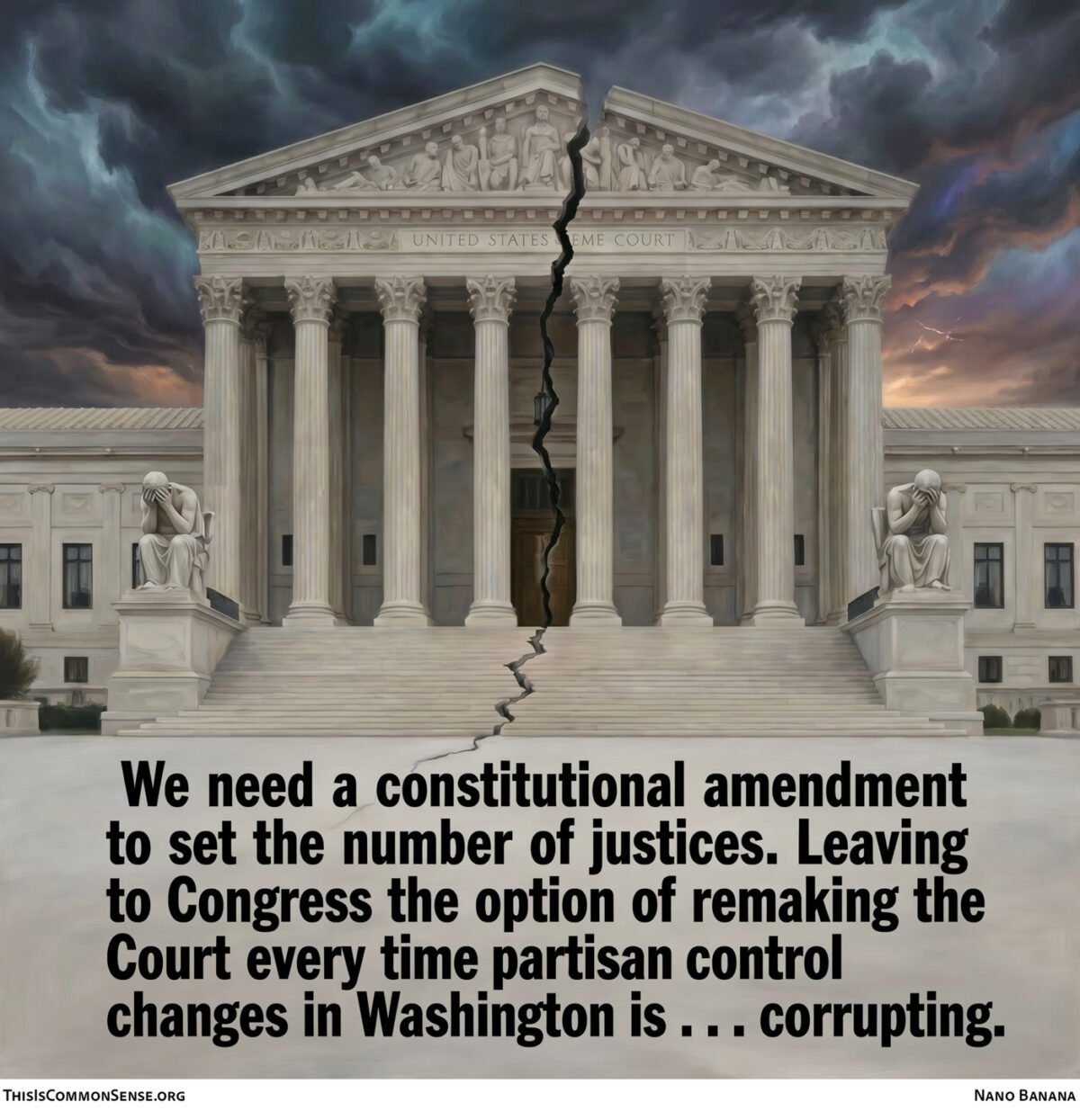
Another major matter of constitutional change is sorely needed. The stability and independence of one of the three branches of the federal government, the U.S. Supreme Court, hangs by a thread.

The number of justices, now nine, is nowhere set in the Constitution. 

Congress and the White House, when held by the same political party — even short of 60 votes in the Senate, because they could simply end the filibuster — could immediately add ten new justices.

Or 20. 

And then confirm all the president’s picks.

All something Democrats mused about doing years ago: packing the High Court with many new justices to magically engineer a new Democratic Party majority on the SCOTUS. 

The number of justices, like the Senate’s super-majoritarian filibuster, aren’t written in stone.

But should be.

This is Common Sense. I’m Paul Jacob. 


PDF for printing

Illustration created with Krea and Firefly

See all recent commentary
(simplified and organized)
See recent popular posts