Categories
crime and punishment defense & war U.S. Constitution

Gunboat Anti-Diplomacy

A boat in international waters off the coast of Venezuela was blown up by the U.S. military, on President Donald Trump’s proud authorization. 

It was not universally praised.

“The controversy erupted on Saturday when Vance wrote on the social platform X,” Sabina Eaton reports, quoting the vice president: “’Killing cartel members who poison our fellow citizens is the highest and best use of our military,’ referencing the September 2 military strike.”

The idea that the “best use” of our armed forces is to destroy — without arrest or declaration of war or even a serious legal case set before world opinion or, for that matter, U.S. opinion — sounds all too modern but not very American.

Does it matter that they were, or merely might have been, “narco-terrorists,” as the president called the eleven people wiped out on the fast-moving boat? Or that Mr. Trump asserted their service to Venezuela’s strongman Maduro — against whom the U.S. has not declared war?

“Sen. Rand Paul all but accused the vice president of celebrating war crimes,” Eli Stokols and Dasha Burns wrote yesterday at Politico. “The Kentucky Republican ripped Vance over the weekend in a social media fight that could offer a preview of future skirmishes between President Donald Trump’s heir apparent and another Republican with 2028 ambitions.”

The Kentucky senator asked, rhetorically, if the vice president had “ever read To Kill a Mockingbird?

“Did he ever wonder what might happen if the accused were immediately executed without trial or representation??

“What a despicable and thoughtless sentiment it is to glorify killing someone without a trial.”

Rand is right. The use of unlawful or unaccountable power can never advance American interests. Because one of our interests is holding power to account, to the rule of law. 

Thank you for your attention to this matter.

This is Common Sense. I’m Paul Jacob.


PDF for printing

Illustration created with Krea and Firefly

See all recent commentary
(simplified and organized)
See recent popular posts

Categories
litigation Tenth Amendment federalism U.S. Constitution

Planned Parenthood Gets the Boot

Medicaid is a huge handout and also a massive burden, straining resources and tax revenues, and (of course) adding to the debt. It is also known for its complexity, a federal program run by the states. 

Some reformers, seeing the program as an over-complicated mess, yearn to “simplify” it by providing medical care as a “free” federal program. Others, concerned about the dangers of centralization and the obvious incompetence of bureaucracies far removed from taxpayers, advise collapsing Medicaid completely back to the states, to be organized and funded locally.

In this context, the Supreme Court’s ruling yesterday allowing South Carolina to remove Planned Parenthood from its Medicaid program is instructive.

“The majority opinion in the 6–3 decision in Medina v. Planned Parenthood South Atlantic was written by Justice Neil Gorsuch,” explains Matthew Vadum in The Epoch Times. “The new ruling reverses a federal appeals court decision that blocked South Carolina from excluding Planned Parenthood from the program.”

The key issue in the litigation regards a supposed right to choose medical providers: South Carolina, by dropping Planned Parenthood, was alleged to be abridging the right of recipients to choose their medical providers.

Remember that choosing your doctor was falsely promised by President Barack Obama in his medical insurance scheme — so, obviously, the option is highly valued by Americans. But is it a “right”?

“New rights for some mean new duties for others,” Justice Gorsuch wrote, elucidating a basic principle of legal philosophy. 

Applying the idea of rights to government handouts (in which taxpayers are on the hook) is a recipe for disaster. 

Applying federalism, on the other hand, makes not only constitutional sense, but — because the states are closer to both taxpayers and those in need — Common Sense.

I’m Paul Jacob.


PDF for printing

Illustration created with Krea and Firefly

See all recent commentary
(simplified and organized)
See recent popular posts

Categories
litigation property rights U.S. Constitution

The Stealing Goes On

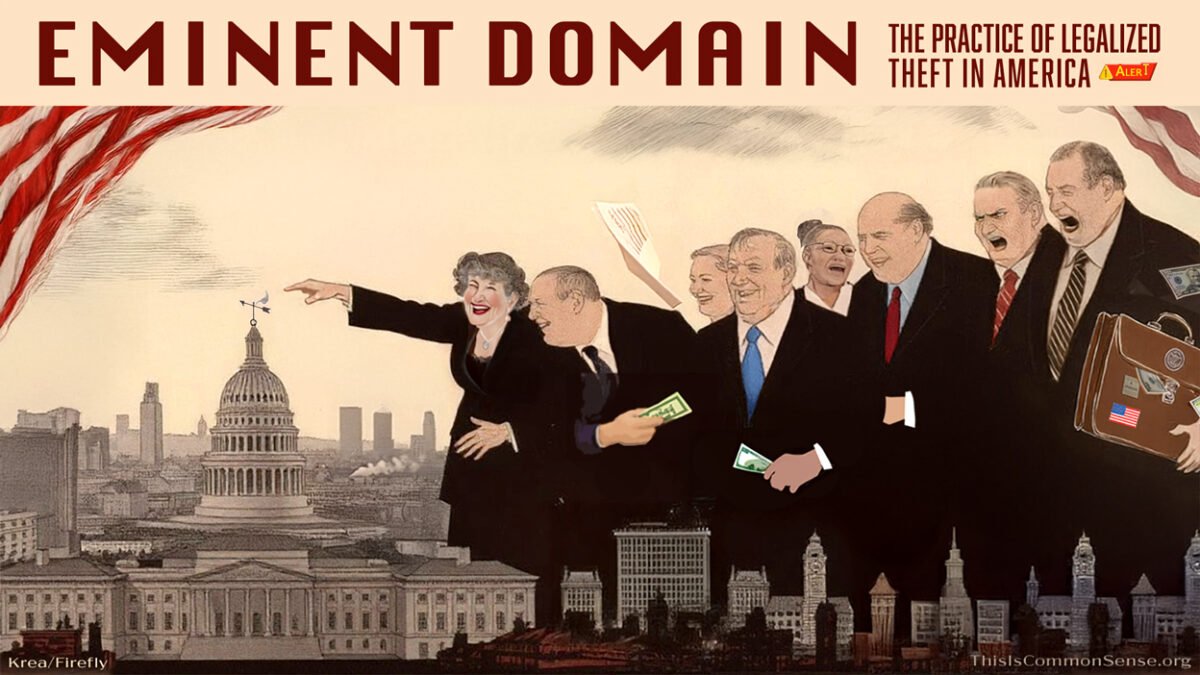
“On March 24, 2025, the Supreme Court of the United States declined to take up the case of Bowers Development, LLC. v. Oneida County Industrial Development Agency Et. Al.,” writes Conner Drigotas, “a decision that allows the practice of legalized theft through eminent domain to continue throughout America.”

This is not good news, as Mr. Drigotas explains. “In that case, Bryan Bowers had asked the Justices to review a ruling from the Supreme Court of New York that allowed Utica city officials to take land on which he had a contract to build and give it to a different private corporation for a separate construction project.” Mr. Bowers had “hoped to stop government officials from using force to pick winners and losers in the construction industry.” But it was a no go.

Politicians and bureaucrats love to grab other people’s property, under cover of “the public interest.” But their “public interest” is nothing more than a thin disguise for helping some individuals (often contributors to politicians’ campaigns) at the expense of others.

“With their denial of Bowers, Justices continued to show support for one of the most hated and notorious decisions to come out of their lofty chambers: that of Susette Kelo v. New London, Connecticut,” explains Drigotas. The Kelo case, often mentioned here, remains the ruling precedent, the government’s license to steal. Its loose construction of what can be regarded as in “the public interest” is a big part of the problem. 

Sadly, the courts have so far refused to rein in government eminent domain abuse. And voters have little sway upon the judiciary. And our representatives, our first line of defense, have also declined to stand up for basic justice and decency.

What to do? Remember that your representatives will soon be on the ballot.

This is Common Sense. I’m Paul Jacob.


PDF for printing

Illustration created with Krea and Firefly

See all recent commentary
(simplified and organized)
See recent popular posts

Categories
education and schooling litigation U.S. Constitution

Education Function Injunction

When President Jimmy Carter broke his 1976 campaign pledge by adding another Cabinet-level department to the federal roster, he swore that a “separate Cabinet-level department will enable the Federal government to be a true partner with State, local, and private education institutions in sustaining and improving the quality of our education system.”

On March 20, 2025, President Donald Trump signed an executive order aimed at shutting down Carter’s Department of Education, fulfilling his campaign promise to reduce federal involvement in education.

This was popular because everybody who’s not a bureaucrat or a teachers’ union agent knows that federal involvement in schooling, since Carter’s time, has been, not just a waste, but a detriment.

Still, teacher union-dominated Democrats are swiping at the administration with numerous lawsuits. U.S. District Judge Myong Joun in Boston issued a preliminary injunction blocking Trump’s layoffs and transfers, ruling that they amounted to an unlawful attempt to dismantle the department without congressional approval. 

Earlier this month, the 1st U.S. Circuit Court of Appeals upheld Joun’s injunction, rejecting the Trump administration’s request to pause the order while appealing. 

Two days later, the Trump administration, through Solicitor General D. John Sauer, filed an emergency appeal with the U.S. Supreme Court. The plea? Lift the injunction and allow the layoffs and reorganization to proceed. Trump’s team argued that the lower court had overstepped its authority and that the layoffs were a lawful personnel action to streamline the department, not an attempt to abolish it without Congress. 

The injunction sent DOE functionaries back to work. Nothing’s been resolved.

Not even the rationales for Carter’s “greatest achievement” (to quote the title of a USA Today op-ed). Carter had promised to reduce the number of departments, for efficiency’s sake. When creating the DOE, he said the move would increase efficiency. 

Instead, it merely increased education spending while academic achievement has plummeted.

This is Common Sense. I’m Paul Jacob.


PDF for printing

Illustration created with Krea and Firefly

See all recent commentary
(simplified and organized)
See recent popular posts
Categories
Fifth Amendment rights U.S. Constitution

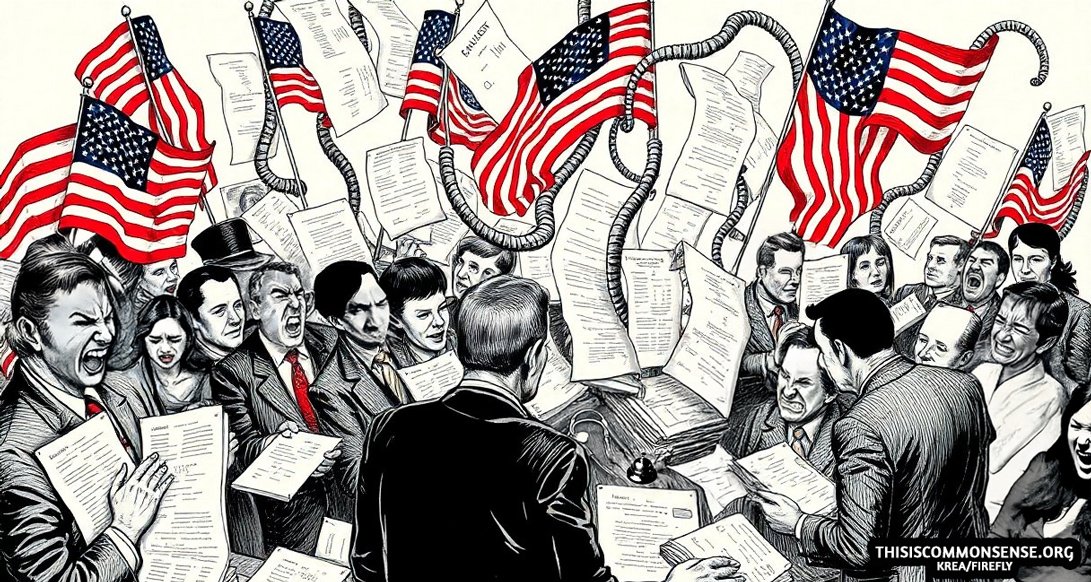
The Hill to Die On

“This is a hill they’re willing to die on,” Sen. Marsha Blackburn (R-Tenn.) told a Fox News audience. The senator was dumbfounded by the Democrats’ support for returning Abrego Garcia, the man deported from Maryland to an El Salvadorean prison.

Former Trump campaign manager and advisor Kelly Anne Conway, substituting for regular host Sean Hannity, opened the program by showing a picture she explained was “Maryland Senator Chris Van Hollen staring affectionally into the eyes of admitted illegal immigrant and accused serial wife abuser and human trafficker with suspected gang ties, who was recently deported to his home country.”

Others claim Garcia is “a loving father and husband,” who “has never been charged with or convicted of a crime in the United States.” 

But whether a dangerous criminal or an innocent, hard-working family man, Garcia’s status is hardly the issue. This is about whether our government must follow its written Constitution. 

In court filings, the Department of Justice acknowledged that Garcia’s deportation was an “oversight” and “an administrative error,” as it violated a previous court order not to send him back to El Salvador.    

A unanimous Supreme Court clarified that the administration is required “to ‘facilitate’ Abrego Garcia’s release from custody in El Salvador and to ensure that his case is handled as it would have been had he not been improperly sent to El Salvador.”

My question is: Why are Trump and Republicans willing to die on this hill? 

It could kill their future political chances. 

I believe in due process, and I vote. 

This is Common Sense. I’m Paul Jacob.


PDF for printing

Illustration created with Krea and Firefly

See all recent commentary
(simplified and organized)
See recent popular posts
Categories
free trade & free markets international affairs tax policy U.S. Constitution

Legal Trade War

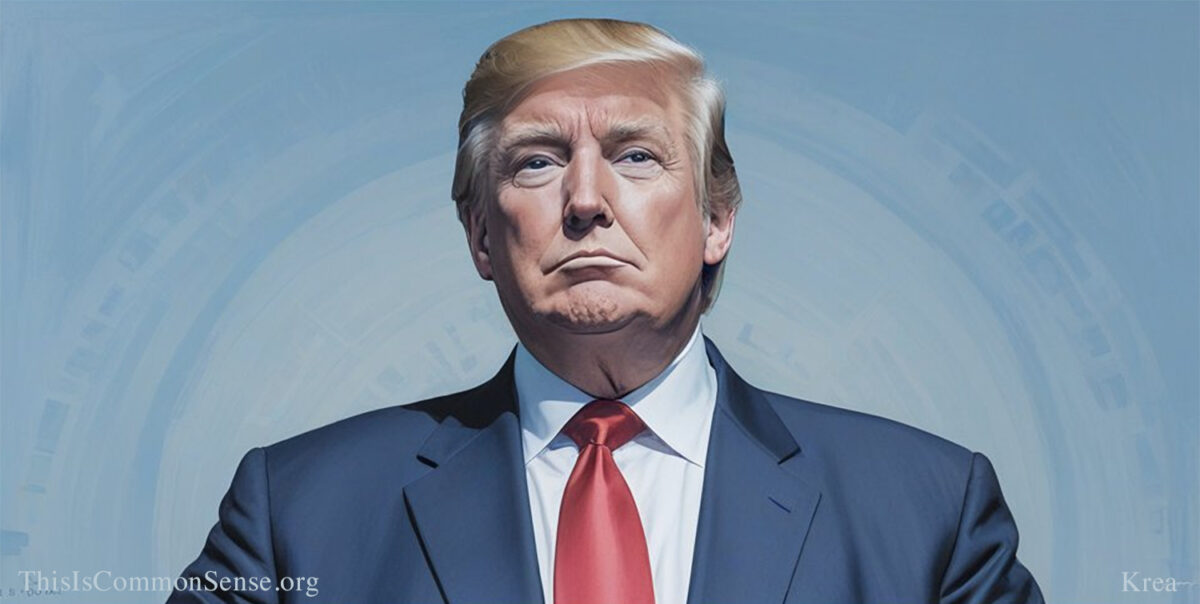
Donald Trump’s imposition and changing of tariffs, all by his lonesome — without Congress — vexes more than a few critics.

His authority to do this, however, derives directly from laws passed by Congress.

The U.S. Constitution gives Congress the power to “lay and collect Taxes, Duties, Imposts and Excises” under Article I, Section 8, which includes tariffs, since they are taxes on imported goods. But Congress has legislated hand-offs to presidents, allowing significant flexibility on tariffs.

The idea seems to be that, as Commander-in-Chief, the president should handle trade because . . . like war, it has to do with foreign countries.

Laws allowing presidential discretion include Section 232 of the Trade Expansion Act, Section 301 of the Trade Act of 1974, and the International Emergency Economic Powers Act of 1977. 

The first says that the president has broad discretion to define as threats to national security all sorts of things and then impose tariffs and other trade restrictions in response.

The 1974 legislation authorizes further along Trump’s favored line, the power to retaliate against “unfair” foreign trade practices.

The IEEPA grants sweeping powers in a declared national emergency.

So if free traders and others are alarmed at Trump’s seemingly dictatorial powers regarding tariffs, it isn’t new. It has been built into the Imperial Presidency. While Congress could take its constitutional authority back, there is certainly no groundswell to do so.

Also not new?

What setting up high tariffs have historically done: elicit similar tariffs in retaliation. 

Yikes: the kind of trade war that made the Great Depression “great.”

This is Common Sense. I’m Paul Jacob.


PDF for printing

Illustration created with Krea and Firefly

See all recent commentary
(simplified and organized)
See recent popular posts

Categories
First Amendment rights U.S. Constitution

Chalk One Up for Equal Treatment

“The government may not enforce the laws in a manner that picks winners and losers in public debates,” ruled Judge Neomi Rao. 

This, in response to a case where anti-abortion protesters were arrested for chalking the words “Black Pre-born Lives Matter” on a Washington, D.C., street back in 2020.

Emma Camp makes clear, in her Reason coverage of the ruling, that the case is not as simple as it may sound in the headlines. “While writing chalk messages on public streets and sidewalks is considered vandalism in D.C., protest leaders had an earlier conversation with a police officer in which he ‘explained that he believed Mayor Bowser had effectively opened up the District’s streets for political markings.’”

Nevertheless, during the protest, “police told demonstrators that they would be arrested if they painted or chalked any messages.” Two individuals in the pro-life protest defied police order and scribbled their message in chalk.

It’s actually a bigger issue than just an altercation during a protest. The police in D.C. had not merely looked the other way, allowing helter-skelter displays of “Black Lives Matter” graffiti, but the city government had actually gotten in on the act and messaged “Black Lives Matter” on the streets itself — in bold paint.

This obviously sends a message to disagreeing citizens: we are on this side, not that.

As Judge Rao insists, “The government may not play favorites in a public forum — permitting some messages and prohibiting others.”

She interprets this injunction as pertaining to the First Amendment, but it goes much deeper than that, reaching to the core idea of a rule of law, and equality of treatment under it.

This is Common Sense. I’m Paul Jacob.


PDF for printing

Illustration created with PicFinder.ai and DALL-E2

See all recent commentary
(simplified and organized)
See recent popular posts

Categories
Accountability national politics & policies U.S. Constitution

Facing the Debt with Deceit

The “trillion dollar coin” solution to the federal debt reared its absurd head, again, during the recent “debt ceiling” brouhaha.

I wrote about it over ten years ago, when Big Talkin’ Republicans were challenging Big Spendin’ Democrats over raising the debt ceiling at that time. 

The idea is bold trickery, allowing the President to inflate the currency by leveraging Treasury’s Congress-given ability to coin platinum coins at any face dollar value. 

Typically, such collector coins sport on the reverse a value far below the metal’s value.* The trillion dollar coin would invert that, fixing the face value far, far above the metal value. The freshly minted coin would be sent to the Federal Reserve, covering the books that way.

It’s inherently deceptive and obviously ridiculous.

Thus it symbolizes contemporary politics quite aptly.

After the recent budget compromise that forestalled any real work of marshaling the federal government’s scarce (if astoundingly awesome) financial resources, however, the trillion dollar coin has been shelved.

For now.

Indeed, Democrats are tiring of the debt ceiling brinksmanship game. And it is mostly posturing. “Democrats have introduced a bicameral proposal to overhaul the debt ceiling process, leaning heavily into the recent default scare to push a bill that would essentially let Treasury ignore the debt cap and continue writing cheques with no limit,” explains The Epoch Times.

Would this any be better than the fake coin?

Perhaps more honest.

But, once again, it would be Congress giving away its authority. 

And until Congress can restrain its spending habits, we, the people, will always come up tails.

This is Common Sense. I’m Paul Jacob.


* On the day I checked, the spot price for an ounce of platinum was just over $1000, and the face value on the American Platinum Eagle remained $100, the ratio being a tenth of metal value.

trillion dollar coin, debt, Congress, folly

PDF for printing

Illustration created with Midjourney and DALL-E2

See all recent commentary
(simplified and organized)
See recent popular posts
Categories
national politics & policies term limits U.S. Constitution

The Demand for Term Limits

Lots of talk about term limits last week — in Washington. 

Of all places. 

What bizarre chain of events caused career congressmen to start jawboning and horse-trading about the popular reform that most of them viscerally oppose?

It was the work-product of a small number of hardcore conservative Republican legislators, a mere 20, flexing their strength and commitment at a critical political point — the election of the House Speaker — and armed with concrete demands.

“We offered Kevin McCarthy terms last evening that he rejected,” Rep. Matt Gaetz (R-Fla.) told reporters last Tuesday. One of those? “We’ve sought a vote in [the] first quarter of the 118th Congress on term limits.”

By week’s end, however, McCarthy had been elected Speaker of the House . . . but only after having pledged to bring to the floor that congressional term limits amendment, authored by Rep. Ralph Norman (R-SC), one of the 20 holdouts, along with making other concessions

Meet the Press host Chuck Todd yesterday cast shade on the effort, calling these “show votes.” 

While it’s true that incumbents are unlikely to vote for the term limits amendment in the 2/3 supermajority the Constitution requires, or for the balanced budget amendment for which the holdouts, mostly Freedom Caucus members, also secured a commitment from McCarthy. 

“We’ve got to start taking steps to make fundamental change in America,” Rep. James Comer (R-Ky.) told Todd. And putting every U.S. representative on record on term limits sounds like a great first step for early 2023.

Worth the battle.

This is Common Sense. I’m Paul Jacob.


PDF for printing

Illustration created with Midjourney

See all recent commentary
(simplified and organized)
See recent popular posts

Categories
general freedom media and media people U.S. Constitution

We’ll Keep It

An answer is warranted. 

When a former president of these United States asks a question of such magnitude, as Donald J. Trump did last week on Truth Social, how can we not respond?

“So, with the revelation of MASSIVE & WIDESPREAD FRAUD & DECEPTION in working closely with Big Tech Companies, the DNC, & the Democrat Party,” Mr. Trump inquired, “do you throw the Presidential Election Results of 2020 OUT and declare the RIGHTFUL WINNER, or do you have a NEW ELECTION?”

Trump is, presumably, referring to Elon Musk’s recent release of information about FBI communications with Twitter during the 2020 campaign, with the Feds suggesting that stories about the Hunter Biden laptop were likely Russian disinformation — even though the FBI knew at the time that that it was Hunter’s laptop. For the FBI to work to discourage media platforms from providing such information to the public is deceptive and wrong. It should be investigated and, depending on the evidence, prosecuted to the full extent of the law. 

Such collusion is even more destructive of our democratic system when done with partisan political motives. Which may now be SOP at the Bureau.  

So, let’s answer Mr. Trump’s questions. “No,” per declaring him the winner and sending President Biden packing. And a no-go on a new election. Of course, there is one in 2024, and Trump is a declared candidate.

Yes, the news media is largely dishonest, drunk with their power and deluded into thinking they should keep information from us if it might make us vote contrary to their desires. Moreover, the Deep State is actively colluding with them (and vice-versa) to warp public opinion. 

Trump argues that this new information “allows for the termination of all rules, regulations and articles, even those found in the Constitution.” He’s dangerously mistaken.

Who would “terminate” these laws and constitutional provisions? His dear friends in Congress, The White House, the FBI and DOJ? Unelected judges — who’ve already ruled against his campaign? A mob, pray tell?  

No, thanks. That Constitution? We’ll keep it. 

This is Common Sense. I’m Paul Jacob. 


PDF for printing

Illustration created with DALL-E2

See all recent commentary
(simplified and organized)
See recent popular posts