Categories
property rights tax policy thoughtNew

Two Horrors Don’t Make It Right

The mayor of New York City, commie Mamdani, is trying to raise more money to pay for his socialism.

One scheme is to punish owners of a second home by imposing a so-called “pied-à-terre tax,” a tax on the second residence of wealthy New Yorkers above and beyond regular property taxes.

Now, the assumption that anybody with a second home, or an expensive second home in an expensive property market, must be rolling in liquid funds is faulty. The notion that if you have more wealth than somebody else it should be taken from you? Also faulty.

The new tax bill is going to many New Yorkers with only one home. And the website set up (speaking loosely) to permit challenges of the designation of one’s home as a pied-à-terre is proving nightmarish to navigate.

One recipient of an extra-tax bill, for $43,000, is Karen Young, who has lived in her brownstone with her husband for thirty years. Two minutes of research would have prevented the mistake, she observes. “Is this a witch hunt?”

New assaults on our rights often have two parts. One part is really horrific. The other part is even more horrific in some other way. The greedy government may eventually withdraw or correct the even more horrific form of the assault; at which point everybody is relieved . . . except anyone noticing that the first form, also horrific, and serving as precedent, is still ongoing.

Was that the game plan here?

This is Common Sense. I’m Paul Jacob.


PDF for printing

Illustration created with Nano Banana

See all recent commentary
(simplified and organized)
See recent popular posts

Categories
international affairs national politics & policies regulation tax policy

How to Lower Gas Prices

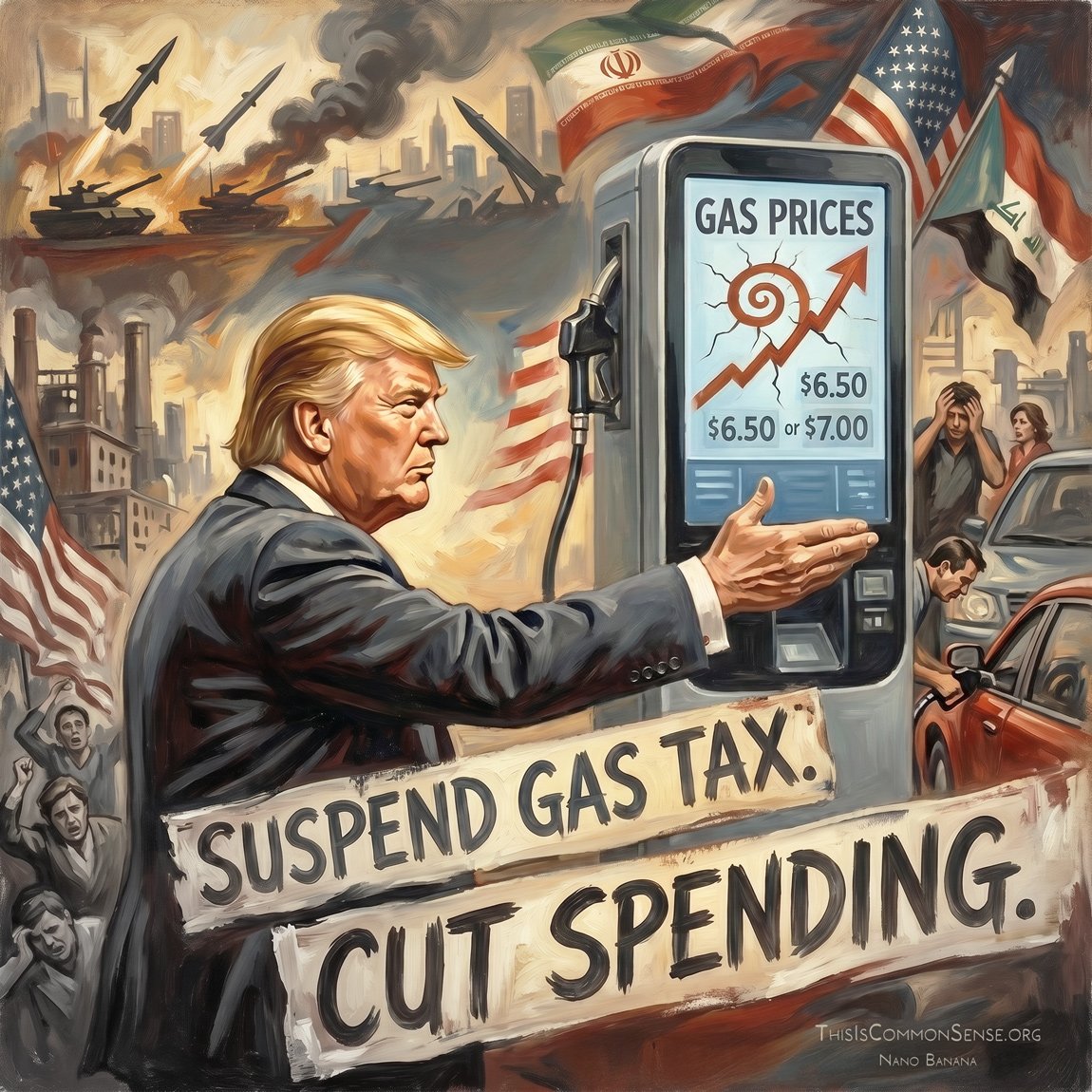
Gasoline prices have skyrocketed. The Iran War is to blame, but the President has not been able to bring it to an end.

Still, he has offered a small fix. A federal gas tax suspension!

In its favor, this temporary measure would offer some relief. In addition, the federal government shouldn’t be attaching an excise to fuel sales anyway. The states already burden our fuel bills with their own taxes.

As if to seize a political win, Senator Josh Hawley (R.-Mo.) declared he will introduce a bill to enact that suspension.

Cutting off a source of revenue would increase the deficit, of course. But there is a simple solution to that: spend less. For example, the fuel taxes are supposed to fund road repairs. All but two percent of U.S. roads are state roads now. During the emergency, suspend the two percent spending on repairs and let the 98 percent of spending carry on, as it does now, at the state level.

Adam N. Michel at Cato argues that the best way to spend less would not only reduce the deficit but also lower gas prices: end the Iran War. 

And not just rhetorically. 

But Michel and his Cato colleagues offer a more politic plan, too: don’t merely suspend the tax, end the tax forever and end the highway spending burden along with it. “States know what their infrastructure needs are,” he contends, “and they have the fiscal tools — gas taxes, sales taxes, user charges, debt, and privatization — to meet them without a federal middleman.” 

Before October, Congress is supposed to re-authorize the federal highway program. Don’t. Dismantle it all. 

For good.

This is Common Sense. I’m Paul Jacob.

PDF for printing

Illustration created with Nano Banana

See all recent commentary
(simplified and organized)
See recent popular posts
Categories
initiative, referendum, and recall tax policy too much government

The New Property-Tax Revolts

Decades after a famous revolt by California homeowners led to the relief provided by Proposition 13, taxpayers acting to resist sky-high property taxes are making waves throughout the country.

Just a few of the many examples reported by The Epoch Times:

Ohio. The elderly couple who paid off the mortgage on their home long ago but cannot now afford the property taxes is one reason that people are signing a statewide petition to eliminate local property taxes. It will take about 413,000 signatures, collected by a July 1, 2026 deadline, for the measure to reach the November ballot.

Florida and Texas. Legislators in Florida and Texas hope to limit the “flexibility” that local governments enjoy in how they raise revenue.

Minnesota and North Dakota. Lawmakers are pushing a cap on property tax increases tied to inflation and population growth. Voters would have to agree to any change in the cap. Recent school-board driven increases of 8 or 9 percent would be limited to 3 or 4 percent in typical scenarios.

Montana. Lawmakers want a two-percent limit on tax hikes for “local government spending but not for schools, which consume about 55 percent of property tax revenues.” A fatal flaw? Public schools are better at bloating costs than improving education.

The author observes that 46 states and D.C. already impose some sort oflimits on local property tax increases — though “their designs and restrictiveness differ widely,” adds the Tax Foundation.

Let’s improve those designs and increase the restrictiveness ASAP.

This is Common Sense. I’m Paul Jacob.


PDF for printing

Illustration created with Nano Banana

See all recent commentary
(simplified and organized)
See recent popular posts

Categories
budgets & spending cuts deficits and debt tax policy

The Beast Cometh

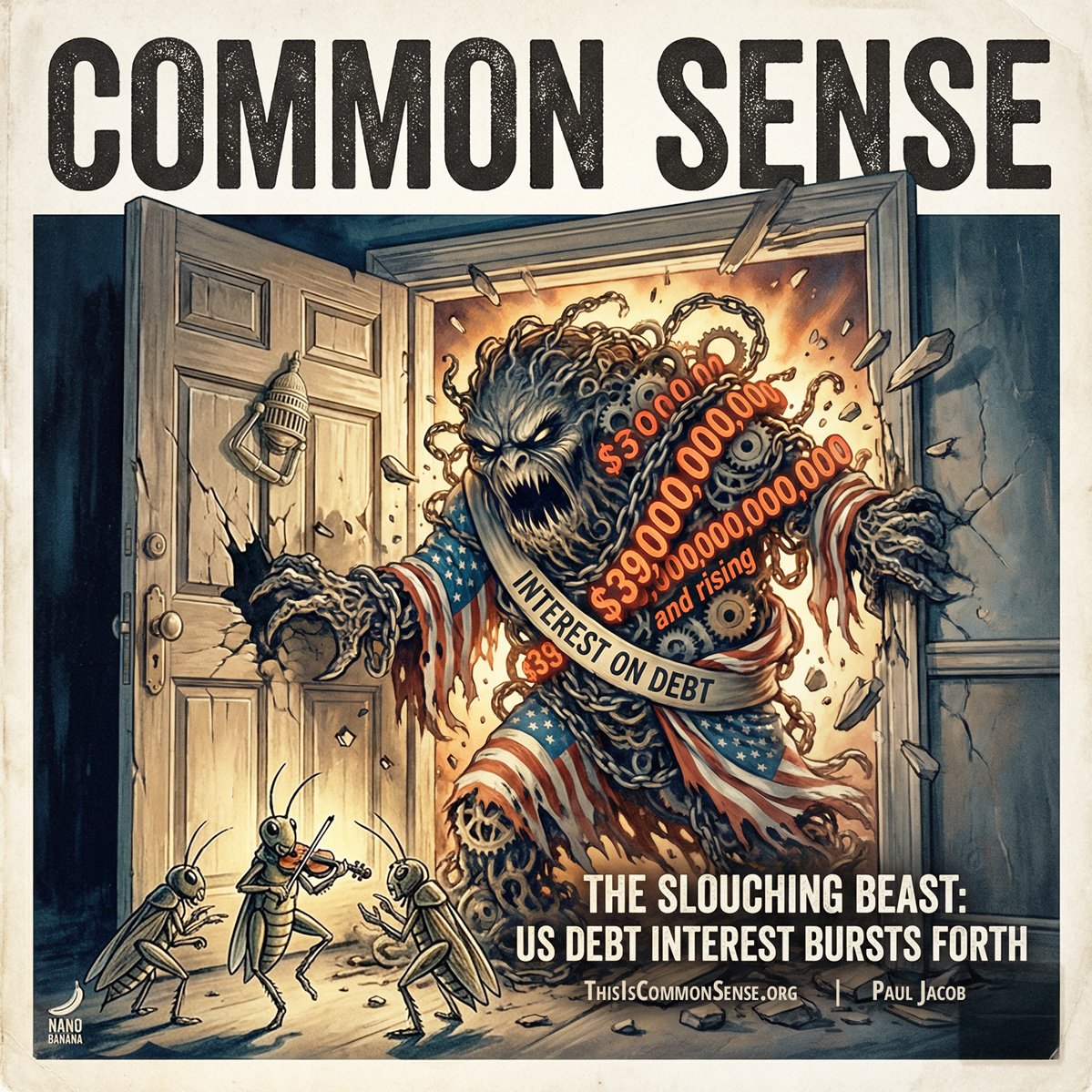
As the U.S. Debt Clock ticks towards $39 trillion, a predictable but horrible beast slouches towards us, ready to knock on the door. Or, rather, burst through.

The federal debt hit $38.8 trillion this weekend: it’s $38,830,051,666,666 as I type these words on Sunday.

But that’s not the beast. 

This year’s annual deficit is $1.9 trillion.

But that’s still not the beast.

The Congressional Budget Office warns that the debt-to-GDP hits 120% by 2036 — above post-WWII peak.

That isn’t the beast either.

The beast is the interest on the debt, and the service charge the government must regularly make merely to keep the borrowing going.

Net interest payments will be over one trillion smackeroos this fiscal year. That rivals or exceeds spending on defense/veterans in many breakdowns — those payments are projected to double to over two trillion per year by 2036. 

It’s the fastest-growing line item. 

It’s non-discretionary. 

And it compounds; the beast only gets bigger.

And with it any hope for tax relief goes out the window. Just last week the president, reacting to the Supreme Court decision in Learning Resources v. Trump, floated what amounts to a revenue-directed tariff, and under normal circumstances voters could not unreasonably demand, say, an offsetting 15 percent reduction in income taxes, across the board.

Nothing like that is in the offing. Not because tax cuts wouldn’t be a big win for the tariffer-in-chief, but because any extra revenue might be more cost-effectively thrown as debt service at the American holders of $31 trillion in federal debt.

This is as bipartisan an issue — and failure — as anything can be, yet the bipartisan response?

Crickets.

This is Common Sense. I’m Paul Jacob.


PDF for printing

Illustration created with Nano Banana

See all recent commentary
(simplified and organized)
See recent popular posts

Categories
defense & war tax policy U.S. Constitution

The Emergency Tariff Question

As is often the case in Supreme Court decisions, in Learning Resources v. Trump it is the dissenters’ views that are most interesting. 

At issue? The president’s authority to impose tariffs, or alter them. Donald Trump — a life-long tariff proponent — took the International Emergency Economic Powers Act (IEEPA) as an excuse to levy broad new duties on imports from multiple countries. That act delegated to the executive the power to use tariffs as emergency foreign policy measures.

On February 20, the majority on the court gave a decisive No to the President’s use of IEEPA to impose tariffs.*

I generally oppose Congress delegating powers to the executive branch and support free trade. But what does the Constitution actually say? Could dissenters Kavanaugh, Thomas and Alito have a point?

Kavanaugh’s humungous written opinion claims that tariffs are a traditional, common, and lawful means of “regulat[ing] . . . importation” in foreign-policy crises; he says the majority’s narrow reading ignores text, history, precedent, and the special deference due the President in external affairs. “The text of IEEPA authorizes the President to regulate importation,” explains Kavanaugh, “and tariffs are a means of doing so.”

Thomas stresses that IEEPA’s emergency-declaration process provides political accountability, so judicial second-guessing is unwarranted. Further, he argues that from the Founding, “regulate importation” has always included duties; early Congresses and Presidents (Monroe, Jackson, etc.) routinely delegated and adjusted tariffs. While matters of rights cannot be delegated, Thomas argues that privileges can, and have, and that this has long been recognized in constitutional law.

The key question, as Kavanaugh advances, is the balance of power. “Congress retains the ultimate authority to clarify, amend, or repeal IEEPA,” he reasonably asserts, “if it believes the President’s exercise of emergency powers has gone too far.”

This issue became a federal court case because Congress is dysfunctional.

Which puts the issue back in our lap. Where voters can have some control. How? Through elections, pressure, or pushing . . . term limits.

This is Common Sense. I’m Paul Jacob.


* Other avenues may remain open. And Trump is jumping on them.

PDF for printing

Illustration created with Nano Banana

See all recent commentary
(simplified and organized)
See recent popular posts
Categories
ideological culture media and media people tax policy

Post California Soaking

Rumors that Washington Post owner Jeff Bezos has been pushing the Post in a more commonsensical editorial direction could very well be true.

A recent Post editorial slams progressives who “think of taxation the way teenage boys think about cologne: if some is good, more must be great.”

I’m no fan of even a moderate amount of that brand of cologne. But anyway. The Post is discussing a proposed ballot measure backed by the ultra-lefty Service Employees International Union.

SEIU troops are currently collecting signatures. And before they’ve even gotten enough to post it to ballot, the people being targeted have started moving. 

Out of state.

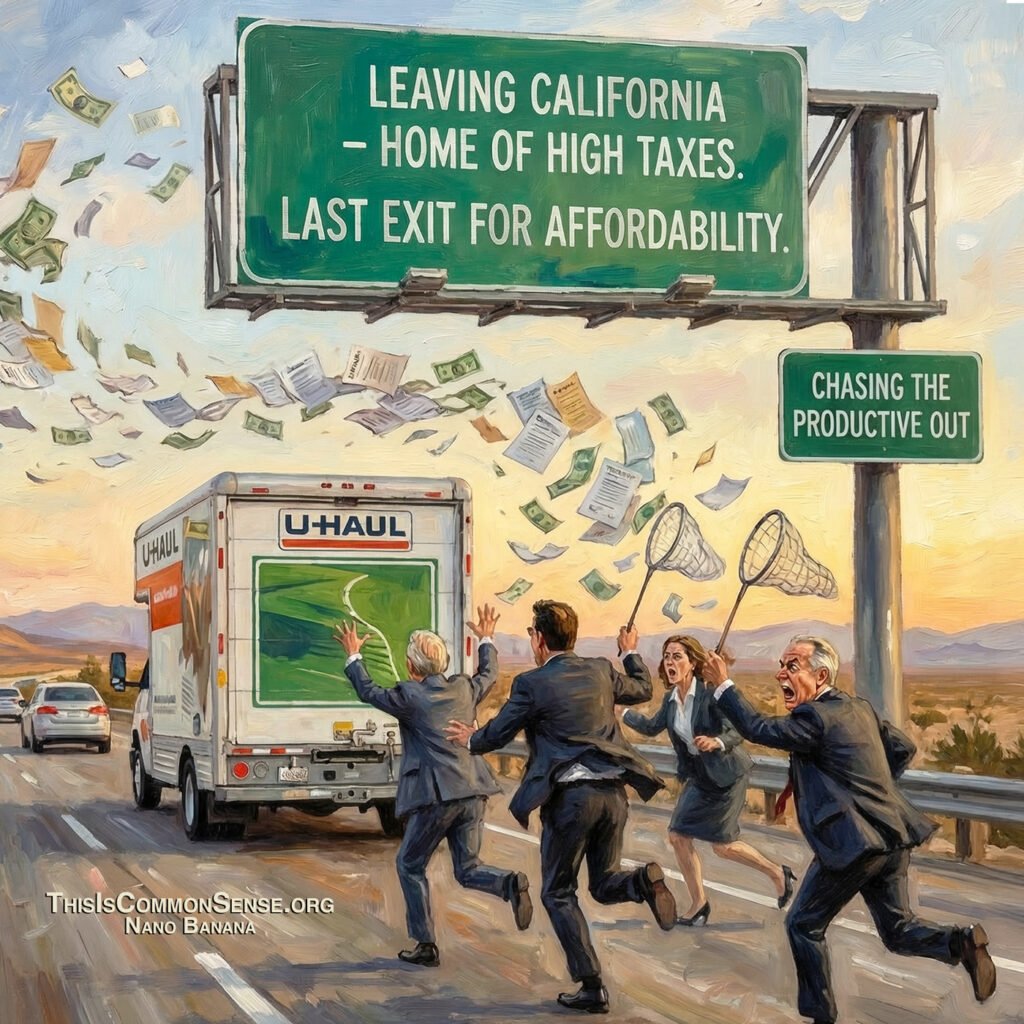
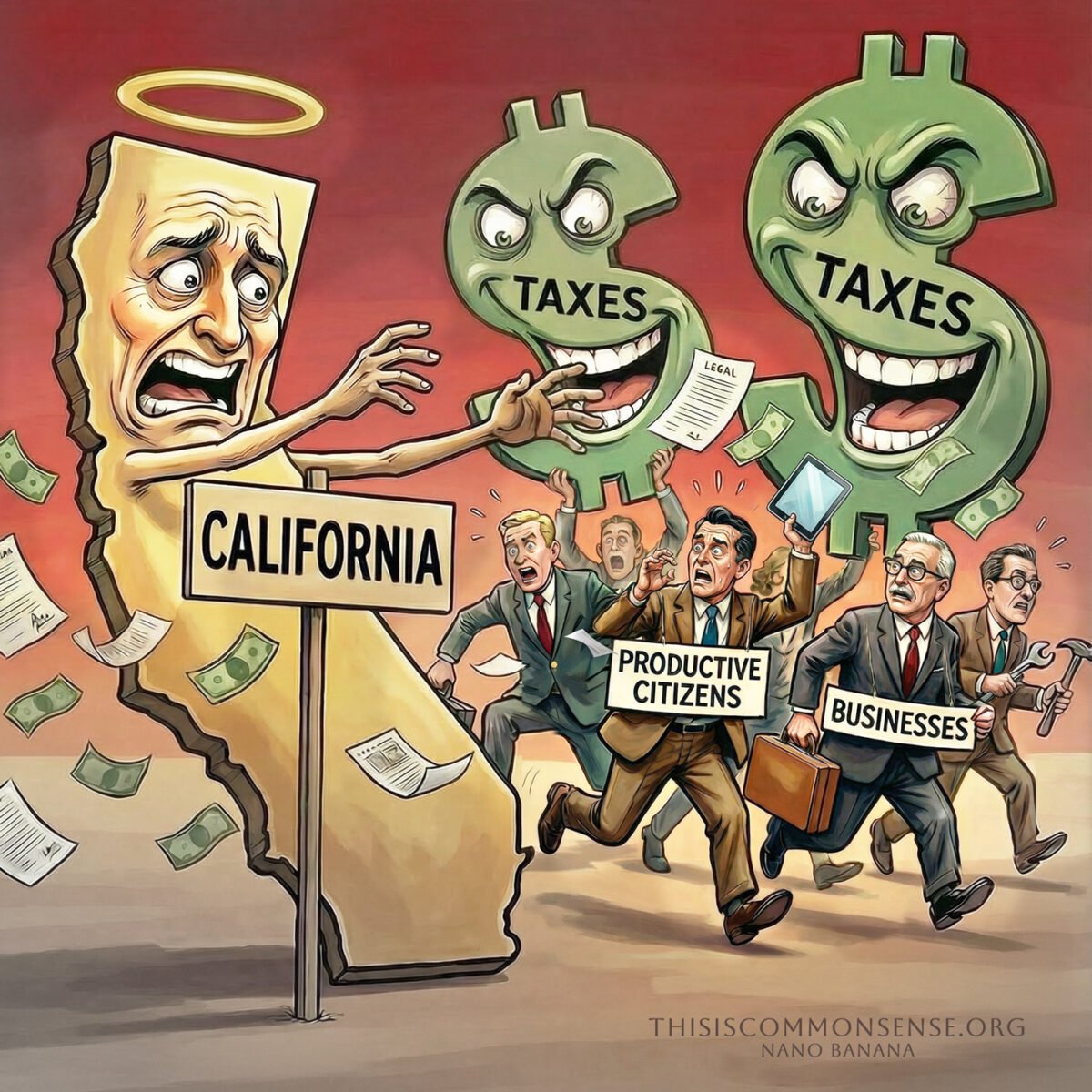
The measure would impose a new 5 percent tax on billionaires. Some of the state’s billionaires, including Google cofounder Larry Page and Palantir cofounder Peter Thiel, aren’t willing to wait and see whether it actually reaches the ballot and passes in November. Why? The measure would apply retroactively “to those who were California residents on January 1, 2026.”

Some Democratic lawmakers are saying “good riddance,” as if it’s possible to loot billionaires who don’t wait around to be looted. Or that it’s good for state coffers to lose their billionaire entrepreneur “contributors.”

The Post says the retroactivity would open the measure to legal challenges, but that if it gets passed and survives litigation, “it’s a safe bet this won’t be a one-off. Funding ongoing expenses like health care with one-time taxes isn’t sustainable. Progressives will want to return to the well until they’ve sucked it dry.”

And no one should know better than Californians how dangerous dry wells are.

This is Common Sense. I’m Paul Jacob.

PDF for printing

Illustrations created with Nano Banana

See all recent commentary
(simplified and organized)
See recent popular posts

Categories
property rights tax policy

Tax Assessor, House-Nabber

In 1994, Scott Pung won exemption from a school tax. He died in 2004. But years later, a local tax assessor contended that his widow, now also deceased, should have submitted new paperwork to retain the exemption.

Pacific Legal Foundation observes that according to state law, “the exemption continues as long as family members continue to live in the home. . . . Based on her misreading of the law, the tax assessor retroactively denied the exemption for several previous years.”

The estate’s administrator, Mike Pung, got nowhere trying to explain things to the tax assessor. So he brought his case to the Michigan Tax Tribunal. The tribunal ruled in favor of the Pungs.

Didn’t matter. When Mike paid the property taxes for 2012, the assessor called it an underpayment, since payment for the tax that the Pungs did not owe had not been included.

Mike still refused to pay the school tax. So the county grabbed the home that it had assessed at $200,000 and auctioned it for $76,000 to recover the amount of that tax.

With PLF’s help, the Pungs ultimately received $73,000 of this amount, less than half the home’s assessed value. Now PLF is headed to the Supreme Court to make the case for further compensation.

Chances are good. Two years ago, the Supreme Court affirmed in other PLF litigation that local governments “are not allowed to abuse the tax system to take more from families than is owed.”

Or not owed.

This is Common Sense. I’m Paul Jacob.


PDF for printing

See all recent commentary
(simplified and organized)
See recent popular posts
Categories
tax policy

Hating One’s Own Tax Hikes

It’s terrible, the high taxes these days, Maine Senate President Mattie Daughtry decries. Look at property taxes. We must fix this!

“Property taxes just keep going up,” Daughtry lamented on social media. So “first-time homebuyers can’t take the plunge . . . and older Mainers struggle to afford staying in the towns they know and love. . . . We’re setting up a Property Tax Task Force. They’ll provide suggestions to the legislature. Then legislators can use their findings to pass laws that make living in Maine sustainable for EVERYONE in our state.”

Steven Robinson, editor-in-chief of the Maine Wire, points out in his Robinson Report that Daughtry herself is a big reason for the problem she now supposedly wants to remedy.

Her hand-wringing over high taxes is, he says, “borderline psychopathic behavior and true gaslighting — akin to O.J. Simpson standing over some stabbing victims and filming a TikTok video demanding an explanation for how they ended up dead. . . .

“On two occasions just this year Daughtry has celebrated — yes, celebrated! — taxes going up on working Mainers.”

Daughtry and other Democrats passed LD 2012, a bill to repeal the limit on municipal property tax levies. As the bill itself said right up front, “property taxes may increase.”

The Senate leader is not exactly apologizing for her tax-and-spend ways to date, so maybe her giddy gaslighting has something to do with seeking higher office. Who knows. 

But at least with Steven Robinson in the neighborhood, she isn’t getting away with her phony baloney scot-free.

This is Common Sense. I’m Paul Jacob


PDF for printing

Illustration created with Krea and Firefly

See all recent commentary
(simplified and organized)
See recent popular posts

Categories
free trade & free markets regulation tax policy

The New Old Coke

The President of these United States famously drinks Diet Coke.

Despite his preference, however, it’s regular Coca-Cola he’s making waves about.

“I have been speaking to Coca-Cola about using REAL Cane Sugar in Coke in the United States, and they have agreed to do so,” Donald Trump wrote on Truth Social last week. 

The Atlanta-based company has confirmed the story, but it will not be removing High Fructose Corn Syrup (HFCS) Coke from the market. 

What will change? 

“Mexican Coke” (made from refined cane sugar) is available in glass bottles right now, for a premium, in many venues. In effect, Trump is merely helping promote this currently U.S.-made product, allowing it to sit next to regular Coke just as aspartame-sweetened Diet Coke competes on the shelf with Coke Zero, which is made with a blend of artificial sweeteners, including aspartame and acesulfame potassium (Ace-K).

Maybe all Coca-Cola will really do is re-brand Mexican Coke.

To “Trump Coke”?

“I’d like to thank all of those in authority at Coca-Cola,” added the president. “This will be a very good move by them — You’ll see. It’s just better!”

Matters of taste aside, cane sugar may be marginally healthier for you than HFCS. Invented in the Fifties and Sixties in labs, it has been pushed by the USDA, which regulates its prices (as Matt Damon’s 2009 comedy The Informant! makes clear). But both are sugar, if slightly different, chemically.

Behind the proposal to switch to HFCS lies a broader reality: domestic refined cane sugar production from states like Hawaii, Florida, and Louisiana falls short of U.S. consumption needs, while protectionist policies keep its price significantly above global market levels.

For some reason, Donald Trump hasn’t been talking about reducing the sugar tariff!

This is Common Sense. I’m Paul Jacob.


PDF for printing

Illustration created with Krea and Firefly

See all recent commentary
(simplified and organized)
See recent popular posts
Categories
free trade & free markets international affairs tax policy

The Tariff King

The fight over the president’s tariffs is taking place in Congress. 

Or is it?

“House Republicans blocked on April 9 an effort by Democrats to force a vote on halting the reciprocal tariffs imposed by President Donald Trump,” explains The Epoch Times, “which are currently paused for three months.”

Let’s make that clearer. These now-infamous/much-debated “reciprocal tariffs” went “into effect” immediately after midnight yesterday. As Republicans “sneakily” worked to change the rules to disallow any congressional move to dissolve the president’s declared emergency — which, by Congress’s own legislation, gives the executive a great deal of latitude to change tariff rates — and Democrats moved to do just that, get rid of the “state of emergency,” President Trump put most of his tariff hikes on hold for three months.

Except for those on China — now in effect, at a rate of 125 percent.

It sure looks like Trump’s main concern is trade relations with China, not Lesotho or Israel or anywhere else. And much can be said about China’s trade policies (try selling American consumer goods in China) or respect for intellectual property. But it is the matter of constitutionality that interests me most.

Whatever the alleged merits of high tariffs, unilateral free trade, or any of these issues, these policies should not be decided by the president; the Constitution gives Congress the responsibility “to lay Taxes, Duties, Imposts and Excises” and “regulate Commerce with foreign Nations.”

By handing the president “emergency” powers to change tariff policy in the first place, Congress has abdicated its role in setting tax policy. Republicans in the House seem gung-ho about Trump’s prerogatives. And Democrats haven’t sought to repeal the International Emergency Economic Powers Act, which gives the president legislative taxing authority.

Apparently, Congress wants the president to be king.

This is Common Sense. I’m Paul Jacob.


PDF for printing

Illustration created with Krea and Firefly

See all recent commentary
(simplified and organized)
See recent popular posts