Categories
national politics & policies subsidy tax policy

The New Hollywood?

It may be the president’s goofiest idea yet.

His Monday brainstorm was for the federal government to get into the movie business. In a Truth Social post, Mr. Trump floated the notion of creating a “Federal Production Incentive to create Entertainment Jobs in America.” So this isn’t exactly a socialist proposal — where the government would seize the means of production and go about making movies — it’s a subsidy proposal: tax breaks; to “benefit ALL of America.”

Trump posts as if he has worked the math out, where the booty the government loses in direct taxation “will be made up tenfold by the money pouring into the Treasury’s coffers.”

A familiar rationale. But does it work? Do tax credits incentivize producers so much that taxes downstream of the productions make up for all the bother and paperwork?

Well, no need for theory. States already have such programs.

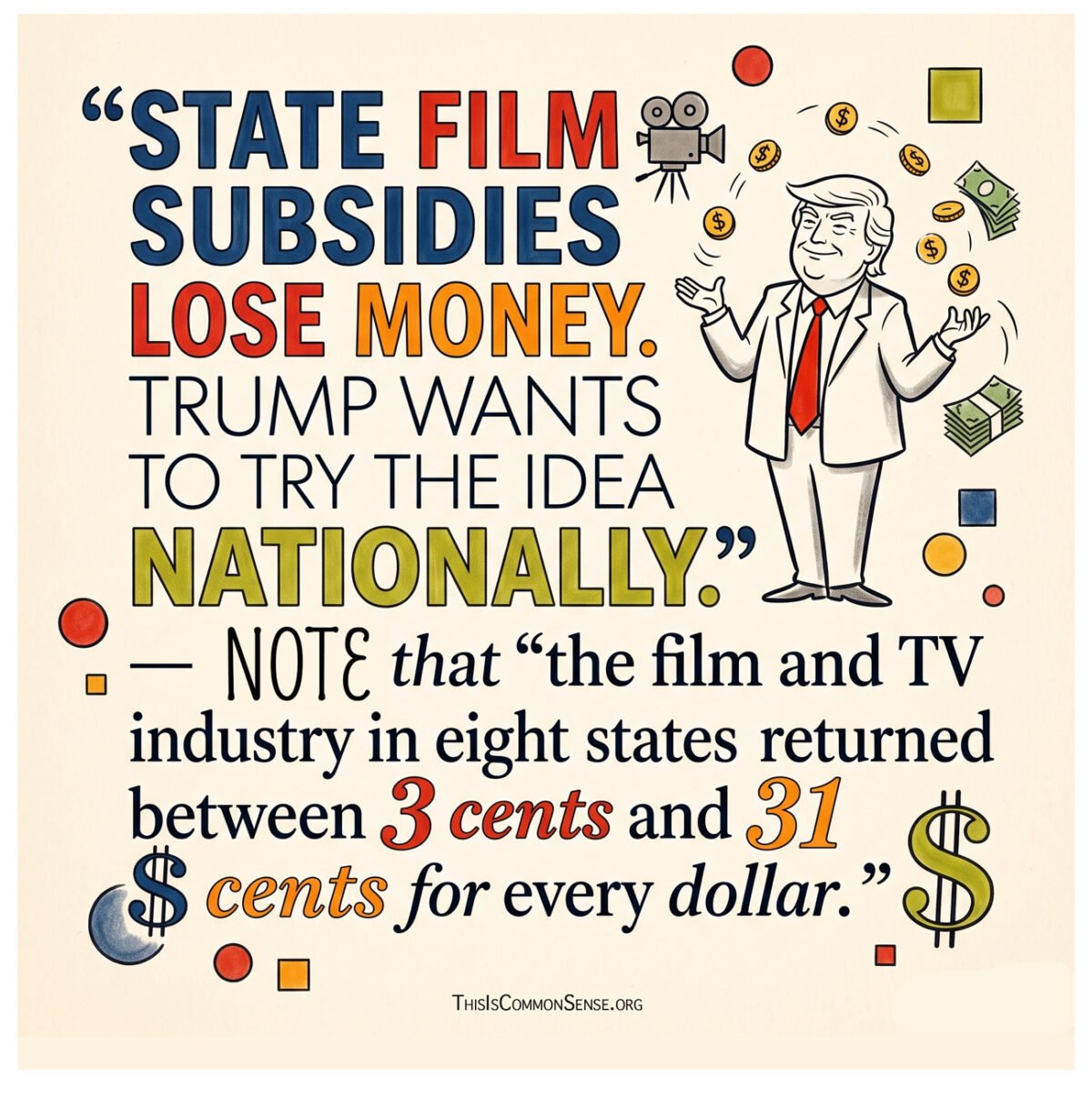
Tosin Akintola, in his Reason article — “State Film Subsidies Lose Money. Trump Wants To Try the Idea Nationally.” — found that “the film and TV industry in eight states returned between 3 cents and 31 cents for every dollar.” 

Entertainment projects do not create that many jobs.

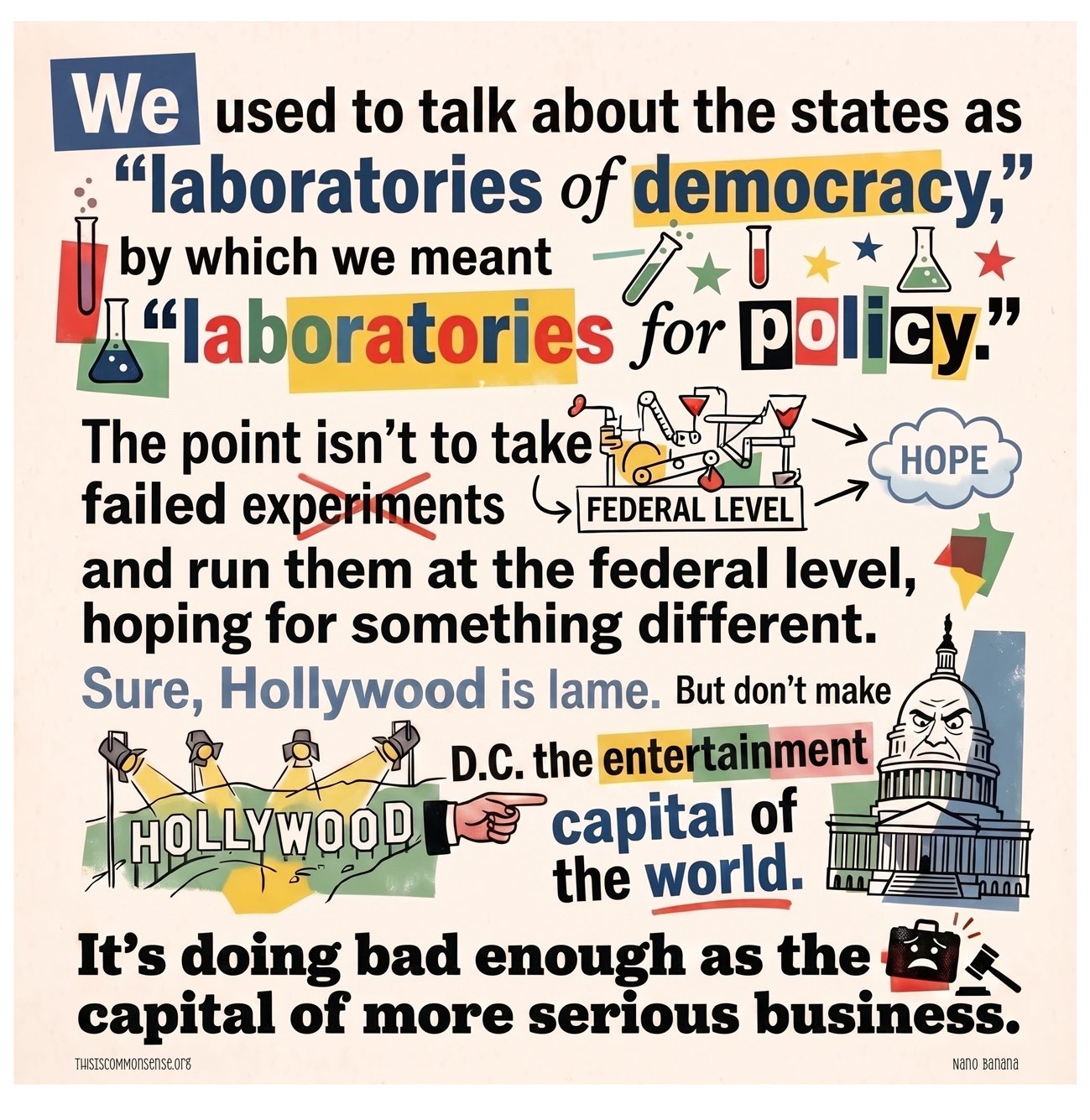
We used to talk about the states as “laboratories of democracy,” by which we meant “laboratories for policy.”

The point isn’t to take the failed experiments and run them at the federal level, hoping for something different.

Sure, Hollywood is lame. But don’t make Washington the new entertainment capital of the world. It’s doing bad enough as the capital of more serious business.

This is Common Sense. I’m Paul Jacob.
Hollywood, entertainment, Washington DC, democracy, subsidy, tax break

PDF for printing

Illustration created with Nano Banana

See all recent commentary
(simplified and organized)
See recent popular posts
Categories
folly ideological culture media and media people

Deep Dark Truthful Mirror

At my advancing age, I couldn’t stay up late enough to watch Hollywood’s winners grab their Oscars and punctuate their rambling, teary-eyed acceptance speeches by hurling brickbats at President Trump.

The Donald will have to defend himself for perverse statements such as heard on the Access Hollywood tape: “[W]hen you’re a star . . . You can do anything.” Live by the stars, die by the stars.

Still, consider: how much more effective would those Hollywood (snoozed-through) scoldings be had these cultural “icons” voiced similar disfavor against President Bill Clinton’s similar actions.

Regardless of the precise Clintonian “is”-ness of “is,” clearly “hypocrisy” is up in lights in Tinseltown.

Another seeming Hollywood double-standard strolls down the red carpet unimpeded: the gender pay gap. “Compared to men, in most professions, women make 80 cents to the dollar,” actress Natalie Portman said last month. “In Hollywood, we are making 30 cents to the dollar.”

Much ballyhooed and largely erroneous, the national gender wage gap compares the median male income against the median female income out of hundreds of millions of workers, without regard to jobs done, hours worked, or levels of experience. Conversely, leading roles in a movie can more fairly be compared.

The North Korean hack of Sony Pictures revealed numerous cases where female stars were paid far less than their male counterparts. For instance, in the film No Strings Attached, Ashton Kutcher, Portman’s male co-star, received compensation three times greater.

Yesterday, at Townhall, I asked a simple question: Wouldn’t it better serve the interests of fairness and equality were actors to muster whatever truth to be had directly at the Hollywood power structure . . . sitting before them in the ballroom?

This is Common Sense. I’m Paul Jacob.


Printable PDF


Categories
ideological culture

The New Hollywood Blacklist

Hollywood folks often boast about their tolerance and liberality. Maybe they should look up those words.

Our national myth-makers especially like to go over the horrors of the McCarthy “Blacklist” period, when the power of government nudged studio owners to blacklist writers and actors and directors who were (or were associated with) Communists.

Almost no one likes blacklists. Indeed, the McCarthy period censorship did much to harm the anti-communist movement.

But don’t look for such subtleties of judgment from Hollywood today. After all, there is a working blacklist right now.

This time, though, there’s no pressure from Congress or regular Americans for this form of censorship. Hollywood players serve as their own censors, maintaining their blacklist by shunning those they don’t agree with politically.

Take the case of J. Neil Schulman. He was an up-and-coming writer in the ’80s. The people at L.A. Law really liked his proposals. But he had the gall to write an op-ed they didn’t approve of, favoring the right to gun ownership, so the L.A. Law folks dropped him like a hot potato, and spread the word. “Too right-wing,” they said.

Dan Gifford tells the tale on Big Hollywood. It’s an interesting story. You can see why the new blacklist is more effective than the old: It’s tacit, hush-hush. There are no hearings, interviews, what-have-you. But the effect is pretty much the same as the McCarthy Era blacklist: Chilling.

This is Common Sense. I’m Paul Jacob.