Categories
representation

What We Want and How to Get It

British-American philosopher Mick Jagger put it best: “You can’t always get what you want.”

A universal verity.

But what about a sadder situation? “You must always get what you don’t want.”

Only the deepest pessimist thinks this pertains to our lives, our “lived experience” in even these our mixed-up times. But it does apply to one huge domain of life: our representation in Congress.

Or so says Stephen Erickson. “The American people consistently rank career politicians among the least trustworthy professions. At the same time, professional politicians are supposed to represent us, and they have more power over our lives than any other profession.”

I don’t think this needs to be argued. Though Mr. Erickson does cite evidence, the thesis hardly needs massive data sets. Or British-American philosophers. So what to do? Erickson, being a practical man, takes the bull by the bumps on its head, two of them:

“First, we need to show how representative democracy might work without professional politicians.” The basic proposal is to “Reduce all local electoral districts to no more than 10,000 residents” where “every district becomes walkable and winnable with handshakes, flyers and yard signs.” This would work because small districts turn politics into “personal reputations and relationships, not money and marketing. Special interests therefore lose their influence.”

His second show-and-tell is “a realistic path forward.” That path lies with “the citizens’ initiative and referendum.”

As readers of this column know, my support for this more direct approach is both long-standing and thorough-going. The initiative process is the only decent process for serious reforms of our representative system because our representatives will block serious reform otherwise. 

Please read Stephen Erickson’s essay, “How to Eliminate Politics as a Profession.”

No one wants to be their Beast of Burden.

This is Common Sense. I’m Paul Jacob.


PDF for printing

Illustration created with Grok Imagine

See all recent commentary
(simplified and organized)
See recent popular posts
Categories
election law litigation partisanship

Un-Redistricting Virginia

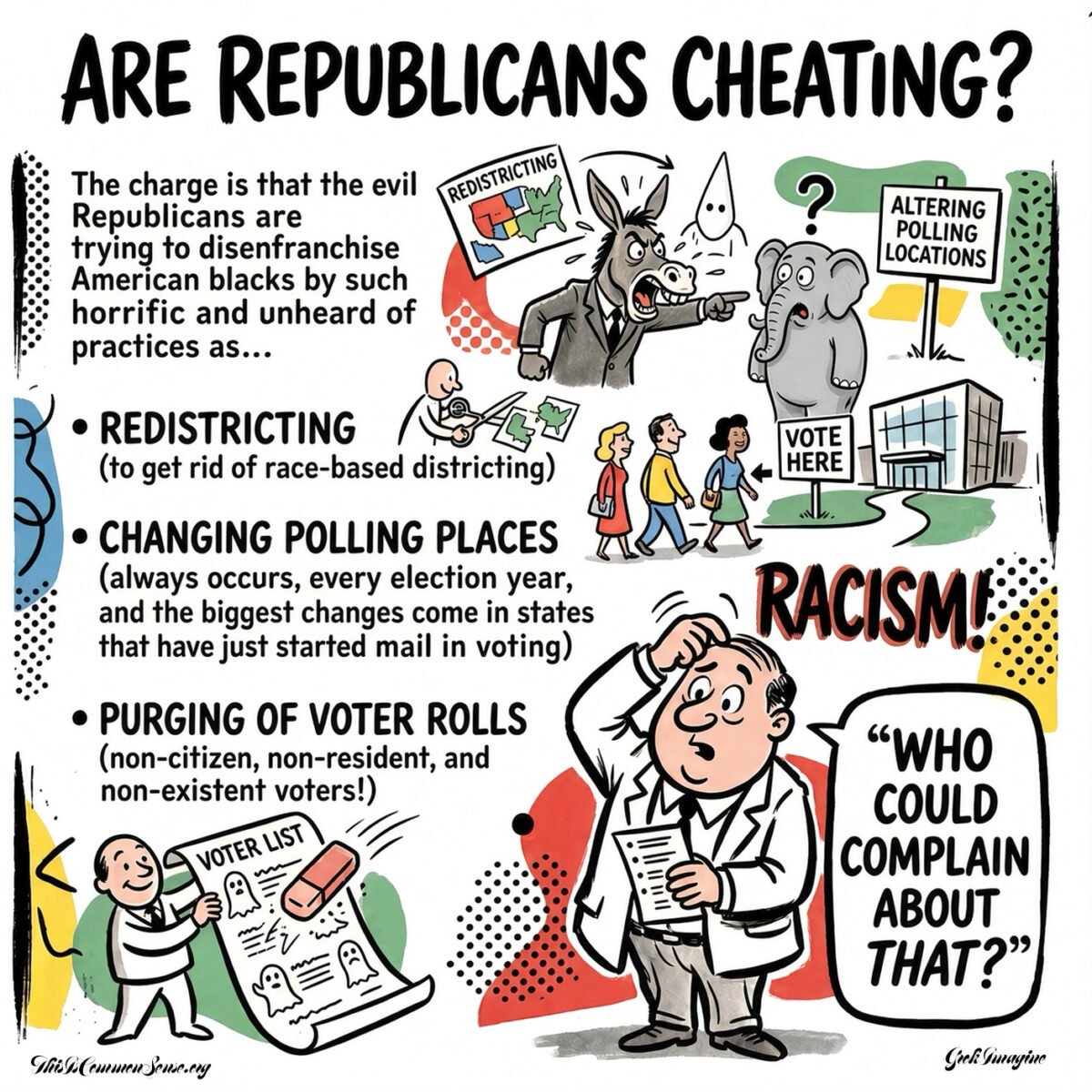
A circuit court has ruled that Virginia’s new voter-passed congressional map, gerrymandered to give Democrats in the state a prohibitive advantage in the next congressional election, is unconstitutional.

Judge Jack Hurley, of the Circuit Court of the Commonwealth of Virginia for the 29th Judicial Circuit, Tazewell County, denied a motion to stay his injunction blocking certification of the election using the new districts. Former Virginia attorney general Ken Cuccinelli reports that once a final order is drafted and entered, “it will be immediately appealed.”

If the rejiggering survives the challenge, it could be the factor that tips the balance in the House of Representatives toward the Democrats next November.

Cuccinelli, who is now national chairman of the Election Transparency Initiative, had been saying that passage of the gerrymander would not be the last word. In their rush to get the measure to voters and enacted before November 2026, lawmakers ignored sundry constitutional requirements.

The 2024 special session that took up the redistricting measure had been convened to legislate about the budget. “Its governing resolution limited the session’s scope. Expanding it to include a constitutional amendment on redistricting required a two-thirds vote that never occurred.”

Also, says Cuccinelli, the state constitution requires that “an election must intervene between first and second passage” of a proposed constitutional amendment. “Here, first passage occurred during an election cycle — not before an intervening one.”

Among other problems is the constitutional stipulation that “every electoral district shall be composed of contiguous and compact territory.” The proposed map violates this requirement “badly.”

When you’ve got to go, you’ve got to go, and this partisan map must go.

This is Common Sense. I’m Paul Jacob.


PDF for printing

Illustration created with Grok Imagine

See all recent commentary
(simplified and organized)
See recent popular posts
Categories
election law U.S. Constitution Voting

Noncitizen Voting Q&A

Question: What stops the California Assembly from allowing noncitizens to vote in federal elections?

Answer: Nothing. 

Noncitizens are now voting in two major California cities: San Francisco and Oakland. Legally. Including those in the country illegally.

And California courts have upheld the constitutionality, after San Francisco’s law was challenged. 

Voting in the Golden State doesn’t have to be limited to U.S. citizens.

So, it’s not all that far-fetched to think California’s legislature might one day pass a statute allowing noncitizens to vote in state legislative elections. Maybe in Maryland, too, where 16 cities now have legal and illegal aliens voting. Or Vermont, where a legislative supermajority overrode the governor to say yes to three cities giving the vote to noncitizens. Legislation has been introduced in both New York and Connecticut, in recent years, to give noncitizens the vote in those states’ legislative elections.  

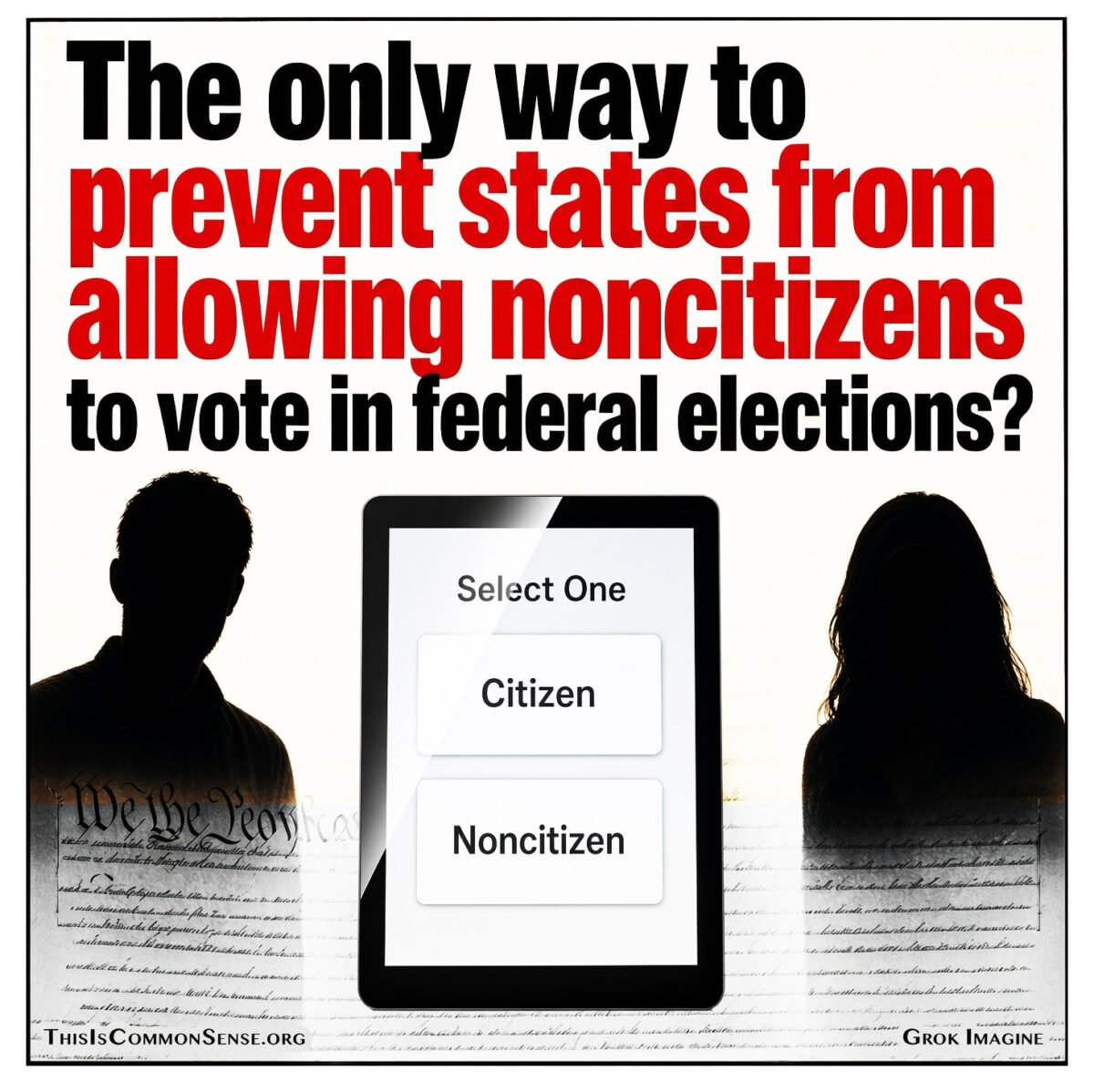
“The Constitution is clear,” law professor Bradley Smith wrote Monday in The Wall Street Journal, “Under Article I and the 17th Amendment, any person who is allowed to vote in a state legislative election is automatically also allowed to vote for members of Congress.” 

In other words, the federal statute that purports to ban noncitizen voting in federal elections has a hole in it big enough to drive, say, the state of California through. 

“A federal statute can’t trump the Constitution’s explicit, exclusive grant of power to each state to determine who is eligible to vote,” explained the professor. 

. . . “even if the SAVE America Act were passed. . . .

“Although no state allows noncitizens to vote for its legislature,” Smith said, “that could change.” 

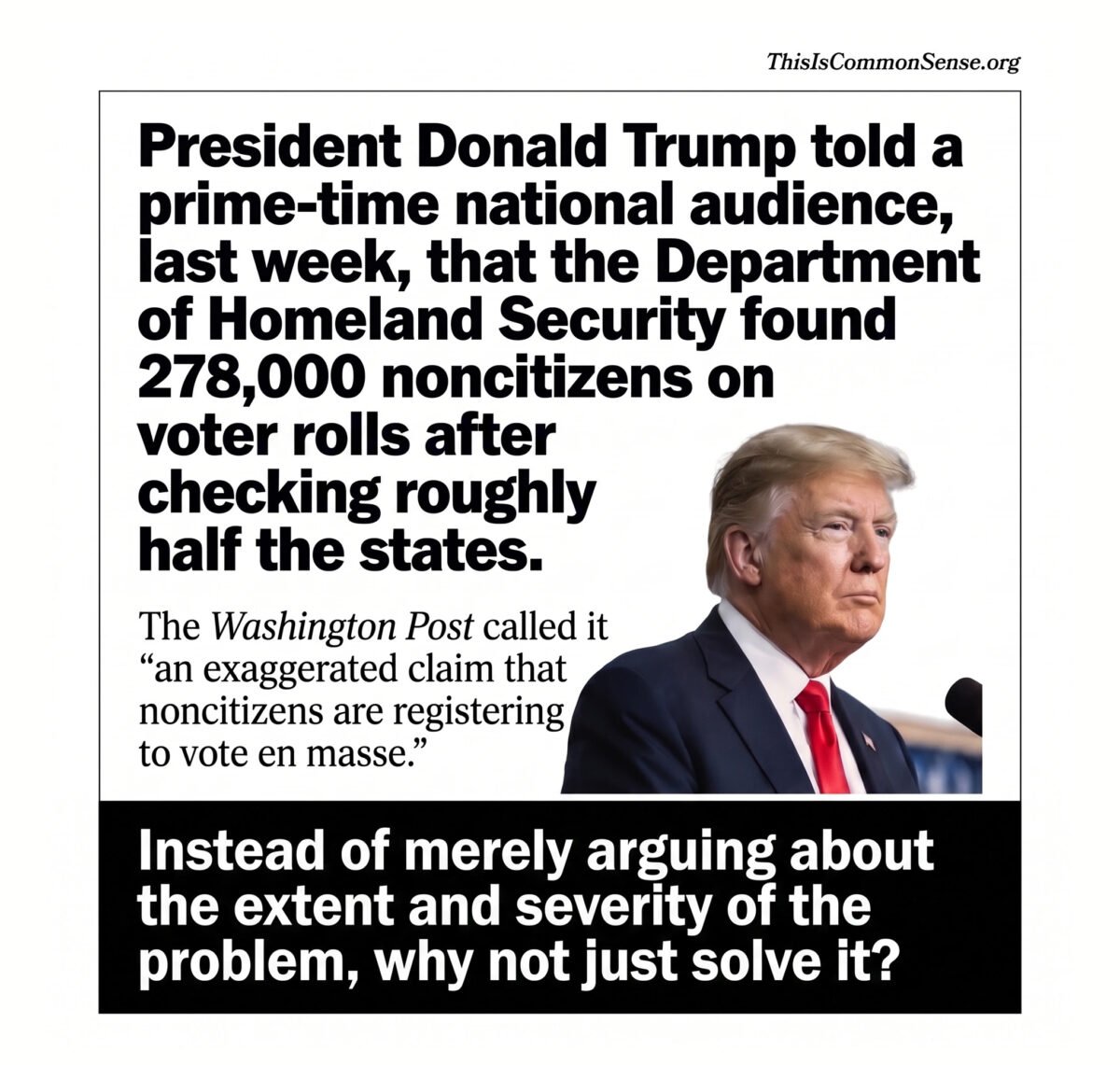
We need a constitutional amendment in this 250th year of our Republic because only citizens of the United States should vote in federal elections. Rep. Laurel Lee (R-Fla.) just introduced it.

This is Common Sense. I’m Paul Jacob. 


PDF for printing

Illustration created with Nano Banana

See all recent commentary
(simplified and organized)
See recent popular posts
Categories
initiative, referendum, and recall partisanship

Gerrymandered Hypocrisy 

“Gerrymandering is detrimental to our democracy,” declared Virginia Governor Abigail Spanberger . . . back in 2019.

“Let voters decide, not politicians,” former President Barack Obama offered just last month. 

The problem? They’re correct!

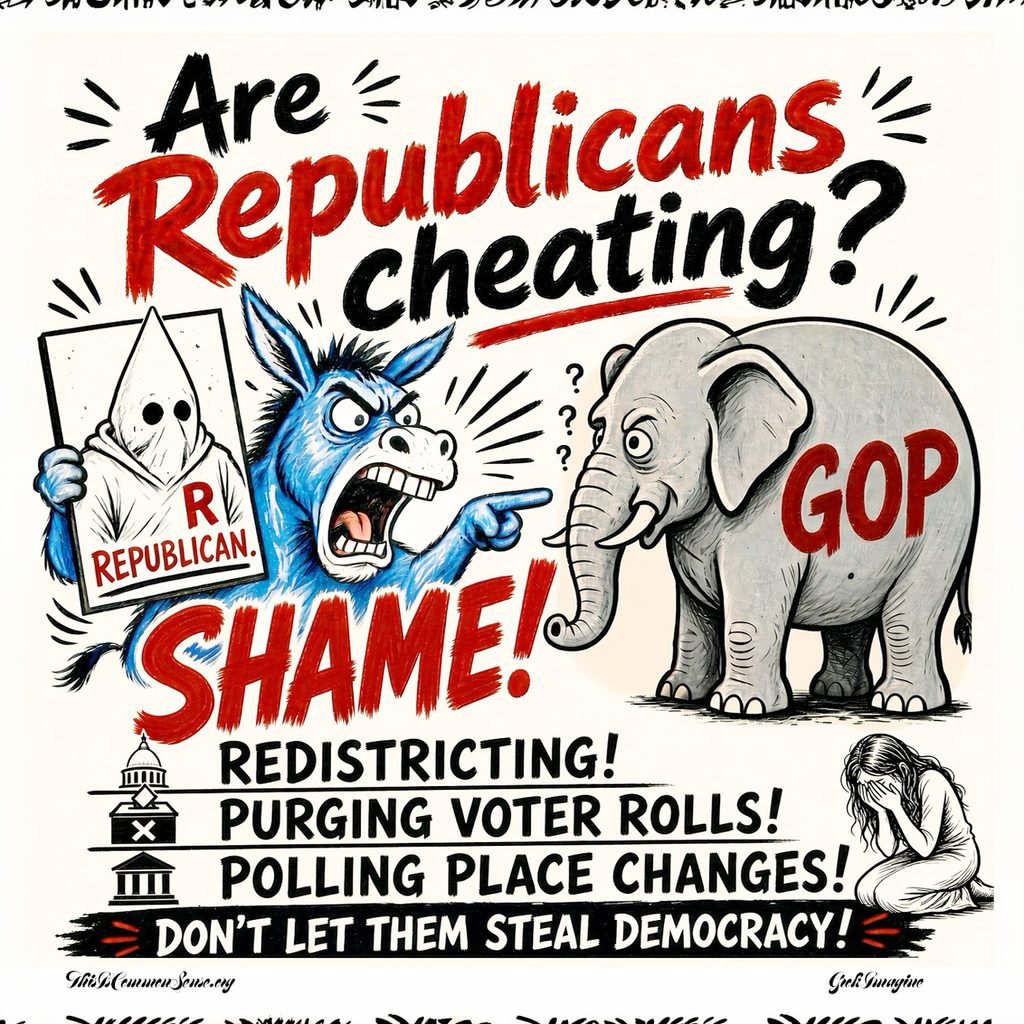
And Republicans are now sharing the statements by these two high-ranking Democrats with Virginia voters. Why? They oppose the April 21 constitutional referendum that, if passed, would allow the legislature to gerrymander the state’s congressional district lines to likely turn the federal delegation from its current six- to five-seat Democratic majority into a ten to one Democratic majority.

How dare opponents repeat the precise words previously uttered by Spanberger and Obama as Virginians go to the polls!

WUSA-TV in Washington, D.C., headlined its report: “Anti-redistricting mailers in Virginia are misleading, critics warn.”

“This has been misconstrued,” explained Gaylene Kanoyton, the Political Action Chair for the Virginia NAACP. “This does not pertain to these unusual, unprecedented times that we are in right now.”

“It is true they made these statements years ago,” a fellow from my hometown was quoted, “but the situation has changed.”

“They don’t like it because we’re exposing their leaders for their hypocrisy,” argues former Republican Delegate A.C. Cordoza with Justice for Democracy PAC. 

Democrats can of course blame Republican gerrymandering efforts in other states to justify their own, but it is a race to the bottom for voters. 

But, as I pointed out last week, Democrats deserve all the blame. The language on the ballot is completely slanted, telling voters the measure will “restore fairness.” This is so outrageous that even the liberal Washington Post editorialized last month that “Democratic politicians are presenting the proposed amendment to voters in the most brazenly dishonest way imaginable.”

Partisans will always be self-serving. But can’t they even try not to appear blatantly hypocritical?

This is Common Sense. I’m Paul Jacob.


PDF for printing

Illustration created with Nano Banana

See all recent commentary
(simplified and organized)
See recent popular posts
Categories
initiative, referendum, and recall partisanship

Against Fairness?

I’m against fairness?

Nah, it’s just Democrats who think that, because I won’t vote for their proposed constitutional amendment allowing the legislature to redraw my state’s congressional districts. 

The official question on the April 21 ballot reads: “Should the Constitution of Virginia be amended to allow the General Assembly to temporarily adopt new congressional districts to restore fairness in the upcoming elections, while ensuring Virginia’s standard redistricting process resumes for all future redistricting after the 2030 census?”

What, exactly, is “fair” about this amendment? 

“If approved, Virginia’s 11 districts would likely go from six Democratic to five Republican leaning seats to 10 Democratic seats and one Republican seat,” explains WJLA, ABC’s Washington, D.C., affiliate. “The new map would draw heavily blue urban areas in Northern Virginia, with rural Republican areas far away.”

Democrat House Speaker Don Scott argues that “levels the playing field.” 

Well, it would be a fairer map if the commonwealth’s electorate were comprised of 90 percent Democrats and less than 10 percent Republican voters. Yet, in 2024, Democrat Kamala Harris garnered just 51 percent of Virginia’s vote for president. Even in last year’s blowout gubernatorial election, Democrat Abigail Spanberger won only 58 percent. During that campaign, Spanberger expressed skepticism of this district map . . . but then, as governor, signed on. 

Democrats, always selective in applying “fairness,” are outspending Republicans “by about 14 to 1 on advertising” and holding the vote for this constitutional question early, in April, with low voter turnout expected — for the first time in state history.

In the minds of Democrats, this maneuver is fair because President Trump has urged Republican states to engage is such partisan redistricting. That’s their case.

But arguments in favor of a measure do not belong in the wording voters see on their ballot as they make their decision. 

That’s unfair.

This is Common Sense. I’m Paul Jacob. 


Note: In the quoted ballot question, emphasis added.

PDF for printing

Illustration created with Nano Banana

See all recent commentary
(simplified and organized)
See recent popular posts
Categories
election law initiative, referendum, and recall local leaders

Obscenely Unacceptable

“F*ck this sh*t.”

That’s how the erudite opponents of Michigan’s Citizen Only Voting Amendment responded to supporters submitting a petition with more than 750,000 voter signatures to place the measure on the November ballot. 

Sans the asterisks, actually, which I supplied.  

Back in 2022, these oppositionists, fraudulently calling themselves Voters Not Politicians (VNP), helped politicians weaken Michigan’s voter-enacted term limits. 

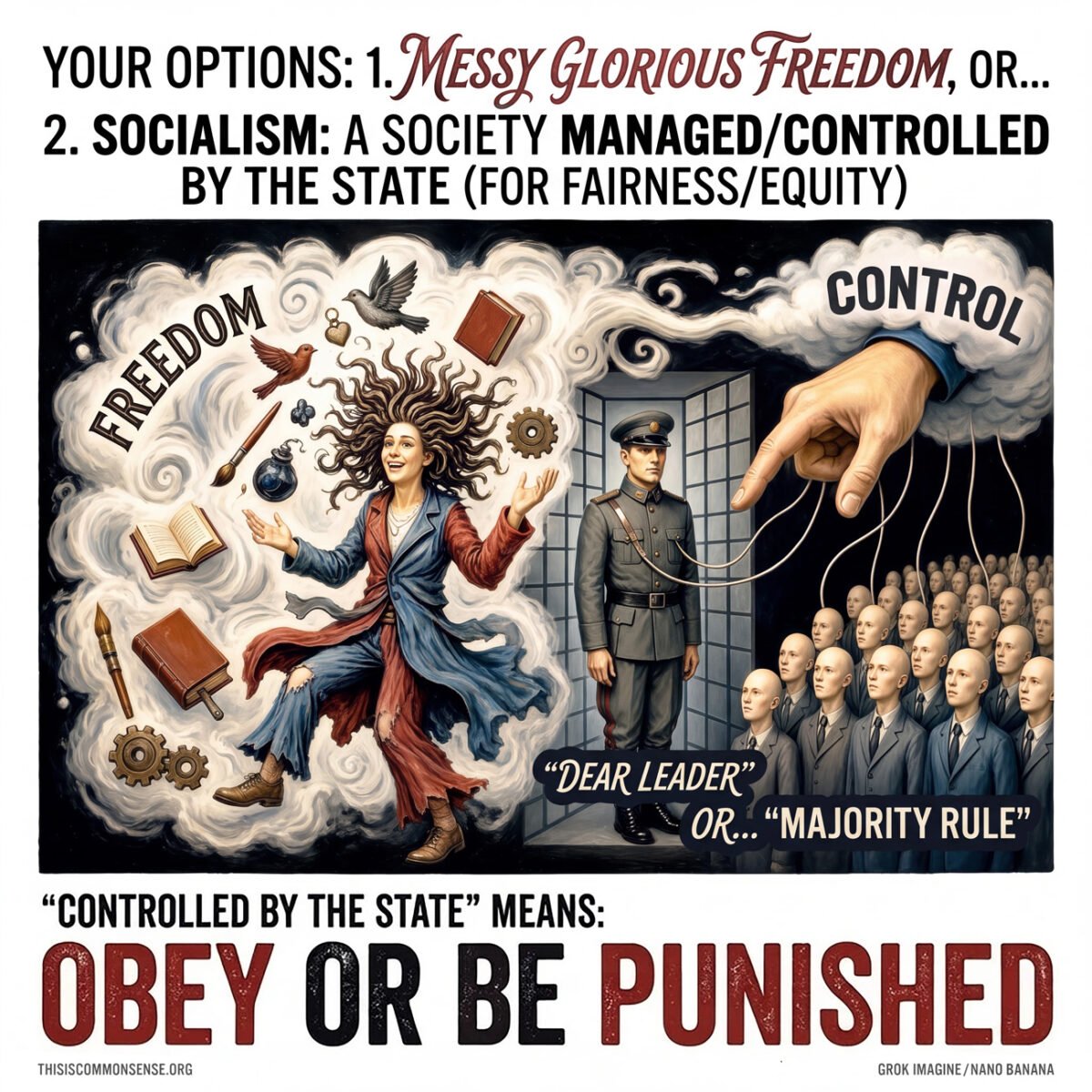
Now they’re fighting an initiative that I’m promoting, which would: (1) clarify that only U.S. citizens are eligible voters at the state and local level, (2) mandate that the Secretary of State check the voter rolls to ensure it contains only citizens, and (3) require photo ID to vote.

VNP argues this measure is “voter suppression,” after actively urging their liberal activists to “disrupt circulation” of our petition in order to suppress a vote on it. “If this campaign gets enough signatures to get their proposal on the ballot,” VNP acknowledged, “it’s likely to pass.”

Why might voters support the amendment? 

“In Michigan, there have been incidents where non-citizens have not only been allowed to register but then were able to cast ballots,” explained a recent Detroit News editorial. “While the number of incidents is few, that the loophole exists at all is unacceptable.”

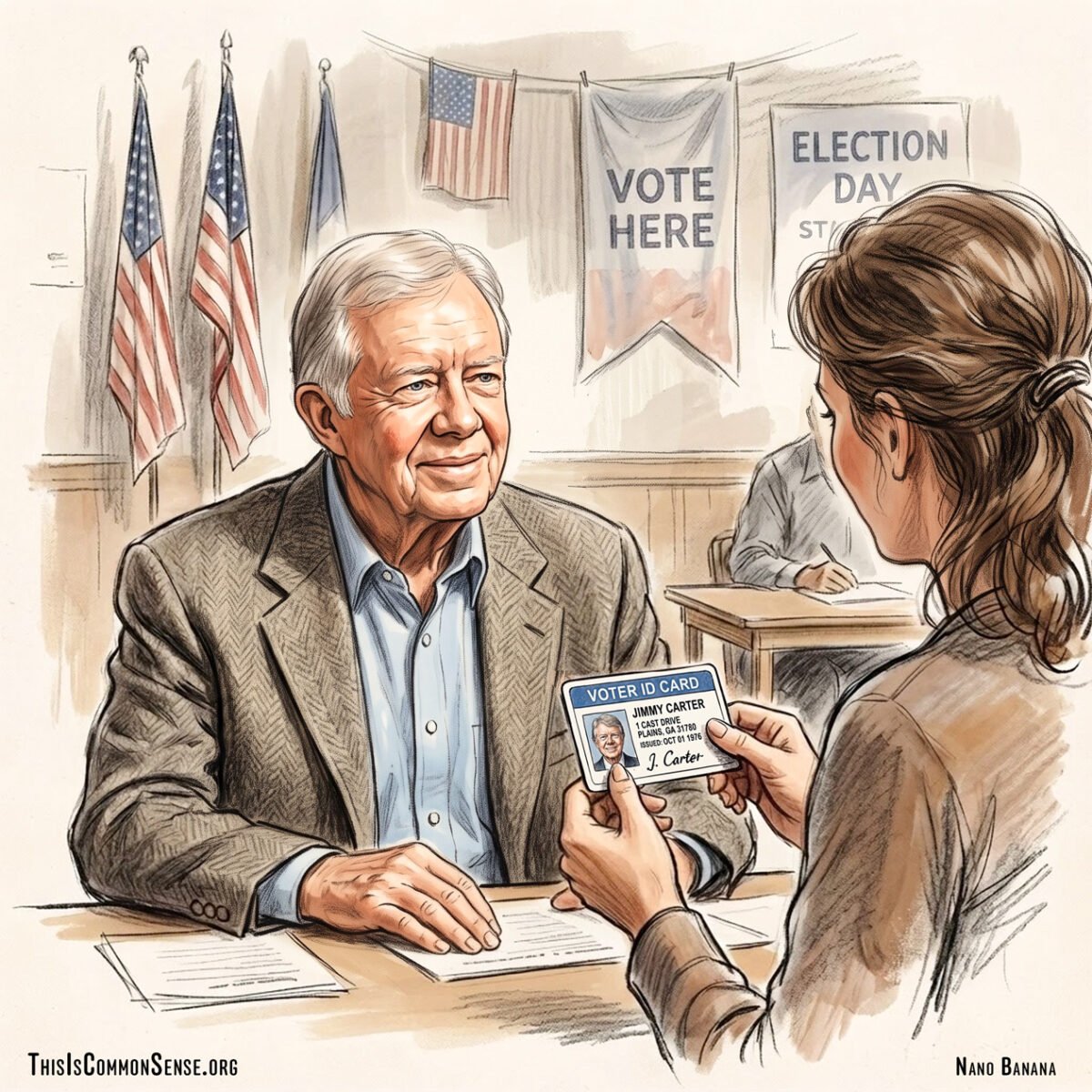
At a capitol news conference before delivering 199 boxes of petitions, Sen. Ruth Johnson, a former two-term Secretary of State, told reporters, “You need ID to get a library card to check out a book. You need ID to get a fishing license. And you should have an ID to vote.”

“Only citizens of the United States should be voting in our elections,” offered Rep. Ann Bollin, a former local election clerk. “It is not rocket science. It is common sense.”

This is [expletive deleted] Common Sense. I’m Paul Jacob. 


PDF for printing

Illustration created with Nano Banana

See all recent commentary
(simplified and organized)
See recent popular posts
Categories
election law Voting

Logic Suppression

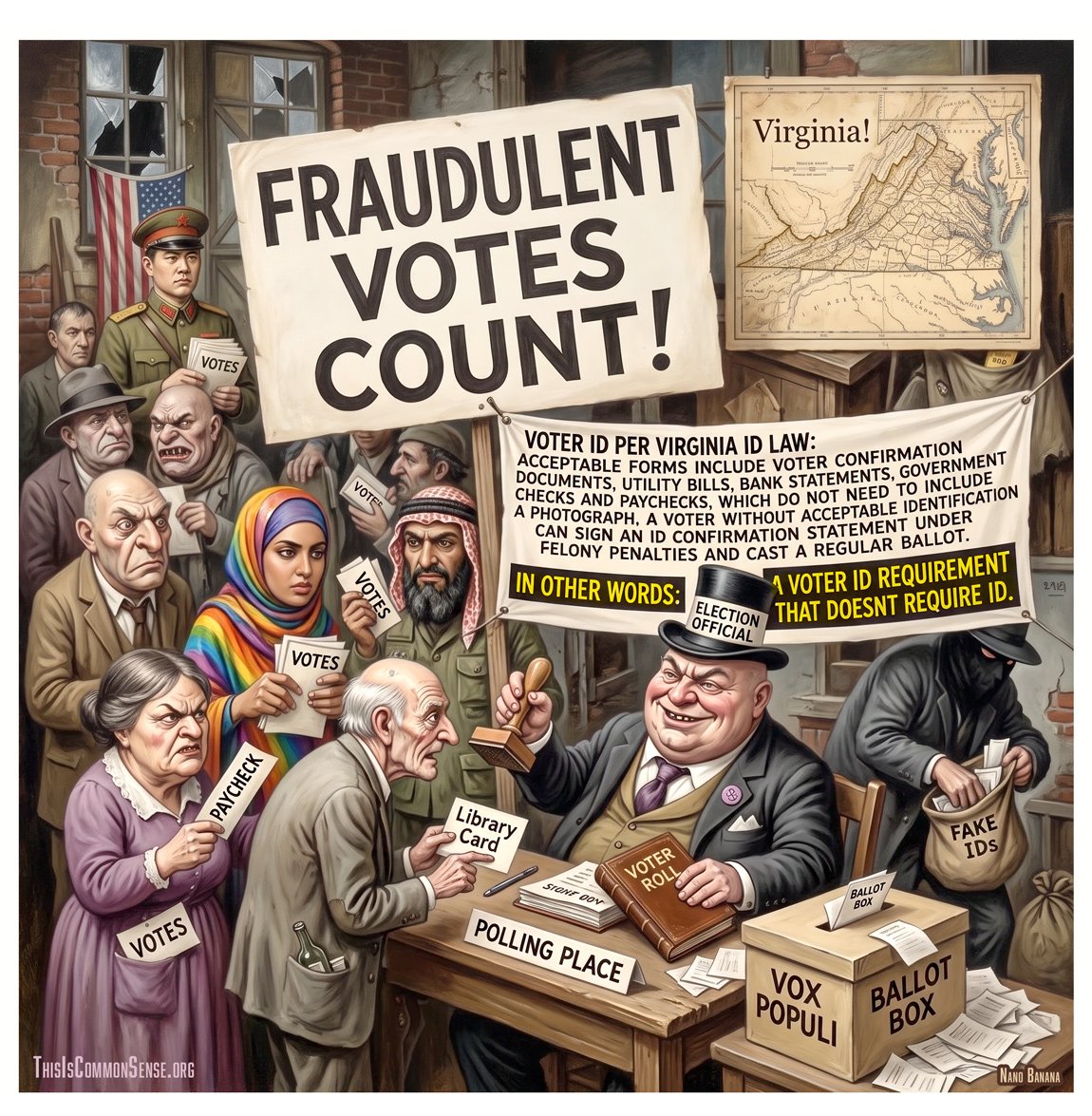
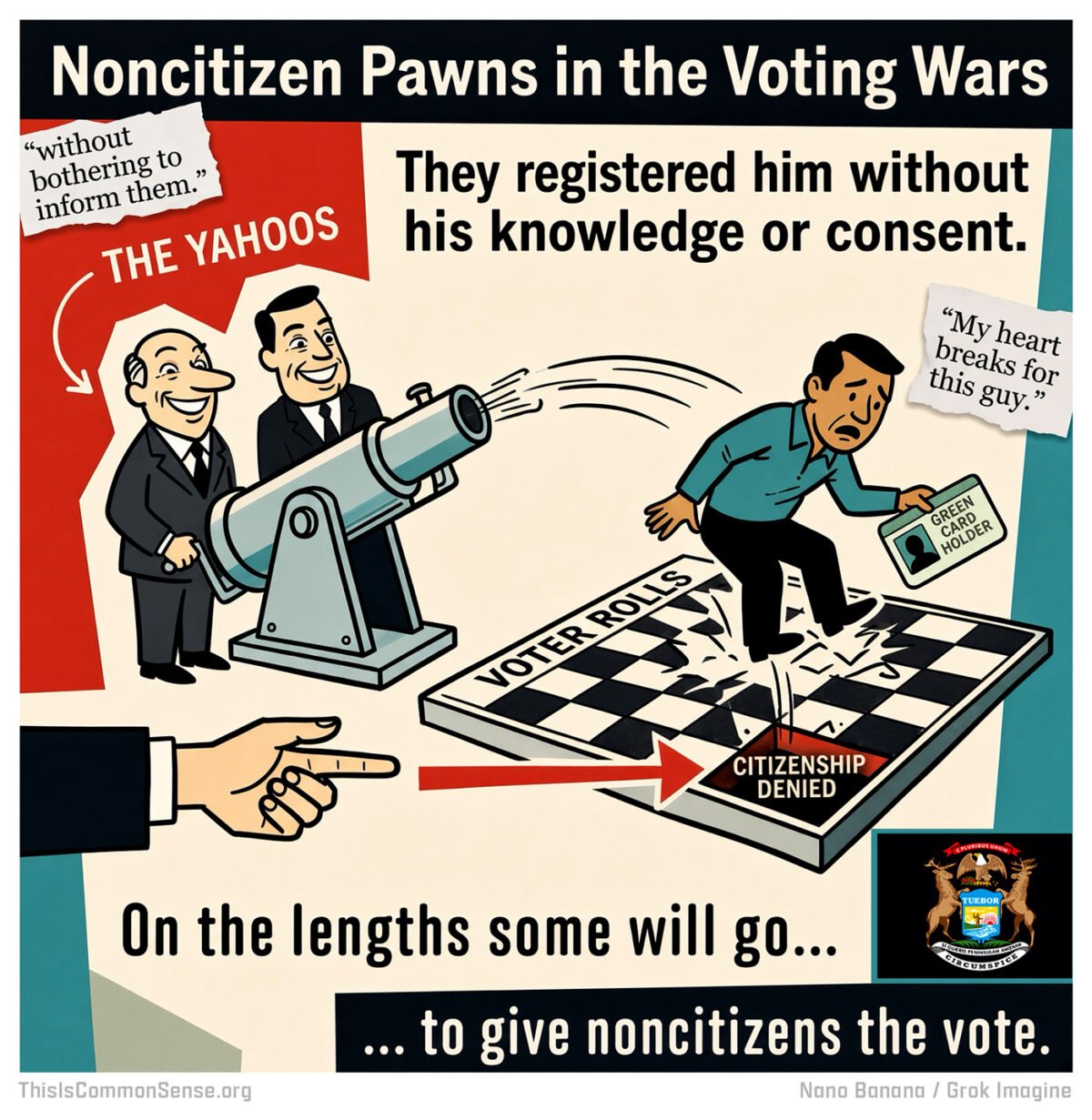
“In any other area of life — boarding a plane at DSM, picking up Cyclone tickets at will-call, or even buying Sudafed — showing a photo ID is a non-event,” Luke Martz writes in the Des Moines Register. “It is the baseline of participation in a modern society.”

The Republican political consultant, who has “served as an international election observer in Europe and the Middle East,” compares Iowa’s election system with “the mess currently unfolding in Minnesota,” where “Gov. Tim Walz signed a law authorizing illegal immigrants to obtain driver’s licenses.”

Mr. Martz points out the “logical fallacy,” which he says has “effectively undermined their own arguments against voter ID.” How so? “If activists believe requiring a document to drive is reasonable,” he argues, “then their claim that requiring a document to vote is a ‘racist barrier’ collapses.”

Indeed. He notes that the idea “that certain Iowans are somehow incapable of obtaining a free state ID” is precisely the “soft bigotry of low expectations,” highlighted by President George W. Bush decades ago.

Lastly, Martz addresses the “‘voter suppression’ narrative,” which “has always had one major flaw: reality.” 

Remember the hullabaloo over Georgia’s 2021 election law? Former President Sleepy Joe Biden called it “Jim Crow 2.0” and the politicians running Major League Baseball canceled the All-Star Game in Atlanta as punishment, only to see voter turnout in Georgia’s next election “more than 50% higher than in the previous midterm election of 2018.” 

Martz shares Iowa’s story, where “doomsayers predicted a collapse in participation” after passage of voter ID. “Instead, we saw the exact opposite. In 2018, the first general election with the law, Iowa saw its highest midterm turnout in decades. In 2020, we shattered records with over 1.7 million ballots cast.”

Let’s not suppress reality.

This is Common Sense. I’m Paul Jacob.


PDF for printing

Illustration created with Nano Banana

See all recent commentary
(simplified and organized)
See recent popular posts
Categories
initiative, referendum, and recall local leaders

Deliciously Dead

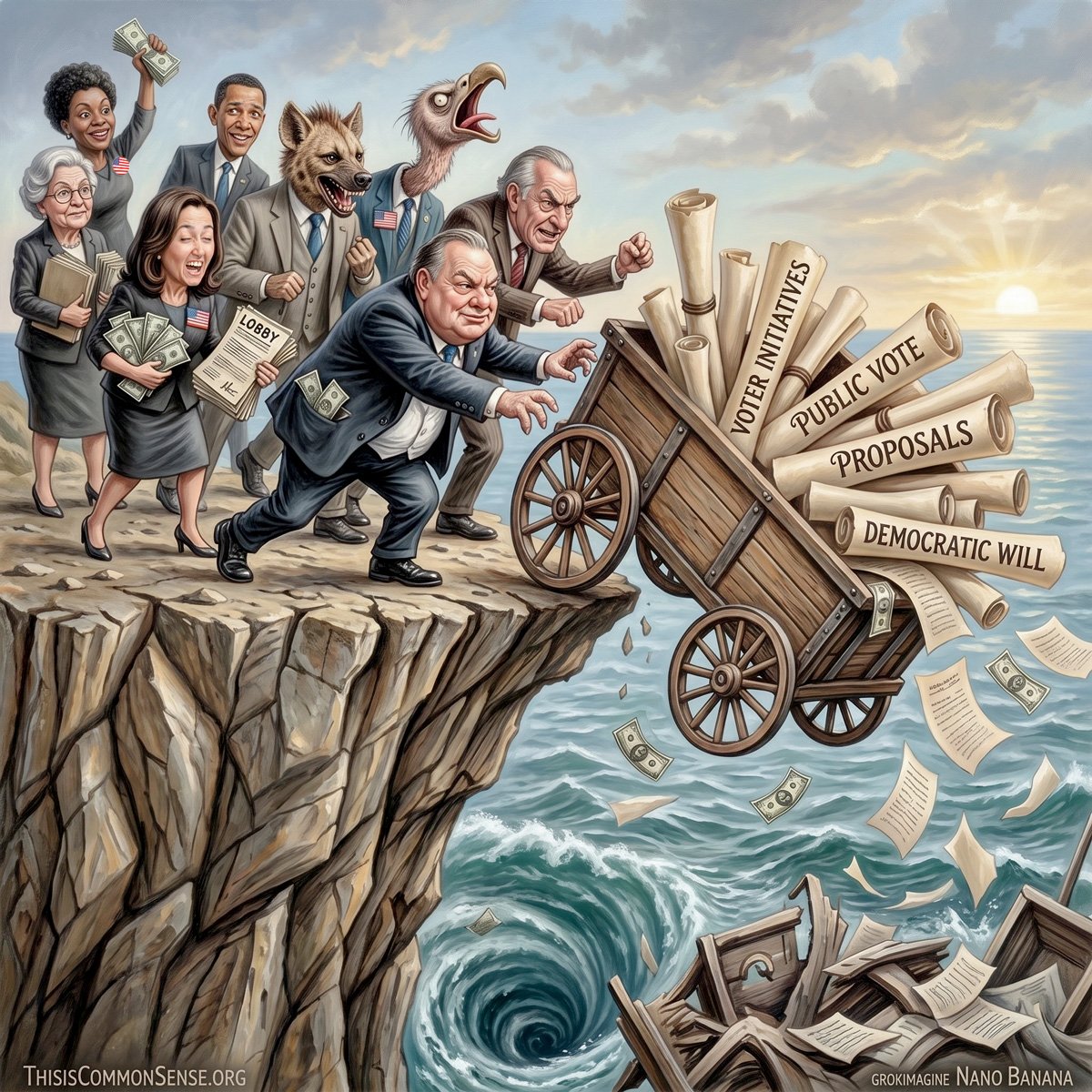
The bill died. Had it lived, it would have — in the words of Tim Eyman — taken away Washington State voters’ “right to initiative, they would stop all dissent.” 

Who’s the “they”? Democrats running the State legislature, who had, Eyman says, been “pushing this thing really hard this session.”

But they gave up. The opposition to the bill was just too strong. Democrats let it die before the scheduled vote on the Senate floor. 

So what was wrong with the bill? 

“SB 5973 would have required a minimum of 1,000 signatures to be submitted to the Secretary of State from those who support the measure, before the issue is given an official title and signature gathering can begin to ensure ‘viability’ of the issue,” explains Carleen Johnson of The Center Square. It would “also have banned the practice of paying signature gatherers for the number of signatures they acquire.”

It was, as opponents called it, an “initiative killer.” You can see why fighting the bill was so important. 

And remember, “initiative killers” are everywhere — at least everywhere initiative and referendum rights are in place. 

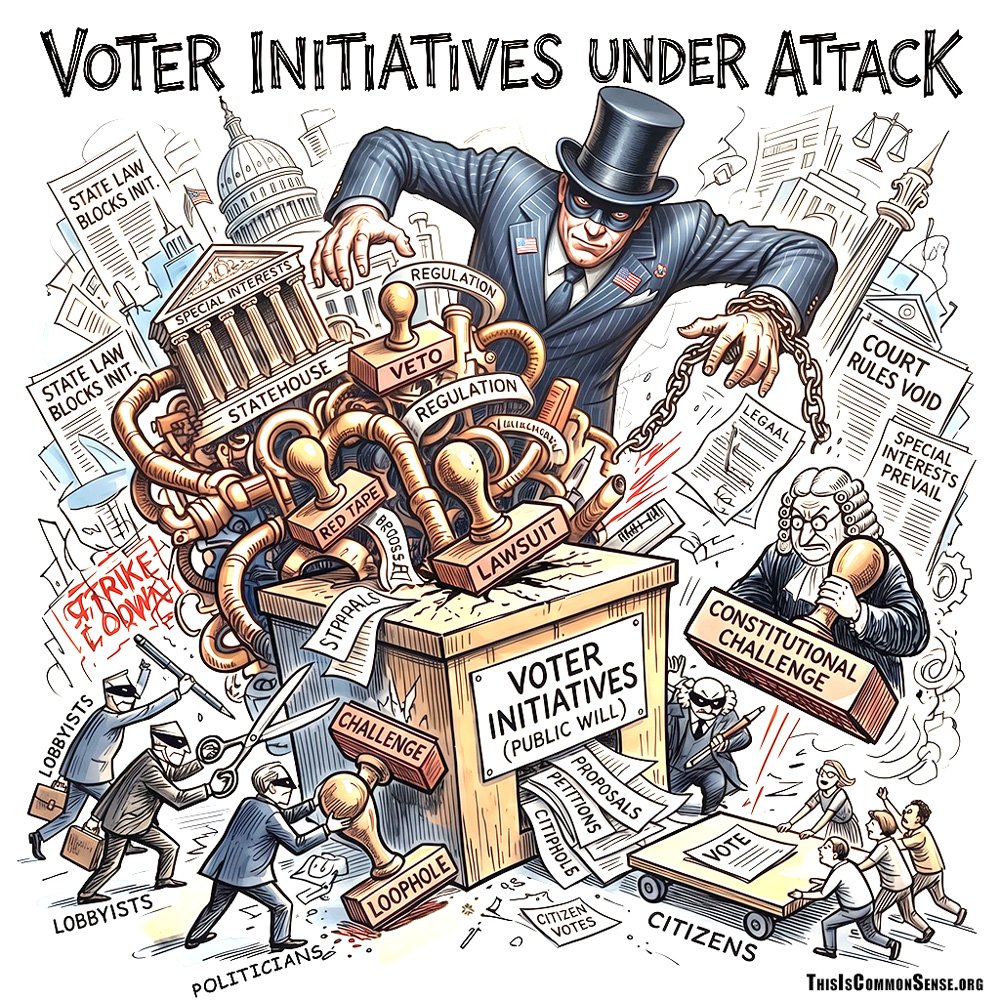
Politicians, who allegedly serve citizens, don’t like it when citizens work around their machinations. So they regularly throw up roadblocks to the initiative process — anything to make it harder for citizens to limit their incessant lust for more taxes, terms of office, etc.

Citizen activists all across the country have their work cut out for them. But, until the next major legislative attack (tomorrow): celebrate!

And don’t forget to thank Tim Eyman and other Washington activists for stepping up to defend everyone’s rights.

This is Common Sense. I’m Paul Jacob.


PDF for printing

Illustration created with Nano Banana

See all recent commentary
(simplified and organized)
See recent popular posts
Categories
election law national politics & policies U.S. Constitution

Federal Election Takeover?

“We should take over the voting, the voting in at least 15 places,” President Donald Trump declared on former FBI deputy director Dan Bongino’s new podcast. “The Republicans ought to nationalize the voting.”

That’s just what Democrats in the U.S. House attempted to do back in 2021 with their H.R. 1. I know well because I worked with a large coalition of groups and individuals to oppose that dishonestly labeled “For the People Act.” 

For the people who are Democratic Party hacks maybe.

A 2021 Heritage Foundation analysis argued the legislation would “Seize the authority of states to regulate voter registration and the voting process.”

“The Democratic bill is indeed sweeping,” PolitiFact informed at the time. “At 791 pages, the bill does everything from prohibiting states’ voter ID laws to breaking the gridlock of the Federal Election Commission by removing a member.”

Luckily, H.R. 1 did not pass the Senate. 

Have you ever noticed that in the tug of war between federal and state power, politicians of all stripes support the Constitution’s balance when it suits them and ignore it when it doesn’t?

Same goes for news media. The Washington Post falsely reported on Monday that by urging “Republican lawmakers” to act, the president was “claiming a power explicitly granted to states in the U.S. Constitution.” 

Well, Article 1, Section 4 of the U.S. Constitution does say “The Times, Places and Manner of holding Elections . . . shall be prescribed in each State by the Legislature thereof,” but it explicitly adds that “the Congress may at any time by Law make or alter such Regulations . . .”

Democracy dies in half-truths.  

This is Common Sense. I’m Paul Jacob.


PDF for printing

Illustration created by Nano Banana

See all recent commentary
(simplified and organized)
See recent popular posts
Categories
ideological culture media and media people national politics & policies partisanship

Not This King?

“This is why more Americans today identify as an independent than a Republican or a Democrat for the first time in American history,” argued Sarah Isgur during a panel discussion on ABC’s This Week program, the day after another fatal shooting by ICE agents in Minnesota. “Because no one actually believes that either side believes what they’re saying.”

Isgur, a writer and podcaster for The Dispatch, has worked on both Democratic (2016) and Republican (2012) presidential campaigns and even landed a job at the Department of Justice during President Trump’s first term, only later to be fired. 

“Look, honestly,” Isgur continued, “if Barack Obama’s federal officers had killed a member of the Tea Party, who had shown up, who had a concealed-carry permit, who was disarmed before he was shot, that [the protester was armed] would not be what the Right is saying.”

She went on: “And, frankly, the left was all for big executive power, as long as it was Joe Biden. They’re not ‘no kings.’ They just don’t like this king.”

Throughout President Donald Trump’s first term, I recall shouts that he had overstepped his authority under the law only to discover, oftentimes, that the power he was wielding had been bestowed upon our president by a feckless Congress. What I found even more disconcerting was that at no time did those complaining seek to limit these excessive presidential powers.

It appears, as Sarah Isgur suggested, that their concern was not with an imperial presidency, only with this current person as that imperial president.

“If you actually want to do something about the problems, both sides need to actually say, presidents shouldn’t have this power,” Isgur explained. “The federal government shouldn’t have this power.”

Wise government depends on limiting power . . . no matter who is president.

This is Common Sense. I’m Paul Jacob.


PDF for printing

Illustration created with Nano Banana

See all recent commentary
(simplified and organized)
See recent popular posts