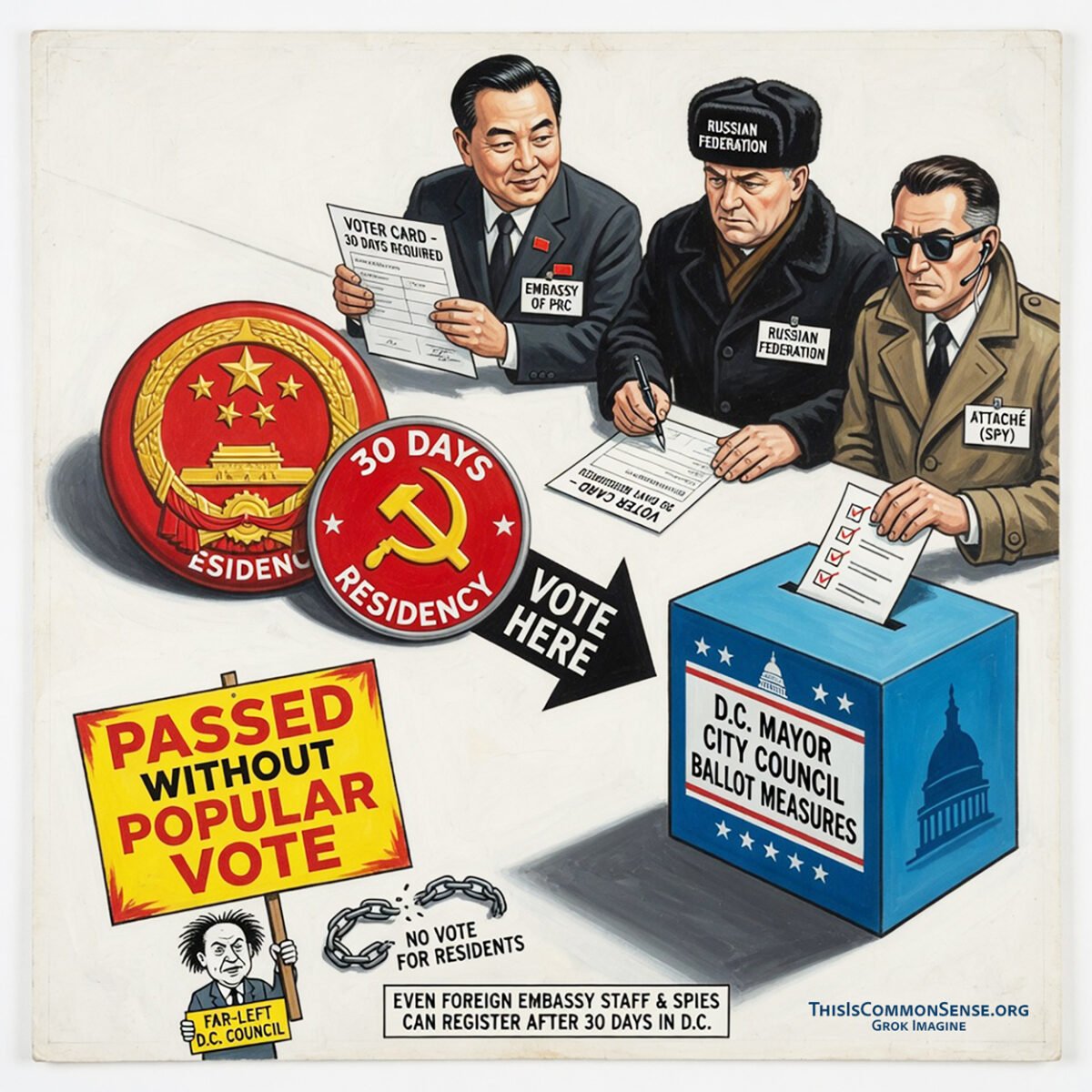
Who should vote? Ought we expand the electorate?
To everyone . . . on the planet?
Do folks from other countries, who have come to America, legally or not, and reside in a community for 30 days, have a right to vote?
Well, they do under a crazy law in our nation’s capital. Even the ambassadors and embassy workers (and spies) that China and Russia send to represent their regimes, could, if they so desired, register and vote for the next mayor, city council-member and ballot measure in the federal capital . . . if those foreign nationals have been here (working for another country) for 30 days.
The far-left-of-sanity Democrats on the D.C. City Council passed it — without a popular vote.
At least in Los Angeles there will be a public vote — should the push by Democratic Socialists of America-backed Democrats on that City Council advance a measure to allow noncitizens in L.A., legally or not, to vote in local elections.
Citizenship seems a wiser qualifier at all levels of government.*
“Federal law prohibits noncitizens from voting in federal elections,” The Los Angeles Times reports. “However, states are allowed to set their own local and statewide election rules.”
Note that The Times does not inform readers that states, such as California, determine who is qualified to vote in federal elections in those states. Were California to allow noncitizens to vote in its state legislative elections — not too giant a leap from noncitizen voting in L.A. and San Francisco — those noncitizens would be legally qualified to vote for California’s representatives in Congress and the U.S. Senate.
The U.S. Constitution’s “Qualifications Clause” is clear.
This state “loophole” is something worth closing through Florida Rep. Laurel Lee’s constitutional amendment.
Locally, statewide, nationally: let the people decide.
This is Common Sense. I’m Paul Jacob.
* I serve as chairman of Americans for Citizen Voting. We have worked to pass Citizen Only Voting constitutional amendments in 15 states and to place these measures on six more state ballots this November. We now ask Congress to consider and propose a federal constitutional amendment, HJR 152, the U.S. Citizens Vote Amendment.
Illustration created with Grok Imagine
See all recent commentary
(simplified and organized)
See recent popular posts
4 replies on “Expanding the Electorate”
Yes, the qualifications clause is clear … ly about qualifications to hold office, not to vote.
Why should people from Lansing — who are foreigners to Detroit — get to decide who votes in Detroit’s elections?
• Obviously Paul wouldn’t be advocating the proposed Amendment in question if the Qualifications Clause addressed the issue.
• Democracy is not self-legitimizing, but emerges from meta-negotiation. The people of Michigan have an obvious interest in ensuring that the voters of Detroit don’t send poorly chosen legislators to Lansing; and those people outside Detroit much the same interest in ensuring that the voters of Detroit don’t choose the City Council poorly as those who live on your block have an interest in acting against the beating of children two blocks away. Practical answers vary with circumstance, but the interest is abiding.
Any Amendment needs ratification by three-fourths of the constituent states — currently 38. I wonder whether this proposal can get that many.
The states with Republican majorities should simply be no problem. And the Democrats are unlikely at this time to openly support non-citizen voting in elections to Federal office.
But I imagine that a fair number of them will argue that the proposed Amendment should be rejected as superfluous — as unnecessary on a claim that no state would allow non-citizens to vote in a Federal election. Meanwhile, others could to try to move the Overton Window.
I believe that, at present, 18 state legislatures are controlled by the Democrats, 28 controlled by the Republicans, and four split bicamerally. Even if my counts are off by a few, the proposed Amendment could be indefinitely stalled.
States run the elections but the Constitution gives Congress the ability to set its own rules for federal elections. It needn’t be by amendment. Section 4, Clause 1 states: The Times, Places and Manner of holding Elections for Senators and Representatives, shall be prescribed in each State by the Legislature thereof; but the Congress may at any time by Law make or alter such Regulations, except as to the Places of chusing Senators. (the exception was made moot by the 17th Amendment.)