Categories
ideological culture individual achievement social media

X Marks the Grift?

Most of the calumnies against Elon Musk come from people who are either envious or completely unaware of the basic principles of economics. Or both.

That being said, not everyone “in my camp” admires or defends the South African-American tech magnate. On Sunday, Eric Peters — “the libertarian car guy” — published, on his website, “Xcrement Is Just That (and more).”

“I have written a number of articles critical of Elon Musk’s ‘free speech’ social media grift,” Mr. Peters asserts, “which I say is just that because it isn’t free. . . .” 

Since I pay nothing for X, I was surprised. What?

Peters is “assuming you want more than a few people to know you’ve spoken.” That’s how he put it. “You must pay a recurrent fee for what is styled ‘reach.’ Even then, your ‘reach’ is subject to being limited via completely obscure parameters known only to Elon and his algorithm.”

And the complaint is . . . ?

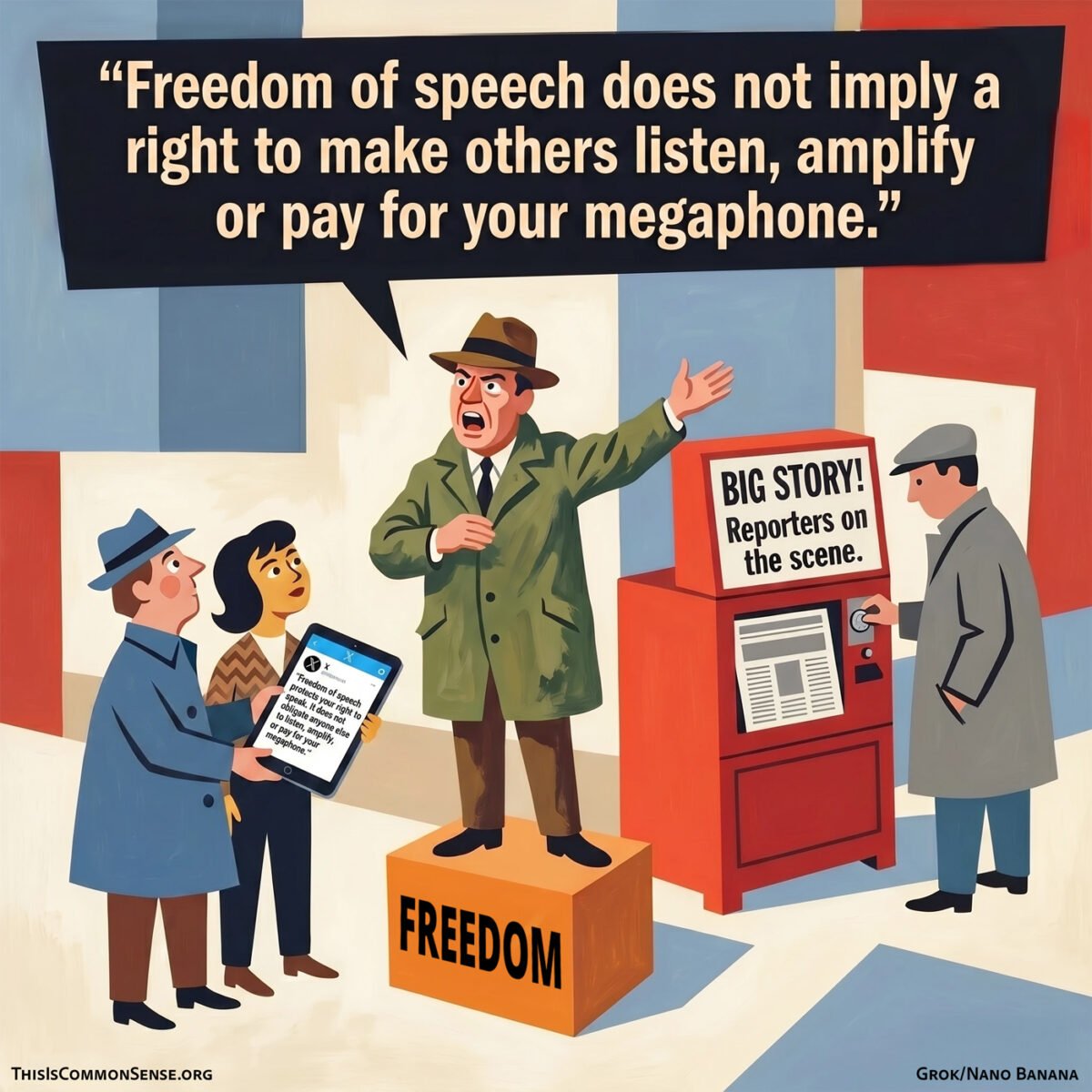
The Twitterverse prior to Elon’s acquisition of the platform, asserted, with some perspicacity, that “freedom of speech is not freedom of reach.” The “freedom of reach” part was nothing other than “freedom of the press” — and the technological and business platforms that make up “the press” have never been “free of price.” Someone must pay for getting ideas out there far and wide.

Yet Mr. Peters seems to think that “Free ought to mean not just without cost but open. As in everyone can use it and no one is limited in any way from using it. Xcrement does not work like that.”

Well, the telephone system in days of yore was indeed open to everyone, but that did not mean “free.” And if you wanted to make a long-distance call, you had to pay the phone company.

While old-time telephony isn’t equivalent to modern-day social media, the parallel is close enough to show that this specific case against Elon is without merit.

Still, I wouldn’t call it excrement.

This is Common Sense. I’m Paul Jacob.


PDF for printing

Illustration created with Nano Banana

See all recent commentary
(simplified and organized)
See recent popular posts
Categories
First Amendment rights social media too much government

Are British Censors Winning?

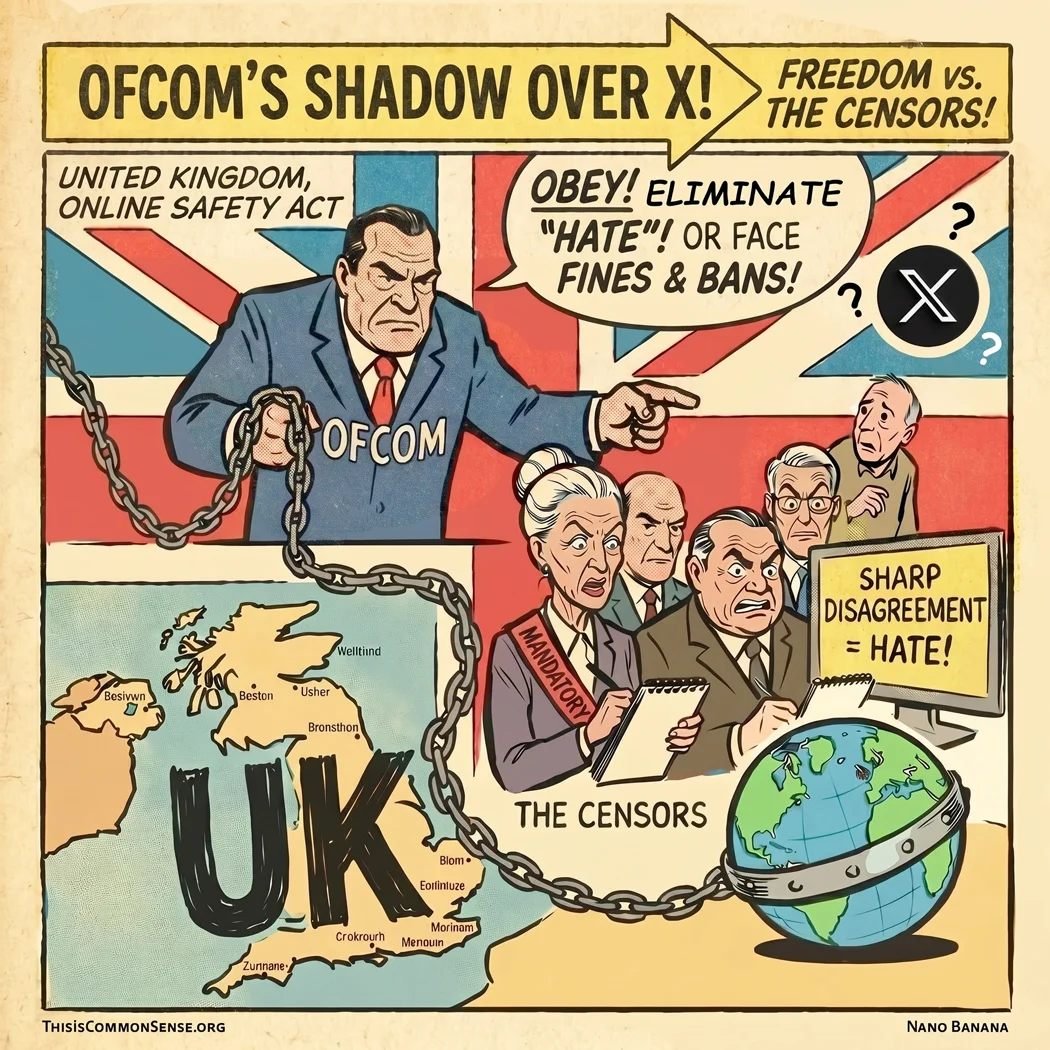
An outfit in the United Kingdom called Ofcom, the main enforcer of the U.K.’s Online Safety Act, is requiring social platforms to implement onerous procedures to censor “hate,” including stripping users of anonymity — or face mammoth fines, bans in the U.K., and other draconian penalties.

Nobody would object to compelling the removal of content that is clearly criminal. But is that what most so-called “hate” content really is? Of course not. Much of what irks censors and the merely censorious is merely vituperative, and no small part of what gets their goat is nothing other than sharp disagreement with those authorities who decide what “hate” is — that is, the censors themselves. 

Last year, the social media platform X formally decried Ofcom’s demands as “overreach” even as it tried to comply with the new regulations. The platform objected to U.K. mandates that would “prevent adults from encountering ‘illegal’ content” and impose “steps to ensure age verification that limit adults’ anonymity online.”

But X has now caved. It has agreed to review most content flagged as illegal “hate” within two days. All the language of that earlier remonstration is “gone now,” Reclaim the Net observes. What remains is only an agreement to comply with an organization and a system known to be militantly hostile to freedom of expression — and to Elon Musk’s X.

What could X do instead? 

Fight. 

Pull out of the United Kingdom and tell UK users, “Sorry. You’re just going to have to use a VPN to disguise your location in the UK if you want to keep using your X account,” with links to free VPNs.

This is Common Sense. I’m Paul Jacob.


Further Reading:

PDF for printing

Illustration created with Nano Banana

See all recent commentary
(simplified and organized)
See recent popular posts
Categories
First Amendment rights Internet controversy social media

Modern Tech Irrelevant

“I’ve never been more pleased by ‘losing’ in my life,” tweeted Jay Bhattacharya.

What makes the Director of the National Institutes of Health a “loser”?

Well, the doctor (who also serves as current Acting Director of the Centers for Disease Control) has not always served in the federal government. In his days between Trump administrations he’d run afoul of censors on social media. Now he’s jubilant that a major case against censorship has come to a freedom-of-speech conclusion.

Aptly, he started that post on X with “Huzzah!”

The actual news? “The New Civil Liberties Alliance, on behalf of its clients Jill Hines and Dr. Aaron Kheriaty,” reads the official press release of the lawyers, “has reached a settlement agreement and Consent Decree concluding the landmark Missouri v. Biden lawsuit against government-induced social media censorship.”

This follows an executive order by President Trump on the first day of his new administration. The president had declared that the federal government, under President Joe Biden, had “infringed on the constitutionally protected speech rights of American citizens across the United States in a manner that advanced the government’s preferred narrative about significant matters of public debate.”

This not a judicial ruling. It’s an agreement, the key point being, “The Parties agree that modern technology does not alter the Government’s obligation to abide by the strictures of the First Amendment.”

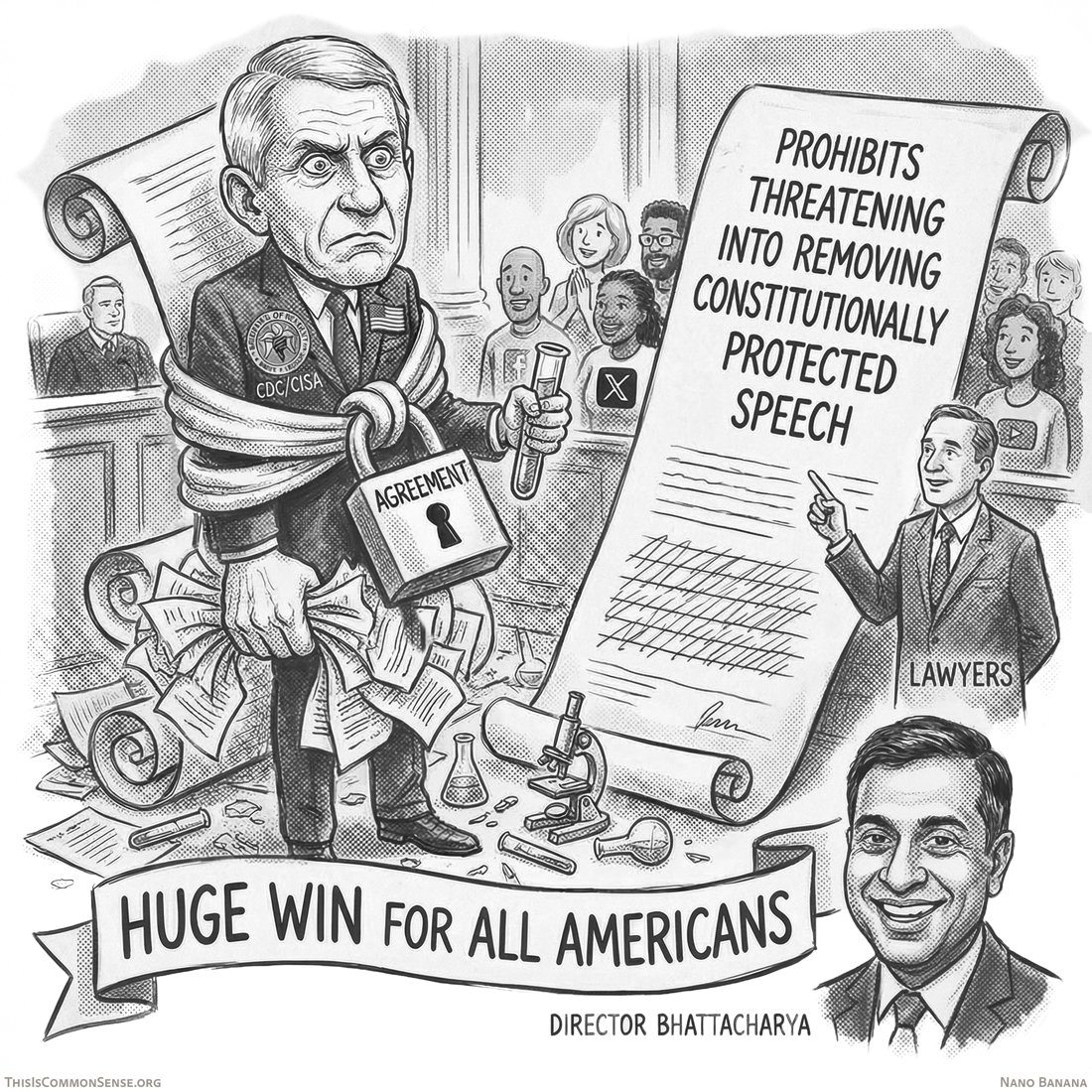
Specifically, the agreement (in the lawyers’ words) “prohibits the U.S. Surgeon General, Centers for Disease Control and Prevention (CDC), and Cybersecurity and Infrastructure Security Agency (CISA) from threatening social media companies into removing or suppressing constitutionally protected speech on Facebook, Instagram, X (formerly Twitter), LinkedIn and YouTube.” And more.

Director Bhattacharya calls it a “huge win for all Americans.”

You bet Huzzah!

This is Common Sense. I’m Paul Jacob.


PDF for printing

Illustration created with Nano Banana

See all recent commentary
(simplified and organized)
See recent popular posts
Categories
free trade & free markets general freedom individual achievement media and media people social media

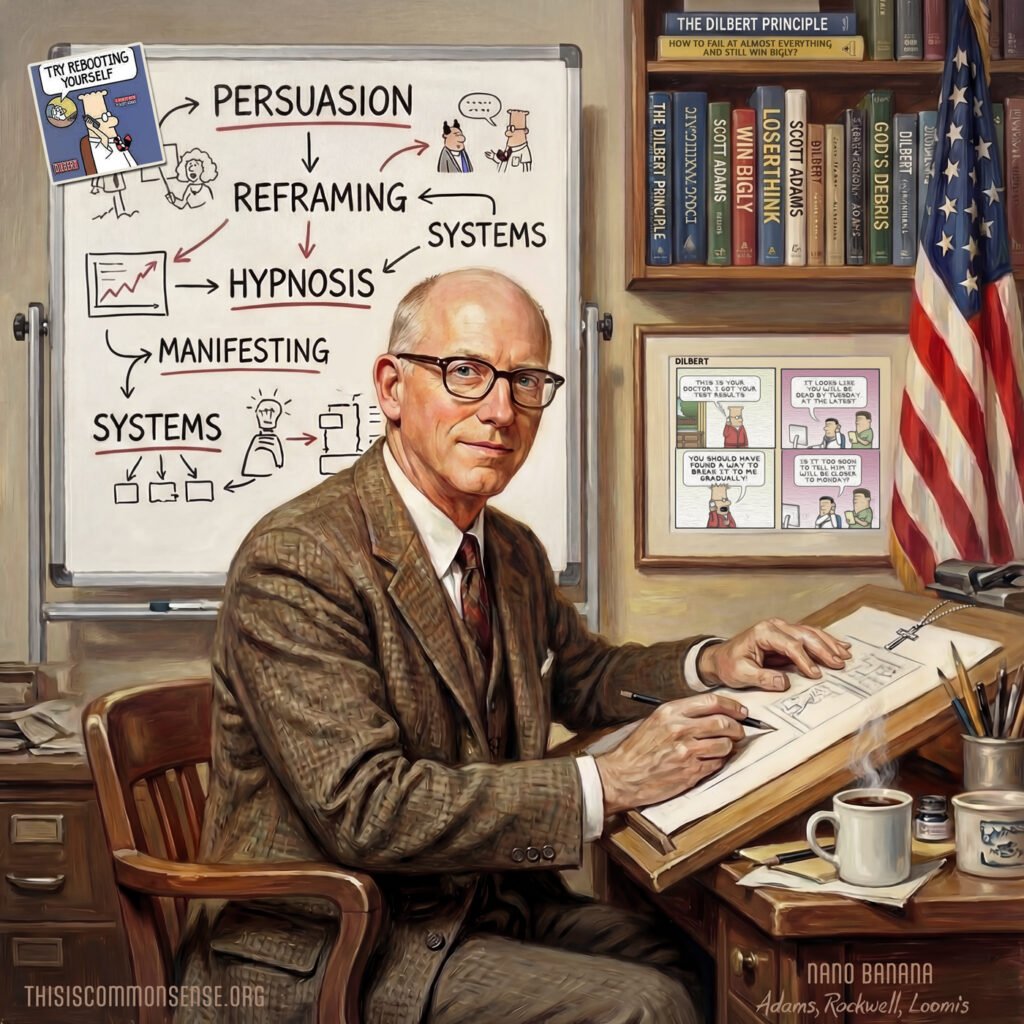
A Man of Learning

Facts mattered to the man who told us “facts don’t matter.”

Ideas, principles, arguments — these mattered, too.

Which is probably what I will remember most about Scott Adams, who died yesterday

He had been suffering from prostate cancer for some time. During the moment, last year, when President Joe Biden’s possible prostate cancer diagnosis became a matter of public discussion, Mr. Adams informed us that he, too, had been diagnosed with that form of cancer, and that he had not long to live.

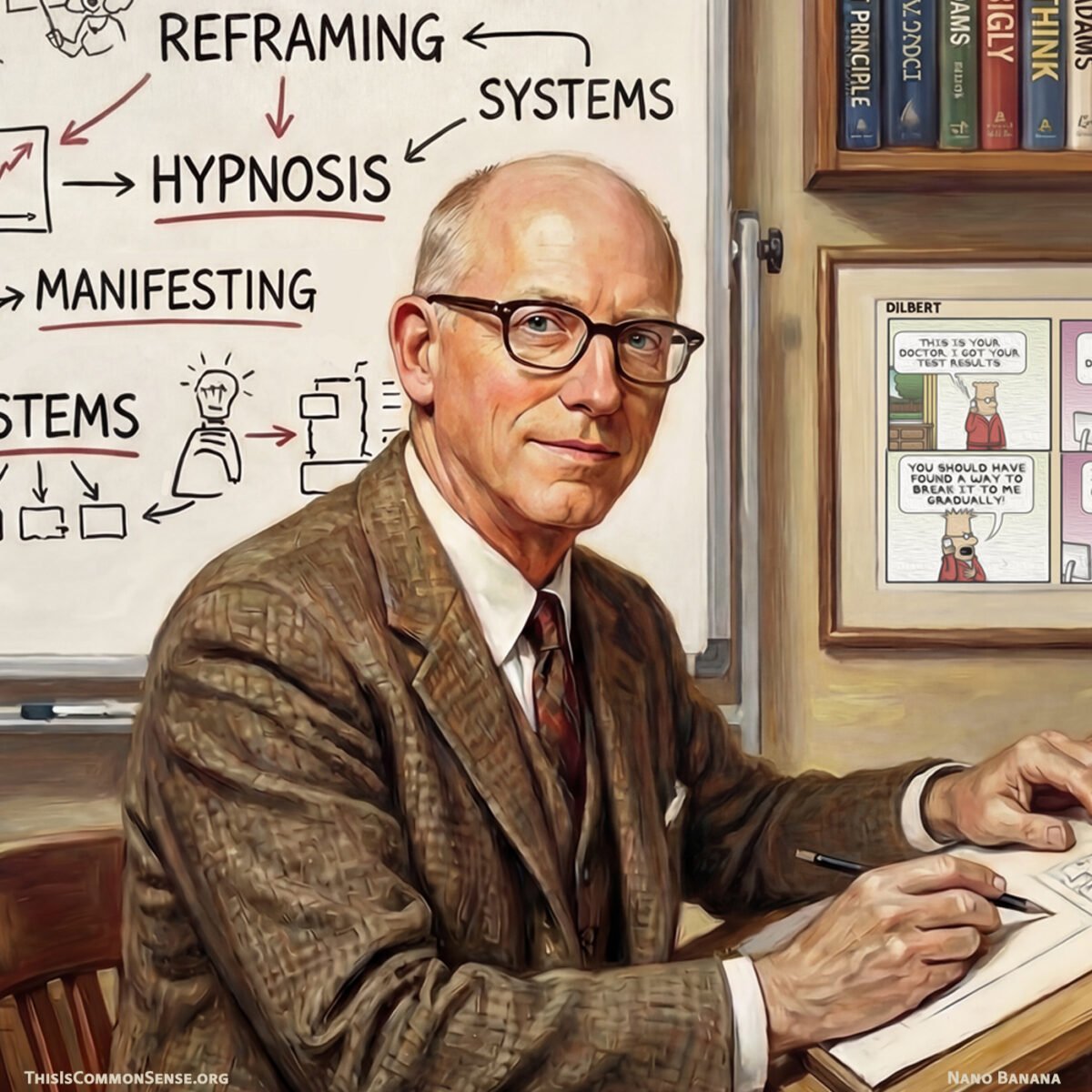
Like most newspaper readers, I knew of Adams from his Dilbert comic strip. I missed his career in writing books, in the aughts and early teens. But I caught up with the man when he predicted, in 2015, that Donald Trump possessed a “talent stack” that would likely lead to winning the presidency — an insightful judgment — that may have helped the prophesied event to occur.

Adams became one of the more interesting podcasters, an intellectual powerhouse who urged us to reframe how we think about politics, culture, our very lives. I never became a fan, exactly, but I not only admired him, I liked him. He was quite a character; he was a man of character.

It was interesting, especially, to watch him develop in the context of our odd (transitional?) moment in history. On the late pandemic, for example, many of his early opinions and meta-opinions were misguided. But he changed his mind, as many of us have. And though, as I mentioned above, his most famous assertion was that, in matters of persuasion, “the facts don’t matter,” he was persuaded to change opinions when he learned more. 

So may we all.

This is Common Sense. I’m Paul Jacob.


PDF for printing

Illustration created with Nano Banana

See all recent commentary
(simplified and organized)
See recent popular posts
Categories
First Amendment rights general freedom ideological culture international affairs regulation social media

U.S. Bans EU Censors

European leaders are condemning American use of visa bans to penalize European enemies of American freedom of speech.

Which is understandable, since the U.S. State Department more than merely condemned the European Union.

In the words of Marco Rubio, the five just-sanctioned persons “have led organized efforts to coerce American platforms to censor, demonetize, and suppress American viewpoints they oppose.”

Thierry Breton. Former EU commissioner and top proponent of the Digital Services Act, which seeks to force U.S. tech giants to “police illegal content more aggressively” or face big fines. “Illegal” here doesn’t mean speech deployed to commit bank robberies; it’s speech EU censors dislike.

Josephine Ballon and Anna-Lena von Hodenberg. Leaders of HateAid.

Clare Melford. Leader of Global Disinformation Index, which, the State Department observes, exhorts “censorship and blacklisting of American speech and press.”

Imran Ahmed. Leader of Center for Countering Digital Hate, described by Breitbart as the “deplatforming outfit which defined its central mission as ‘Kill Musk’s Twitter.’ ” CCDH also worked hard to get Breitbart and other sites blacklisted from social media.

Maybe none of these villains was planning a trip to the United States anytime soon.

And, doubtless, much more could be done to combat overseas attempts to censor Americans. But at least this much action against enemies of our First Amendment rights is warranted, even if mostly symbolic.

Just give us a little more time, European leaders. We’ll do more to oppose and thwart your obnoxious global censorship agenda. 

This is Common Sense. I’m Paul Jacob.


PDF for printing

Illustration created with Nano Banana

See all recent commentary
(simplified and organized)
See recent popular posts
Categories
ideological culture social media

Of Loudmouths and Silence

The murders of Rob Reiner and his wife — allegedly by their son, Nick — were horrific enough. But because the elder Reiner was, in rallies and interviews and on social media, a spittle-flecked progressive who said vile things about his opponents, including the current resident of 1600 Pennsylvania Avenue, it was inevitable that President Donald Trump’s reaction would fail to serve as a stellar example of gracefully acknowledging the death of a
public figure.

After calling the fatal knife attack a “sad thing” but before exclaiming “May Rob and Michele rest in peace,” Trump made the incident about himself. 

The butchery, he asserted, “reportedly” was the result of “the anger he caused others through his massive, unyielding, and incurable affliction with a mind crippling disease known as TRUMP DERANGEMENT SYNDROME, sometimes referred to as TDS.” Trump referred to Reiner’s “raging obsession” and “paranoia” that reached “new heights as the Trump Administration surpassed all goals and expectations of greatness, and with the Golden Age of America upon us, perhaps like never before.” 

More extreme than Rob Reiner’s derangement may be Trump’s own. 

But the actor and director, in his heyday, also demonstrated some difficulty assessing his public persona honestly. Reiner never seemed to realize that he became the “Meathead” he played (maybe with only inadvertent satire) on All in the Family in the 1970s.

Some folks find it hard to condemn Trump for being petty and political upon Reiner’s death when that seemed to be precisely what Reiner was upon, say, Rush Limbaugh’s.

Both Reiner and Trump inhabit the “loudmouth” camp of public rhetoric, using strong condemnatory language and a reliance on over-statement when railing against their opponents. At death, do loudmouths deserve less honor?

The acceleration of history being what it is, perhaps, “too soon” no longer sticks as a useful censure when it comes to gallows humor and double-murder indecency.

This is Common Sense. I’m Paul Jacob.


PDF for printing

Illustration created with Nano Banana and Firefly

See all recent commentary
(simplified and organized)
See recent popular posts
Categories
First Amendment rights international affairs social media

Don’t Pay, Don’t Play

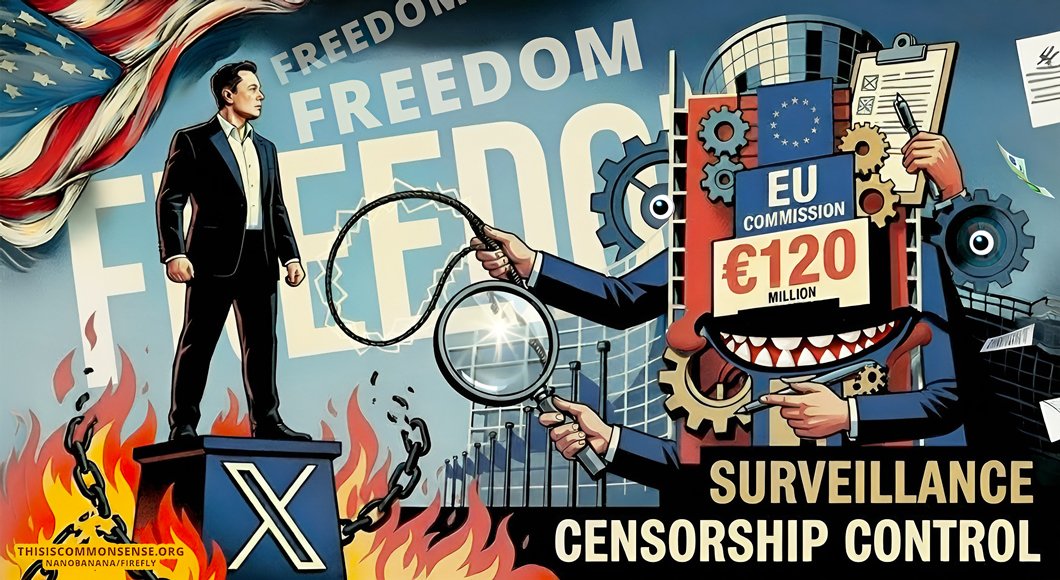
The European Commission is fining the X platform 120 million euros (140 million dollars), for “transparency failures”: not sharing advertising and user data with the EU and not making it easy to censor account holders.

As Reclaim the Net reports, the European Union wants platforms to open themselves to what it calls “independent research.” In practice, this means that “academics and NGOs, often with pro-censorship political affiliations” get special access to the data, “exactly the kind of surveillance the [Digital Services Act] claims to prevent. . . . The EU is angry that X is not policing speech the way it wants.”

My advice to Elon Musk is to shut down X (formerly Twitter) throughout the EU. And refuse to pay the fine.

X’s departure from the EU wouldn’t need to be permanent. For the censors would then have not only X and its uncooperative CEO to contend with; suddenly, a pro-X lobby of millions of Twitterers would be putting pressure on the censors.

The chances of unilateral surrender by the EU? Pretty high. And that’s the only kind of surrender Musk should accept.

If he agrees to even a little EU repression in return for lifting of the fine, that could lead to a total loss for the freedom-of-speech side; the bureaucrats, spies, and busybodies would likely take that seemingly marginal concession and relentlessly work to enlarge it.

Accept only total victory. And be ready to again leave the EU the instant the EU-crats resume their attacks.

This is Common Sense. I’m Paul Jacob.


PDF for printing

Illustration created with NanoBanana and Firefly

See all recent commentary
(simplified and organized)
See recent popular posts

Categories
crime and punishment First Amendment rights international affairs social media

Quit Banging on Brits

We hear so much bad news about censorship coming out of the United Kingdom that it’s almost shocking when something good happens instead.

That good news is a retreat from harassing innocent people for posting online too freely for the taste of British police enforcers.

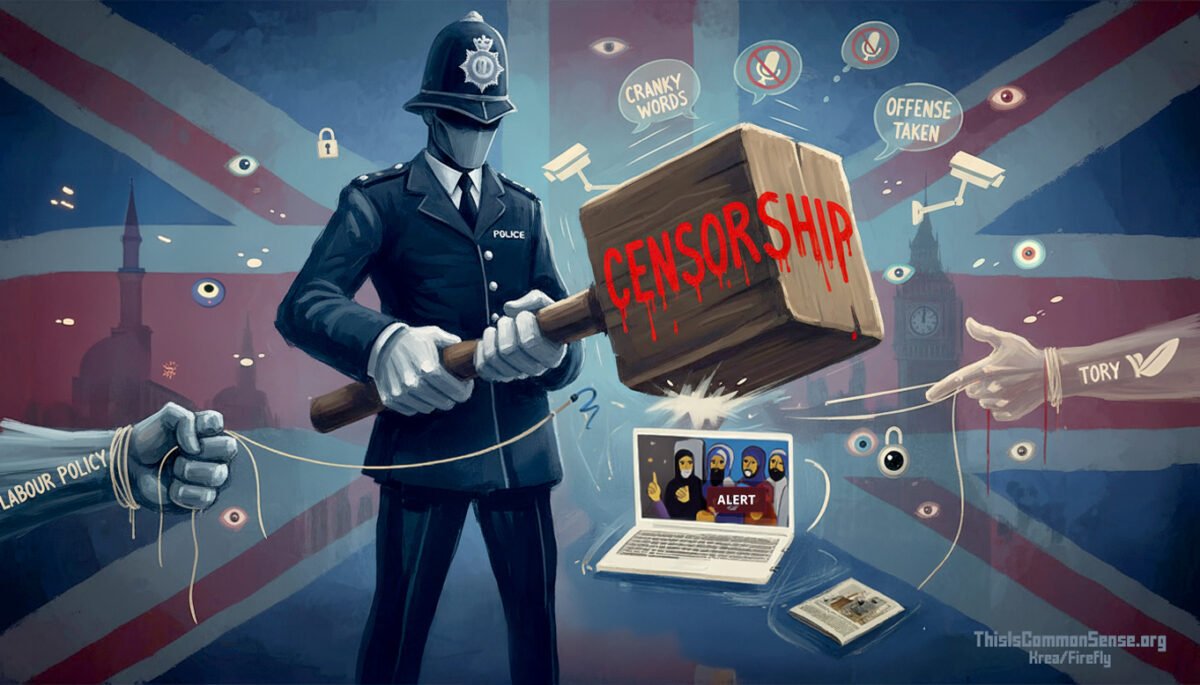
In the big picture, the change in policy by the Metropolitan Police Service is but a minor tactical withdrawal in the pursuit of a censorship agenda that is otherwise proceeding on all fronts. It’s not so minor for people like, say, comedy writer Graham Linehan.

Several weeks ago, Linehan was arrested at Heathrow Airport by five armed officers.

“I was arrested at an airport like a terrorist, locked in a cell like a criminal, taken to hospital because the stress nearly killed me, and banned from speaking online.” His sin was posting a few tweets critical of transgender activists.

The charges against Linehan have been dropped. 

And from now on, says the Met, it will stop investigating “non-crime hate incidents.” A spokesperson explains that the commissioner “doesn’t believe officers should be policing toxic culture war debates. . . .” 

The “non-crime hate incidents” will still be logged, though.

The policy of harassing Britons for cranky words has been softened before, by the Tories. When Labour came in, the new government promptly hardened things again.

And further caution: Met policy is not government policy. 

So this particular hammer for banging upon speakers daring to offend the easily offendable could come swinging down again at any moment.

This is Common Sense. I’m Paul Jacob.


PDF for printing

Illustration created with Krea and Firefly

See all recent commentary
(simplified and organized)
See recent popular posts

Categories
insider corruption political challengers Regulating Protest social media

Revolution Gen Z

It began as online outrage. 

Nepal’s government had banned social media, fearing the extremity of sentiment that might be expressed against the regime, but what followed that ban brought down the government. The general mood of protest escalated into nationwide demonstrations, clashes with security forces, and the storming of government buildings, resulting in at least 74 deaths and over 2000 injuries.

But this was not an organized coup. It developed so swiftly from youth protest to the fall of Prime Minister K.P. Sharma Oli’s government* that it sure seemed to be spontaneous, taking just a few weeks’ time (or days’, depending where you set the starting point.)

Interestingly, the government the protesters ousted was communist, as in Marxist-Leninist — but both the ruling CPN-UML and the Maoist Centre are less ideologically rigid than traditional Marxist parties, focusing on nationalism, development, and power-sharing rather than the totalitarian push for utopia.

That is, the commies went straight to the corruption part of the long arc of socialism.

And that’s what young people objected to, focusing special ire on “nepo baby” status examples, the scions of wealthy rulers living life extra-large. 

But the low employment rates also mattered, as did the censorship of the Internet, upon which so many Nepalese economically depended. 

In fact, the momentum of Nepal’s uprising appears to have been largely driven by domestic digital activism on TikTok and Discord. 

It’s not called the “Gen Z Revolution” for nothing.

This is Common Sense. I’m Paul Jacob.


* Protesters battled security forces on September 8; by the next day the parliament building and other government offices were in flames and the prime minister had resigned. The social media ban was lifted. The army imposed a nationwide curfew on the 10th; Sushila Karki, 73-year-old former Supreme Court Chief Justice became Nepal’s first female prime minister on September 12, 2025.

PDF for printing

Illustration created with Krea and Firefly

See all recent commentary
(simplified and organized)
See recent popular posts

Categories
First Amendment rights government transparency ideological culture social media

Google Confesses All

Google is no longer silent about whether the Biden administration pushed Google to censor customers for their viewpoints. 

Under Biden, Google censored YouTube content creators under federal pressure, specifically about COVID-19. But Google did muzzle discourse on other matters, such as disputes about the legitimacy of the 2020 election, as a result of its own policies that it now says are “sunsetted” along with policies resulting from its submission to a rogue administration.

Its own role is important because we know that a tech giant can effectively resist federal pressure to censor on the basis of the principles of the company’s leaders.

The proof is how Twitter changed course while Biden or his autopen was still the president. Twitter revamped its policies after Elon Musk ascended to the helm, starting to welcome back those who had been censored under the previous owners.

Yes, Elon Musk found himself under assault from every direction from a variety of federal agencies; which, it seemed, were acting as if in concert with and at the behest of a foiled Biden administration. Musk’s opposition to censorship and documentation of administration pressure to censor was not risk-free.

Now Google is following suit. When restoring freedom of speech is lots less risky.

Let’s hope Google’s words now decrying censorship, and its still-in-progress efforts to make things right — inviting the return of former YouTubers whose channels it had censored, for example — will render the company less eager to cooperate when the next pro-censorship administration takes power.

This is Common Sense. I’m Paul Jacob.


PDF for printing

Illustration created with Krea and Firefly

See all recent commentary
(simplified and organized)
See recent popular posts