Categories
First Amendment rights international affairs

Fecklessly Fining 4chan

You host a website. Users can say whatever they want on this site. Next thing you know, a UK regulatory agency is sending you, an American organization based in the United States, a letter announcing a trillion-dollar fine for failure to comply with UK censorship demands. How much do you panic?

If you’re 4chan, not much.

4chan hasn’t been fined a trillion dollars yet. But some day the ever-increasing meaningless fine may reach that level.

The redcoat-staffed regulatory agency is called Ofcom. It has fined 4chan £520,000 — in dollars that’s about $693,000 — “Under a Law That Doesn’t Apply in the US.” The bulk of the fine is for failing to implement age verification — that is, failure to force users who are by and large anonymous to identify themselves.

The back-and-forth between Ofcom and 4chan started in April 2025. Ofcom isn’t getting the message. 4chan’s lawyer says the company “has broken no laws in the United States, my client will not pay any penalty. Increasing the size of a censorship fine does not cure its legal invalidity in the United States. . . . As has been explained to your agency, ad nauseam, the United Kingdom lost the American Revolutionary War. We are not in the mood to discuss the matter further. . . .”

The only problem for 4chan I see on the horizon is the struggle in the U.S. to impose a similar regulatory regime here. Fortunately, our own courts still somewhat recognize the relevance of our First Amendment.

This is Common Sense. I’m Paul Jacob.


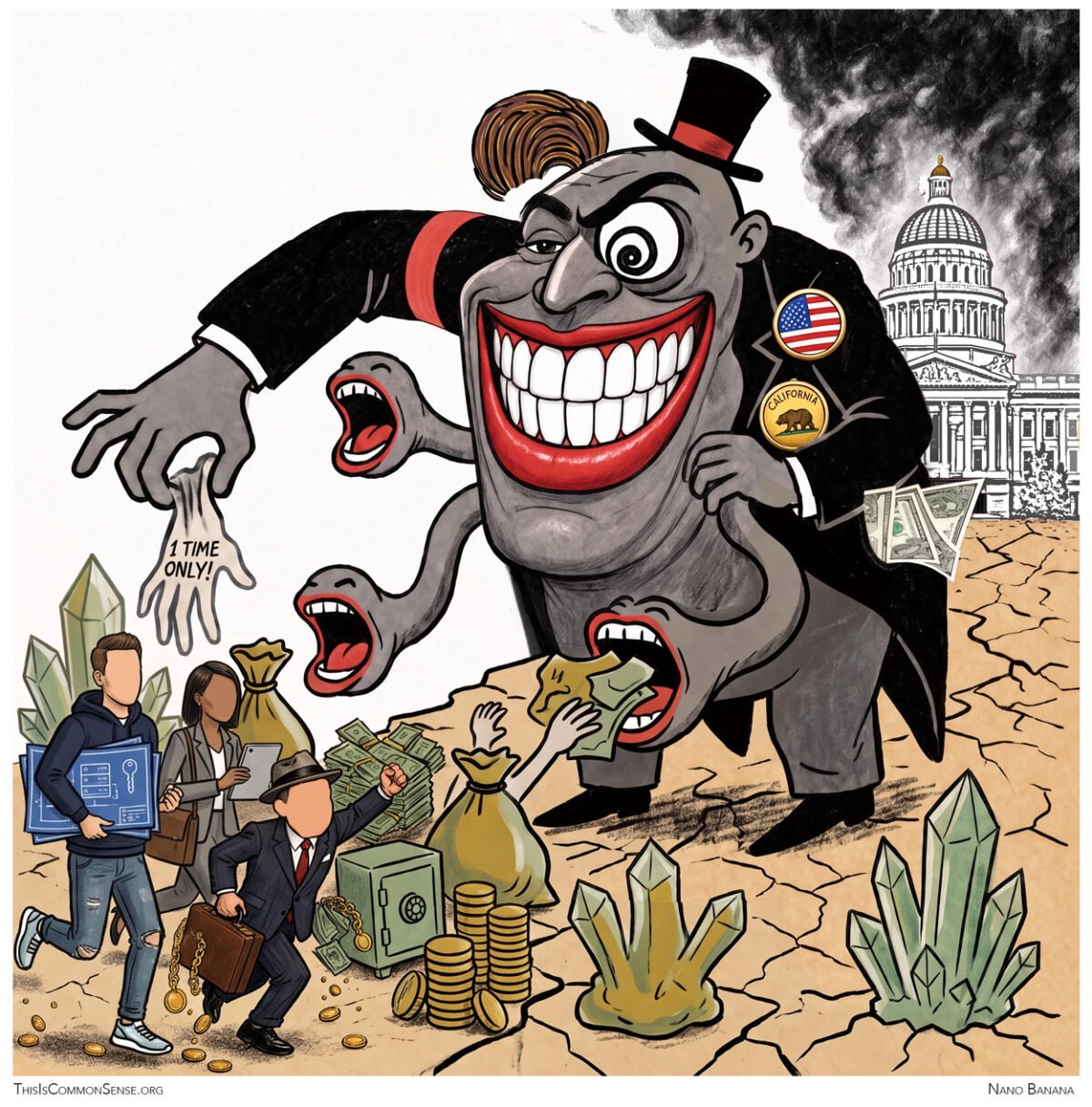
Illustration created with Nano Banana

PDF for printing

See all recent commentary
(simplified and organized)
See recent popular posts
Categories
Thought

Lucretius

Sed neque tam facilis res ulla est, quin ea primum
difficilis magis ad credendum constet, itemque
nil adeo magnum neque tam mirabile quicquam,
quod non paulatim minuant mirarier omnes.

For no fact is so simple we believe it at first sight,
And there is nothing that exists so great or marvelous 
That over time mankind does not admire it less and less.

Titus Lucretius Carus, De Rerum Natura (On the Nature of Things), Book II, lines 1026–1029 (tr. Stallings).

Categories
Today

Rockingham

On March 27, 1782, the Second Rockingham ministry assumed office in Great Britain and began negotiations to end the American War of Independence.

On 1794 on this day of the month, the United States Government established a permanent navy and authorized the building of six frigates.

Categories
national politics & policies regulation

Safer Nukes Now?

We may have power-hungry artificial intelligence operations to thank for the fact that the Nuclear Regulatory Commission has issued a permit for the “first commercial reactor” that it has approved for construction “in nearly a decade.”

It’s also “the first approval for a non-light water reactor in more than 40 years.”

National Review characterizes the construction permit as the first to be issued by the NRC in its 52-year history “for an advanced nuclear reactor design.”

TerraPower subsidiary US SFR Owner has one more regulatory hurdle. (SFR: sodium-cooled fast reactor.) It must apply separately for an operating license before the projected 345-megawatt electric plant, once built, can begin operating. After that, the way will have been paved for more such plants.

Jeff Terry, with the Illinois Institute of Technology, praises the reactor’s cheaper and safer design. “The advantage of a sodium fast reactor is that it’s cheaper to build because it’s not pressurized. So you don’t have to worry about loss of pressure. If you have an accident, the sodium fuel will harden and solidify. It’s a nice, stable, passively safe design.”

He says that the technology available now “helps the safety of a reactor which was incredibly safe 30 years ago.”

Efforts have been made to build a sodium-cooled reactor before. In the 1980s, the Department of Energy developed a prototype, and it passed safety tests with flying colors. But the Clinton administration ended the program for reasons that Terry summarizes as “sheer stupidity.”

We should prefer sheer wisdom.

This is Common Sense. I’m Paul Jacob.


PDF for printing

Illustration created with Nano Banana

See all recent commentary
(simplified and organized)
See recent popular posts
Categories
Thought

Cicero

O tempora! O mores!

O the times! O the manners!

Marcus Tullius Cicero, Against Catiline (63 BC), first speech.

Categories
Today

South Korea

On March 26, 1991, local self-government in South Korea was restored after three decades of centralized control.

Categories
First Amendment rights Internet controversy social media

Modern Tech Irrelevant

“I’ve never been more pleased by ‘losing’ in my life,” tweeted Jay Bhattacharya.

What makes the Director of the National Institutes of Health a “loser”?

Well, the doctor (who also serves as current Acting Director of the Centers for Disease Control) has not always served in the federal government. In his days between Trump administrations he’d run afoul of censors on social media. Now he’s jubilant that a major case against censorship has come to a freedom-of-speech conclusion.

Aptly, he started that post on X with “Huzzah!”

The actual news? “The New Civil Liberties Alliance, on behalf of its clients Jill Hines and Dr. Aaron Kheriaty,” reads the official press release of the lawyers, “has reached a settlement agreement and Consent Decree concluding the landmark Missouri v. Biden lawsuit against government-induced social media censorship.”

This follows an executive order by President Trump on the first day of his new administration. The president had declared that the federal government, under President Joe Biden, had “infringed on the constitutionally protected speech rights of American citizens across the United States in a manner that advanced the government’s preferred narrative about significant matters of public debate.”

This not a judicial ruling. It’s an agreement, the key point being, “The Parties agree that modern technology does not alter the Government’s obligation to abide by the strictures of the First Amendment.”

Specifically, the agreement (in the lawyers’ words) “prohibits the U.S. Surgeon General, Centers for Disease Control and Prevention (CDC), and Cybersecurity and Infrastructure Security Agency (CISA) from threatening social media companies into removing or suppressing constitutionally protected speech on Facebook, Instagram, X (formerly Twitter), LinkedIn and YouTube.” And more.

Director Bhattacharya calls it a “huge win for all Americans.”

You bet Huzzah!

This is Common Sense. I’m Paul Jacob.


PDF for printing

Illustration created with Nano Banana

See all recent commentary
(simplified and organized)
See recent popular posts

Categories
Thought

Rubén Blades

I think we risk becoming the best informed society that has ever died of ignorance.

Rubén Blades, in a conference at Harvard University reported by Anne Stewart, “Not everyone enthusiastic about the future of TV,” Bangor Daily News (February 18, 1993).

Categories
Today

To the Capitol

On March 25, 1965, civil rights activists led by Martin Luther King, Jr., successfully completed their four-day, 50-mile march from Selma to the capitol in Montgomery, Alabama.

Categories
too much government

Homelessness Costs

“Spending tripled,” shows the graph, but the “population grew 26 percent.”

Charlie Smirkley (@charliesmirkley) provided the graph, deriving the numbers from official state reports, just out.

New York City, writes Mr. Smirkley, “spends more per homeless person than the median NYC household earns.” And that “$81,705 per person in FY2025,” he explains, “is a floor.” Excluded? Supportive housing (about a half a billion per year), mental health response teams; the costs of police department dealings with homeless encampments. 

Shocking? Yes and no. We expect increasing costs in government “charity,” in part because governments centralize and standardize methods, discouraging innovation and adaptation. It’s not a market. Government bureaucrats and operatives try to coordinate increasing staffs (along with market costs in housing, etc.) while necessarily dealing with clients as objects of pity and bother rather than, as in markets (where people exchange valuable goods), subjects whose responses immediately affect the “business” at hand.

This year, the city projects to spend about $97,000 per person.

Some of the articles on the subject are better than others, naturally enough, and at least one had great graphs, too. But this sentence in Meagan O’Rourke’s Reason contribution caught my eye: “The most alarming part of the comptroller’s report is that the state cannot assess whether tax dollars are being spent effectively.”

It’s a typical problem governments have — which points to a problem not with the homeless but with government.

And of course this is not just a Big Apple thing: while spending per homeless individual since 2019 is up 187 percent in New York, spending’s up 190 percent in San Francisco, 430 percent up in Portland, and 480 percent up in L.A.

Homelessness is expensive.

This is Common Sense. I’m Paul Jacob.


PDF for printing

Illustration created with Nano Banana

See all recent commentary
(simplified and organized)
See recent popular posts