Categories
judiciary U.S. Constitution

Unpacking the Court

“Once again, the Supreme Court has shown that it’s not in the tank!” Dan Abrams exuberantly reminded his SiriusXM listeners yesterday. 

That is, the same High Court that Democrats have so harshly demonized as in President Trump’s pocket just handed him yet another defeat, striking down his executive order restricting birthright citizenship.

“It’s a very conservative court. I disagree with some of the rulings, I agree with others,” continued Abrams. “That’s not the question. The question is . . . questioning the legitimacy of the court.”

Calling that a “problem,” he added, “that’s what we’ve seen liberals doing again and again and again.”

Even to the point of advocating court-packing, arguing that when Democrats ever win back the White House and Congress, they should add enough new justices to gain an immediate majority. As Sen. Corey Booker (D-NJ) puts it, Democrats are looking “to reform the court and bring it back into alignment.”

If you ask me, a judiciary independent enough to be out of political “alignment” is a good thing. But the number of Supreme Court justices is not constitutionally prescribed; Congress could alter it at any time.  

As we celebrate the 250th anniversary of the Declaration of Independence, the birth of these United States, we should recognize what a gift our justice system is. With all of its flaws, it’s still the envy of the world. 

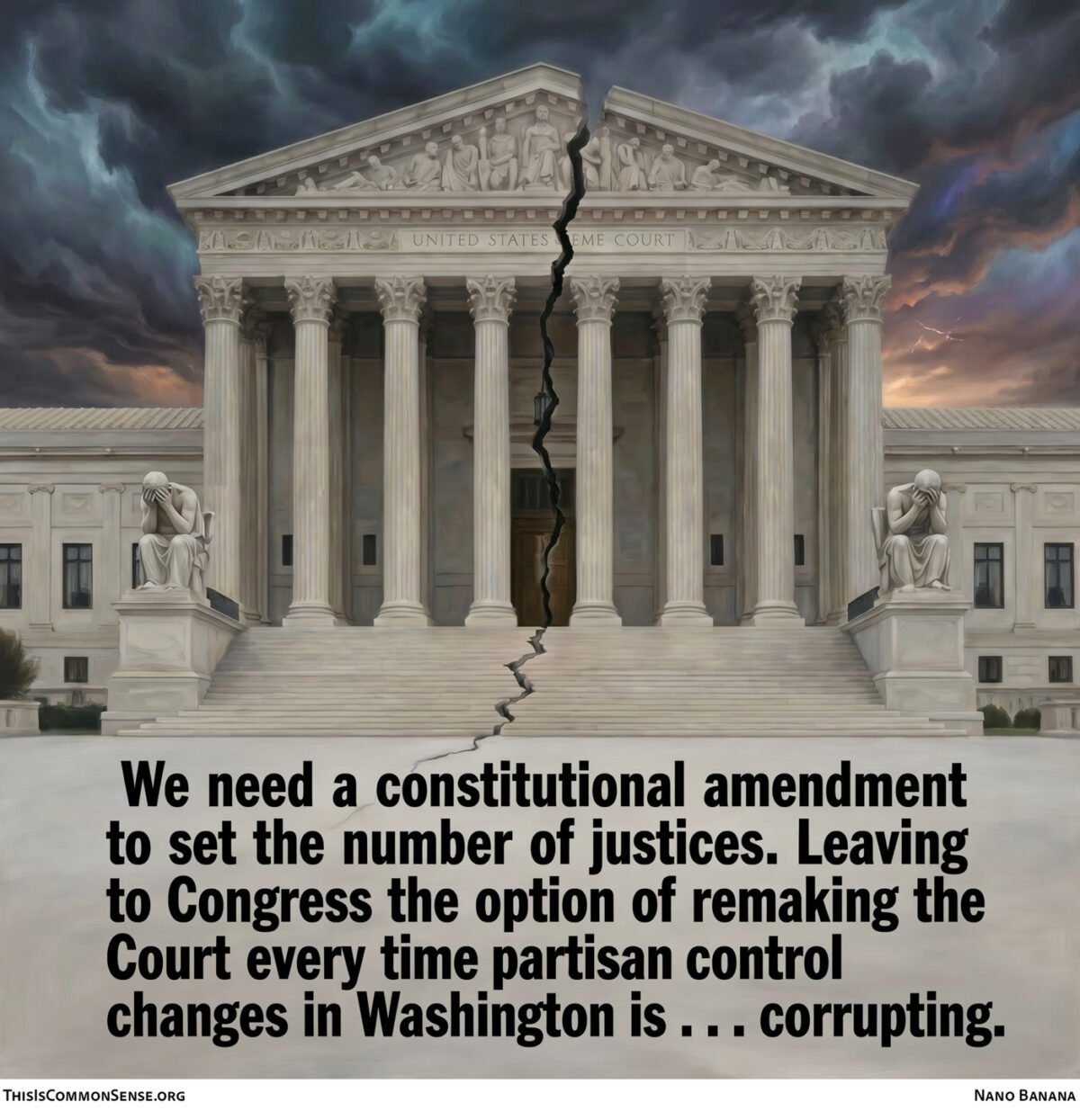
We need a constitutional amendment to set the number of justices. Leaving to Congress the option of remaking the Court every time partisan control changes in Washington is . . . corrupting

And let’s do that before we edit the 14th Amendment to end birthright citizenship for those entering the country illegally . . . as well as Chinese nationals and others practicing “birthright tourism.”

This is Common Sense. I’m Paul Jacob.


PDF for printing

Illustration created with Nano Banana

See all recent commentary
(simplified and organized)
See recent popular posts
Categories
judiciary litigation regulation

Justice Delayed Forever

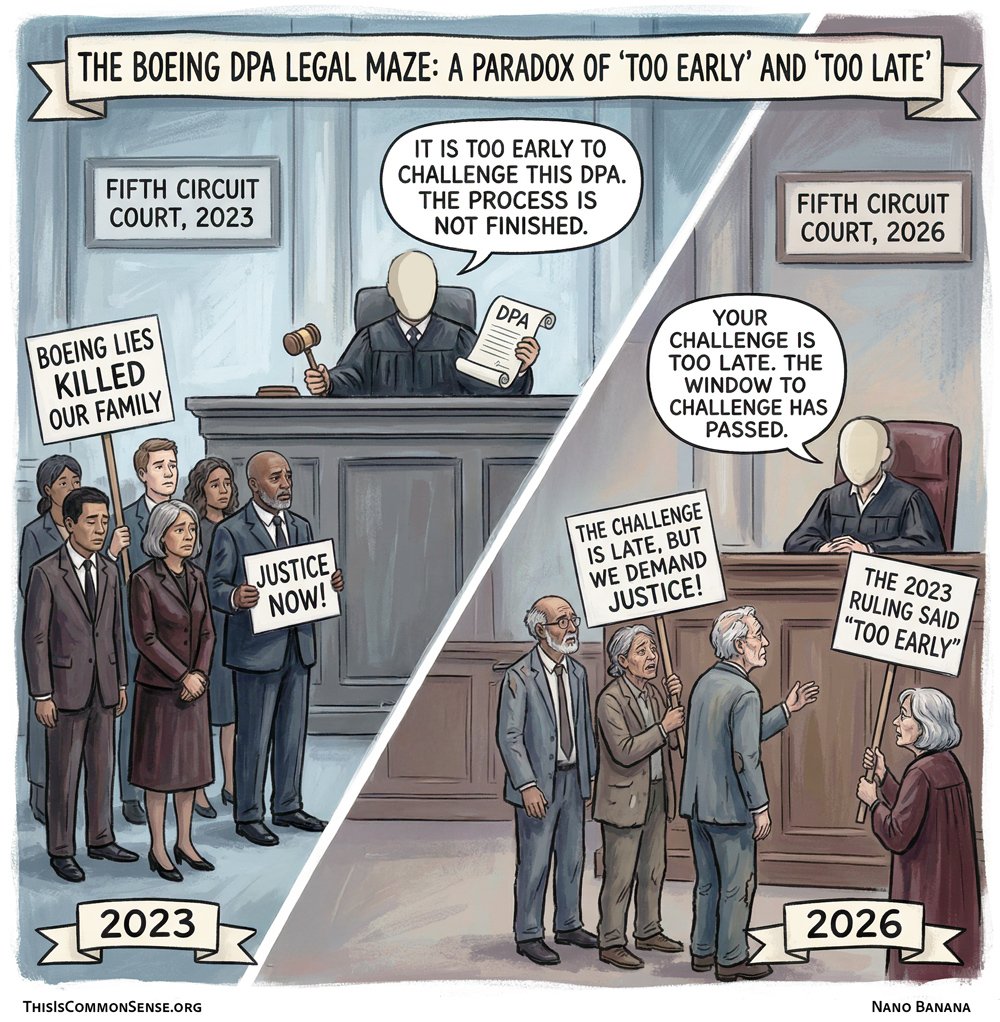
In 2023, the families of persons who had died because of Boeing’s lies about safety were told that it was too early to challenge the Justice Department’s deferred prosecution agreement (DPA) with Boeing. Now, in 2026, the same Fifth Circuit says that their challenge is too late.

When was the perfect Goldilocks moment? When was lawyer Paul Cassell supposed to challenge, on behalf of his clients, “the Justice Department’s 2021 deferred prosecution agreement and 2025 non-prosecution agreement (NPA) with Boeing”?

Cassell reports that several years ago, Boeing “lied to the FAA about the safety of its new 737 MAX aircraft.” After Justice investigated, it charged Boeing with a criminal conspiracy — yet immediately signed a “sweetheart DPA” that let Boeing avoid a criminal conviction so long as it paid penalties and compensation to the families. 

And promised to do better.

In court, the families proved that the Justice Department had hidden the agreement from them even though legally obliged to consult with them. The same judge who acknowledged this in 2022 went on to rule, in 2023, that there was nothing he could do.

Appealing that decision, Cassell was next foiled by the Fifth Circuit, which ruled in December 2023 that any relief for the families was “premature.” Now, many complications later, the Fifth Circuit has “simply ignored its previous promises.”

With Boeing suffering no proportionate consequences for its incompetence and dishonesty about safety, it is just a matter of time before similar cases are repeated.

This is Common Sense. I’m Paul Jacob.


PDF for printing

Illustration created with Nano Banana

See all recent commentary
(simplified and organized)
See recent popular posts

Categories
election law judiciary regulation U.S. Constitution

Fifty Years After Buckley

Congress began regulating campaign finances in the 1960s.

In 1976, the Supreme Court’s ruling in Buckley v. Valeo reined in such regulation . . . in part.

This month, at a symposium marking the 50th anniversary of the ruling, John Samples — a former Vice President at the Cato Institute and currently a Member of Meta’s Oversight Board — compared what happened after the 1976 ruling to what might have happened had the ruling been better or worse.

The alleged point of campaign finance regulation was to “level the playing field.” The actual point, Samples observed, has been to “protect the political status quo” by making it harder “to spend enough money to effectively challenge congressional incumbents.”

In Buckley, the court ruled that contribution limits were indeed valid (they aren’t) for the sake of combatting corruption or the “appearance of corruption.” But it also ruled that limits on campaign spending are limits on speech, hence invalid — thereby saving democracy, argued former Federal Election Commission chair Bradley Smith, in the Wall Street Journal a few weeks ago: “The Buckley court understood that effective political speech requires resources.”

The Court also upheld compulsory disclosure of donors and donations. This led to chronic calumniation of donors, helping to poison public discourse.

Samples suggeststhat a more libertarian Buckley might have enabled major reform, even perhaps privatizing of New Deal and Great Society spending programs in the 1980s.

On the other hand, had the decision been worse, “validating spending limits” as well, Congress would likely have continued to hobble challengers. And thus, perhaps, prevented the ascendancy of Ronald Reagan and the emergence of a GOP majority in the U.S. Senate.

Unwarranted restrictions on freedom of speech should be removed completely. Substantially removed is better than not at all, sure. But now let’s finish the job.

Something Brad Smith’s Institute for Free Speech works on every day.

This is Common Sense. I’m Paul Jacob.


PDF for printing

Illustration created with Nano Banana

See all recent commentary
(simplified and organized)
See recent popular posts

Categories
ideological culture judiciary property rights too much government U.S. Constitution

Who’ll Oppose the Quasi-Commie?

Should we expect a four-year pitched battle?

I see one brewing between the new communist mayor of New York City and those judges who respect law and the U.S. Constitution.*

Some say that Zohran Mamdani, though on record admitting his goal of seizing the means of production, is technically not a communist. Well, if allowed to fully impose all he wants on New Yorkers, maybe that would amount to going straight to a fascist model of totalitarian governance — bypassing the Maoist-Stalinist stage.

Giving him the benefit of the doubt.

But we do know that Mamdani was quick to hire such advisors as housing czarina Cea Weaver, who has lamented home ownership as a “weapon of white supremacy” and declared property as such to be something regrettably long treated as “an individualized good” that now must be treated as a “collective good.”

If you don’t own your house as an individual and have a spare room (or half a room), and somebody needs a place to live, could a Mamdani-and-Weaver-run Big Apple compel you to give space to a stranger that you don’t want around? If property becomes a “collective good” and all must cuddle in the warm bosom of the state-managed collective, the answer must be: yes.

But New Yorkers may not be quite doomed.

Not, anyway, if there are enough judges like David Jones, who recently interfered with an attempt by the Mamdani administration to interfere in the sale of many rental properties owned by Pinnacle Group.

Mamdani’s office says they’ll keep trying. 

Of course they will.

This is Common Sense. I’m Paul Jacob.


* Or the New York State Constitution, for that matter: see §7 (a), which clearly states that “Private property shall not be taken for public use without just compensation.” 

PDF for printing

Illustration created with Nano Banana

See all recent commentary
(simplified and organized)
See recent popular posts
Categories
ideological culture judiciary litigation

Trouble with Definitions

Is it time to push for a complete wall of separation between Sports and State?

The First Amendment helped the United States — together and separately — protect religion from the ravages of regulation, taxation, suppression, and favoritism. Maybe it’s time to extend the concept. 

This came to mind as I skimmed through the transcript to a current case before the Supreme Court, Little v. Hecox (Docket No. 24-38), which involves a challenge to Idaho’s law restricting “transgender women and girls” from participating in women’s and girls’ sports.

I doubt the forthcoming ruling will get government out of sports generally, much less out of sports in public schools — which is what this is all about, Idaho’s law applying only to athletic teams sponsored by public educational institutions (or certain nonpublic ones competing against public ones), not to purely private teams. 

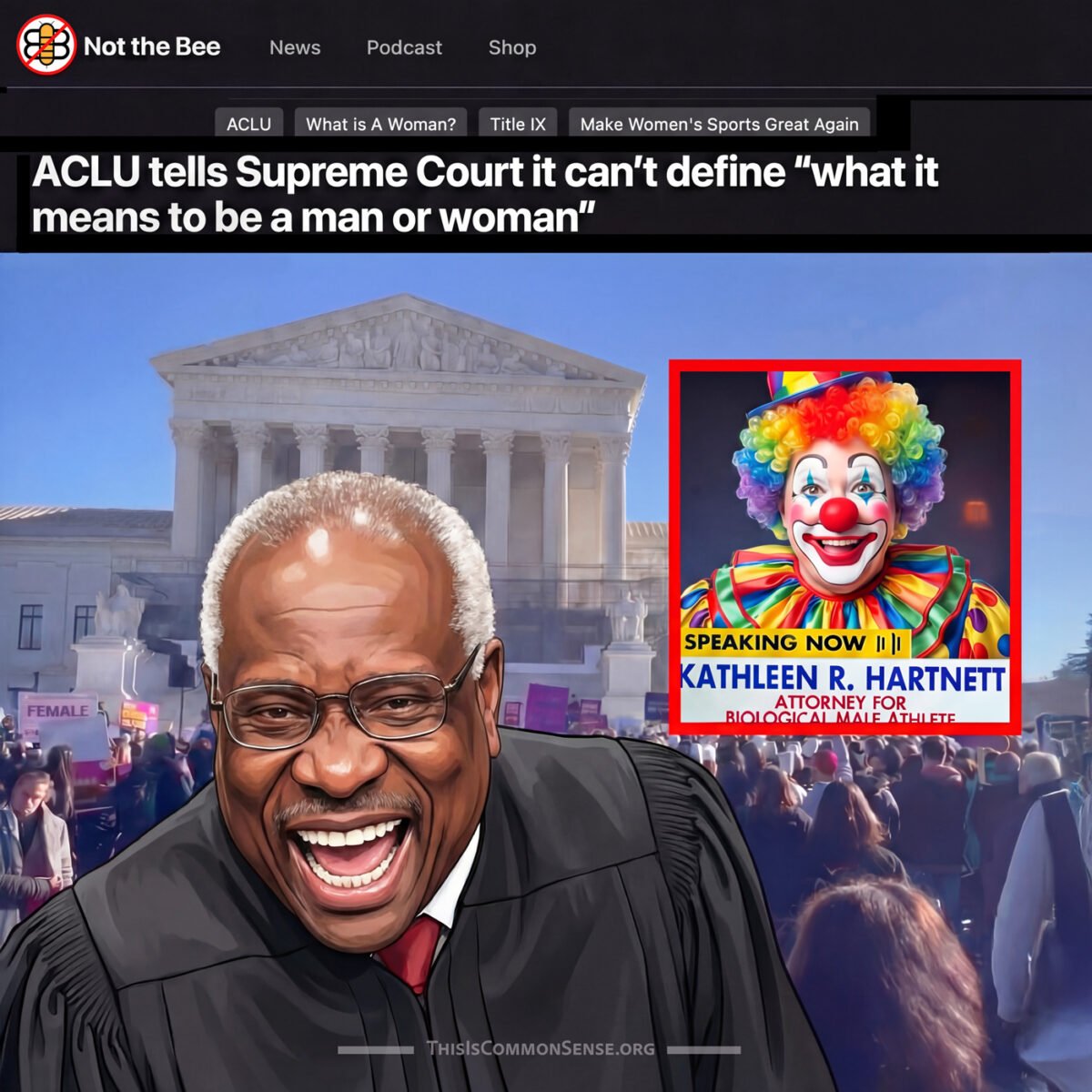
One lawyer for the respondents, Kathleen R. Hartnett, Esq., got stuck with the “tough” job. She was asked by Justice Alito if an understanding of what men and boys are, and what women and girls are, was relevant to the Equal Protection Clause. She said yes, but then confessed to lacking a definition of the sexes for the Court.

Then “how can a court determine that there’s discrimination on the basis of sex,” Alito inquired, “without knowing what sex means. . . . ?”

Her answer started out on a most unpromising note: “I think here we just know . . .” immediately pivoting to the statute’s applicability. Alito went on to challenge her on a key notion in trans ideology, that one becomes trans just by saying so.

I see a lot of people online chortling on the comedy of it all.

But I think here we just know it’s … seriously troublesome.

This is Common Sense. I’m Paul Jacob.


PDF for printing

Illustration created with Nano Banana

See all recent commentary
(simplified and organized)
See recent popular posts

Categories
First Amendment rights judiciary

Satire Censorship, DOA

In the endless battle to protect our freedom of speech, the forces for good can chalk up another victory, this one out in California.

The Golden State government has been trying to impose censorship on so-called “deep-fake” videos by forcing social-media platforms to find and eliminate “materially deceptive content” about incumbents and candidates. Platforms like Twitter-X and Rumble contend that the law would compel them to act as government censors.

Had a ban on “materially deceptive content” been imposed on TV networks, it might have wiped out most campaign commercials aired over the past 65 years.

But the deepfakes that California politicians want to censor are satirical. Example: a popular video of Kamala Harris talking about what a lightweight and unscrupulous politician she is. 

The bogosity of the video is obvious. 

Indeed,the effectiveness of such parody is what caused politicians like California Governor Newsom to hit the red-alert button.

A district judge, John Mendez, recently stated in court that since platforms are protected from being punished for third-party content under the Communications Decency Act, the California law seeking to punish platforms that fail to remove “deep-fake” political criticism on behalf of pusillanimous pols is dead on arrival.

Mendez has already blocked enforcement of the law throughout the state until he can issue a formal opinion.

“No parts of AB 2655 can be salvaged,”he explained. 

Judge Mendez also suggested that a related California censorship law targeting videos, AB 2839, is doomed because it violates First Amendment rights.

This is Common Sense. I’m Paul Jacob.


PDF for printing

Illustration created with Krea/Grok and Firefly

See all recent commentary
(simplified and organized)
See recent popular posts

Categories
crime and punishment judiciary

Today’s Stunning Outrage

“Americans are watching with outrage the stunning news that Trump’s FBI has arrested a sitting judge in Milwaukee for alleged obstruction of an immigration arrest,” declared U.S. Rep. Jamie Raskin (D-Md.).

Arresting judges?

“This is a drastic escalation and dangerous new front in Trump’s authoritarian campaign of trying to bully, intimidate, and impeach judges who won’t follow his dictates,” Raskin explained. “We must do whatever we can to defend the independent judiciary in America.”

Oh, my goodness, what is Mr. Trump doing now? was admittedly my first thought. But then I looked at the two cases raised. 

The first features Joel Cano, a former magistrate judge in Doña Ana County, New Mexico, and his wife, Nancy, both charged with evidence tampering, as reportedly “jail records show.” Cano resigned back in March, after the Department of Homeland Security raided his home, on information that “an undocumented immigrant from Venezuela whom authorities suspect of being a Tren de Aragua member, and others were staying on the Canos’ property.”

Last Friday, the FBI arrested Milwaukee County Circuit Court Judge Hannah Dugan on obstruction of justice charges, “alleging,” NBC News reported, “that she obstructed federal authorities who were seeking to detain an undocumented immigrant by escorting the man and his defense attorney though a nonpublic jury door.”

That man, Eduardo Flores-Ruiz, in court on a new domestic violence charge, was successfully apprehended by ICE, nonetheless. But what to make of a judge aiding and abetting a criminal’s escape?

Yes, we want an independent judiciary. But independent from politics — not independent from the law

This is Common Sense. I’m Paul Jacob. 


PDF for printing

Illustration created with Krea and Firefly

See all recent commentary
(simplified and organized)

See recent popular posts

Categories
free trade & free markets judiciary

Musk’s Bête Noire

Should a judge decide how much Elon Musk can be paid?

Well, when the job that Musk is doing is not a government job and a company’s internal process of determining the compensation is voluntary and aboveboard . . . no.

But according to a Delaware judge, Chancellor Kathaleen McCormic, who last January rescinded Tesla’s compensation package then worth $56 billion, now worth more than $100 billion, Musk is not entitled to this compensation. And she has just affirmed her ruling.

Musk says that “shareholders should control company votes, not judges.”

Tesla says: “The ruling is wrong, and we’re going to appeal.”

The appeal could take a year or more.

There’s nothing in the U.S. Constitution authorizing judges to run private companies or decide how much their most valuable personnel may be paid. The judge has no constitutional warrant. And no moral warrant. 

Not her business.

Ignoring the enormous success of Tesla, McCormic is simply deciding that Musk’s pay is way too much with respect to some arbitrary personal criterion that is irrelevant to the decisions that companies must make to attract and keep their greatest entrepreneurial talents, the ones who do the most to make it all go.

Still, maybe we should give the judge a break — I mean, just a tad?

Remember, it was Chancellor McCormic who forced Musk to go through with his Twitter purchase — which turned out to be the most consequentially favorable free-speech/-free-press event of our time. 

Sure, then too she was grinding a personal or ideological animus against the magnate.

But credit where credit’s due!

This is Common Sense. I’m Paul Jacob.


PDF for printing

Illustration created with …

See all recent commentary
(simplified and organized)
See recent popular posts

Categories
judiciary property rights

Lost Justice, Long Island

You can’t win them all.

The Institute for Justice and its clients, Ben and Hank Brinkmann, suffered a defeat in a recent eminent domain case, Brinkmann v. Southold, New York, when the U.S. Supreme Court declined to take the case.

IJ notes that the three justices in favor, Thomas, Gorsuch, and Kavanaugh, “took the unusual step of recording their votes publicly.” But four votes were needed.

The two brothers own a chain of hardware stores. In 2016, they found an apparently ideal place for a new store in Southold, New York.

Although the property they bought was commercially zoned, the town government imposed one arbitrary and expensive obstacle after another to prevent construction. Finally, it used eminent domain to seize the property.

Though blatant, the town’s arrogant and capricious behavior was accepted by lower courts.

“Government shouldn’t be able to get away with these abuses of power,” the brothers say, “and shining a light on them like we did with the help of IJ will continue to build public support so that one day no one will have to go through what we have.”

Sometimes, when the bad guys go all out to violate the rights of people who are willing to go all out to defend those rights, unfortunately it’s the bad guys who “win,” if you want to call getting away with it a victory.

But the good fight is itself a kind of victory, and it will lead to victories for others.

This is Common Sense. I’m Paul Jacob.


PDF for printing

See all recent commentary
(simplified and organized)
See recent popular posts
Categories
judiciary local leaders

Arresting Speech Victory

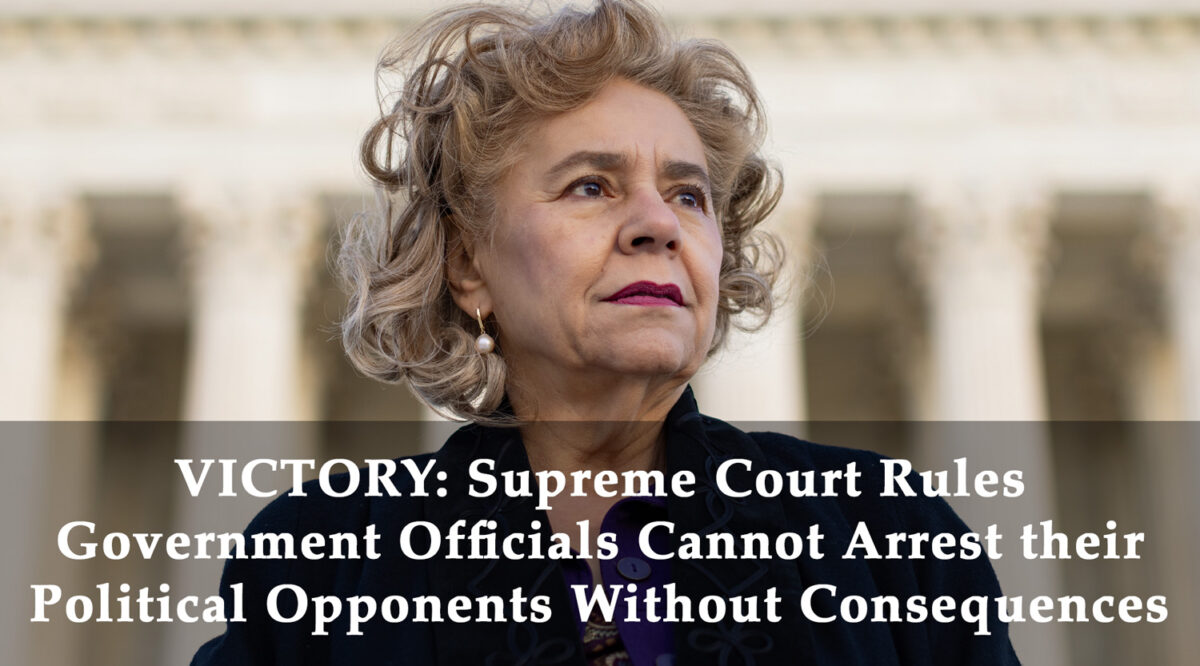
I am happy that the U.S. Supreme Court ruled the way it did, letting Sylvia Gonzalez proceed with her litigation.

But why was there even a question?

The case is Gonzalez v. Trevino. It started in 2019 when Gonzalez was elected to the council of Castle Hills, Texas. After winning, she led a petition drive to remove the city manager from office for abusing employees and neglecting his duties.

Soon the mayor and the police chief were falsely accusing her of tampering with a government record. She was arrested and jailed. But the district attorney dropped the charges after a day.

After Gonzalez resigned from the council because of “ongoing intimidation,” the Institute for Justice helped her file a federal lawsuit against the town for selective prosecution.

A lower court had gone along with the city’s request to dismiss the case. The rationale was that Gonzalez had not shown that others who trivially “mishandled a government petition” in exactly the same way Gonzalez did were not then arrested.

In reversing this decision, the Supreme Court said that “the demand for virtually identical . . . comparators goes too far.” Plausible evidence that Gonzalez had been singled out for retaliation, thus violating her First Amendment rights, was enough to let the case proceed.

It’s an important issue for all of us, not only for Sylvia Gonzalez. As IJ stresses, this kind of retaliation “against citizens engaging in protected speech or activity” is more common than we may suspect.

This is Common Sense. I’m Paul Jacob.


PDF for printing

Photo provided by Institute for Justice

See all recent commentary
(simplified and organized)
See recent popular posts