
Categories
judiciary U.S. Constitution

Unpacking the Court

“Once again, the Supreme Court has shown that it’s not in the tank!” Dan Abrams exuberantly reminded his SiriusXM listeners yesterday. 

That is, the same High Court that Democrats have so harshly demonized as in President Trump’s pocket just handed him yet another defeat, striking down his executive order restricting birthright citizenship.

“It’s a very conservative court. I disagree with some of the rulings, I agree with others,” continued Abrams. “That’s not the question. The question is . . . questioning the legitimacy of the court.”

Calling that a “problem,” he added, “that’s what we’ve seen liberals doing again and again and again.”

Even to the point of advocating court-packing, arguing that when Democrats ever win back the White House and Congress, they should add enough new justices to gain an immediate majority. As Sen. Corey Booker (D-NJ) puts it, Democrats are looking “to reform the court and bring it back into alignment.”

If you ask me, a judiciary independent enough to be out of political “alignment” is a good thing. But the number of Supreme Court justices is not constitutionally prescribed; Congress could alter it at any time.  

As we celebrate the 250th anniversary of the Declaration of Independence, the birth of these United States, we should recognize what a gift our justice system is. With all of its flaws, it’s still the envy of the world. 

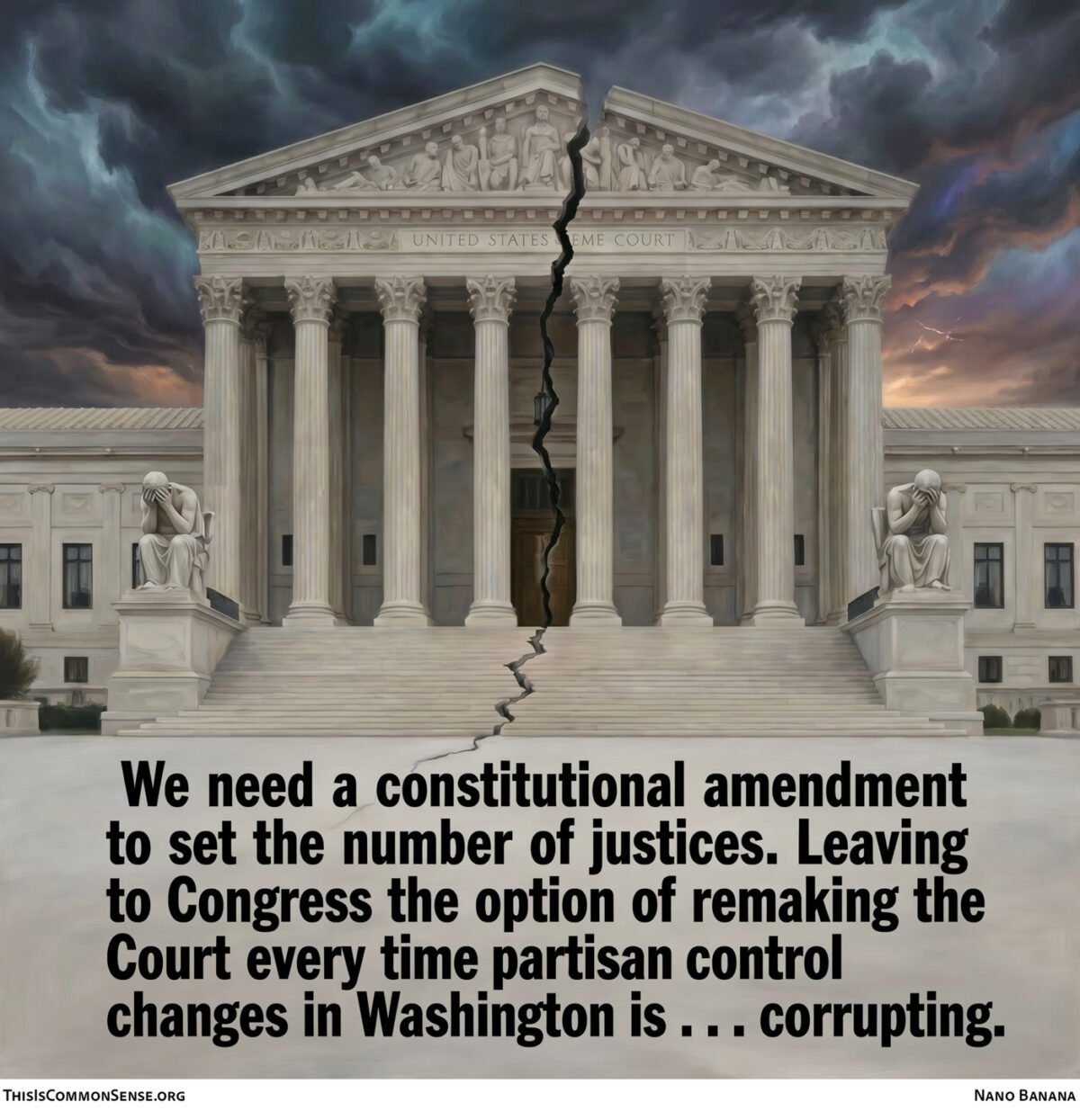
We need a constitutional amendment to set the number of justices. Leaving to Congress the option of remaking the Court every time partisan control changes in Washington is . . . corrupting

And let’s do that before we edit the 14th Amendment to end birthright citizenship for those entering the country illegally . . . as well as Chinese nationals and others practicing “birthright tourism.”

This is Common Sense. I’m Paul Jacob.


PDF for printing

Illustration created with Nano Banana

See all recent commentary
(simplified and organized)
See recent popular posts

Categories
property rights

Our Property, Not Their Loot

It’s getting harder to hit innocent Coloradans over the head with civil forfeiture laws.

If you live in the Rocky Mountain State and the police want to grab some of your stuff on the basis of a suspicion (or a claimed suspicion) that you have committed a crime, you’re better off today than you would have been a few weeks ago.

Colorado has become the second state of the union to entitle you to a lawyer if police are seizing your property.

The new law also requires “a conviction of the nonowner criminal defendant before the noninnocent owner’s property may be forfeited,” which is a little nonclear but means, if enforced properly, that authorities in the state will not be able to greedily grab your property on grounds of mere suspicion that you or some good buddy of yours has committed a crime.

One needs civil forfeiture laws to disrupt organized crime, say supporters. But Reason’s C.J. Ciaramella points out how much evidence has piled up over the years showing how easily civil forfeiture can be abused. And how frequently it has in fact been abused. Undoubtedly, civil forfeiture laws have “created perverse profit incentives for police departments and lacked due process protections for innocent property owners.”

State by state — or in all states at once, if Congress can help in a way that survives judicial challenges — the incentives must be wiped out.

Due process for innocent people subject to the confiscations must be ensured.

This is Common Sense. I’m Paul Jacob.


PDF for printing

Illustration created with Nano Banana

See all recent commentary
(simplified and organized)
See recent popular posts
Categories
First Amendment rights general freedom national politics & policies regulation

Mandatory Internet IDs

An assault on your freedom to use your computer without having to “verify your age” has migrated from states like California, Colorado, and New York to the United States Congress.

This is the so-called Parents Decide Act, which would “require operating system providers to verify the age of any user of an operating system.”

The honor system, the for-now method of the California law, doesn’t stop ten-year-olds from claiming to be 35. For such laws to “work,” the PC would have to require you to verify your age before you can use it.

That method cannot help but be invasive, like scans of your ID card or your face. Sure, many users of mobile computing devices have private security using their faces or fingerprints, but those users do not intend to share this secret information to third parties — which sure seems like what’s going on here.

PC Gamer observes that, although the method of age verification is crucial “in terms of privacy and data security,” the Energy and Commerce Committee will be deciding such things after passage. 

They’d have to pass the bill for us to see what’s in it.

Whatever the method, many users would obey, conscientiously giving the PC — and the PC or OS maker — ID or facial info that might be linked to purchase info in the company’s database.

Could such databases be hacked and provide criminals with new information with which to commit their crimes? Only if the umpteen stories per day on successful hacks of the databases of major companies are any clue.

“Save the children” is the familiar sales pitch, but if government is in charge of saving the children, our children are in trouble.

This is Common Sense. I’m Paul Jacob.


PDF for printing

Illustration created with Nano Banana

See all recent commentary
(simplified and organized)
See recent popular posts

Categories
crime and punishment First Amendment rights national politics & policies

Prosecutorial Shell Game?

The Department of Justice’s case against the egregious former head of the Federal Bureau of Investigation, James Comey, is as weak a case as he could hope.

Comey had shared an image on social media — a photo of shells on a beach gathered together to markout “86 47” — and, when people interpreted it as a possible threat, he deleted it. “He said he thought it was a political message, not a threat,” an NPR story summarizes, “but now a grand jury in North Carolina has made a federal case out of this. It’s charged Comey with two felonies, including allegedly threatening the life of the president.”

So why do I call it weak? While “86” may have originally meant “kill” or “delete,” amongst gangsters, real or Hollywood, it’s often used colloquially to mean “get rid of.” And though “47” is the number of Trump’s second administration, it’s possible — indeed likely — that Comey didn’t mean “Kill Trump.” He could have meant “impeach Trump” or “prosecute Trump” or any other politically acceptable way to force the president out of office. 

Don’t get me wrong. Was it a dumb thing for the disgraced former government official to share? Sure. But even outstandingly horrible former FBI heads have freedom of silly speech.

This is not the first time Comey’s been prosecuted by the Trump DOJ. The last time it fizzled. And, considering the First Amendment, this one will fizzle.

Bringing forward dumb charges looks bad, like Democrats looked prosecuting Trump. The political persecution of enemies is not all that popular. 

And in a country filled with political corruption, it sets the cause of “draining the swamp” back, not forward.

This is Common Sense. I’m Paul Jacob. 


PDF for printing

Illustration created with Grok Imagine

See all recent commentary
(simplified and organized)
See recent popular posts

Categories
privacy regulation too much government

All Your OS Are Belong to Us

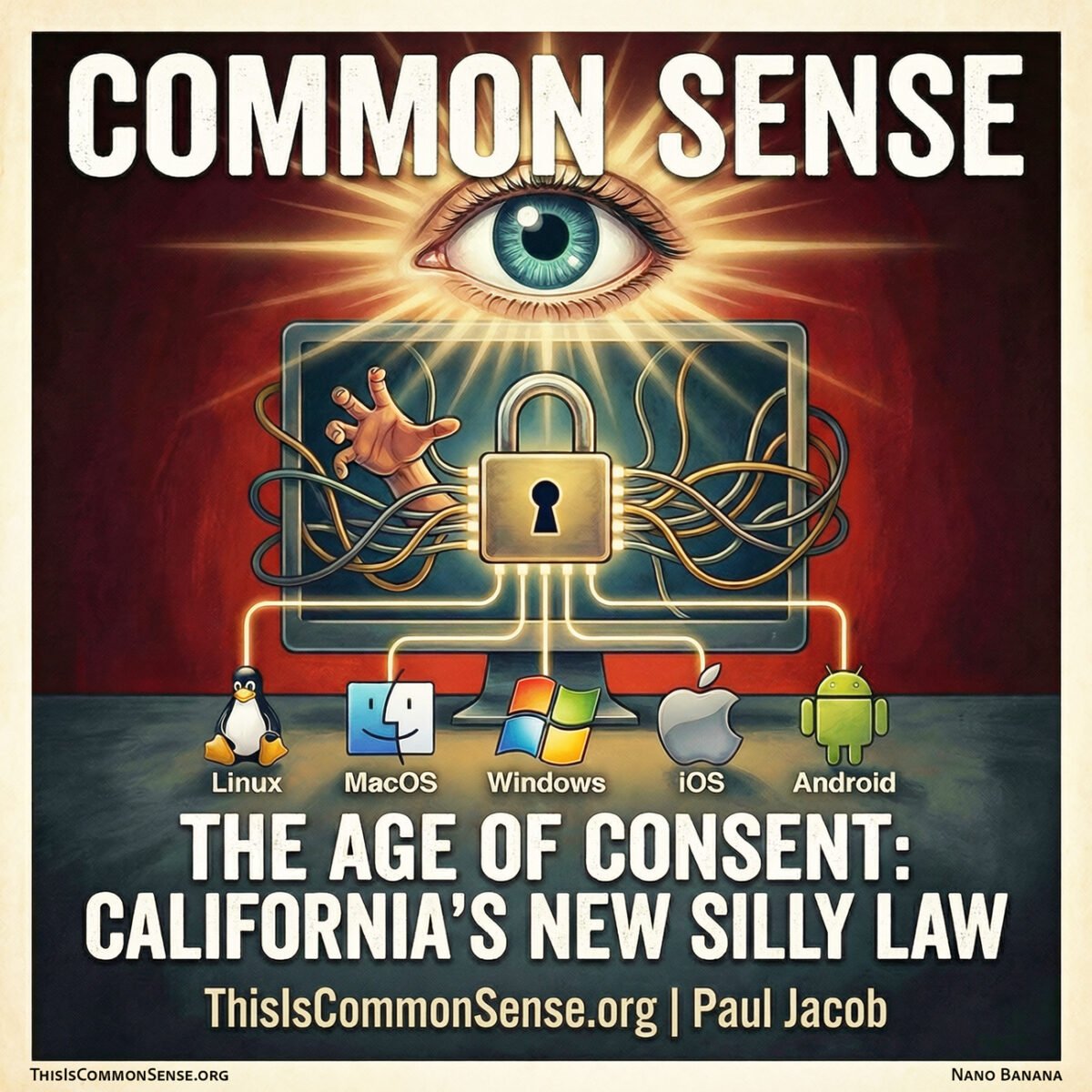
The always-wrong California legislature has unanimously passed — and the state’s always-wrong governor has signed — legislation to compel makers of computer operating systems to verify the owner’s age. The information from Linux, MacOS, Windows, iOS and Android would then be transmitted to the software (“apps”) running on each respective platform.

Reclaim the Net observes that in a “different timeline, wiring an age-surveillance layer into the boot sequence of every computing device in California is an idea that would have died in committee.”

AB1043 doesn’t require any upload of government ID or facial scan, just that the user report age when setting up the OS. I am not relieved.

All the shmexperts eager to erode our privacy say that requiring web surfers to type a number into a box to report age is insufficient. If California’s new law is allowed to stand, perhaps in part because it seems fairly innocuous — any plucky 12-year-old could type “89” when ordered to report age — would the politicians stop there?

Some kind of ID verification would be mandated sooner or later. Then use of fake IDs would lead to calls for biometric confirmation. Etc.

Reclaim the Net explains that Linux distributions don’t even have a way to comply with the silly California law. Decentralized Linux exists for people who don’t want to be surveilled when doing their computing, and “there’s no entity to mandate, no account system to modify, no API to build.”

These and many more objections appear to me to be just common sense — now illegal in California.

I’m Paul Jacob.


PDF for printing

Illustration created with Nano Banana

See all recent commentary
(simplified and organized)
See recent popular posts

Categories
free trade & free markets litigation regulation

Free to Advise

People should be free to talk to each other about whatever they want as long as they’re not thereby conspiring to rob and murder and so forth. They should even be able to give advice.

Including legal advice. 

New York State disagrees. 

The Institute for Justice is asking the U.S. Supreme Court to let the non-lawyer volunteers of a company called Upsolve keep giving advice to people facing lawsuits to collect debt.

As IJ explains, New York State is trying to “protect people from hearing advice from volunteers” who have relevant training. The point is that the First Amendment “doesn’t allow the government to outlaw discussion of entire topics . . . by requiring speakers to first obtain an expensive, time-consuming license.” (That Upsolve’s advisors have relevant training is relevant but also superfluous. Even untrained talkers have the right to talk, obviously.)

In 2022, a federal district court agreed with the plaintiff that its volunteers have a First Amendment right to speak and let Upsolve operate as litigation continued. Then a court of appeals ruled against Upsolve. Now IJ and Upsolve hope that the U.S. Supreme Court will step in and put an end to the nonsense. 

We know what this is about: politicians catering to lawyers who don’t want less expensive sources of legal advice out there competing for customers. 

It’s certainly not about protecting those who would have one fewer resource to turn to were this one taken away.

This is Common Sense. I’m Paul Jacob.


PDF for printing

Illustration created with Nano Banana

See all recent commentary
(simplified and organized)
See recent popular posts

Categories
initiative, referendum, and recall

Initiative Killers

“Almost nothing is more sacred for the voters,” says Sam Reed, former Secretary of State in Washington State, “than their right to petition to change laws or to refer laws to the voters.”

He reminded members of the Senate State Government and Elections Committee that “the initiative process is utilized by progressives, conservatives, and nonpartisan individuals. . . . For over 100 years, the initiative process has served our citizens well and any changes made to it must be justified.”

Reed argues that the changes in Senate Bill 5973 (as well as in House Bills HB 2599 and 2260) are in no way justified.

“The stated reason for this bill is to stop fraudulent or forged signatures from being counted. But that’s already being done. Besides substantial penalties deterring such actions, the Secretary of State is extremely diligent and reviews every petition sheet and every signature and any that are even remotely questionable are set aside and never counted.” This means that “all of SB 5973’s requirements will substantially burden the Secretary of State’s already overworked staff and the citizen signature gathering process without any added benefit.”

The bills add more requirements that end up being more burdensome on an already high-hurdled petitioning process.

“All aspects of the proposed bill (SB 5973 / HB 2599) impose severe restrictions, limitations, and onerous requirements on circulators and ballot measure campaigns,” adds attorney Nicholas Power, pointing out that the bill’s intent section “admits there hasn’t been any fraud for 12+ years.”

What’s really going on with these bills?

Politicians generally don’t like citizens creating laws any more than they like citizens limiting their terms in office. It really cramps their style.

So, they want to kill the initiative. Instead, let’s keep cramping their murderous style.

This is Common Sense. I’m Paul Jacob.


PDF for printing

Illustration created with Nano Banana

See all recent commentary
(simplified and organized)
See recent popular posts
Categories
Accountability defense & war national politics & policies responsibility U.S. Constitution

The Irresponsible vs. The Unaccountable

Six Democrats in Congress — Arizona Sen. Mark Kelly, Michigan Sen. Elissa Slotkin, U.S. Representatives Jason Crow of Colorado, Maggie Goodlander of New Hampshire, and Chris Deluzio and Chrissy Houlahan of Pennsylvania — caused quite a stir, recently, producing a video “to speak directly to members of the Military and the Intelligence Community.” 

What did these former military and intelligence agency vets-turned-congressmen tell our current soldiers and spooks?  

“You can refuse illegal orders.”

While that’s true, and important . . . what orders are they talking about? 

Perhaps the continued bombing of ships in the Caribbean and killing of crews, all on accusations by the White House that these are drug smugglers — without any check or real accountability — is such a case.*

Yet, these powerful senators and representatives are not making it.

Instead, they’ve not even identified one breach. And by refusing to identify any of President Trump’s specific orders, their call devolves into second-guessing the chain of command and encouraging dissension in the ranks, dissuading military personnel from always being “at the ready.”

Further, these wielders of legislative power in Washington have taken no serious action to protect the Constitution nor promoted any legislative action to hold executive action accountable. 

Instead, they pass the buck to the soldier (or CIA analyst) to determine the legality of orders on the fly.

As Haley Fuller wrote at Military.com last week, “[A]sking individual service members to make on-the-spot legal judgments without guidance can put them at enormous personal risk.” 

Was this Democrat video “SEDITIOUS BEHAVIOR, punishable by DEATH!” as Trump posted on social media? I don’t think so. 

It is, however, tragically emblematic of the complete and total abdication of responsibility by these pretend leaders in Congress. 

This is Common Sense. I’m Paul Jacob.


* Reminds me of President Obama’s policy of killing American citizens abroad by drone strikes without, as even he acknowledged, any real process of checks and accountability. Thank goodness for Sen. Rand Paul’s 2013 filibuster raising concerns about this unaccountable power to execute. 

PDF for printing

Illustration created with Nano Banana and Firefly

See all recent commentary
(simplified and organized)
See recent popular posts

Categories
partisanship U.S. Constitution

Constitutional Defects

“It is now time for the Republicans to play their ‘TRUMP CARD,’ and go for what is called the Nuclear Option — Get rid of the Filibuster, and get rid of it, NOW!” 

That’s what President Trump posted on Truth Social back during the shutdown, adding, “WE are in power, and if we did what we should be doing, it would IMMEDIATELY end this ridiculous, Country destroying ‘SHUT DOWN.’”

This was prior to Democrats, off-year election over, suddenly deciding to agree to the same deal to reopen the government that Republicans had been offering for weeks.  

The 60-vote supermajority the United States Senate needs to end debate and vote on legislation is a small-r republican measure, not a small-d democratic one. Reasonable people can disagree over its merits, certainly, but I like the greater consensus it requires. 

What I don’t like is that the party in control of the Senate can at any time change the filibuster rule in any way it wishes, including ending it altogether. 

Rules shouldn’t be this easy to junk. 

Make the Senate filibuster not just a rule, but constitutional law. 

Another major matter of constitutional change is sorely needed. The stability and independence of one of the three branches of the federal government, the U.S. Supreme Court, hangs by a thread.

The number of justices, now nine, is nowhere set in the Constitution. 

Congress and the White House, when held by the same political party — even short of 60 votes in the Senate, because they could simply end the filibuster — could immediately add ten new justices.

Or 20. 

And then confirm all the president’s picks.

All something Democrats mused about doing years ago: packing the High Court with many new justices to magically engineer a new Democratic Party majority on the SCOTUS. 

The number of justices, like the Senate’s super-majoritarian filibuster, aren’t written in stone.

But should be.

This is Common Sense. I’m Paul Jacob. 


PDF for printing

Illustration created with Krea and Firefly

See all recent commentary
(simplified and organized)
See recent popular posts

Categories
crime and punishment government transparency privacy

Transparency, Weaponized

Transparency is usually a good thing. But so is privacy. And so, too, are limits on government power. 

Which bring me to the Epstein files — or, more accurately, those files bring me here. 

“I don’t think we’ve had a scandal like this in this country,” Rep. Ro Khanna (D-Calif.) offered yesterday on Meet the Press, “and what we’re asking for is justice for those survivors.” 

I want justice, too — that is, the prosecution of any crime grand juries honestly believe was likely committed. 

By anyone! No matter how powerful that suspect might be.

On the other hand, the Epstein File Transparency Act, which will be voted on this week in the U.S. House of Representatives and for which Khanna is a primary sponsor, “would require the Justice Department to declassify and release all files pertaining to the prosecution of the late sex trafficker, Jeffrey Epstein.”

The public has a right to know! 

But does it? 

And if so, does that ‘right’ mean we permit the federal Department of Justice to use prosecutorial power to grab incriminating evidence on “suspected criminals” and then weaponize and deploy that information not to prosecute a crime in a court of law, but rather to publicize the damaging dirt discovered in the court of public opinion?

From then-FBI Director James Comey’s ridiculous public preening over the non-prosecution of Hillary Clinton in 2016 to the demanded release of the Epstein files today, we must be careful the DOJ does not become an opposition research firm for the party in power, using badges and guns. Or the world’s most outrageous doxxing scheme.

Our criminal justice system should do one thing and only one thing: Prosecute crimes.

This is Common Sense. I’m Paul Jacob.


PDF for printing

Illustration created with Krea and Firefly

See all recent commentary
(simplified and organized)
See recent popular posts