Categories
crime and punishment Eighth Amendment rights regulation too much government

Fly the Cruel and Unusual Skies

Sometimes, cruel punishment is the usual, as in states like the People’s Republic of China. Everybody is a victim there. But entire ethnic or religious groups of people are routinely subjected to even more cruel tyranny than most Chinese people must put with.

If Americans aren’t yet in this situation — not for lack of trying by various local, state, and federal autocrats — one reason is that instances of cruel and unusual punishment can be fought in court. Which is what Ken Jouppi is doing with the help of the Institute for Justice.

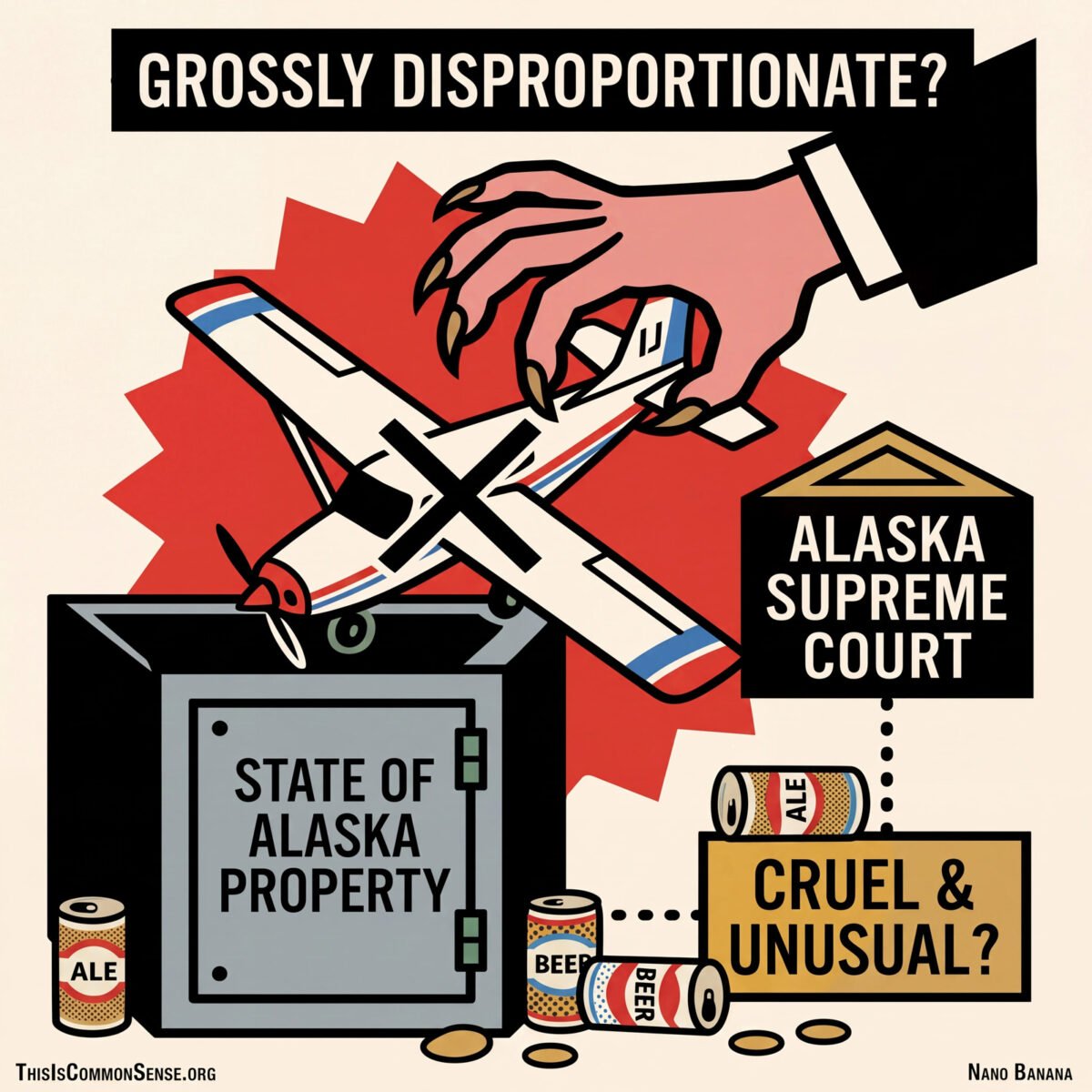
What was Jouppi’s alleged crime? He let a passenger bring “visible” containers of beer on board his Cessna 206. Why is this a problem? The number of beer cans was 72, and the destination was a dry village, so you can imagine the horror involved!

The trial court determined intent as Jouppi being “willfully blind” to the contraband, but it may be that he just failed to leap into action when he noticed the beer . . . assuming he did. 

Jouppi was punished 13 years ago, a year after the “crime,” with three days in jail and a $1,500 fine. But that wasn’t good enough for the Alaska government, which tenaciously enforces local alcohol prohibitions — it demanded that Jouppi forfeit his $95,000 airplane. 

“Although that penalty seemed grossly disproportionate,” says Reason magazine, “the Alaska Supreme Court ruled that it did not violate the Eighth Amendment’s ban on excessive fines.” 

Yes, this is a case of civil asset forfeiture, covered here for decades now.

Will the U.S. Supreme Court see reason? Regardless of the outcome, the process has also been the punishment, one that is both cruel and all too usual.

This is Common Sense. I’m Paul Jacob.


PDF for printing

Illustration created by Nano Banana

See all recent commentary
(simplified and organized)
See recent popular posts

Categories
crime and punishment Eighth Amendment rights general freedom

The Case of the Narrow Driveway

Sandy Martinez: mother of three, working hard to get by, whole life ahead of her — why would she sabotage it by failing to perfectly park her car in her narrow driveway such that two of the wheels edged onto the grass?

Think I’m making it up? 

No. It’s true. Some people get distracted and treat their grass as if it were gravel and let their car edge onto it.

Why’dja do it Sandy, huh? Why?

On the hand, it’s her property, so who cares? 

What difference does it make? 

Well, mucho . . . if you’re Lantana, Florida, which fined Sandy $101,750 for imperfect parking, $47,000 because of storm-inflicted fence damage, $16,000 for cracks in her driveway.

The good news is that Institute for Justice is litigating on behalf of Sandy Martinez and other homeowners being hit with plainly unjust fines for trivial code violations.

IJ argues that the state and local governments at fault are violating the Eighth Amendment’s prohibition against excessive fines. And the Institute and its clients are winning. The U.S. Supreme Court has just ruled, in Timbs v. Indiana, that this Eight Amendment ban applies to cities and states as well as to the federal government. 

Many locales, perhaps including Lantana, Florida, may still try to get away with the grift despite this definitive ruling. But sooner or later, some judge will throw out the blatantly excessive fines and point to the recent Supreme Court decision.

Help is on the way, Sandy.

This is Common Sense. I’m Paul Jacob.


PDF for printing

Illustration created with PicFinder and Firefly

See all recent commentary
(simplified and organized)
See recent popular posts