Categories
initiative, referendum, and recall partisanship

Gerrymandered Hypocrisy 

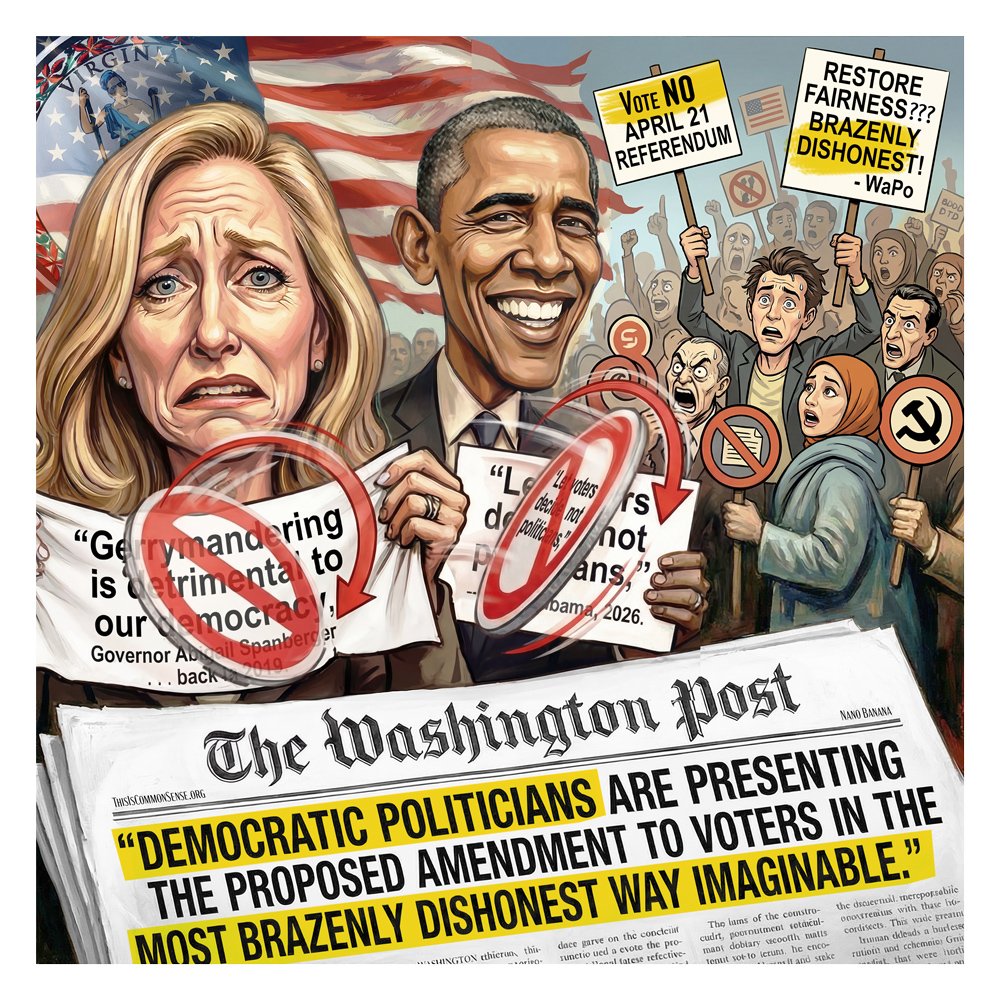
“Gerrymandering is detrimental to our democracy,” declared Virginia Governor Abigail Spanberger . . . back in 2019.

“Let voters decide, not politicians,” former President Barack Obama offered just last month. 

The problem? They’re correct!

And Republicans are now sharing the statements by these two high-ranking Democrats with Virginia voters. Why? They oppose the April 21 constitutional referendum that, if passed, would allow the legislature to gerrymander the state’s congressional district lines to likely turn the federal delegation from its current six- to five-seat Democratic majority into a ten to one Democratic majority.

How dare opponents repeat the precise words previously uttered by Spanberger and Obama as Virginians go to the polls!

WUSA-TV in Washington, D.C., headlined its report: “Anti-redistricting mailers in Virginia are misleading, critics warn.”

“This has been misconstrued,” explained Gaylene Kanoyton, the Political Action Chair for the Virginia NAACP. “This does not pertain to these unusual, unprecedented times that we are in right now.”

“It is true they made these statements years ago,” a fellow from my hometown was quoted, “but the situation has changed.”

“They don’t like it because we’re exposing their leaders for their hypocrisy,” argues former Republican Delegate A.C. Cordoza with Justice for Democracy PAC. 

Democrats can of course blame Republican gerrymandering efforts in other states to justify their own, but it is a race to the bottom for voters. 

But, as I pointed out last week, Democrats deserve all the blame. The language on the ballot is completely slanted, telling voters the measure will “restore fairness.” This is so outrageous that even the liberal Washington Post editorialized last month that “Democratic politicians are presenting the proposed amendment to voters in the most brazenly dishonest way imaginable.”

Partisans will always be self-serving. But can’t they even try not to appear blatantly hypocritical?

This is Common Sense. I’m Paul Jacob.


PDF for printing

Illustration created with Nano Banana

See all recent commentary
(simplified and organized)
See recent popular posts
Categories
initiative, referendum, and recall partisanship

Against Fairness?

I’m against fairness?

Nah, it’s just Democrats who think that, because I won’t vote for their proposed constitutional amendment allowing the legislature to redraw my state’s congressional districts. 

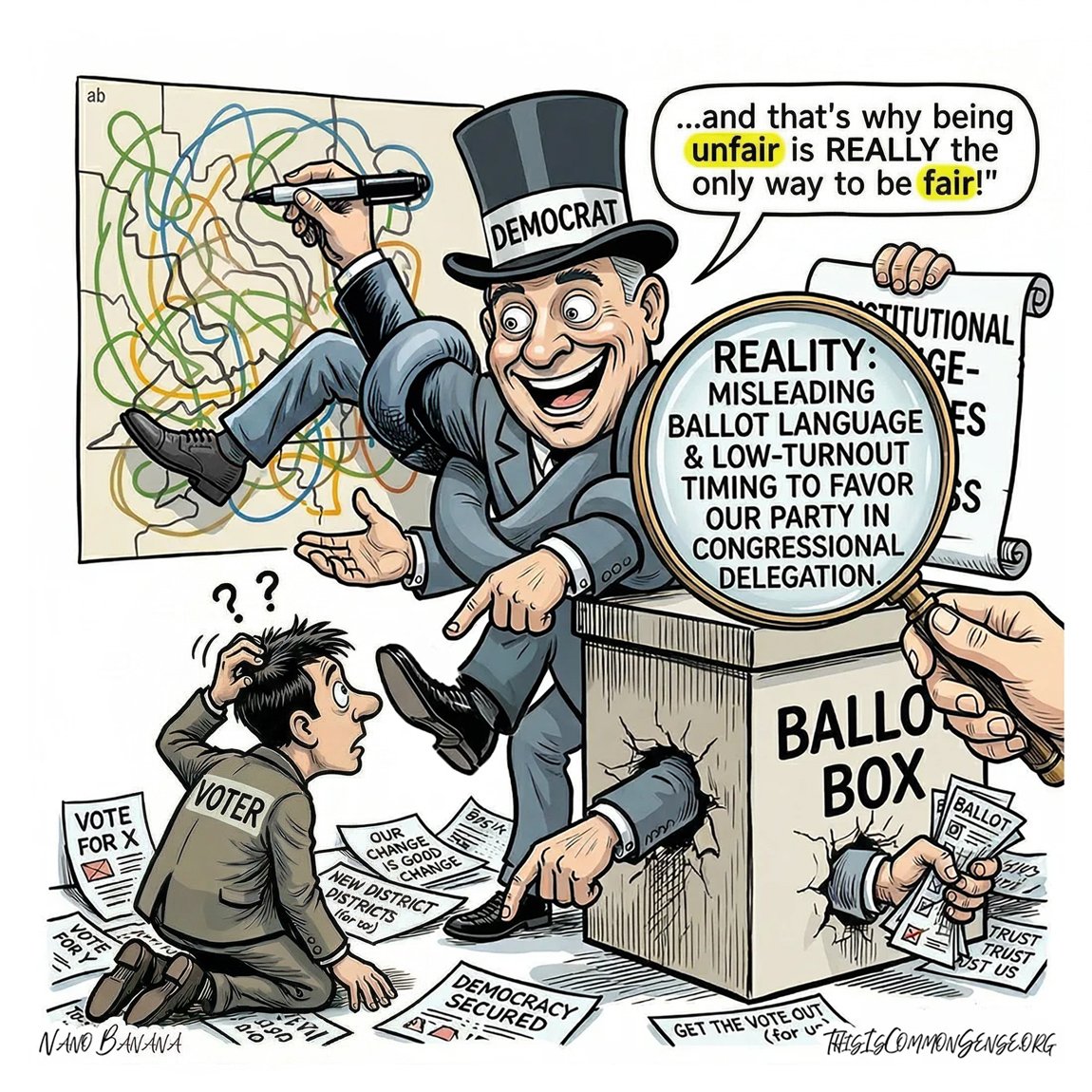
The official question on the April 21 ballot reads: “Should the Constitution of Virginia be amended to allow the General Assembly to temporarily adopt new congressional districts to restore fairness in the upcoming elections, while ensuring Virginia’s standard redistricting process resumes for all future redistricting after the 2030 census?”

What, exactly, is “fair” about this amendment? 

“If approved, Virginia’s 11 districts would likely go from six Democratic to five Republican leaning seats to 10 Democratic seats and one Republican seat,” explains WJLA, ABC’s Washington, D.C., affiliate. “The new map would draw heavily blue urban areas in Northern Virginia, with rural Republican areas far away.”

Democrat House Speaker Don Scott argues that “levels the playing field.” 

Well, it would be a fairer map if the commonwealth’s electorate were comprised of 90 percent Democrats and less than 10 percent Republican voters. Yet, in 2024, Democrat Kamala Harris garnered just 51 percent of Virginia’s vote for president. Even in last year’s blowout gubernatorial election, Democrat Abigail Spanberger won only 58 percent. During that campaign, Spanberger expressed skepticism of this district map . . . but then, as governor, signed on. 

Democrats, always selective in applying “fairness,” are outspending Republicans “by about 14 to 1 on advertising” and holding the vote for this constitutional question early, in April, with low voter turnout expected — for the first time in state history.

In the minds of Democrats, this maneuver is fair because President Trump has urged Republican states to engage is such partisan redistricting. That’s their case.

But arguments in favor of a measure do not belong in the wording voters see on their ballot as they make their decision. 

That’s unfair.

This is Common Sense. I’m Paul Jacob. 


Note: In the quoted ballot question, emphasis added.

PDF for printing

Illustration created with Nano Banana

See all recent commentary
(simplified and organized)
See recent popular posts

Categories
education and schooling

Gaming a Newly Rigged System

Education is important. I want my young adult offspring to get into a great college or university.

Sadly, my bribery fund is empty.

Must she, then, rely only upon working hard for good grades and preparing for the Scholastic Aptitude Test (SAT)? 

No. There is a workaround: find a way to improve our family’s Adversity Score.

“The College Board plans to assign an adversity score to every student who takes the SAT,” The Wall Street Journal reports, “to try to capture their social and economic background, jumping into the debate raging over race and class in college admissions.”

This year 50 universities, including Yale, used these scores; next year, 150 will do so. Students are assessed on 15 not fully disclosed factors, things such as the level of crime and poverty in one’s high school and neighborhood, “the educational level of the parents,” and “family stability.” 

“An adversity score of 50 is average,” notes the Journal. “Anything above it designates hardship, below it privilege.”

Hmmm, how to climb (or descend) the “Overall Disadvantage Index”? What sacrifices to make?

My wife and I could divorce. Coming from a single parent household would improve our daughter’s opportunities in higher education.

We won’t sink her chances by upgrading our own educations. That’s obvious.

And crime-free homeschools certainly place kids at a distinct disadvantage in being disadvantaged. I guess we could move to a more dangerous neighborhood. 

Heck — what am I thinking?! — we can stay put and just commit crimes ourselves. Show some entrepreneurial initiative! Don’t be dependent on others, for heaven sake! Be the change we wish to see in our world.

On that one, though, I better check my exuberance with my wife . . . if our divorce hasn’t yet been finalized.

This is Common Sense. I’m Paul Jacob.


SAT, college, racism, race, fairness,

See all recent commentary
(simplified and organized)
See recent popular posts


Categories
incumbents partisanship

AOC Right, DCCC Wrong

“AOC is right as rain here,” I re-tweeted Sunday.

And what was the usually all-wet U.S. Rep. Alexandria Ocasio-Cortez (D-N.Y.) right about?

“By stymieing primaries,” the freshman representative had tweeted at her own party’s congressional leaders and the Democratic Congressional Campaign Committee (DCCC), “you deny most voters their best chance at choosing their representative.”

On purpose. 

Ocasio-Cortez refers to the recent DCCC announcement, first reported by The Intercept, that “warned political strategists and vendors . . . that if they support candidates mounting primary challenges against incumbent House Democrats, the party will cut them off from business.”

Isn’t the goal of the DCCC to elect as many Democrats to Congress as possible? 

No. 

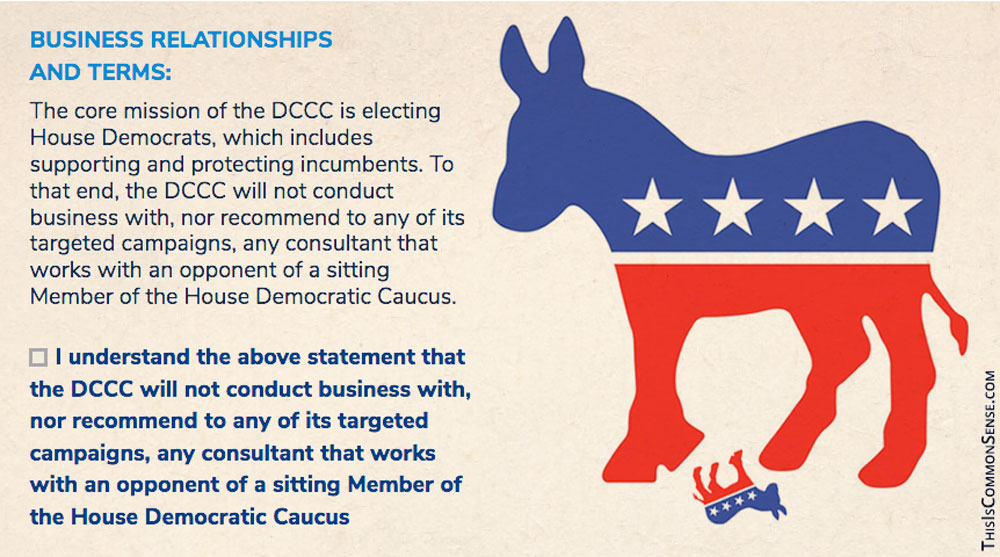
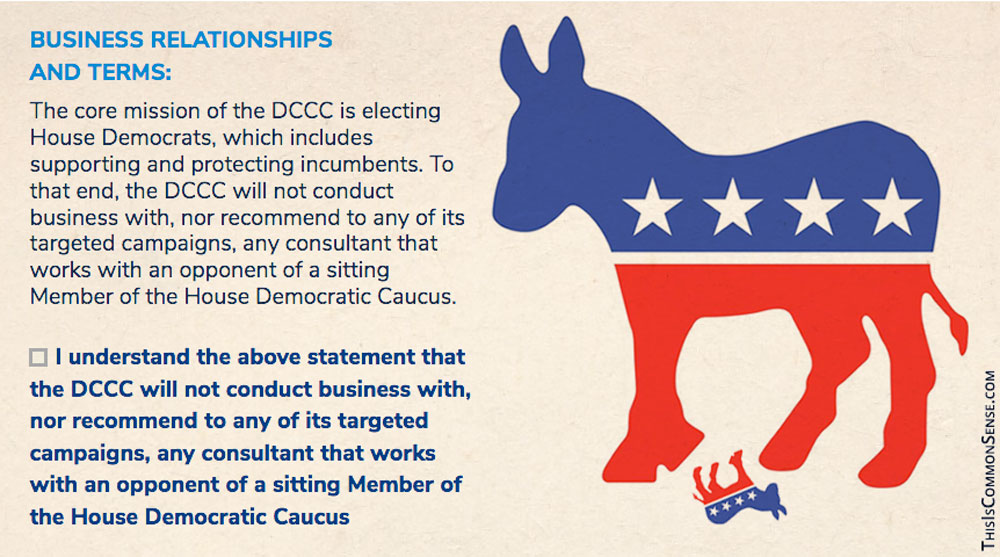
“The core mission of the DCCC is electing House Democrats, which includes supporting and protecting incumbents,” reads a new form for party political consultants. “To that end, the DCCC will not conduct business with, nor recommend to any of its targeted campaigns, any consultant that works with an opponent of a sitting Member of the House Democratic Caucus.”

In short, if you want to make money, and most political professionals do, don’t dare work for a Democratic challenger against a Democratic incumbent. 

“If the DCCC enacts this policy to blacklist vendors who work with challengers, we risk undermining an entire universe of potential candidates and vendors — especially women and people of color,” Rep. Ayanna Pressley of Massachusetts, another Democratic freshman who defeated an incumbent Democrat, tweeted on Saturday. 

The policy has been enacted and is in full effect.

Among Washington Democrats, incumbency trumps everything . . . even diversity. 

This is Common Sense. I’m Paul Jacob.


N.B. The National Republican Congressional Committee has long had this same total fixation — mutatis mutandis — on re-electing incumbents. In fact, the newsworthiness of this latest DCCC strong-arming of consultants seems to be only that the insider power-play is more “open” than ever before.

PDF for printing

Democrat, incumbent, fairness, AOC

See all recent commentary
(simplified and organized)
See recent popular posts

Categories
Accountability education and schooling folly general freedom ideological culture local leaders media and media people moral hazard nannyism national politics & policies responsibility too much government

Demeritocracy

New York Mayor Bill de Blasio has a beef with Stuyvesant High School.

It’s about race, of course.

Stuy (as it is affectionately known) is a tuition-free accelerated academic/college prep program open to all city residents based on how well they perform on a specific test.

Unsurprisingly, Asians make up the bulk of the student body.

And de Blasio finds this horrific, a “monumental injustice” — there should be more Hispanic and black students, he says.

In front of black parishioners.

Demagoguery aside, the New York Mayor’s attack is really against the very idea of a meritocracy. The old Progressive vision was to pull from every ethnic group, economic strata, and community the best and brightest, allowing people to advance by study and hard work. Progressives called this “equality of opportunity”; most everybody else, “the American Dream.”

It was the Progressives’ pride and joy.

And today’s progressives are hell bent on destroying it.

They demand “diversity” instead — by which folks like de Blasio mean participation based not on talent and studiousness and sheer academic drive (which some cultures push more than others), but, instead, on today’s primary progressive obsession: skin color.

“My limited tolerance for affirmative action,” writes Richard Cohen in the Washington Post, addressing de Blasio’s excess, “possibly permissible when the poor are advantaged at the expense of the rich — hits a wall in this case.”

My tolerance for “affirmative action” hits the wall earlier: Help the poor afford to go where they can academically earn a spot. (Helping privately would be best.) But do not let race or any other demographic factor put a finger on the merit scale.

This is Common Sense. I’m Paul Jacob.


PDF for printing


Categories
Accountability national politics & policies political challengers

How Does “Unfair” Play?

“We’re being treated very unfairly.”

I don’t know about you, but this constant complaint from Donald Trump is getting a bit old.

Even if true.

Maybe I lost some patience for this shtick because my side in the political arena — the 85 percent majority for term limits, for example — has constantly had to bear with undue weights from major candidates, public officials, and other political insiders. This week I’m in Arkansas to help put term limits back on the ballot, after politicians lied to the citizenry in a legislatively referred measure, successfully fooling them to substantially weaken the limits.

It turns out that honest people have always been at a disadvantage in politics, because our enemies often feel free to lie, cheat, steal, etc.

My impatience is that, well, coming from a billionaire, the complaint seems . . . hollow. To the extent that wealth and fame lead to an unfair advantage over others, Trump has indeed parlayed both into a shot at the White House.

So to talk about how being treated unfairly smacks of narcissism. It is like going to the funeral of a good friend and having to listen to some whiner take the limelight to complain of his lumbago.

It seems inappropriate, in context.

But mainly it reminds me of Bernie Sanders in particular, and the socialist left in general. “Life [or The System] has treated us unfairly — so give us free stuff!”

Trump is not asking for free stuff. He is merely expecting us to forgive his ugly tirades — as in the current mess about the judge sitting on his Trump University case — and nasty escalations of name-calling.

He expects a free pass. And has so far gotten one.

This is Common Sense. I’m Paul Jacob.


Printable PDF

Donald Trump, thin skinned, cry, 2016 Presidential, Hillary Clinton


Categories
free trade & free markets general freedom ideological culture individual achievement media and media people national politics & policies

Parker and the Pope

Kathleen Parker is far from my favorite columnist, but her Sunday column comparing Pope Francis and presidential aspirant Sen. Bernie Sanders regarding their shared message on economic fairness and equality of outcomes was well worth the effort.

She treats the men differently. She gives Pope Francis a pass because, as a religious leader, he “wants to raise consciousness about our obligation to the less fortunate,” while bashing Sanders, the politician, who “wants to restructure America’s economic institutions to ensure that money trickles down — mandatorily rather than charitably.”

“Let’s face it, most of us work hard . . . for a paycheck.” So Parker pointedly asks, “As the tax man chisels away at such monetary rewards, where goes the incentive to work hard?”

How persuasive — encouraging actual, real-world achievement — would a Sanders Four Year Plan be?

Addressing the Pope’s harsh words for individualism, Parker argues, “The ‘rampant individualism’ that Francis condemns is precisely what has driven American ingenuity, entrepreneurship and a level of prosperity unmatched in human history.”

Precisely.

In other words, maybe — just maybe — we did build it. Through our own sweat and toil. Individualism is decidedly not big government. And it is not public-private crony capitalism, either.

So, considering that it was America’s laissezfaire-ism that created such great wealth and prosperity, which presidential candidates are promising a return to more robust and vivacious individualism?

Not the ones promising everything. Nor the one promising the “best deal.”

The job of the next heroic leader will be to shovel whole layers of intrusive government out of our way.

Parker seems on board, boasting, “This is common sense.”

Hey, wait a second, Kathleen, that is my line. I’m Paul Jacob.


Printable PDF

Kathleen Parker, Pope Francis, Bernie Sanders, economic fairness


Common Sense Needs Your Help!

Also, please consider showing your appreciation by dropping something in our tip jar  (this link will take you to the Citizens in Charge donation page… and your contribution will go to the support of the Common Sense website). Maintaining this site takes time and money.

Your help in spreading the message of common sense and liberty is very much appreciated!


Categories
folly ideological culture moral hazard national politics & policies tax policy too much government

The B. S. Theory

Bernie Sanders is worse than merely wrong about the rich not paying their fair share of taxes.

It’s we, the much-lauded “Ninety-nine Percenters,” who don’t pay enough!

At least, when we figure taxes paid against direct subsidies/services rendered: taxes minus transfers. And, according to the Congressional Budget Office, only the top quintile of income earners — including the much-abhorred One Percenters — pay appreciably more in taxes than they receive in “benefits.”

In a republic, you would expect the masses to pay taxes, receiving only indirect benefits, like a broadly defined “security” and “the rule of law.”

The calculation of who is and is not a net tax-payer or net tax-consumer has to be difficult. I certainly haven’t vetted the studies carefully. But previous accountings also show that the super-rich pay the bulk of income taxes in America.

How to put the system aright?

Don’t tax us more!

Bernie’s preference, to tax a whole lot more as well as to provide more subsidies and “benefits,” will only make a bigger mess.

Unfortunately, doing the right thing (cutting back on the giveaways at all levels) is politically . . . tricky.

But there’s something missing in all this: the indirect hazards of the “benefits” . . . the opportunity costs involved when we get hooked on hand-outs. The most trapped people in America are those who pay the least and take the most. The dollar-value of their received transfer payments measure neither their dependency nor their consequent lack of upward mobility.

How could we figure real harms and helps embedded in the current system, when some “benefits” are, in fact, detriments?

This is Common Sense. I’m Paul Jacob.


Printable PDF

tax the rich, tax, pay, paid, paying, Common Sense


Categories
national politics & policies tax policy too much government

Avoid the Big Gov Trap

We do not face just one problem, but our many problems tend to come down to one thing: trying to do too much through government.

Last weekend, at Townhall, I noted that the most wildly popular economic policy doctrine of the last hundred years, Keynesianism, has not — its proponents say — been properly given a chance during the two biggest financial contractions of our time, the Great Depression and the recent mortgage-backed securities implosion. In both cases, more money was needed for proper “stimulus.”

Ironic, perhaps, since Keynesianism has been used as an excuse to run deficits and increase debt for scores of years.

Yes, even a doctrine designed to play into the hands of politicians gets abused by politicians.

The lesson: Excuses to grow government are not revolutionary insights, they’re traps.

Yesterday I talked about how the “Laffer Curve” point where raising the tax rate actually reduces revenue is lower for capital gains than for general income. But one consequence of a revenue-maximizing capital gains rate is that there would then be rich investors who wind up paying a smaller percentage of their incomes in taxes than do common laborers.

Tax fairness is an issue that should not be ceded to those caught in the clichés of the age. Think of tax fairness, instead, as a rationale for a limit. Not as an excuse to raise tax rates punitively, hatefully, foolishly (like the current president wants).

Bring all tax rates down to the level of the tax with the lowest revenue-maximizing rate. Don’t raise capital gains taxes, lower the income tax. 

Taxes would then be fair. And government would have to be reduced to accommodate the fairness, and thus more limited.

Less of a trap.

This is Common Sense. I’m Paul Jacob.