Categories
free trade & free markets international affairs tax policy

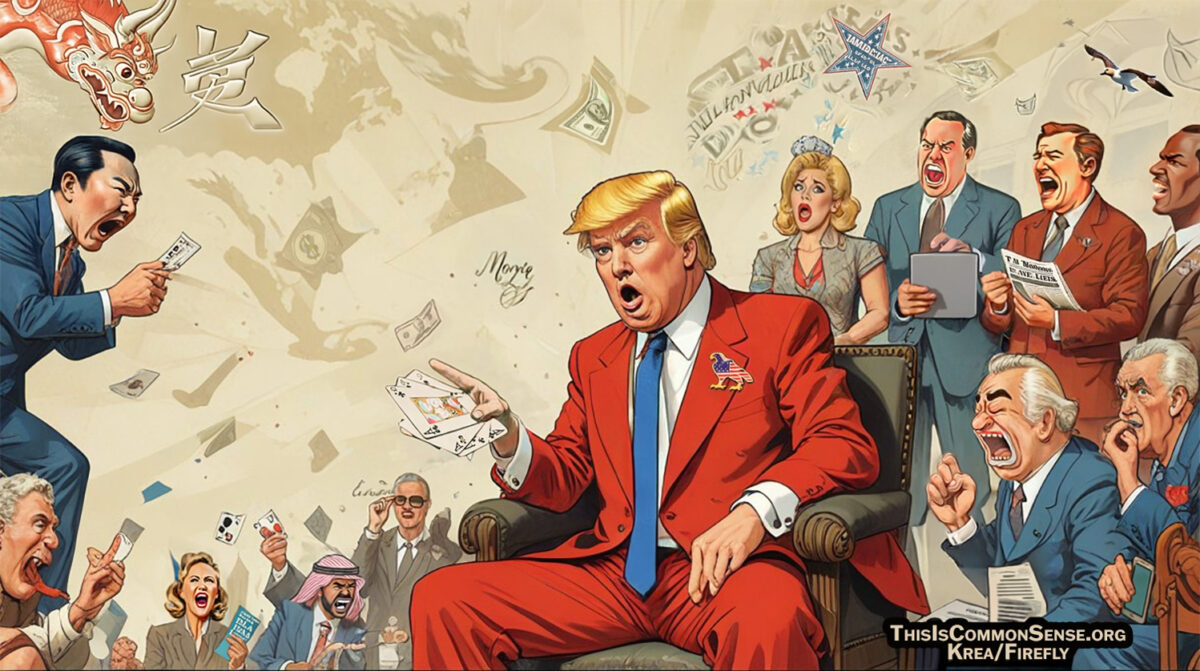
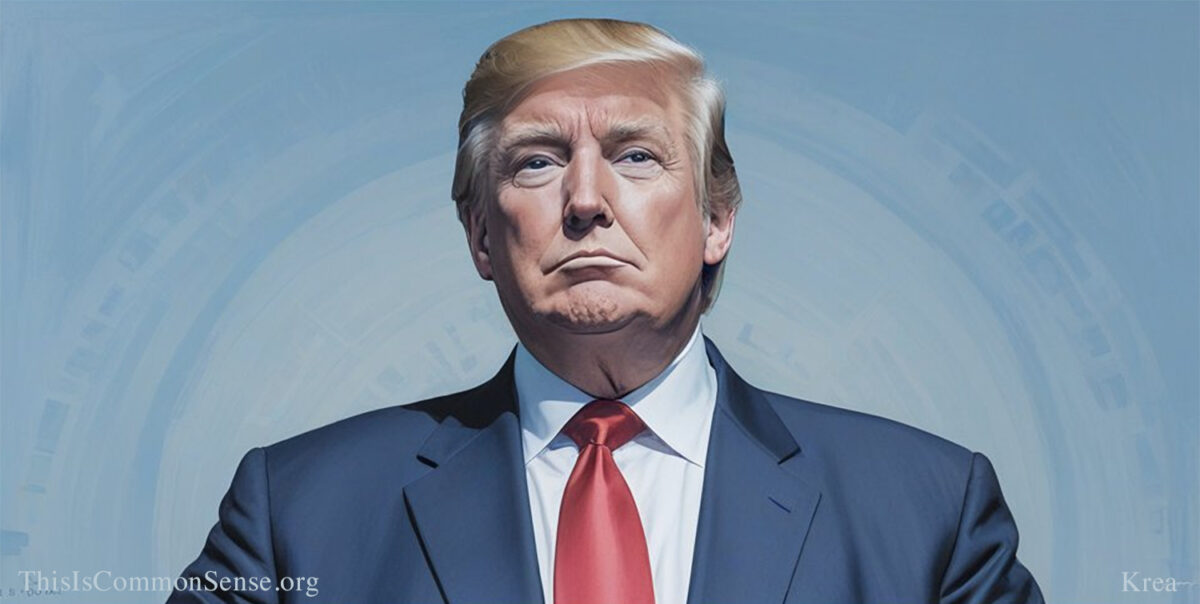
The Tariff King

The fight over the president’s tariffs is taking place in Congress. 

Or is it?

“House Republicans blocked on April 9 an effort by Democrats to force a vote on halting the reciprocal tariffs imposed by President Donald Trump,” explains The Epoch Times, “which are currently paused for three months.”

Let’s make that clearer. These now-infamous/much-debated “reciprocal tariffs” went “into effect” immediately after midnight yesterday. As Republicans “sneakily” worked to change the rules to disallow any congressional move to dissolve the president’s declared emergency — which, by Congress’s own legislation, gives the executive a great deal of latitude to change tariff rates — and Democrats moved to do just that, get rid of the “state of emergency,” President Trump put most of his tariff hikes on hold for three months.

Except for those on China — now in effect, at a rate of 125 percent.

It sure looks like Trump’s main concern is trade relations with China, not Lesotho or Israel or anywhere else. And much can be said about China’s trade policies (try selling American consumer goods in China) or respect for intellectual property. But it is the matter of constitutionality that interests me most.

Whatever the alleged merits of high tariffs, unilateral free trade, or any of these issues, these policies should not be decided by the president; the Constitution gives Congress the responsibility “to lay Taxes, Duties, Imposts and Excises” and “regulate Commerce with foreign Nations.”

By handing the president “emergency” powers to change tariff policy in the first place, Congress has abdicated its role in setting tax policy. Republicans in the House seem gung-ho about Trump’s prerogatives. And Democrats haven’t sought to repeal the International Emergency Economic Powers Act, which gives the president legislative taxing authority.

Apparently, Congress wants the president to be king.

This is Common Sense. I’m Paul Jacob.


PDF for printing

Illustration created with Krea and Firefly

See all recent commentary
(simplified and organized)
See recent popular posts

Categories
national politics & policies tax policy

DOGE Does the IRS

A note of caution going into today’s subject: let us try to bite our tongues; no expressions of schadenfreude; no sarcastic “Boo-hoos” or the like.

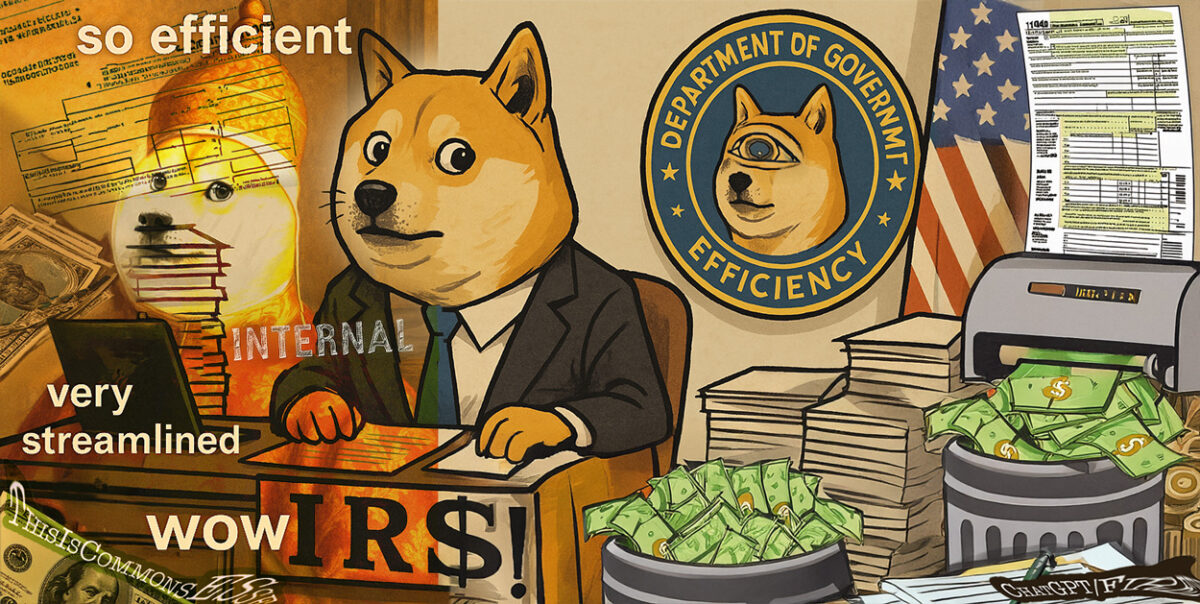
The IRS has been grossly inefficient for a very long time, as now uncovered in a Department of Government Efficiency [DOGE] investigation.

Courtesy of Laura Ingraham, we learn that the Internal Revenue Service is “35 years behind” in its scheduled upgrades, and “already $15 billion over budget.”

“You’ve heard the sob stories,” says Ms. Ingraham. “And they are quite entertaining at times. But the [presumably non-Fox legacy news] media — they continue to spread this story: ‘DOGE is some dark and mysterious organization; you know, embedding itself into departments like some jack-booted thugs, just intimidating staff, threatening those that don’t comply.’ OK. We’re asking, what is the truth?” 

So she interviewed Treasury Secretary Scott Bessant and Treasury’s DOGE adviser, Sam Corcos.

“We,” Corcos said, including himself in the IRS’s very “they” themness, “process about the same amount of data as a midsize bank. A midsize bank has 100 to 200 people in IT and a $20 million budget. The IRS? It has 8,000 IT employees and a $3.5 billion operations and maintenance budget. I don’t really know why yet.” But he does notice that 80 percent of that budget goes to “contractors and software licenses.”

“DOGE advisers have found billions in waste just by asking questions,” explains Ingraham’s report. Secretary Bessant blames the power of special “entrenched interests” that “keep constricting themselves around the power, the money, and the systems. Nobody cares.”

“Inertia” is also a word often heard on this subject.

Democrats have been complaining about the president’s cutting of the IRS budget, and number of employees. But if most of the force is just spinning gears, the cuts could hardly be said to hurt the “service.”

And you’d think that the most pro-government party in our political system would want this key function of government — everything rests on taxes, they admit — to be efficient, do the assigned jobs well.

But for some reason that does not seem to be the case.

Shocking, I know.

This is Common Sense. I’m Paul Jacob.


PDF for printing

Illustration created with Krea and Firefly and ChatGPT

See all recent commentary
(simplified and organized)
See recent popular posts

Categories
media and media people national politics & policies political economy tax policy

The Trump-Tariff Question

“To this day I cannot tell you what Trump truly believes about tariffs,” Daily Wire’s Michael Knowles recently confessed. “Does he want tariffs instrumentally, to increase trade? Does he believe in tariffs as a revenue-raising mechanism? And is he hard-core on tariffs? I couldn’t tell you; the man is inscrutable.”

In “Tariffs Are Awful, But The Income Tax May Be Worse,” economist Walter Block seems less confused. “Donald Trump supports them on the ground that the McKinley administration was prosperous, and relied upon tariffs,” Walter’s Eurasia Review op-ed posits. Our free-market economist notes that this rests on a fallacy: “since A precedes B, A must be the cause of B.”

Professor Block offers a better “historical episode to shed light on this matter, the Smoot-Hawley Tariff of 1930.” You know, the tariff hike that worsened the Great Depression.

The best part of Walter Block’s refutation, however, follows his explanation of the Law of Comparative Advantage. He discusses the gains to our economy if the expert workers Trump fires from the IRS were to find work in the private sector.

And, contemplating the idea of switching from income taxes to tariffs, our widely-published octogenarian notes that “it takes relatively little labor to run a tariff system. Hey, we already have tariffs in place. An increase in their level would hardly call for much more manpower, likely hardly any more at all.” The gains of nixing income taxes would be vast; the harms of higher tariffs would be comparatively minuscule.

An interesting argument? Sure. But I don’t see politicians giving up the income tax any time soon.

This is Common Sense. I’m Paul Jacob.


PDF for printing

Illustration created with Krea and Firefly

See all recent commentary
(simplified and organized)
See recent popular posts
Categories
subsidy tax policy

Oh, SNAP!

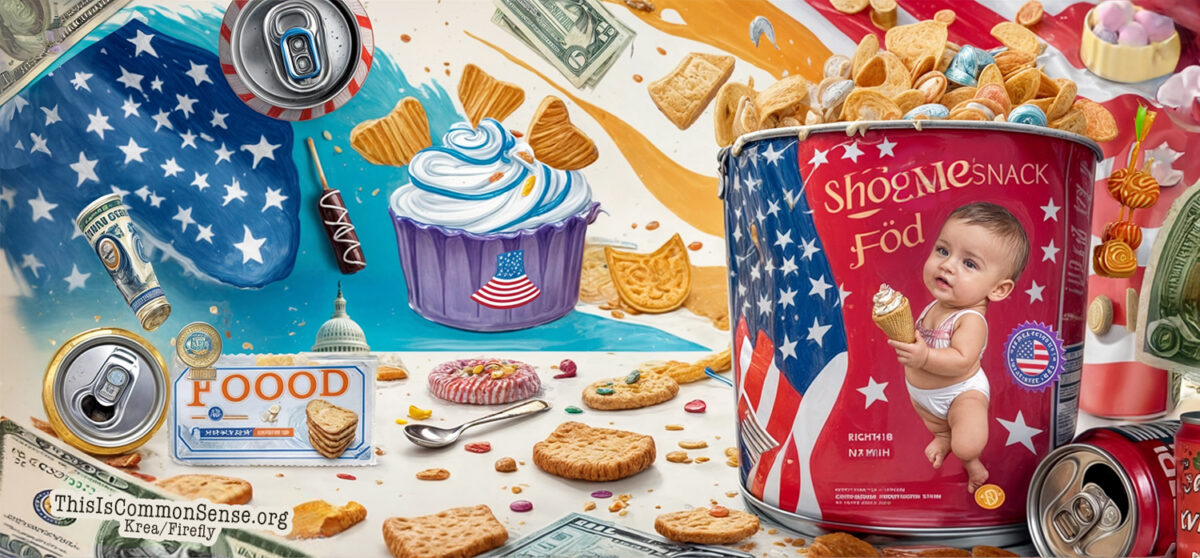
It appears that recipients of “food stamps” (the Supplemental Nutrition Assistance Program, or SNAP) “often have lower diet quality and higher rates of diet-related health issues compared to non-participants,” according to an article in healthjournalism.org

“While it’s unclear whether SNAP directly causes these outcomes or if other factors are at play, some argue that the program, at minimum, sustains unhealthy eating habits by not restricting purchases of nutritionally poor foods.”

Among the “some” who argue for restrictions is Robert Kennedy, Jr., head of Health and Human Services. He promises to purge unhealthy foods from the subsidy list.

Currently, the taxpayer-funded “benefit” may “be used for ‘any food or food product intended for human consumption,’ except alcohol, tobacco and hot foods, including those prepared for immediate consumption. Critics argue that SNAP’s allowance for purchasing sugary snacks, soda and junk food promotes unhealthy eating habits, which can lead to obesity and other related health issues.”

The critics are undoubtedly correct; indeed, the proposed limitations will almost certainly be too tame. 

If the program must exist, it should do good without enabling demonstrable harm. So instead of a cumbersome and extensive list of prohibited food items, there should be a concise list of allowed categories:

  • uncooked meats and dairy products without added sugars
  • fresh, frozen, dried, and canned beans, fruits and vegetables
  • staple ingredients of traditional meals, such as flour, spices, and oils

Some rail against any idea of restricted benefits, but government handouts are not there to expand the “freedoms” of the poor; they are provided to help folks weather hard times. 

The freedoms of taxpayers have already been sacrificed for their sake. Forcing taxpayers to watch SNAP’s EBT card users in the grocery line buying candy and sodas adds insult to the benefactors while injuring the beneficiaries.

This is Common Sense. I’m Paul Jacob.


PDF for printing

Illustration created with Krea and Fireflly

See all recent commentary
(simplified and organized)
See recent popular posts
Categories
free trade & free markets international affairs tax policy U.S. Constitution

Legal Trade War

Donald Trump’s imposition and changing of tariffs, all by his lonesome — without Congress — vexes more than a few critics.

His authority to do this, however, derives directly from laws passed by Congress.

The U.S. Constitution gives Congress the power to “lay and collect Taxes, Duties, Imposts and Excises” under Article I, Section 8, which includes tariffs, since they are taxes on imported goods. But Congress has legislated hand-offs to presidents, allowing significant flexibility on tariffs.

The idea seems to be that, as Commander-in-Chief, the president should handle trade because . . . like war, it has to do with foreign countries.

Laws allowing presidential discretion include Section 232 of the Trade Expansion Act, Section 301 of the Trade Act of 1974, and the International Emergency Economic Powers Act of 1977. 

The first says that the president has broad discretion to define as threats to national security all sorts of things and then impose tariffs and other trade restrictions in response.

The 1974 legislation authorizes further along Trump’s favored line, the power to retaliate against “unfair” foreign trade practices.

The IEEPA grants sweeping powers in a declared national emergency.

So if free traders and others are alarmed at Trump’s seemingly dictatorial powers regarding tariffs, it isn’t new. It has been built into the Imperial Presidency. While Congress could take its constitutional authority back, there is certainly no groundswell to do so.

Also not new?

What setting up high tariffs have historically done: elicit similar tariffs in retaliation. 

Yikes: the kind of trade war that made the Great Depression “great.”

This is Common Sense. I’m Paul Jacob.


PDF for printing

Illustration created with Krea and Firefly

See all recent commentary
(simplified and organized)
See recent popular posts
Categories
free trade & free markets regulation tax policy

Destroying Dane Farming

In February, Denmark’s farmers were worried “that plans to levy a carbon emission tax on farming” in the name of global weather control “would force them to reduce production and close farms.”

In the same month, farmers across Europe protested against assaults on their livelihood.

Meanwhile, a report by a government commission concluded that the carbon tax could cause Denmark’s agricultural production to decline by as much as a fifth. The central planners made clear that this was a price they were willing to pay in order to indulge their ideological-meteorological fantasy.

And also, not incidentally, in order to collect more tax dollars.

But the concern and the estimates of the severity of the blow on farmers — to be penalized for providing food, a requirement of survival — availed naught.

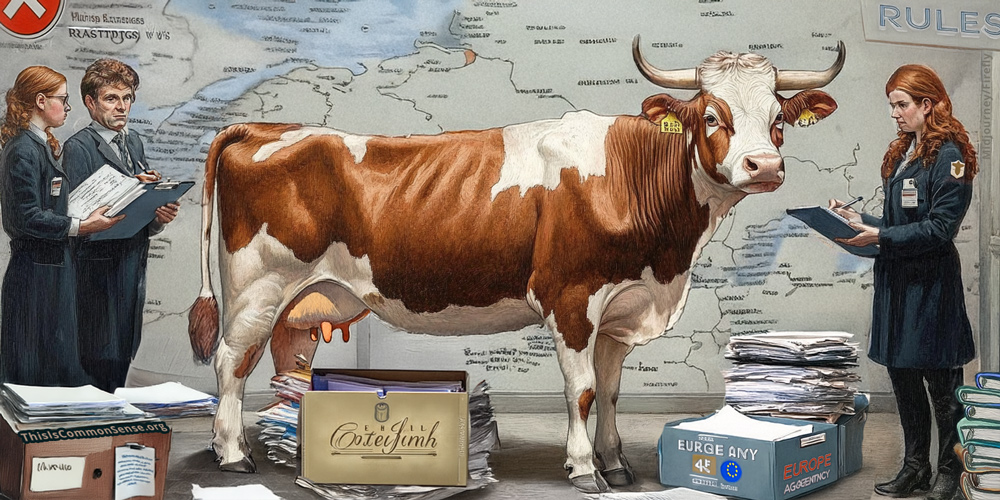
The carbon emissions tax is being enacted and will take effect in 2030. The levy will initially be something like $96 per cow, rising to $241 per cow in 2035.

Insane. But cows produce methane “through their burps and manure,” CNN reports. So what can tyrants do but tax farmers into oblivion?

The fantasists may claim success no matter what global climate turns out to be in years to come. Or they may claim that their measures haven’t yet fixed the global climate only because the rest of the world’s countries haven’t yet followed suit and appropriately penalized their farmers for farming.

Only when civilization is fully destroyed will we be able “save” it.

This is Common Sense. I’m Paul Jacob.


PDF for printing

Illustration created with Midjourney and Firefly

See all recent commentary
(simplified and organized)
See recent popular posts
Categories
free trade & free markets international affairs tax policy

Trump’s Tariff Question

If Donald Trump fails to re-take the White House in November (and then for real in early 2025), his legacy may quickly devolve into a matter for historians, not live politics. After people calm down and the culture war stuff recedes (once again, if allowed by events), what will be left to argue over are a half-dozen major issues, which include war, mass migration . . . and tariffs.

Tariffs have long been Mr. Trump’s major hobby horse; he gets excited about 100 percent levies. The whole business about the “bloodbath” quote was his insistence that American auto industry will be destroyed if Trump himself doesn’t get the chance to erect ultra-high tariffs against automobiles from Mexico.

Trump looks at tariffs on foreign goods as harming foreign nations and helping us, the Americans.

But it is worth noting that economists from Adam Smith and David Ricardo onward have regarded tariffs as chiefly harming consumers within the country that erects them. 

At Reason you can read Veronique de Rugy make the classic free-trade case, anew, in “No, Trump-Style Tariffs Do Not Grow the Economy.” If Frédéric Bastiat didn’t convince you, maybe de Rugy will.

But something’s missing. Surrounding Trump’s talk against free trade in general and China in particular there was always another element that neither Bastiat nor de Rugy emphasize: free-trading with China helps Chinese and Americans, sure; gotcha — but it also helps the Chinese state, and its ruling Communist Party. 

“Trump is an avowed restrictionist on both immigration and trade,” de Rugy writes. But both unchecked immigration and free trade present problems not economic so much as political. It’s about real bloodbaths, actual warfare, not metaphorical ones.

Even if Trump misdiagnosed the domestic economy, he saw problems with China perhaps more clearly than anyone else.

This is Common Sense. I’m Paul Jacob.


PDF for printing

Illustration created with PicFinder and Firefly

See all recent commentary
(simplified and organized)
See recent popular posts
Categories
national politics & policies subsidy tax policy

Kamala Hood

American politics is largely devoted to the grand task of taking from some and giving to others, a sort of Robin Hood mania that has nothing to do with giving back to taxpayers what was taken from taxpayers (as in the legend) — or doing much of anything for the poor — but, instead, to ostentatiously give to some and quietly take from as many people as possible.

Nevertheless, that giving is not always ostentatious. Sometimes it is surreptitious

Or at least not ballyhooed.

Kamala Harris has taken up an old Democratic Party stalking point: soak the rich! Though she tries not to mention just how much money she and her fellow Biden Administration insiders have been giving to a few big corporations.

“Despite Harris’ rhetoric of fighting for the middle class,” writes Jack Salmon at Reason, “her policies have disproportionately benefited the wealthy and large corporations while leaving middle- and lower-income Americans behind. Far from soaking the rich, Harris’ legacy has been one of feeding them.”

Corporate subsidies have “exploded,” explains Mr. Salmon, going from a ten-year budget allocation of $1.2 trillion in 2021 to now surpassing $2 trillion.

Nearly doubled!

“The beneficiaries of this largesse are extremely concentrated,” Salmon notes, most of it going to “just 15 large corporations, seven of which are foreign.” Of course, a lot of this is under cover of “saving the planet” and fighting “climate change”: “Wind turbine manufacturers like General Electric, Vestas, and Siemens/Gamesa — who collectively produce 79 percent of all turbines — are among the biggest winners.”

Robbing from the few and giving to the many makes neither for good mathematics or a winning political strategy. Robbing from the many and giving to the few is what usually works. But if your appeal is to “the left,” you have to pretend to grab most from the super-rich few.

Your pals.

This is Common Sense. I’m Paul Jacob.


PDF for printing

Illustration created with PicFinder and Firefly

See all recent commentary
(simplified and organized)
See recent popular posts
Categories
national politics & policies tax policy

Kill the Stock Market!

Taxing capital gains is a form of income taxation that Democrats love. 

And it’s not just a matter of increasing revenue. Remember that President Obama thought that increasing the capital gains rate was a good idea even if it decreased government revenue. Democrats are playing to a soak-the-rich sentiment among their base, even when the most important supporters are billionaires.

Take Mark Cuban. He’s a billionaire. And he supports Kamala Harris for president. 

Weeks ago, the Democrat standard-bearer came out with a wild proposal to tax unrealized capital gains. And Cuban, for all his faults, is not an idiot; he knows just how incredibly corrosive that tax on capital would be.

“It would kill the stock market,” he points out

In a chat with Fox Business, Cuban explained how he told Democratic insiders that taxing unrealized capital gains (as when stocks you hold gain value, but you haven’t sold them so you have no income from them), would become “the ultimate employment plan for private equity, because companies are not going to go public because you can get whipsawed, right?” 

By this he means that a stock owner might have to borrow money to cover taxes, only to have the stocks go down later and enjoy neither rebate from the government nor any income from the investment to cover the debt.

Cuban insists that Democratic insiders are pragmatic and will not push this tax.

Yet, with both members (comrades?) of the presidential ticket spouting Marxist talking points, how do we know that they are stable (corrupt?) enough to save public capitalism from their malign agenda?

How can we be sure they’re just lying?

This is Common Sense. I’m Paul Jacob.


Note: Since unrealized capital gains aren’t income, I don’t know how taxing them could be constitutional. Perhaps someone can explain this to me.

PDF for printing

Illustration created with PicFinder and Firefly

See all recent commentary
(simplified and organized)
See recent popular posts

Categories
education and schooling national politics & policies tax policy

Trump to Ax Tip Tax

When Biden panders to his lower-income supporters, he targets zeroing out their student debt and regulating credit card companies with further restrictions on their ability to charge for overdrafts and the like.

When Trump panders to his lower-income supporters, he promises to exempt tips from income taxation, as he did recently in Las Vegas.

This may be the most obvious difference between left- and right-styles in politicking to the masses, good-ol’-fashioned vote-buying or its twin: leftists forgive debts and add regulations, rightists reduce taxes.

Like me, you may, at first blanch, prefer the latter form of pandering, but Eric Boehm, at Reason, offers some reasons not to look so kindly on Trump’s pandering. First, and most obviously: “Reducing revenue without identifying offsetting spending cuts means Trump is merely promising to borrow more heavily.”

A bigger challenge comes later: “On the surface, that sounds great. But there’s already one likely unintended consequence: A lot more income will suddenly be reported as tips. Any time a government gives preferential tax treatment to one type of economic activity, you tend to get a lot more of that type of economic activity. Does that mean we’ll have an entirely tip-based economy?” The answer is a likely No.

Oddly, Mr. Boehm doesn’t address one obvious element: Tips aren’t wages and they aren’t profits. Tips are gifts. They aren’t determined by employers and they aren’t specified by employees. And gifts aren’t taxed as income like other income is.

So letting people who accept tips in the course of their labors not pay taxes on them is really, really hard to object to.

In fact, I don’t object.

This is Common Sense. I’m Paul Jacob.


PDF for printing

Illustration created with PicFinder and Firefly

See all recent commentary
(simplified and organized)
See recent popular posts