Categories
election law

Your Fraudulent Vote Counts

Give it to ABC News host Jonathan Karl!

On This Week Without George Stephanopoulos, Karl asked U.S. Senator Mark Warner of Virginia not about the entirety of the SAVE Act but “very narrowly” about photo ID to vote, which Americans of both parties strongly favor. 

“You know what?” the senator responded. “In Virginia, we have voter I.D. and photo I.D.” 

“That’s actually not the case,” Karl corrected. “I mean, I’m a Virginia voter. You don’t need to show a photo I.D. in Virginia. There are a wide range of things you can show for I.D., and if you don’t show one of those, you can sign an affidavit, saying —”

“You can sign an affidavit,” Warner repeated. “Those become ballots that, if you want to contest later, can be contested. But . . . we have voter I.D. of one form or another.”*

My senator is mistaken. Those ballots cannot later be contested; they count. Even if you prosecute folks for fraudulently signing the form, their ballots would still not be identifiable . . . and therefore, not contestable.

While it is a felony to falsely sign the ID Confirmation Statement, there is no one checking.

The same process exists in Michigan, where I’m involved in a ballot initiative to require voter ID. The question “Do I need an ID?” is posed for voters at the Michigan Secretary of State’s website. 

“You will be asked to show ID when you check in to vote,” explains the SOS, adding in bold type: “If you don’t have one, you can still vote.

“If this happens, expect a poll worker to ask you to sign a form before you vote that explains you didn’t have an ID. Your ballot will be included with all others and counted.”

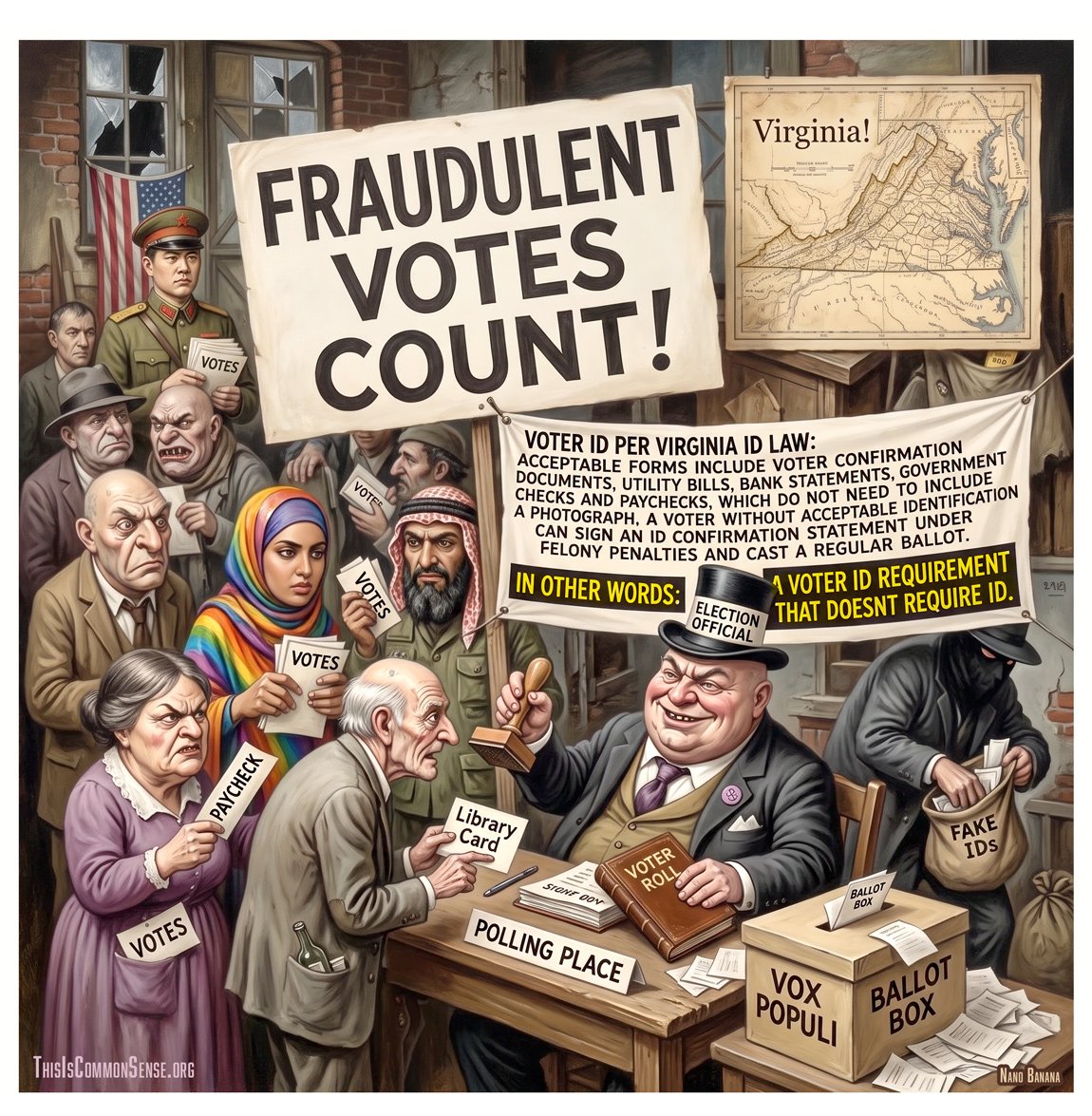
How “political”: a Voter ID requirement that doesn’t require ID. 

This is Common Sense. I’m Paul Jacob.


* Fox News reports that per ID in Virginia “acceptable forms include voter confirmation documents, utility bills, bank statements, government checks and paychecks, which do not need to include a photograph. A voter without acceptable identification can sign an ID Confirmation Statement under felony penalties and cast a regular ballot.” The story helpfully provides a link to the Virginia statute in question.

PDF for printing

Illustration created with Nano Banana

See all recent commentary
(simplified and organized)
See recent popular posts

Categories
crime and punishment fraud national politics & policies subsidy

$100 Billion Stolen

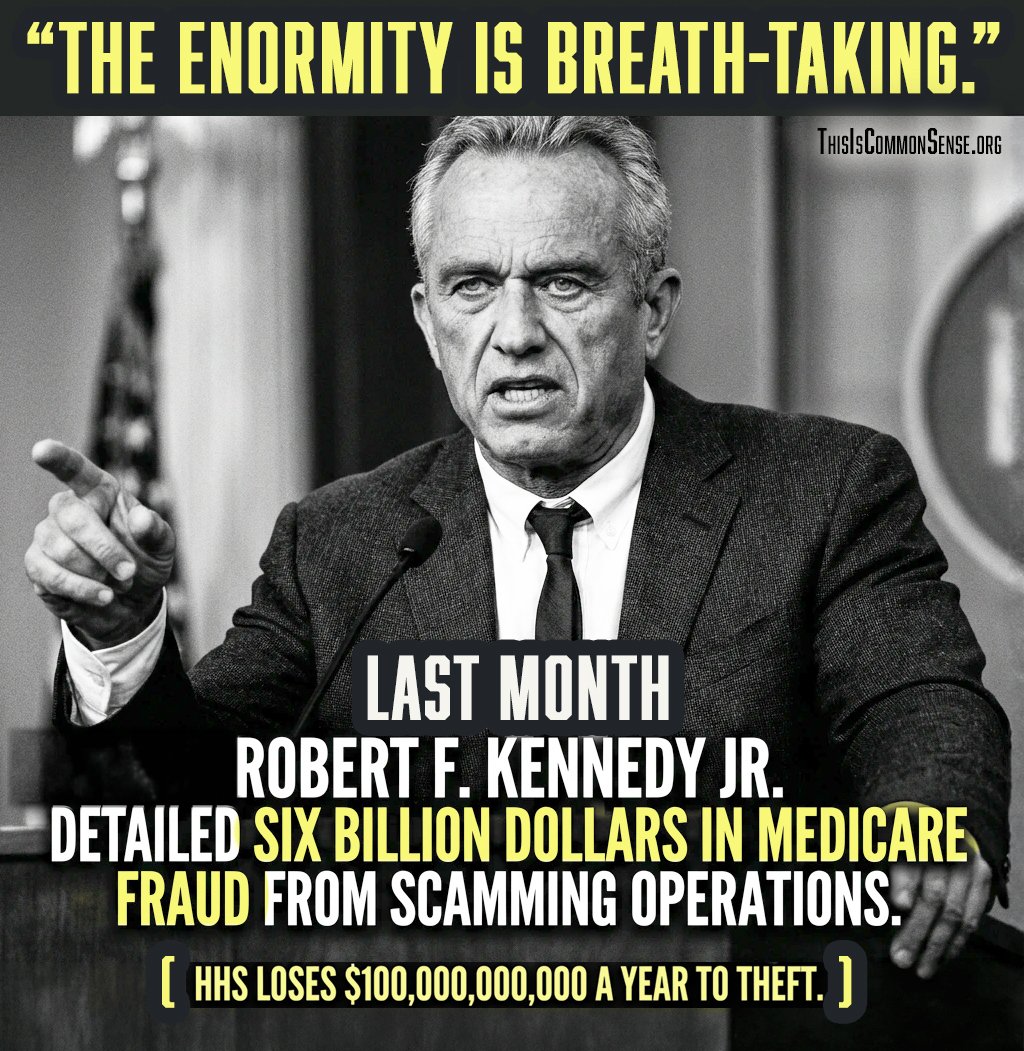
Last month, Secretary of the Department of Health and Human Services Robert F. Kennedy Jr. detailed six billion dollars worth of Medicare fraud, where scamming operations were caught “chasing money from our agencies.” 

Some while willfully neglecting patients.

On Friday, he estimated that the HHS “loses $100,000,000,000 a year to theft.” This was from an interview on the Fly Zone Podcast, widely shared by conservatives on X.

“We shut down 800 hospices,” Kennedy explained. “You know what a hospice is? Where you’re going to die. Typically, if you go to a hospice, you leave within 18 days because your dying is terminal.” This is the context. Yet, when HHS investigated taxpayer-funded hospices in Los Angeles, “the people never died. Two or three years later they were there, and we’re paying $6,000 a month.”

The enormity is breath-taking: “We found a hotel room with 29 hospices in it. I mean a hotel, every room was a hospice, and none of them had any patients.” Some of the scams were more ambitious, involving bribery of patients and worse.

“Estonians and Armenians and people from Eastern Europe . . . were getting the patient numbers . . . stealing them from doctors’ offices.” And there were more scams, too, from members of other ethnic groups — remember Minnesota’s Somali fraudsters

Tellingly, after closing down the operations, the HHS did not receive “a single call from a congressman or from a business owner saying, ‘Oh, you shut down my hospice and all these patients are on the street.’ None of them, because they were all crooked and they knew they were crooked.”

Folks on the left seem oddly silent. Have you heard any denunciations of, say, greed? Or is that vice only attributable to corporations and “the millionaires and billionaires”?

This should be a non-partisan issue.

This is Common Sense. I’m Paul Jacob.


PDF for printing

Illustration created with Nano Banana

See all recent commentary
(simplified and organized)
See recent popular posts
Categories
Accountability crime and punishment fraud

Watchdogs That Don’t Bark

Yesterday, I refrained from completely quoting Dr. Mehmet Oz, administrator of the Centers for Medicare and Medicaid Services, saving for today the juiciest part. After declaring the fraud in Minnesota dwarfed by what he saw in California, Oz said, next: “which is whole-scale cultural malfeasance around health care.”

“Cultural”?

Dr. Oz clarified at length: it’s about the cover-up. Minnesota’s fraud network? Bureaucrats knew. But when a whistleblower tried to toot on the proverbial whistle, these folks, Oz explained, were “culturally . . . dissuaded, intimidated, from speaking up.”

This would happen “any time people raised the possibility that, for example, the Somalian subpopulation, who have different cultural mores than the folks who have historically been in Minnesota, might be taking advantage of systems that were built for Minnesota nice people.”

The “cultural” aspect is the pseudo-niceness of political correctness. “So you have well-meaning people trying to be nice, trying not to ruffle any feathers. If you do ruffle feathers, you get outed.” The auditors lacked the temperament to actually audit, with those daring few speaking up systematically prevented — shuffled away — from doing any actual work. 

“Although you may still have a job there, you don’t get to do anything in that job.”

While Oz claims not to know how high up cover-for-fraud goes, I’ve a hunch that the smart ones in government know all-too-well what they are doing. They certainly know the fear. And use it. 

It’s suffused throughout: “cultural.”

This story is not unrelated to the grooming gangs in Britain, Finland and elsewhere, allowed for years by police to carry on what we used to call “white slavery” because the cops feared being called racist

You cannot have watchdogs too “nice” to bark.

This is Common Sense. I’m Paul Jacob.


PDF for printing

Illustration created with Nano Banana

See all recent commentary
(simplified and organized)
See recent popular posts
Categories
crime and punishment fraud too much government

Oz in Fraudland

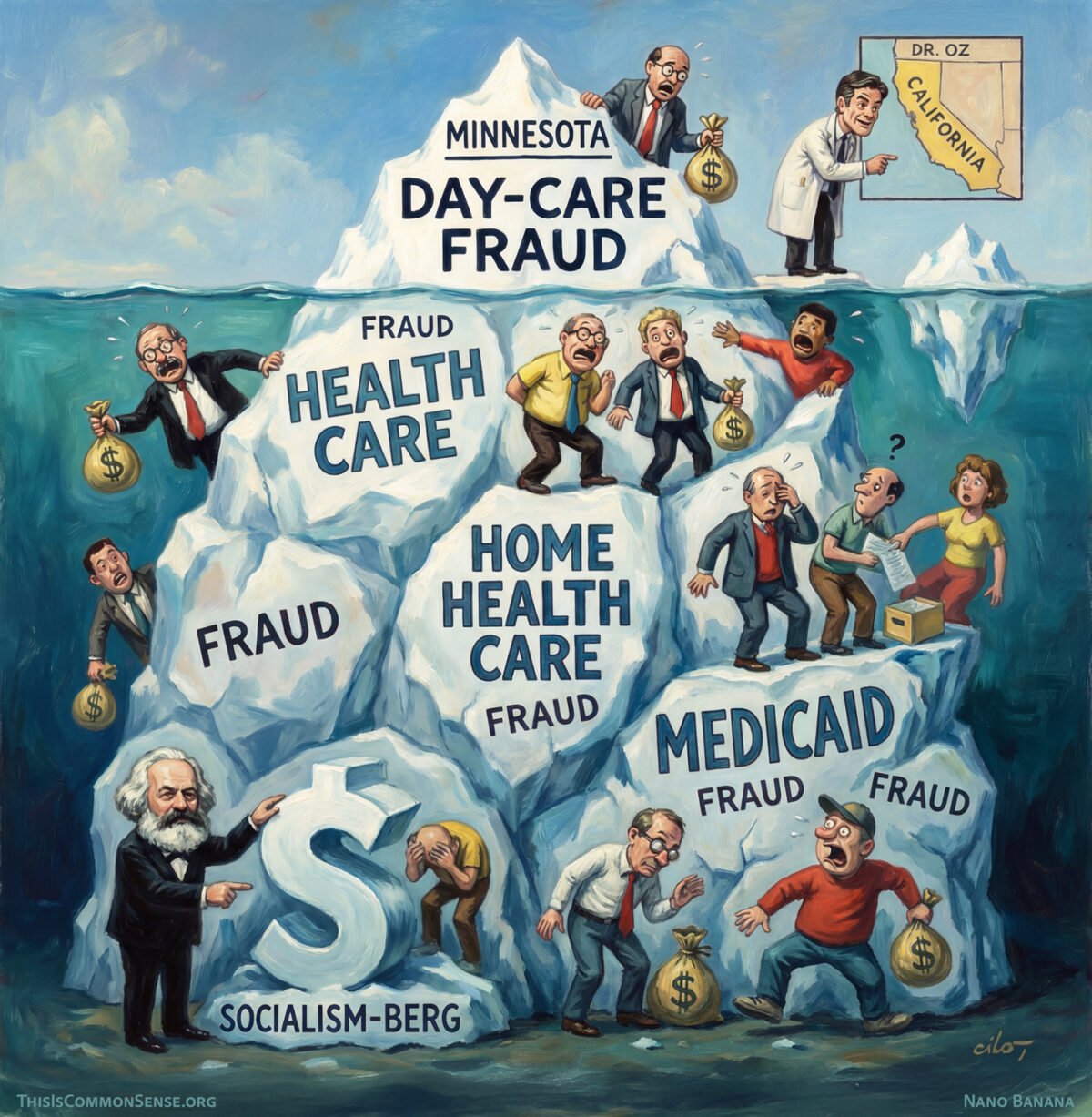
Ten days ago, I quoted Veronique de Rugy, warning that Minnesota’s day-care fraud scandal was “only the tip of the iceberg.” 

Beyond subsidized daycare? Health care, home health care, Medicaid. 

Fraud, fraud, fraud.

But it wasn’t just a lone Reason scholar saying it. “What we’re seeing in Minnesota … is dwarfed by what I saw in California,” The Epoch Times quotes Dr. Mehmet Oz, administrator of the Centers for Medicare and Medicaid Services. 

Minnesota, Dr. Oz said, “is just the tip of the iceberg.”

Just in California’s hospice and home health care, Oz figures, fraud rockets up to at least $4 billion.

Add a few billion here and there and soon you’re talking real money.

I titled my commentary quoting Ms. de Rugy “The Tip of the Socialism-berg.” Remember Mr. Socialism? Karl Marx? He introduced to the world a complicated, rather magical theory of exploitation in market society focusing on “surplus value.” While I have trouble making heads or tails of his theory — seems utterly nuts — I do know something about its origin. 

Marx nabbed it from classical liberal French scholars who preceded him. But they said the exploitation was through government mechanisms: it’s those who skim off of taxes who exploit the masses. 

Marx turned it upside down.

So let’s turn things right-side up: we all know that when it comes to policy, good intentions don’t make up for bad consequences. And those who de-fraud the taxpayers don’t have “good intentions.” 

They’re thieves. 

This is Common Sense. I’m Paul Jacob.


PDF for printing

Illustration created with Nano Banana

See all recent commentary
(simplified and organized)
See recent popular posts

Categories
subsidy

Non-Billions for Non-Trains

The federal government has officially stopped throwing money at California’s long-in-the-non-making “high-speed” railroad. A scheduled-but-unspent $4 billion in federal subsidy has been canceled.

If the nonexistent project continues, money to fund non-laying down of non-tracks must come from other sources.

Non-tracks? Yes. As Victoria Taft notes, “Not one foot of track” of the not-in-progress “high-speed” railroad of the future has been glued into place. 

We were just getting to track-laying phase, California Governor Newsom protests.

The going rate for snail-pace non-completion of nonexistent, not-in-progress railroads is $15 billion (says the Department of Transportation): the estimated amount of federal funding for California’s non-project to date.

The total graft bin may have been even larger than that; who knows how many nickels for the non-project have been collected from widows and orphans? But something like $15 billion is how much the federal government doled out over 16 years to ensure the railroad’s non-construction. Projected total cost of California’s infinite-prep-phase railroad: $135 billion.

Why has it taken so long — six-ish whole months — for the second Trump administration to get around to stoppering this particular gusher of monstrous waste of taxpayer dollars?

Perhaps proceeding as fast as they can, the cost-cutters and fraud-flayers take their mission one thing at a time. In Trump’s place, you might be tempted to chuck the whole five-mile-thick list of federal expenditures, throw it into the pyre and defund everything, re-starting from scratch with the courts and military. But not all temptations play out in Washington.

This is Common Sense. I’m Paul Jacob.


PDF for printing

Illustration created with Krea and Firefly

See all recent commentary
(simplified and organized)
See recent popular posts
Categories
Accountability too much government

Federal Self-Service

Even government agencies that perform an identifiable function should be eliminated if they are not performing a proper function of government.

But what about an agency that exists primarily “to provide luxurious lifestyles for its employees”?

The Federal Mediation and Conciliation Service is one of the agencies getting the ax under the Trump administration, at least until some judge tries to resurrect it.

Nominally, FMCS existed to serve as a voluntary mediator between unions and businesses. But aside from doling out grants to unions and applicants with a tenuous connection to unions, its overriding purpose was to enable employees to splurge on themselves at the expense of taxpayers.

That’s what Luke Rosiak discovered during a year-long investigation.

One FMCS official pretended to take a years-long “business trip” so that taxpayers would foot the bill for his living expenses.

Employees unblocked government credit cards to circumvent protections against abuse, then used them to fund personal expenses. One leased a BMW with the card.

Junkets to resort locations supposedly to drum up interest in the pointless agency were really just a way of enjoying government-funded vacations.

One employee told Rosiak: “Personally, the reason that I’ve stayed is that I just don’t feel like working that hard, plus the location on K Street is great, plus we all have these oversized offices with windows, plus management doesn’t seem to care if we stay out at lunch a long time. Can you blame me?”

Yes, we can.

This is Common Sense. I’m Paul Jacob.


PDF for printing

Illustration created with Krea and Firefly

See all recent commentary
(simplified and organized)
See recent popular posts

Categories
crime and punishment

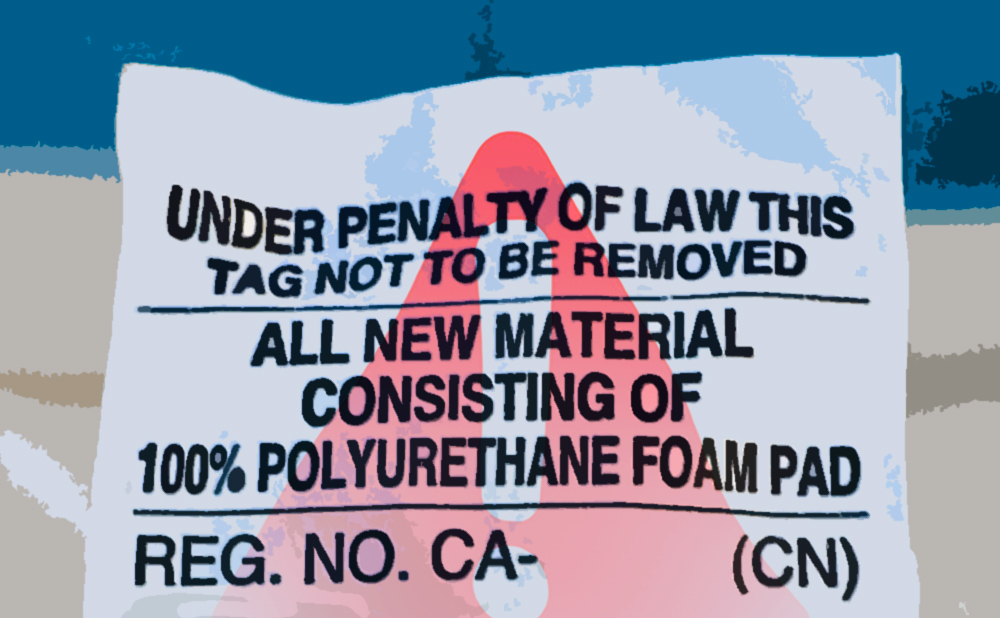
Do Not Remove This Tag

Unless you’re the customer. Then it’s okay.

Once upon a time, the warning that now reads something like “Under penalty of law this tag is not to be removed except by the consumer” did not include those last four words.

The original wording has been the occasion of much not entirely genuine concern about the prospect that officers of the law will invade the homes of unruly tag-rippers. These renegades were celebrated in song by science fiction writer, libertarian, and singer L. Neil Smith. (You’ll find the lyrics in his novel The Wardove.) More famously, Chevy Chase, in the movie Fletch (1985), bluffed his way out of a tight spot pretending to be concerned about mattress tags.

But if you’re a company selling something with a tag, removing it can be deceptive. Especially if you remove it in order to replace it with another tag that gives customers a very mistaken idea about the product you are selling.

Such a fraud has apparently been committed by a company called Lions Not Sheep, which caters to lions (leaders). The company removed tags saying Made in China from clothing that it sells and replaced them with tags saying Made in USA. For this, the FTC fined the firm $211,335.

Lions Not Sheep understands its market.

Yes, when buying stuff, many people hope to avoid directly or indirectly supporting the Chinazi government to the extent possible. These folks create a substantial demand for goods made not in China but in America (or in other acceptably non-totalitarian countries).

But defrauding the buyer is, of course, not the way to meet this demand.

This is Common Sense. I’m Paul Jacob.


PDF for printing

See all recent commentary
(simplified and organized)
See recent popular posts

Categories
ballot access Voting

Our Elections — How Broken?

Election fraud didn’t suddenly disappear during the 2020 presidential election.

Or so observes John Fund, co-author of Our Broken Elections: How the Left Changed the Way You Vote, in a wide-ranging interview with Jan Jekielek, Wall Street Journal reporter and elections expert.

The list of problems is long. One example is what happened in New York City during the last days of the Bloomberg administration.

Testing the election system, the Department of Investigations sent 63 inspectors to try their hand at fraudulent voting. The inspectors used names of dead people, jailed people, people who had moved out of state. All they had to do to immediately get a ballot was supply a name and address. There was no double-checking.

In almost every case, the inspectors had no problem putting over the fraud. (Fake fraud; they didn’t follow through.)

In one case, an inspector was merely sent from one precinct to another precinct, only a temporary delay.

In another case, an inspector was rebuffed only because he had used the name and address of an imprisoned person who happened to be the son of the poll worker the inspector was trying to con.

In response to an exhaustive and damning report, furious Board of Elections officials demanded that the inspectors be criminally prosecuted for impersonating people. The officials testing the system were so widely savaged for this temerity that they backed off.

We must not back off, though. Ballot fraud is an insidious enemy of democracy. 

This is Common Sense. I’m Paul Jacob.


PDF for printing

See all recent commentary
(simplified and organized)
See recent popular posts
Categories
insider corruption

Jesse Jackson, Jr., Fraudster

Guilty. That’s what Jesse Jackson, Jr., former congressman, pleaded in court yesterday.

Fraud. That’s the name of his crime, though it was a particular kind of fraud, the taking of campaign contributions for personal use.

Partnered. The Rev. Jesse Jackson’s famous son was not alone, nor did he merely “fall into” crime out of lax record-keeping. His wife was also involved in the pattern of embezzlement and tax fraud, and the level of their misappropriations was not trifling.

Sandra Jackson admitted to not reporting $600,000 of income, and the couple confessed to using re-election campaign funds to

  • buy a gold-plated Rolex for more than $40,000;
  • purchase $5,000 worth of fur capes and parkas;
  • over $9,000 worth of children’s furniture.

This is corruption, the most obvious kind to which a democratic republic is susceptible.

It is only made more frequent and more expensive in our modern times by the enormous power a congressman can hold over Washington’s tossing about of billions and trillions of dollars.

Who even notices the millions?

Jesse Jackson, Jr., isn’t alone in wanting a piece of the Washington action. Nor is he alone in thinking about himself first, and . . . well, not having time to think about anything second.

I’ve even seen this happen to minor-party candidates. It’s too easy to see a political campaign as about the candidate and not the principles — about personal advancement, not representation.

We’ll never have perfect people in public office, but we can do a whole lot better. And it’s good to see the guilty caught and prosecuted.

This is Common Sense. I’m Paul Jacob.

Categories
crime and punishment national politics & policies

Ponzi in California

Keeping loans and investments distinct is important not merely for business people, but for governments.

Case in point? Mahmoud “Mike” Karkehabadi’s 89 felony counts of securities fraud and grand theft. The Laguna Niguel, California, movie maker is accused of turning his business into a Ponzi scheme.

When his film Hotel California flopped, bringing in just over half a million dollars, Mr. Karkehabadi convinced his investors to roll over their loans to him into future movie projects. When he did this, it is alleged, he fuzzed up the distinctions between different deals, and entered dark territory. Fraud.

According to California Attorney General Jerry Brown, Karkehabadi “ran a cold and calculated scam, making promises he never intended to keep and using the funds of new victims to pay off the earlier ones.”

I don’t know which this sounds like more, something out of Get Shorty or the Social Security Act of 1935.

It’s interesting that, at the same time it prosecutes Karkehabadi, the state of California is hastily and drastically re-arranging its finances. Politicians are forced to do so because they have promised the state’s retiring employees returns on investments never made in amounts state government could never, realistically, afford to come through on.

The whole story of the accused Mr. Karkehabadi looks bad. Criminal. But then, so does the whole story of how politicians in California (and elsewhere) behave.

Fraud isn’t as uncommon as it should be.

This is Common Sense. I’m Paul Jacob.