Categories
insider corruption political economy

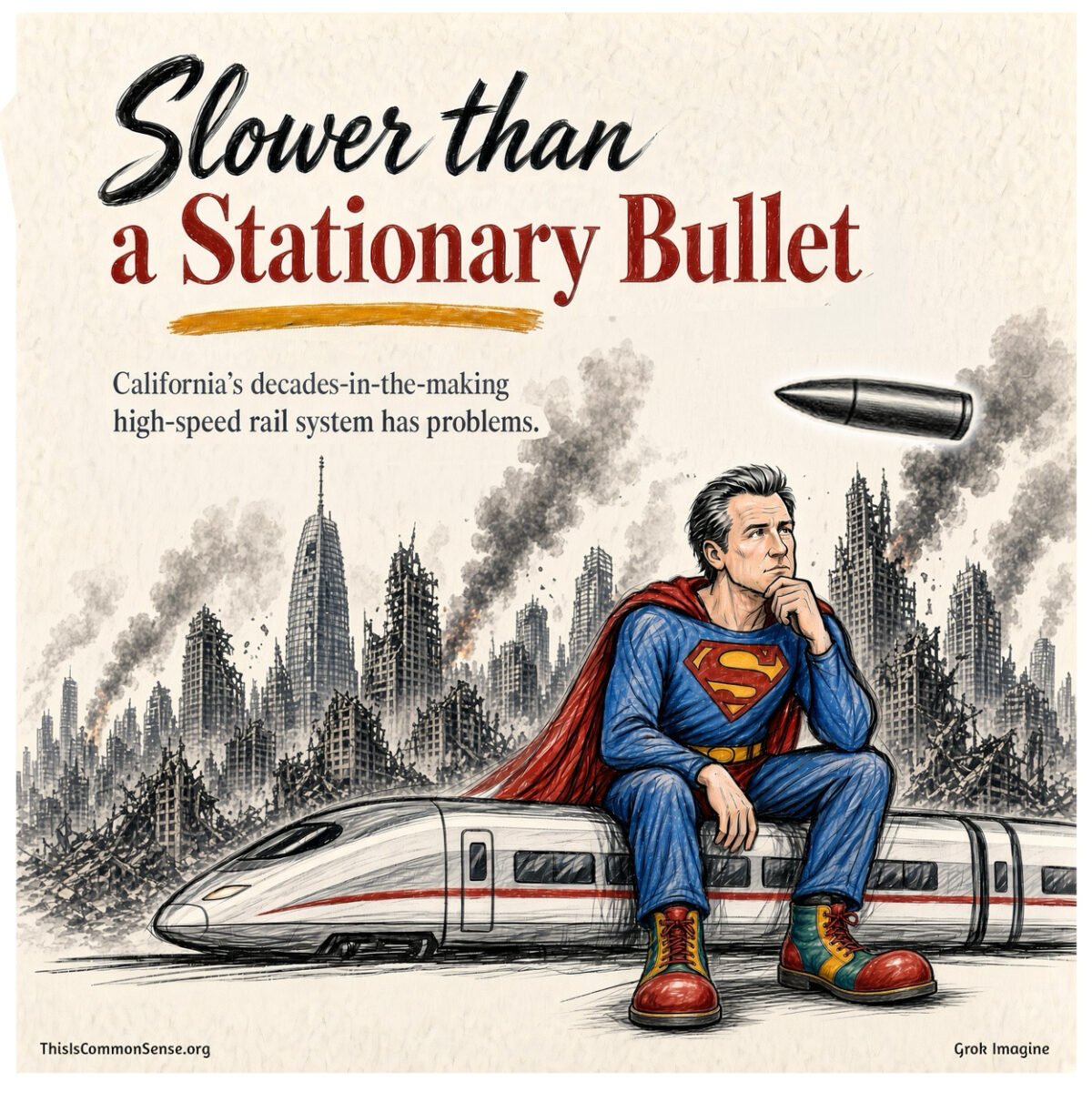
Slower Than a Stationary Bullet

California’s decades-in-the-making high-speed rail system has problems.

The first: In 2008 Californians approved a $10 billion bond measure as down payment on a $45 billion, 800-mile bullet-train system.

At the time, a policy analyst suggested that many people “sense that maybe that [bullet train] is something I can use at some point. It’s something they can relate to.” Hence the 52.7% support.

Now, I can “relate to” plenty of big projects I might “use at some point,” preferably before shuffling off this mortal coil, but that doesn’t mean I favor forcing fellow taxpayers to shell out many tens of billions for extravagant dreams. 

Neither does it mean I wish to open the door to endless horse-trading and political skullduggery.

There is another problem: It’s become clear that the only likely result of California’s “high-speed” project, in addition to lining the pockets of the politically well-connected, will be duplicating and interrupting an already-existing service.

The chapter-and-verse is laid out by blogger Chris Bray. “The High-Speed Rail Authority is,” Bray writes, “replacing trains with trains, and train stations with train stations. The Central Valley, which is connected by rail, is being connected by rail, after which the Gold Runner will be shut down where it overlaps, but still operated where it doesn’t.”

Instead of the mega-connective system Californians though they were voting for, they’ll get “trains to Fresno where they already have trains to Fresno.” And when riding, have to keep switching back and forth between an Amtrak train and a bullet train.

But, hey, look on the bright side: maybe it will never happen.

This is Common Sense. I’m Paul Jacob.


PDF for printing

Illustration created with Grok Imagine

See all recent commentary
(simplified and organized)
See recent popular posts
Categories
subsidy

Non-Billions for Non-Trains

The federal government has officially stopped throwing money at California’s long-in-the-non-making “high-speed” railroad. A scheduled-but-unspent $4 billion in federal subsidy has been canceled.

If the nonexistent project continues, money to fund non-laying down of non-tracks must come from other sources.

Non-tracks? Yes. As Victoria Taft notes, “Not one foot of track” of the not-in-progress “high-speed” railroad of the future has been glued into place. 

We were just getting to track-laying phase, California Governor Newsom protests.

The going rate for snail-pace non-completion of nonexistent, not-in-progress railroads is $15 billion (says the Department of Transportation): the estimated amount of federal funding for California’s non-project to date.

The total graft bin may have been even larger than that; who knows how many nickels for the non-project have been collected from widows and orphans? But something like $15 billion is how much the federal government doled out over 16 years to ensure the railroad’s non-construction. Projected total cost of California’s infinite-prep-phase railroad: $135 billion.

Why has it taken so long — six-ish whole months — for the second Trump administration to get around to stoppering this particular gusher of monstrous waste of taxpayer dollars?

Perhaps proceeding as fast as they can, the cost-cutters and fraud-flayers take their mission one thing at a time. In Trump’s place, you might be tempted to chuck the whole five-mile-thick list of federal expenditures, throw it into the pyre and defund everything, re-starting from scratch with the courts and military. But not all temptations play out in Washington.

This is Common Sense. I’m Paul Jacob.


PDF for printing

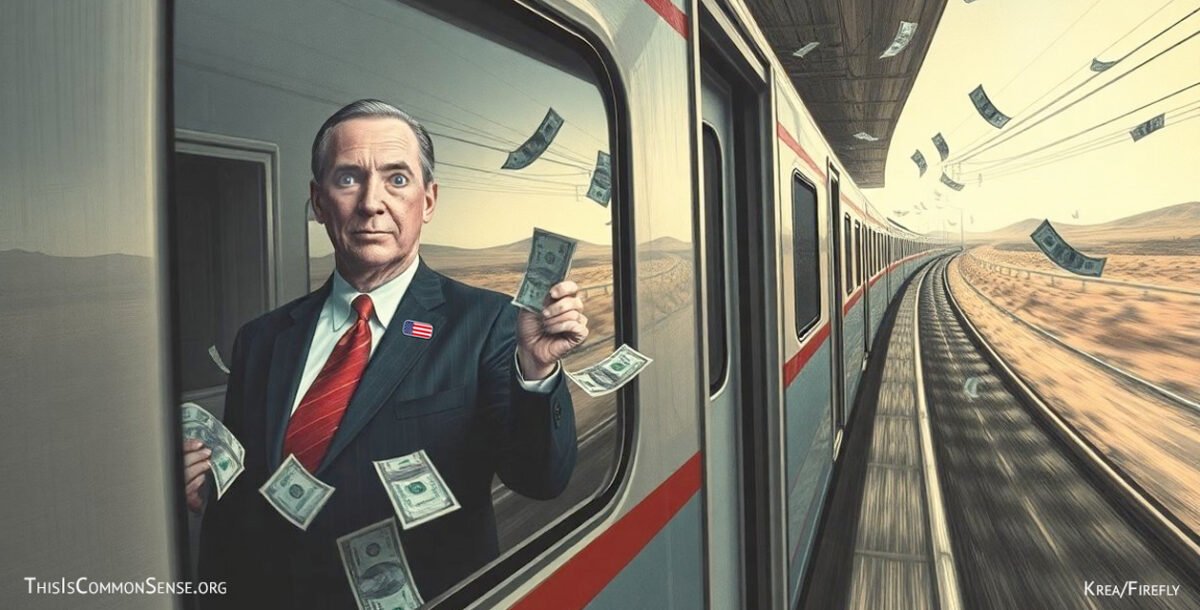
Illustration created with Krea and Firefly

See all recent commentary
(simplified and organized)
See recent popular posts
Categories
folly porkbarrel politics responsibility too much government

A Bullet Train to the Head

Romanticism. The yearning for greatness; the need for speed. Efficiency! It’s all there in California’s high-speed rail project — hopes and dreams and a sense of the grandeur of progress.

And yet the bullet train project, approved by voters in 2008, is a fiasco.

One can blame the voters, I suppose. At least the 53.7 percent who said yes to a referendum authorizing a 9.95 billion bond. Just to get the project started.

But we shouldn’t, really. All the people pushing the bullet train notion (from Los Angeles to the Bay) said that most of the investment would come from private investors. Further, it would require no ongoing subsidies.

Those assurances, however, “were at best wishful thinking, at worst an elaborate con,” writes Virginia Postrel for Bloomberg.

How bad is it? Total construction cost went from a $33 billion to $68 billion — despite route trimming. The first segment, which is understood to be the easiest to build (shooting through an empty stretch), is four years behind schedule, and still lacks necessary land.

The list of failures goes on and on, and includes a dearth of investors. And then there’s the estimate of the company who got the first bid on the project. It says that the line will almost certainly not be self-sustaining.

“The question now,” Postrel concludes, “is when they’ll have the guts to pull the plug.”

Corruption, hope without realism, business as usual — all these are revealed in the project. And wasn’t the second season of True Detective about this? Let’s hope this real-world fiasco ends with less bloodshed.

Californians have already lost enough in treasure!

This is Common Sense. I’m Paul Jacob.


Printable PDF

California, high speed, rail, boondoggle, waste, illustration