
Categories
Accountability education and schooling

Graduation Without Testing

The problem with all government activity is the difficulty of establishing accountability. 

“As colleges across the country are reinstating standardized tests,” writes Meagan O’Rourke at Reason, “New York [government] high schools are taking another approach: eliminating the state’s longstanding Regents exam requirements.”

Thankfully, the tests are not to be completely junked: “This week, the New York Board of Regents, which oversees the state’s public schools, voted to make the standardized exams optional going forward. They are currently required for most high schoolers to graduate,” explains Ms. O’Rourke.

They want the exams to be “opt-in.”

While we’ve grown used to public school educators fiddling with grades, exams like those currently required — even if far from perfect — constitute an even better way to glean how well (or badly) teachers and students are doing.

Government schools suffer, of course, from “increased spending and mediocre results,” as Reason puts it. (I covered Michigan’s problems yesterday, for example.) The avoidance of “metrics” — in business lingo — is just the kind of evasion that one might expect from under-performing institutions. New York’s opt-in downgrade is comparable to a failing student doctoring his report card or forging a parent’s signature.

But what do they really hope to accomplish? The New York Times quotes officials admitting they are trying to “eliminate barriers to graduation for some students.”

Ignorance and lack of skills are the barriers educators should be seeking to remove. 

Through teaching stuff like math, reading, and science. And inculcating basic skills.

Graduation “magically” follows.

It is interesting — in a bad way — that education bureaucrats think their job is, instead, merely pushing the biggest number of students through the system. 

This is Common Sense. I’m Paul Jacob.


PDF for printing

Illustration created with Nano Banana

See all recent commentary
(simplified and organized)
See recent popular posts
Categories
education and schooling

New Employees for the Bloc

Low teachers’ pay: a common complaint. We do not hear about it much from non-government school teachers, however. Private and church school salaries fall outside public awareness, for the public doesn’t contribute to them. Taxpayers hearing about public school teacher salaries, specifically, makes some sense.

This is cleverly addressed at the outset of a recent article in the Michigan Capitol Confidential.

“The superintendent of Port Huron’s public school system said that every year he must replace teachers who leave his district. He blames low teacher salaries,” we read. “But the superintendent was Harlan Davis, and he made his statement more than 100 years ago.” 

For over a century we’ve been told “teaching does not offer a career.”

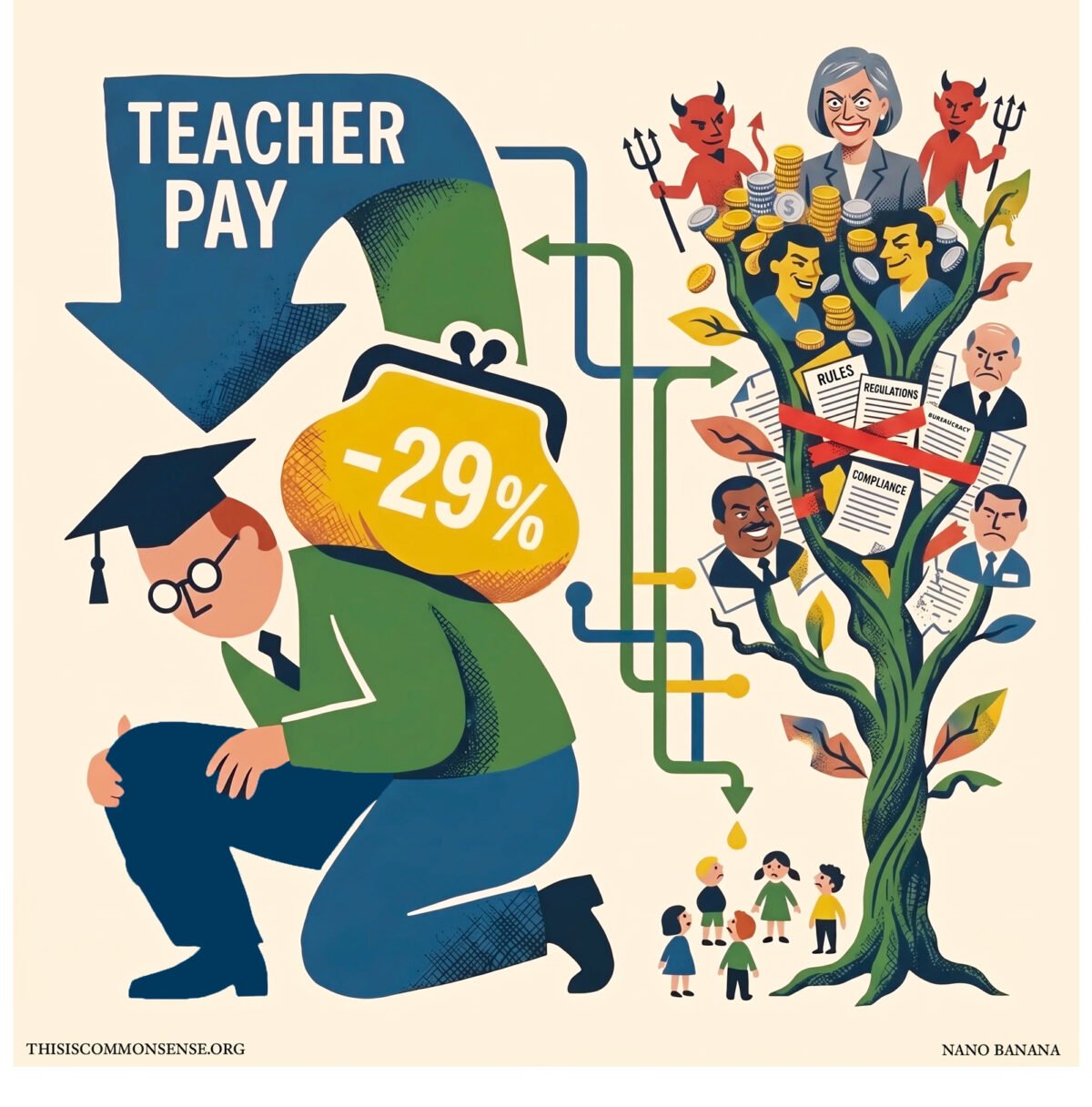
This is all a preface to the current situation, where “several Michigan newspapers” now report “that teacher pay is down 29% since 1995 after inflation is accounted for. . . .”

Thankfully, the Michigan Capitol Confidential, which the Mackinac Center for Public Policy publishes, provides context in addition to long-term inflation. “One reason why less money goes to teacher salaries may be that the state’s public school districts are hiring more and more people despite enrolling fewer and fewer students.” Michigan schools added 35,000 full-time positions while losing 113,000 students.

Now, taxpayers and parents might hope that it’s new teachers who constitute the bulk of that growth, but hopes aren’t realities. During the pandemic, for example, the state’s governor, Gretchen Whitmer, pushed to hire “560 more school psychologists, school social workers, school counselors, and school nurses.” 

If politicians thought teachers’ salaries were all-important, they’d forsake their schemes to hire more non-teaching employees. But it’s obvious: creating a pro-spending voting bloc is what they care about, not teachers.

This is Common Sense. I’m Paul Jacob.


PDF for printing

Illustration created with Nano Banana

See all recent commentary
(simplified and organized)
See recent popular posts

Categories
education and schooling insider corruption

Patronage Over Pupils

Frederick Douglass was a great man, so one might expect that a school named after him would also be great. But Chicago’s Frederick Douglass Academy High School, sporting a nifty web page, falls short. 

In students.

The Illinois Policy Institute’s Chicago Policy Center reports that, “Frederick Douglass Academy, with a capacity of 1,008, had just 27 students in 2025-2026.” 

Yet supporters and employees boast online how “loud and proud” they are about the school — while demanding more funding.

We’re not supposed to notice that 981 shortfall in enrolled students. 

Last year, according to columnist George F. Will, the school had more paid staff members than students! The year previous, taxpayers had funded “education” there to the tune of $93,000 per pupil!

“But Douglass is not entirely an outlier,” explains Mr. Will. “At more than 50 Chicago schools, the percent of students who achieve math proficiency is 0.” 

And the average over all the schools, last year, adds another clue: “43 percent of the city’s teachers were absent 10 or more school days. Students similarly negligent produce the phenomenon called ‘chronic absenteeism.’ A quarter of Chicago high-school students missed more than a month of school, and 100 percent of Douglass’s seniors were chronically absent. Yet the graduation rate remains high, at about 83 percent.”

Will blames the teachers’ union, which he calls “wicked.”

Corruption festers up and down Chicago’s K-12 hierarchy. There has been a moratorium on closing under-utilized schools, with near-empty schools better serving as union pork than as an efficient way to educate the young. 

The Illinois Policy Institute insists that the first step out of this mess is to close failing schools.

We cannot keep passing along those who flunk out. Students and schools, both.

This is Common Sense. I’m Paul Jacob.


PDF for printing

Illustration created with Nano Banana

See all recent commentary
(simplified and organized)
See recent popular posts
Categories
education and schooling

Grades Versus Feelings

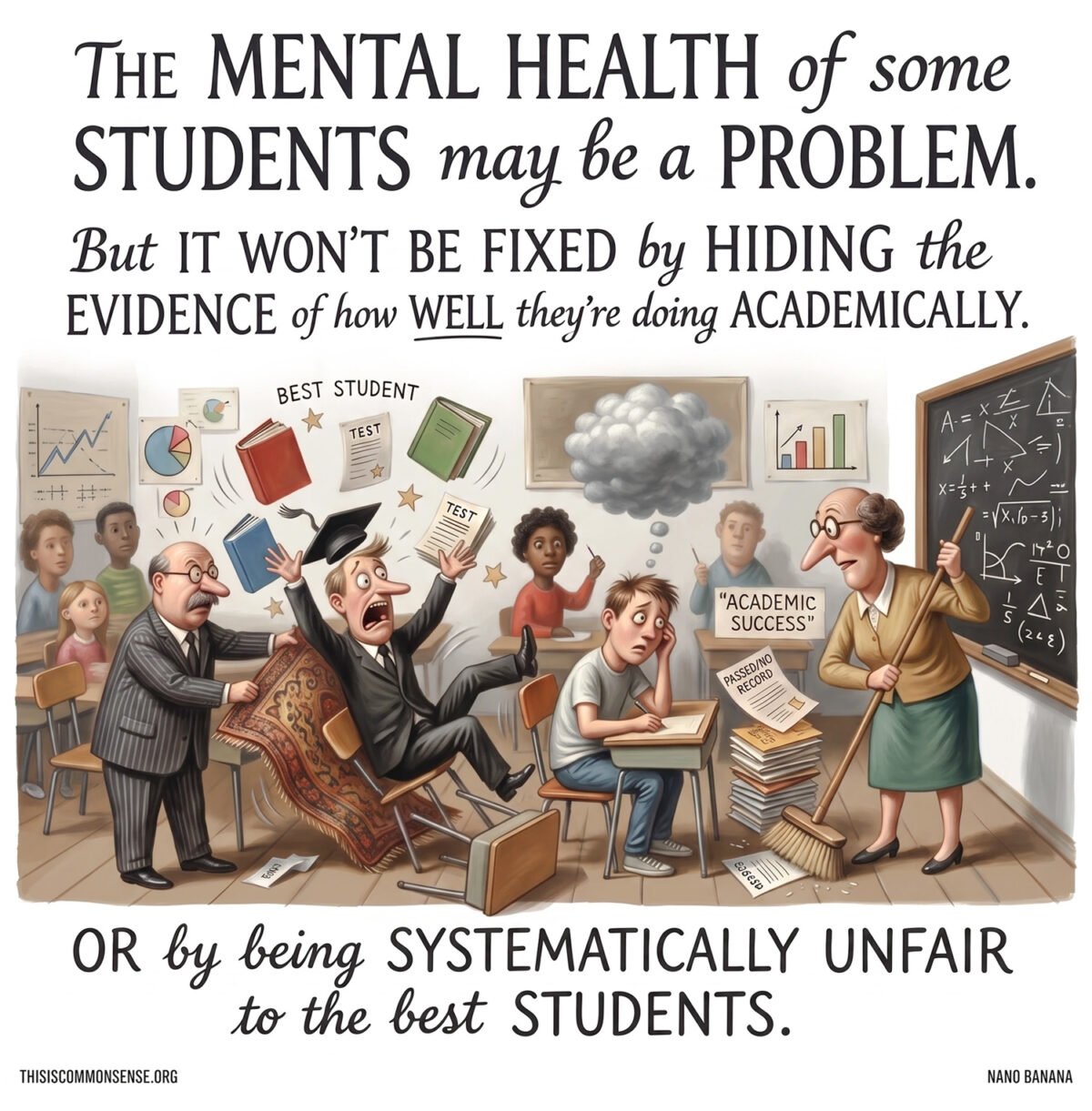
In the 1960s, MIT introduced a “Pass or No Record” system for the first semester of freshman year. The idea? Help students adjust to greater workloads and “variations in academic preparation and teaching methods.”

You’d think that letter grades themselves would help students adjust by providing information about how well they are learning and adjusting — assuming that the grades are at least a roughly objective indication of mastery not yet rendered useless by grade inflation.

Some universities let first-semester freshmen convert a poor letter grade into a pass/no credit “grade.” Only a few have sweepingly replaced letter grades with the pass/no credit system in the first semester.

Now University of Michigan has joined those few. One reason: to “curb the mental health crisis unfolding.”

Why not at least make the pass/no credit “grade” optional for the sake of students who do want their academic achievement to be more specifically recorded on their transcript?

Well, this would “defeat the purpose of facilitating students’ transition to campus.” See, if “covered grades are optional, covering [hiding] an individual’s grades will inadvertently become equated with [their] not doing well in a class.”

Sounds like a reason for keeping letter grades. And what if the mental problems persist into sophomore year? Junior? Senior?

The mental health of some students may be a problem. But it won’t be fixed by hiding the evidence of how well they’re doing academically. Or by being systematically unfair to the best students.

This is Common Sense. I’m Paul Jacob.


PDF for printing

Illustration created with Nano Banana

See all recent commentary
(simplified and organized)
See recent popular posts

Categories
general freedom ideological culture

Welcome the Revolutionaries?

Attending his son’s commencement ceremony at the University of Michigan, Judge Michael Warren came away . . . concerned. 

“In stark contrast to several speakers who dutifully acknowledged that the campus sits on land ceded by the Ojibwe, Odawa and Potawatomi Nations by the 1817 Treaty of Fort Meigs (or Treaty of the Foot of the Rapids),” the judge lamented in The Detroit News on Monday, “not a single speaker dared to acknowledge the birthday of our own nation.”

The ceremonies, writes Judge Warren, “could have occurred in any country without missing a beat.” 

Warren, a U of Malumnus, sadly notes how thoroughly “in thrall” to the “well-documented anti-West, anti-American sentiments” his old school has become. He also highlights how very different they were from the ceremonies, a half century ago, during the Bicentennial, when the keynote speech was entitled “Welcome to the Revolution.”

Nowadays, any Revolution extolled on campus might best be symbolized not by fife and drum or quill on parchment, but by a raised red fist.

Or hammer and sickle — perhaps painted in rainbows.

Lost on the university class? Any charm to the “near magical words” of the Declaration of Independence. Before the Declaration, Warren explains, all governments “were unequivocally opposed to recognizing that the people had the right to reform or start government anew.”

Today’s university folk, expressing the typical pieties of the center-left, in fact mimic our familiar American model to justify their own, much less impressive and far more dangerous notions of never-ending revolution.

In April, Republic Book Publishers came out with The Revolutionary Words that Forged America: The Definitive Guide to the Declaration of Independence by this very same Judge Michael Warren. I bought a copy. It looks great. 

For he takes the founders’ seriously good ideas seriously.

This is Common Sense. I’m Paul Jacob.


NOTE: Judge Warren also happens to be a very serious candidate for the Michigan Supreme Court. And, in full disclosure, my friend.

PDF for printing

Illustration created with Nano Banana

See all recent commentary
(simplified and organized)
See recent popular posts

Categories
education and schooling

Mississippi Learning

“Thank God for Mississippi” was something I heard a lot in my younger years, after moving to Arkansas. Friends from Alabama and Louisiana also know the saying well. 

Back then, Mississippi was ranked 50th in so many categories by which the states were measured against each other that the Magnolia State saved those inhabiting states near the bottom from occupying that un-coveted dead last place. 

This was still the case in 2005, when Mississippi ranked 50th in fourth-grade reading scores. In 2013, Mississippi students climbed one rung, to 49th. Then things started to change.

“The transformation began in 2013 with the passage of the Literacy-Based Promotion Act, a controversial law that allows schools to hold back students who cannot read by third grade,” WAPT, Jackson’s ABC-TV affiliate, recently reported.

“The curriculum shifted from balanced literacy to a phonics-forward approach,” WAPT explained, “and the state invested millions into phonics-based instruction, strict accountability measures, and instructional coaches who work inside schools daily.”

Imagine going back to the way generations were taught to read and, lo and behold, it still works!!!

“Results from the 2024 National Assessment of Educational Progress showed Mississippi fourth graders ranked 9th in the nation for reading scores and 16th in the nation for math scores,” the TeachMS website informs. “Since 2013, that same category of students ranks No. 1 nationally for gains in reading and math.”

“Mississippi has skyrocketed on national tests, while blue states lag,” acknowledged a New York Times account earlier this year, adding that “adjusted for poverty and other student demographics, Mississippi is No. 1 for fourth grade reading and math, and at or near the top in eighth grade, according to the Urban Institute, a left-leaning think tank.”

Thank God for Mississippi. 

This is Common Sense. I’m Paul Jacob. 


PDF for printing

Illustration created with Nano Banana

See all recent commentary
(simplified and organized)
See recent popular posts

Categories
free trade & free markets ideological culture too much government

Unhealthy Kid Stuff

Julian Shapiro-Barnum is the host and creator of Recess Therapy, where he regularly records conversations with kids. Recently, Rep. Alexandria Ocasio-Cortez (D-New York) joined his program to discuss healthcare policy. 

“The children agreed with AOC,” a Washington Post editorial noted, “and brought the same level of sophistication to political and economic questions that Americans have come to expect from the four-term congresswoman.”

AOC and the youngsters shown think healthcare should be free, which The Post used as a jumping off point to have an adult conversation about government-run healthcare, specifically the National Health Service in the United Kingdom.

“Despite the government funding and running a universal health care system, private hospital admissions in the United Kingdom reached their highest level ever in 2024,” readers were informed. 

“The number of people opting to buy private health insurance rose to 6.5 million in 2024, the highest number in a quarter-century, according to the Association of British Insurers.”

The Brits “have learned the hard way that the promise of ‘free’ care is only as good as their ability to get an appointment,” wrote the editors. 

The editorial further explained that “government systems can only stay afloat when they are rationed, often with backlogs that can leave people waiting months for serious procedures.”

“America’s health system is a mess,” The Post concluded, “but the belief that a full government takeover would lead to better outcomes is just childish.”

One of the nation’s largest newspapers appears to be growing up. 

AOC? 

Not so much. 

This is Common Sense. I’m Paul Jacob. 


PDF for printing

Illustration created with Nano Banana

See all recent commentary
(simplified and organized)
See recent popular posts
Categories
education and schooling general freedom ideological culture international affairs subsidy

The Price of a Canadian Education?

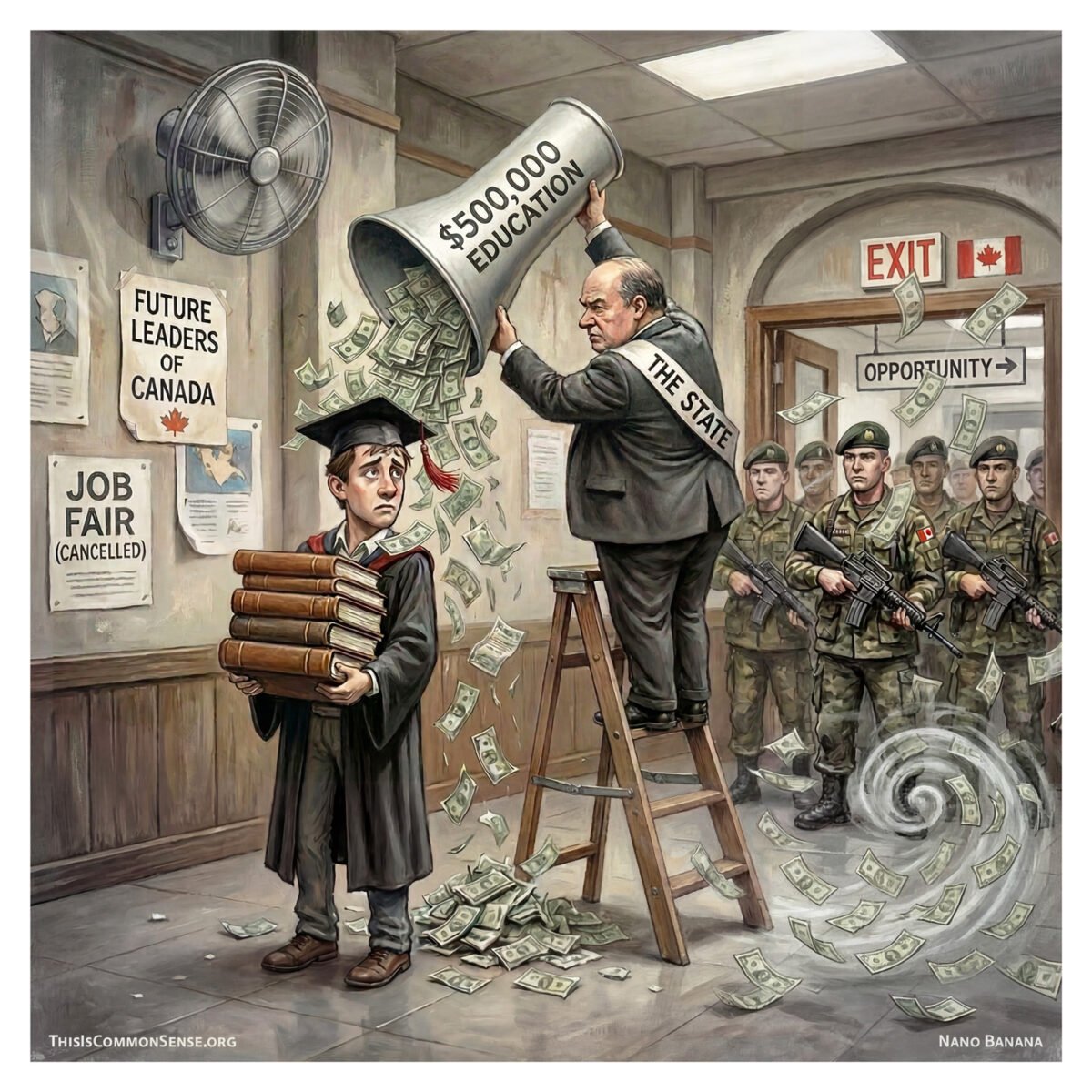
At a convention of Canadian Liberals, tech executive Patrick Pichette proposed that youngsters eager to escape Canada be charged a half-million dollars for what he apparently regards as a privilege, not a right.

We must remind ourselves that the word “liberal,” here, is used in its modern, anti-liberal sense: of the ideology of ever-increasing restraints on everybody.

Very illiberal.

Even if Pichette means Canadian dollars, that’s still $360,000 in real USD dollars. Hardly a ten-dollar processing fee. More like extortion. He rationalizes that the kids owe that much anyway thanks to Canada’s heavily subsidized education system.

Terry Newman observes that Pichette “is a Canadian who left Canada for better opportunities himself.” He went to California and Google and now lives in London.

But Pichette and his de facto self-exemption are not the problem. The problem is all Liberals who “want to govern as many aspects [of the economy] as possible, pick winners, and unload the tax burden of the massive bureaucracy onto Canadians, the smartest of which understand this clearly and choose to leave.”

While Pichette’s proposal had his audience of Canadian Liberals cheering, sane individuals rightfully express varying degrees of alarm. After all, punishing people for leaving a country is eerily reminiscent of what totalitarian states do: prevent them from leaving altogether.

Pichette’s rationale itself is based on a misunderstanding. Are the half-million per student subsidies really there to educate? More like to placate well-organized lobbies of too-often ideologically driven careerists. 

The idea that Canadian students actually receive half-a-million-dollar educations is not believable.

This is Common Sense. I’m Paul Jacob.


PDF for printing

Illustration created with Nano Banana

See all recent commentary
(simplified and organized)
See recent popular posts

Categories
education and schooling

Equality, Not Excellence

The really socialist mayor of New York City, Zohran Mamdani, the city’s new Handicapper General, wants to prevent the brightest children in the city’s school system from getting any extra training of their gifts and intelligence.

So he’s trying to do what one of his predecessors, the pretty socialist Bill DeBlasio, failed to do: eliminate the public school system’s Gifted and Talented programs.

What benefit could there be to students, their parents, and New Yorkers in general, in preventing gifted children from studying in schools and classrooms that give them the best chance of developing their gifts early in life? 

None whatsoever. 

Killing the more demanding academic work does not thereby improve what the average public-school classroom offers students. It also does not improve the ability of students who are not currently qualified to enter the most advanced programs. The only goal achieved is that of a nearer approach to the egalitarian “ideal,” the world of “Harrison Bergeron.”

If the concern were really to improve the average or below-average classrooms, this could be done — conceivably — by focusing on what could be improved in those classrooms. Are there bad teachers who could be fired? Disruptive students who could be better disciplined or shown the door? Vapid, unchallenging, or politically warped curriculum that could be overhauled?

Under the DeBlasio mayoralty, many parents protested his plan to erase opportunities for the Gifted and Talented, managing to thwart that plan. They’ll have to protest again if they want to stop Mamdani from stomping out excellence.

This is Common Sense. I’m Paul Jacob.


PDF for printing

Illustration created with Nano Banana

See all recent commentary
(simplified and organized)
See recent popular posts

Categories
ideological culture

Zero/Not-Zero

Forty-four million views later, the University of Oklahoma has advised student Samantha Fulnecky that the zero her paper received won’t be factored into her final course grade.

While it’s good that the school won’t hold that zero against her, she deserves a grade — an honest, objective grade — for her work.

Fulnecky did submit a paper, contrary to what is implied by the zero. She did indeed turn in an essay on the topic of “gender, peer relations and mental health” that her class was assigned.

Perhaps the word “gender” has given you the clue. You guessed it: she took the wrong view.

The Washington Post reports that her essay “rejected the concept of multiple genders and cited the Bible to support her view that traditional gender roles should not be considered stereotypes. ‘Society pushing the lie that there are multiple genders and everyone should be whatever they want to be is demonic and severely harms American youth,’ Fulnecky wrote.”

Turning Point USA, which collected 44,000,000 views for its post about the controversy, has also posted the essay itself.

Whether Samantha Fulnecky’s work precisely follows the requirements of the assignment I don’t know; these have not been posted as well. Though not deathless prose, the essay is intelligible and on the assigned topic, if perhaps annoying to those who, like the transgender professor who assigned the paper, disagree with its Biblical perspective and non-novel view of male and female.

In other words, it’s not nothing.

This is Common Sense. I’m Paul Jacob.


PDF for printing

Illustration created with NanoBanana and Firefly

See all recent commentary
(simplified and organized)
See recent popular posts