
Categories
crime and punishment education and schooling general freedom

Kamala Harris’s Attack on Parents

Among the skeletons rattling around in presidential candidate Kamala Harris’s closet is her support — while San Francisco’s district attorney and while running for state attorney general — for a law to punish parents for their children’s absences from school.

The story, reported by Huffpost, NPR, and others several years ago, has more recently been publicized by Robert F. Kennedy, Jr.

Harris supported the harass-parents truancy program when it was conceived in the state legislature, saying that “a child going without an education is tantamount to a crime.” Under the program, which still exists, a school can refer persistent truancy to a district attorney’s office, which can then threaten to prosecute parents.

One victim was Cheree Peoples, who was arrested and handcuffed in 2013 while still in her pajamas. “You would swear I had killed somebody.” Her daughter Shayla had missed twenty days of school in the current school year. Cheree faced a possible penalty of $2,500 or a year in jail. 

Shayla has sickle cell anemia and required frequent hospitalization. 

Shayla’s mother fought the charges for a long time. Eventually, they were dropped.

Harris bragged about the truancy program while being inaugurated as attorney general. “If you fail in your responsibility to your kids, we are going to work to make sure you face the full force and consequences of the law.”

Today, Harris says the harass-parents law she championed has been abused by others. But isn’t the law itself the abuse?

This is Common Sense. I’m Paul Jacob.


PDF for printing

Illustration created with PicFinder and Firefly

See all recent commentary
(simplified and organized)
See recent popular posts

Categories
crime and punishment education and schooling First Amendment rights

Don’t Mention the Menace

“It was a chaotic ending to the public comment period during Tuesday night’s Loudoun County [Virginia] School Board meeting,” reports WJLA, the ABC affiliate in our nation’s capital, “when Chair Melinda Mansfield ended that portion of the hearing after giving multiple warnings to parents raising concerns about a current student with alleged gang ties [who] was arrested last year for carrying a gun and making threats to kill a classmate.”

Well, a public official did indeed put parents on notice not to talk further about the problem they came to discuss. However, a student who carries a firearm to school and threatens to murder his or her peers does perhaps warrant some smidgen of dialogue. 

“According to sources with knowledge of the situation,” WJLA informs, “the student is allegedly connected to the MS-13 gang and is in the U.S. illegally.”

Parent Abbie Platt divulged that her “daughter is terrified to go to school with him.”

Four parents addressed the school board regarding this student; each was cut off by the board’s chair who accused them of “breaking the school board policy” by “providing information that could identify the student.”

“Everything that was brought up in this public comment is already public knowledge,” explains Tiffany Polifko, a parent and former school board member, telling the board that to “stop your constituents from speaking” is a classic violation of the First Amendment.

A spokesperson for Loudon County Public Schools defended the board’s speech squelching: “Even some minor details could lead . . . to the identity of a student, that’s just not a situation we’re comfortable with, that we’re going to accept.”

So, your kid needs to accept the risk of brutal torture and death, and you need to be quiet about it — because even discussing the danger might reveal the identity of the murder-and-mayhem-threatening student.

Those are public school priorities. 

This is Common Sense. I’m Paul Jacob. 

PDF for printing

Illustration created with Midjourney and Firefly

See all recent commentary
(simplified and organized)
See recent popular posts
Categories
education and schooling government transparency

The Secret Teachings of Our Age

The high school course was not “Logic and Semiotics in Western Culture” — or “Eastern.” It was not “Memes for Momes.” Or even “Cartoons from Cave Walls to Bathroom Stalls.”

It was “A History of Ethnic and Gender Studies.”

Do we dare ask what’s in it?

Doesn’t matter. Because we’re not allowed to see what’s in it.

“Michigan parents can’t request some school curricula under public record acts after the Michigan Supreme Court chose not to hear an appeal from a lower court,” explains the Michigan Capitol Confidential.

“On Sept. 25, the state’s top court denied an appeal filed by the Mackinac Center for Public Policy on behalf of a Rochester parent who requested the curriculum for a class held in the Rochester Public Schools district.” Using the “the state’s Freedom of Information Act, Carol Beth Litkouhi in 2022 sought course materials” for the class mentioned above. “Rochester Public Schools refused. The district argued that the law did not require it to provide records held by teachers.”

And so far — and barring a revision of state law — the public schools have won. 

Not a happy story, but even more than bad news for Michigan parents and (by extension) their children (the students in public schools), it demonstrates a mindset we’ve encountered before, and not confined to one school district or one state.

According to educators in public service, they have a right to teach your kids and not tell you what they are doing.

They are committed to doing this.

They are indoctrinators and not on your side.

They must be stopped. Politically. 

This is Common Sense. I’m Paul Jacob.


PDF for printing

Illustration created with PicFinder and Firefly

See all recent commentary
(simplified and organized)
See recent popular posts

Categories
education and schooling First Amendment rights

The Racial Land Mine of First Grade

You can’t let kids get away with anything.

Schools must apply some discipline. Otherwise, chaos would ensue. Talking out of turn, pulling pigtails, passing notes . . . and, not least, an epidemic of expressing benign thoughts inconsistent with the poisonous race-conscious ideology that some schools seek to inculcate.

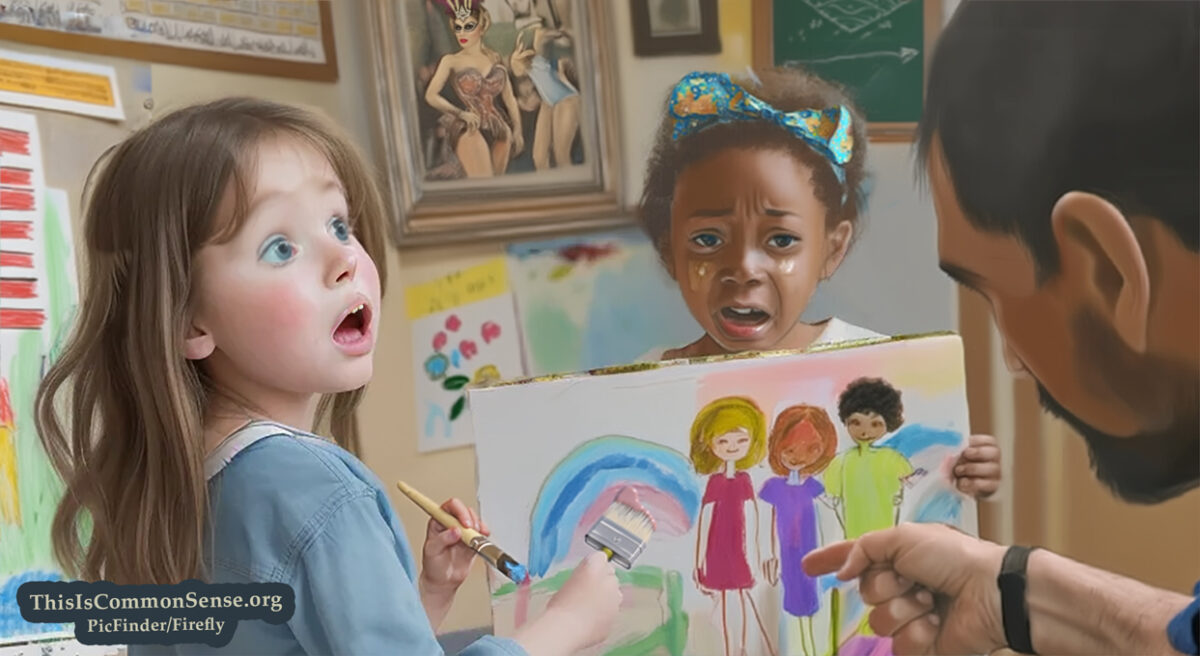
In March 2021, a little girl known as “B.B.” in court documents got into trouble for drawing a group of classmates of different races. She added the words “Black Lives Matter” and, below that, “any life.” She gave the drawing to a black classmate to try to comfort him, as she later explained.

Had B.B. been more attuned to the racial controversies of the day — does she not follow The New York Times and CNN? — she might have realized what treacherous waters she had dived into. 

As it was, she was surprised when the school forced her to apologize to her classmate and forbade her from drawing any more pictures while in school and from attending recess for two weeks.

The parents sued. A district court ruled in favor of the school, but the parents, helped by Pacific Legal Foundation, are appealing.

The district judge says that whether First Amendment protections of free speech apply here depends on whether such speech, however innocent, would “significantly interfere with the discipline needed for the school to function.”

The drawing could hardly have thus interfered unless part of the school’s “function” is to impose race-conscious orthodoxy. 

And suppress even the slightest peep of unwary dissent.

This is Common Sense. I’m Paul Jacob.


PDF for printing

Illustration created with PicFinder and Firefly

See all recent commentary
(simplified and organized)
See recent popular posts

Categories
education and schooling general freedom too much government

The State vs. Homework

Oy, the stress. Of doing stuff. It’s nonstop.

If a California lawmaker gets her way, it will stop, though, at least in the schools. Or at least slow way down.

Consider the pressure, the horrible grinding pressure of having to practice math problems, peer at chemical formulas, read assigned readings, summarize, spell, grammarize, memorize names and dates and Spanish vocabulary, and on and on and on . . . en casa. . . .

It’s the kind of thing that can curdle a kid’s physical and mental health. Not to mention cut into playtime.

So is the legislation AB2999 justified?

Is Assemblywoman Pilar Schiavo warranted in hoping to require school boards to ponder the “reasonable amount of time spent on homework per student that should not be exceeded” or whether “homework should be assigned . . . in any elementary school grade, inclusive” or perhaps that homework be “optional and not graded,” et cetera?

Well, if we think about this, we must admit that there is one and only one reason to ever require students to spend time at home mastering what is introduced in class. Only to prepare them for earning a living and living life by helping them obtain knowledge and skills and realize their potential.

But that’s it. That’s the only reason.

Of course, individual teachers, if competent and conscientious, already think about what homework is appropriate to assign. They must, we hope, want their students to function capably in life. And maybe also to learn that learning is not torture.

This is Common Sense. I’m Paul Jacob.


PDF for printing

Illustration created with PicFinder and Firefly

See all recent commentary
(simplified and organized)
See recent popular posts

Categories
education and schooling First Amendment rights general freedom

Letting DEI Die

The good news

The Massachusetts Institute of Technology will no longer require applicants to make DEI statements.

MIT President Sally Kornbluth says the school can “build an inclusive environment in many ways, but compelled statements impinge on freedom of expression, and they don’t work.”

Correct on both counts, but a bit blah as indictments go. And inadequate. Forget “inclusive.” This is merely a pledge to refrain from being arbitrarily exclusionary.

But the new policy is better than the status quo.

DEI (“diversity, equity, and inclusion”) may sound innocuous, at worst pointless. But DEI guidelines have functioned as a particularly odious form of ideological litmus test. The goal has been to force instructors to toe certain leftist (or collectivist) ideological lines as if the ideas imposed were as self-evidently true as declarations that the cloudless sky is cerrulian blue.

For example, if you dare disagree that race-conscious “antiracist” policies making skin color — and maybe also “gender” — more important than quality of work or some reliable leading indicators of productivity, your views may put you on the wrong side of the DEI divide.

So MIT’s dropping of mandatory DEI-fealty statements is a big step in the right direction. By as prestigious an institution of higher learning as any in the world.

The bad news? 

MIT has apparently not fired the “diversity deans” that it hired in 2021 — and hired not on the basis of excellence of qualifications: serious plagiarism complaints have been filed against two of these personnel!

If MIT retains six “diversity deans” in place, able to run around causing trouble for those faculty who reject DEI edicts, it hasn’t purged itself of the poison quite yet.

This is Common Sense. I’m Paul Jacob.


PDF for printing

Illustration created with PicFinder and Firefly

See all recent commentary
(simplified and organized)
See recent popular posts

Categories
education and schooling ideological culture

Kids Paid to Propagandize

“You get paid good.” 

So said one student when asked “Why should students join CFJ?”

How well-paid? $1,400, for learning to fight for “racial justice” and “social justice.” 

Parrot left-wing propaganda, that is.

The activist group Californians for Justice has paid at least 78 public high school students a total of around $100,000 to take CFJ’s ideological training. Another $20,200 has gone to parents for participating.

The training apparently does not include lessons in independent thinking or assessing alternative viewpoints, such as the view that “social justice” is typically a euphemism for collectivist injustice.

One teacher, who preferred to remain anonymous lest she lose her job, told The Free Press that it’s helpful to know what students think “would help them learn better, but” the students were “obviously reading scripts that have words that they don’t know how to say.” One trainee advised this teacher that students would “come to class on time if we built relationships with them.”

Another teacher in the district, agreed that “CFJ is not helping students find their own voices. . . . They’re teaching them parroting . . . the exact opposite of how you empower children.” 

The focus on “racial justice” is manifested in CFJ’s own recruiting: its website reports that CFJ has “trained hundreds of youth of color in Long Beach to be community leaders and organizers.” Why only “of color”?

The training is not funded by strictly voluntary donations, of course. Long Beach Unified School District has been subsidizing it, using taxpayer dollars. The district has already given CFJ nearly $2 million.

The whole operation stinks to high heaven. But they’re “paid good.”

This is Common Sense. I’m Paul Jacob.


PDF for printing

Illustration created with PicFinder and Firefly

See all recent commentary
(simplified and organized)
See recent popular posts
Categories
education and schooling folly general freedom

School Choice Reform at Last

How to get school choice reform? Keep fighting.

Last year, Texas Governor Greg Abbott, Republican, worked with families and school choice activists to pass school-choice legislation.

SB1 would have given parents who want to take their kids from public to private schools $8,000 a year for tuition, textbooks, and other expenses: taxpayer money that parents would have been able to spend as they saw fit instead of being forced to let public schools get it regardless of performance.

The educrats and their allies were opposed. “Public dollars belong in public schools. Period,” was the comprehensive argument of the Texas Democratic Party chairman.

With his own party constituting a majority of lawmakers in each legislative chamber, it seemed that Governor Abbott and families could have won anyway. The state senate did pass school-choice legislation. As it turned out, though, too many Republican lawmaker in the house were on the anti-choice team.

Which Republicans? The ones that Abbott and other friends of school choice targeted in this year’s primaries. They spent millions of dollars backing challengers who support school choice. And the governor appeared at campaign events to criticize incumbent Republicans who oppose it.

The net result? Of the current 21 anti-school-choice GOP representatives, only six to ten will be returning to the legislature in 2025. (The exact number won’t be known until runoffs on May 28.)

The elections may thus bring enough of a change in the state legislature to let school choice happen for parents and their students in Texas.

This is Common Sense. I’m Paul Jacob.


PDF for printing

Illustration created with PicFinder and Firefly

See all recent commentary
(simplified and organized)
See recent popular posts

Categories
education and schooling general freedom

The Homeschooling Surge

Although homeschooling had once been common in the United States, by the 1970s few families taught their kids at home.

This began to change in the 1980s and 1990s. Researcher Brian Day estimates that by 2019, some 2,300,000 children were being homeschooled.

During the recent pandemic, even more parents gave homeschooling a try. But the trend had already been intensifying for decades. Not coincidentally, of course, because public schools continued to get lousy report cards, with the quality of government-provided education demonstrably in steep decline.

In a recent article on the growth of homeschooling, The Washington Post concludes that it has become “America’s fastest-growing form of education” as families “embrace a largely unregulated practice once confined to the ideological fringe.”

Apparently, now even normal people are rescuing their kids from the educrats (unlike back in the day, when only fringe parents like my wife and I did so).

Looking at data from some 7,000 school districts, the Post concludes:

  • The number of homeschooled kids has increased by 373 percent in Anderson, South Carolina. It increased by 358 percent in one Bronx district.
  • In 390 districts, for every ten children being taught in public schools in the 2020–2021 academic year, one child was homeschooled.
  • The Post estimates that between 1.9 million and 2.7 million kids are currently being homeschooled in this country.

Post-lockdowns, the practice is still going strong. In most districts for which data is available on the 2022–2023 school year, homeschooling “dropped from its pandemic peak. . . . Yet even in those places it remains elevated well above pre-pandemic levels, and in 697 districts it kept increasing.”

That’s good. For the children.

This is Common Sense. I’m Paul Jacob.


PDF for printing

Illustration created with PicFinder

See all recent commentary
(simplified and organized)
See recent popular posts
Categories
education and schooling ideological culture sports

Un-Sportsmanlike Conduct

Tonight, the undefeated Dukes of James Madison University will travel to play the Thundering Herd of Marshall University in a Sun Belt Conference college football game. My youngest graduated from JMU, so I feel heavily invested in the team. 

Duuuuukes!

One might think this sport and spectacle a welcome relief from politics — and surely it is — but not entirely. Because, of course, these great college football programs are attached to public universities financed by us, by our tax dollars. 

The problem? As The Athletic put it recently: “For the second consecutive year, James Madison looks like one of the best teams in the Group of 5. And for the second consecutive year, the Dukes are ineligible for the postseason.”

The Group of 5 are the five best football-playing conferences after the best five conferences known as the Power-5. That’s pretty impressive — especially considering this is only the second year since James Madison made the jump from the second division into the first division of football-playing schools of higher yearning and earning. 

JMU is in the big leagues; it can now play for the national championship. Well, not now. Again, this year, like last year, JMU’s football team is banned from playing in a bowl game or being declared the champion of the conference . . . even though last year they did win the conference . . . except for the rule that says they cannot win the conference.

This year, the Dukes are 6-0 and could perhaps go undefeated. What if College Football’s Magic Computers pick them as among the best? They would still be denied a chance to compete.

Why? Well, those are the rules the colleges and conferences have agreed on. The rationales don’t hold much water. It seems like a hazing ritual holdover to me. 

But, of course, the universities can do whatever they want.  

And suffering the harsh two-year punishment is not so terrible for the coach who will possibly have a decade-long career, or the university that will play on in perpetuity. 

All the unfairness is placed on the shoulders of the student athletes. Denied the conference honors and the post-season play they deserve, these unpaid players who’ve earned millions for their schools have at least learned a lesson. When it comes to sports and money, the kids come last. 

This is Common Sense. I’m Paul Jacob.


PDF for printing

Illustration created with PicFinder.ai

See all recent commentary
(simplified and organized)
See recent popular posts