Categories
litigation property rights U.S. Constitution

The Stealing Goes On

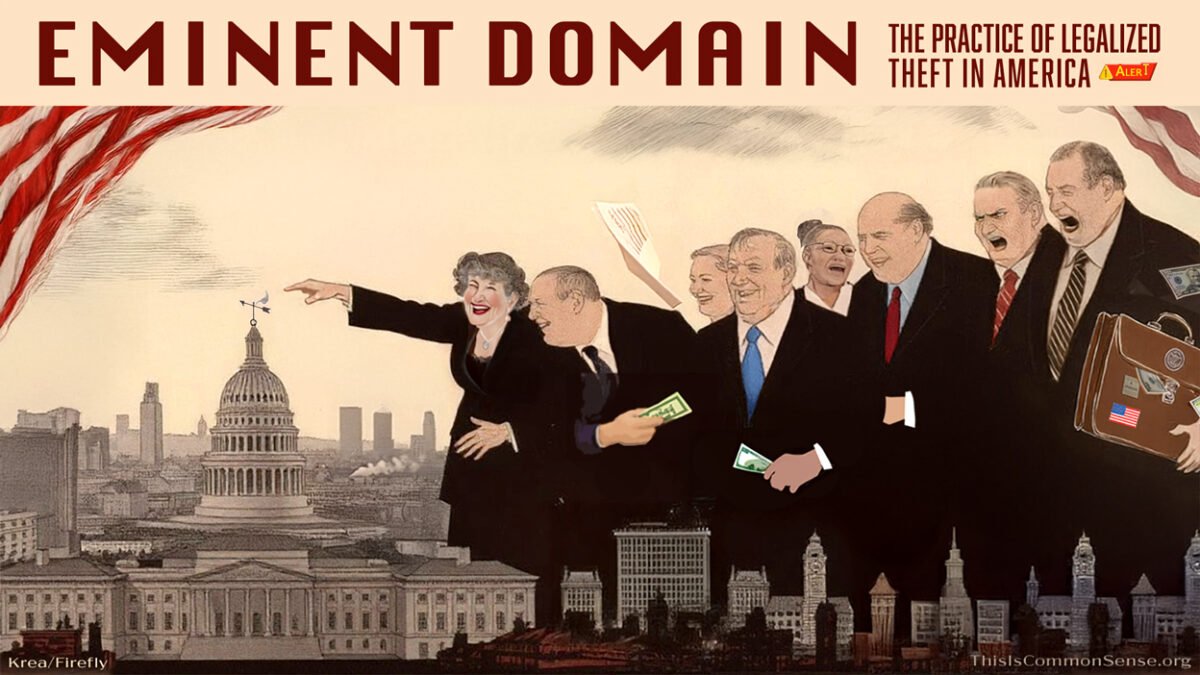
“On March 24, 2025, the Supreme Court of the United States declined to take up the case of Bowers Development, LLC. v. Oneida County Industrial Development Agency Et. Al.,” writes Conner Drigotas, “a decision that allows the practice of legalized theft through eminent domain to continue throughout America.”

This is not good news, as Mr. Drigotas explains. “In that case, Bryan Bowers had asked the Justices to review a ruling from the Supreme Court of New York that allowed Utica city officials to take land on which he had a contract to build and give it to a different private corporation for a separate construction project.” Mr. Bowers had “hoped to stop government officials from using force to pick winners and losers in the construction industry.” But it was a no go.

Politicians and bureaucrats love to grab other people’s property, under cover of “the public interest.” But their “public interest” is nothing more than a thin disguise for helping some individuals (often contributors to politicians’ campaigns) at the expense of others.

“With their denial of Bowers, Justices continued to show support for one of the most hated and notorious decisions to come out of their lofty chambers: that of Susette Kelo v. New London, Connecticut,” explains Drigotas. The Kelo case, often mentioned here, remains the ruling precedent, the government’s license to steal. Its loose construction of what can be regarded as in “the public interest” is a big part of the problem. 

Sadly, the courts have so far refused to rein in government eminent domain abuse. And voters have little sway upon the judiciary. And our representatives, our first line of defense, have also declined to stand up for basic justice and decency.

What to do? Remember that your representatives will soon be on the ballot.

This is Common Sense. I’m Paul Jacob.


PDF for printing

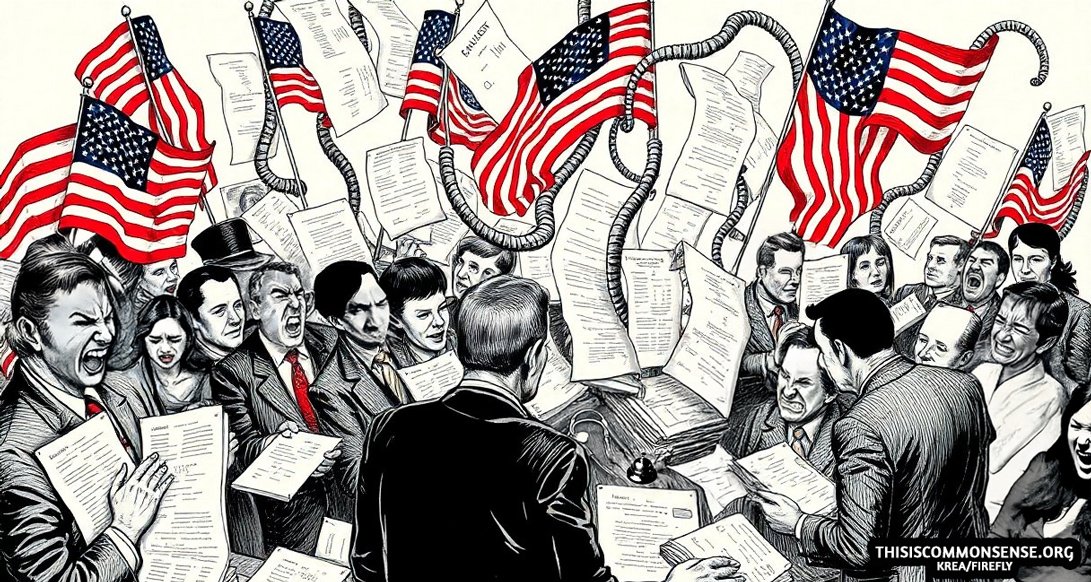
Illustration created with Krea and Firefly

See all recent commentary
(simplified and organized)
See recent popular posts

Categories
education and schooling litigation U.S. Constitution

Education Function Injunction

When President Jimmy Carter broke his 1976 campaign pledge by adding another Cabinet-level department to the federal roster, he swore that a “separate Cabinet-level department will enable the Federal government to be a true partner with State, local, and private education institutions in sustaining and improving the quality of our education system.”

On March 20, 2025, President Donald Trump signed an executive order aimed at shutting down Carter’s Department of Education, fulfilling his campaign promise to reduce federal involvement in education.

This was popular because everybody who’s not a bureaucrat or a teachers’ union agent knows that federal involvement in schooling, since Carter’s time, has been, not just a waste, but a detriment.

Still, teacher union-dominated Democrats are swiping at the administration with numerous lawsuits. U.S. District Judge Myong Joun in Boston issued a preliminary injunction blocking Trump’s layoffs and transfers, ruling that they amounted to an unlawful attempt to dismantle the department without congressional approval. 

Earlier this month, the 1st U.S. Circuit Court of Appeals upheld Joun’s injunction, rejecting the Trump administration’s request to pause the order while appealing. 

Two days later, the Trump administration, through Solicitor General D. John Sauer, filed an emergency appeal with the U.S. Supreme Court. The plea? Lift the injunction and allow the layoffs and reorganization to proceed. Trump’s team argued that the lower court had overstepped its authority and that the layoffs were a lawful personnel action to streamline the department, not an attempt to abolish it without Congress. 

The injunction sent DOE functionaries back to work. Nothing’s been resolved.

Not even the rationales for Carter’s “greatest achievement” (to quote the title of a USA Today op-ed). Carter had promised to reduce the number of departments, for efficiency’s sake. When creating the DOE, he said the move would increase efficiency. 

Instead, it merely increased education spending while academic achievement has plummeted.

This is Common Sense. I’m Paul Jacob.


PDF for printing

Illustration created with Krea and Firefly

See all recent commentary
(simplified and organized)
See recent popular posts

Categories
litigation

A Million from Michael Mann

Things aren’t working out for Michael Mann. The infamous “climate scientist” has been pursuing a years-long vendetta against critics of his methods and conclusions, and it’s been a bumpy ride.

Mark Steyn and Rand Simberg accused him of manipulating data “in the service of politicized science.” Instead of answering the criticism, Mann treated it as actionably defamatory.

In 2012, Mann launched a lawsuit against Simberg (of the Competitive Enterprise) and Steyn (then writing for National Review).

National Review observes that the criticism which offended Mann “was obviously protected by the First Amendment,” so that his suit should have been scuttled immediately.

Instead, judges antagonistic to free speech when they find the speech uncongenial enabled Mann’s litigation to trundle on for years.

The story gets complicated, as touched upon a few months ago. In 2021, the tide seemed to be turning in favor of Steyn and Simberg, with a court issuing a favorable summary judgment. But in January 2024, a jury found Steyn and Simberg liable for defamation. The awards? Steyn was ordered to pay $1 in compensatory damages and $1 million in punitive damages, Simberg to pay $1 in compensatory damages and $1,000 in punitive damages.

That insane $1 million amount was later reduced to $5,000.

Now it is Mann taking the hit, with rulings that he must pay about a million bucks in legal fees to CEI and Rand Simberg ($477,350) and National Review ($530,820).

National Review urges Michael Mann to finally relinquish his authoritarian quest lest he lose even more. 

Will he? It would be irrational to continue, but it was irrational at the start.

This is Common Sense. I’m Paul Jacob.


PDF for printing

Illustration created with Krea and Firefly

See all recent commentary
(simplified and organized)
See recent popular posts