“Money out of politics, money in your pocket, Medicare for All” — so runs the campaign slogan of Abdul El-Sayed, who last week won Michigan’s Democratic Party nomination for the open U.S. Senate seat now held by Democrat Gary Peters.
Dr. El-Sayed, an epidemiologist, ran unsuccessfully for governor in 2018, later heading Wayne County’s Department of Health, Human, and Veterans Services for a few years. He calls himself a progressive, but a “capitalist” one, not a socialist. Yet, seeking a national office, his national fellow travelers are Vermont Sen. Bernie Sanders, Massachusetts Senator Elizabeth Warren, U.S. Reps. Alexandria Ocasio-Cortez and Michigan’s own Rashida Talib and, last-but-not-least, the Democratic Socialists of America.
Today, let’s take the first phrase of his slogan: Money out of politics.
Creating small legislative districts would go a long way toward making outsized campaign spending less effective. Of course, term limits would diminish the value to a special interest of “capturing” an elected official. And limit the threat of politicians forever shaking down interests, special or not.
But that’s not the game plan of Abdul and progressives and, for many years now, congressional Democrats.
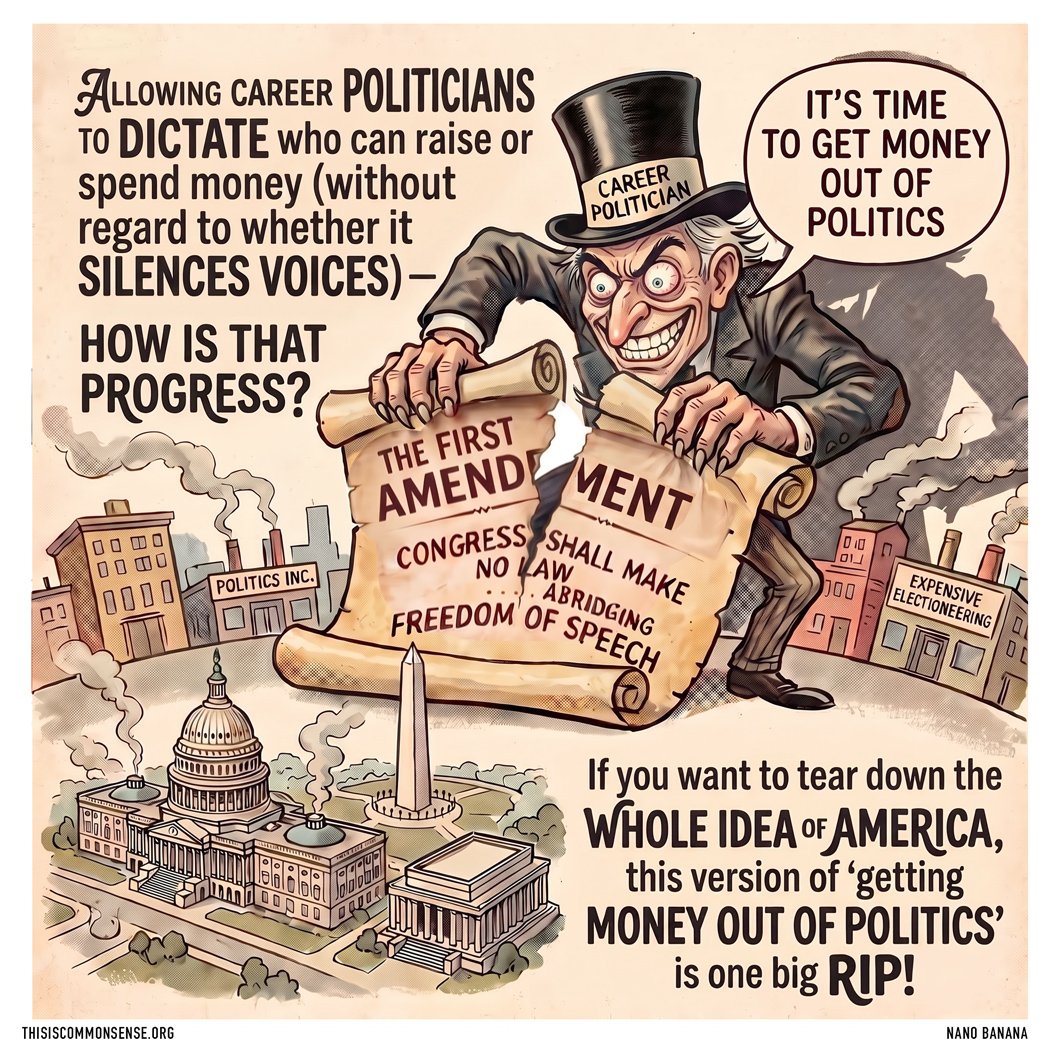
Instead, they want to re-write the First Amendment, reversing it from “Congress shall make no law . . . abridging freedom of speech” to Congress shall have power to regulate the raising and spending of money insofar as it relates to campaigning.
So far, Congress has legislated a Byzantine regulatory regime that serves only to make politics more expensive. The public benefit? Corruption diminished at all? Anyone?
Allowing career politicians to dictate who can raise or spend money (even in the incumbents’ very own election campaigns) and without regard to whether it silences voices — how is that progress?
If you want to tear down the whole idea of America, this version of getting “money out of politics” is one big rip.
This is Common Sense. I’m Paul Jacob.
Illustration created with Nano Banana
See all recent commentary
(simplified and organized)
See recent popular posts
One reply on “El-Sayed vs. The Money”
That share of the political left that claims to support freedom of expression — a significantly smaller share than when I was young — has never arrived at a coherent idea of just what “freedom of expression” would mean.
Most of them would quail at the idea that it would mean that I would have to deliver a speech written by Hassan Piker. About as many would insist that it didn’t mean that Jim had to carry a sign on behalf of Stephen Colbert, nor that he should be disallowed from carrying signs on behalf of Eric Snowden. Quite a few would agree that you didn’t have to use your home printer to make flyers for AOC, nor that you shouldn’t be allowed to make them for Justin Amash.
But they already begin to hive-off there, with some of them claiming that those Amash flyers would be a campaign contribution, and therefore something that a board of wise Latinas might legitimately limit. And, not long ago, the mainstream of the left was likewise advancing rules that would have treated ‘blog entries as campaign contributions and campaign contributions as subject to limit.
When we get to larger-scale printing presses, to movie cameræ, and to transmission equipment, still more of the left hives off.
The left started with money — “Money” they declared “is not speech!” — but money is one of many resources that can be used to effect the expression of ideas. Once the use of money can be limited, so too can be the use of a cable service, a film cameræ, a ‘blog, a yard sign, and eventually your mouth; because, in principle all these are material resources; only differentiations ad hoc can be made. Once you can be forced to contribute money to expression that you detest, you can be forced to donate your other material resources to such expression; only differentiations ad hoc can be made.
Liberty of expression has always lain in the idea that any limitation in how you use what are otherwise your resources cannot be based on the expressive content of the use.
And the liberty of expression that the authors and advocates of the Bill of Rights were most concerned to protect was expression of political or religious nature.
Forceably “getting money out of politics” by limiting material contributions to political causes, just like forceably “getting money out of religion” by limiting material contributions to religious causes”, is plainly a violation of the liberty dearest to what was originally and still properly called “liberalism”, the liberty protected by the First Amendment.