Categories
Accountability crime and punishment folly free trade & free markets general freedom moral hazard nannyism national politics & policies too much government U.S. Constitution

The Ninth and the Tenth of It

When Attorney General Jeff Sessions rescinded the Obama Administration enforcement guidelines regarding the states that have legalized (in their 29 different ways) marijuana, last week, supporters of freedom expressed some worry.

But we had to admit, one excuse for Sessions’s nixing of the mostly hands-off policy seemed to make sense on purely legal grounds. If we want to liberalize drug laws, then our Cowardly Congress should do it.

Definitely not the Executive Branch.

And yet, over at the Volokh Conspiracy, Will Baude argues that “the rule of law” does not require “renewed enforcement of the Controlled Substances Act.”

If anything, he argues, it “requires the opposite.”

Baude mostly rests his case on the Constitution’s Commerce Clause, which does not authorize regulation of intra-state trade. An issue on which the AG does possess a duty to weigh in.*

This rubs against FDR-Era constitutional theory, of course, which treats all commerce as regulate-able interstate trade. But this makes no sense. The Tenth Amendment declares that states possess powers not given to the federal government. An interpretation of the Constitution cannot be justified if it effectively nullifies other parts of the Constitution. (If all trade is “inter” state, what’s left for the states? Powers to do what? And how could there be any constraints on federal power?)

And then there is the Ninth Amendment, which states that the people retain rights not listed in the Constitution.

When citizens assert rights — such as the option to cultivate, sell, buy or ingest a common and quite hardy plant — in their states (largely through ballot initiatives), the federal government should butt out.

This is Common Sense. I’m Paul Jacob.


* “Members of the executive branch have their own obligation to interpret the Constitution,” Baude writes, “and if a federal law is unconstitutional in part then the executive branch, no less than the courts, should say so. It is the Constitution, not the Court, that is the ultimate rule of law in our system.”


PDF for printing


Categories
general freedom U.S. Constitution

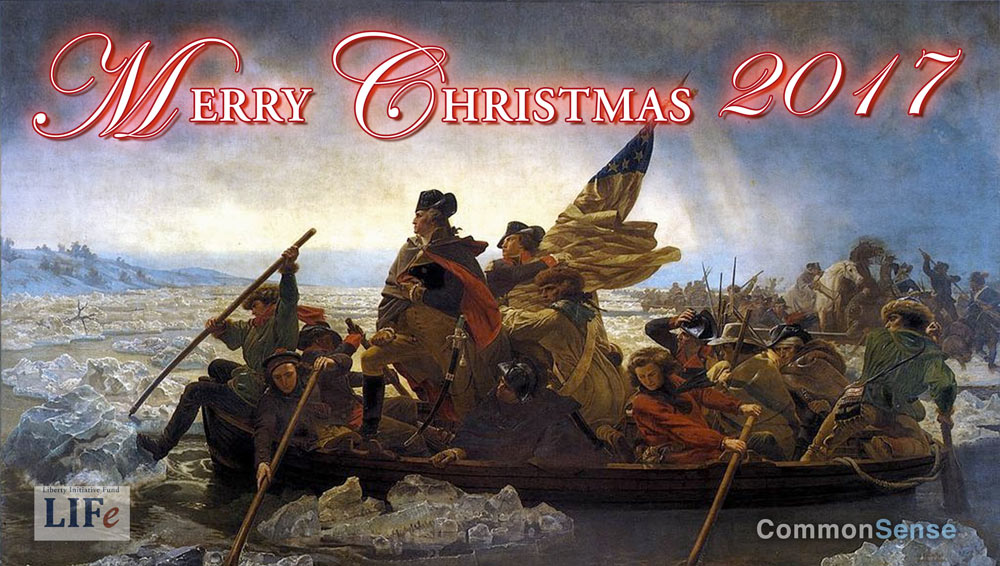
Merry Christmas, America

In addition to the religious significance of Christmas, Americans share an excellent historical reason to celebrate this day.

In January of 1776, Thomas Paine published his smash hit, “Common Sense.” This pamphlet galvanized public opinion in favor of the American Revolution, which had begun the previous year at Lexington and Concord with the shot heard ’round the world.

That July, the Declaration of Independence was written, signed and proclaimed to the new nation by the Continental Congress.

But by December of the same year, the prospects for the American cause were looking bleak.

British forces, along with their mercenary Hessian reinforcements, had manhandled the Continental Army. Gen. George Washington’s troops were routed at Long Island, pushed out of Manhattan, forced to retreat across the Hudson to New Jersey, and then run out of Jersey across the Delaware River to Pennsylvania “exhausted, demoralized and uncertain of [their] future.”

Soon, the British believed, the American revolt would be extinguished.

“To compound Washington’s problems,” recounts the EyeWitnesstoHistory.com website, “the enlistments of the majority of the militias under his command were due to expire at the end of the month and the troops return to their homes.”

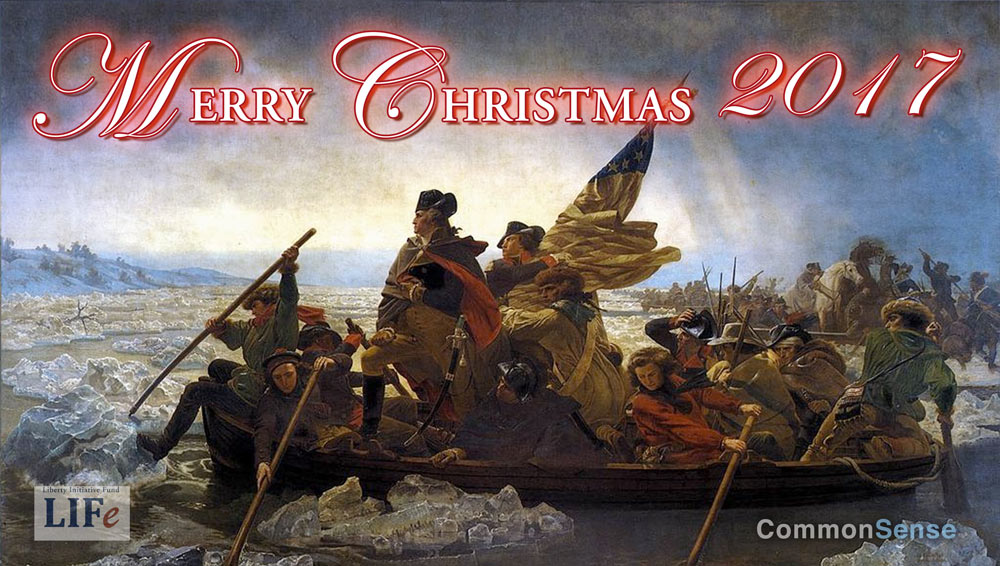
Yet, on Christmas night, Washington marshaled his ragtag soldiers and crossed the icy Delaware, marching his men nine miles to Trenton. In the wee hours of the morning on Dec. 26, the Continentals attacked, catching more than 1,000 Hessian soldiers by surprise and taking nearly all of them captive.

In strictly military terms, the victory was not terribly significant. But in terms of American morale, as well as the perception of important potential allies such as France, the win was an absolutely perfect Christmas gift to the new Republic.

Our Republic, dedicated to liberty and justice for all, continues to this day.

And today, you and I are left to defend it — just like the barefoot minutemen who walked through the snow to face the most powerful military force of their world.

Merry Christmas, America!


PDF for printing


Categories
Accountability general freedom media and media people moral hazard nannyism national politics & policies porkbarrel politics responsibility too much government U.S. Constitution

A Good Tragedy Not Wasted

No matter how “not as bad as we feared” President Donald Trump may be appearing, as we close out the year let’s remember why some of us did not trust him in the first place: his knee-jerk reactions are too often witlessly statist.

The speeding Amtrak train that derailed over I-5 in Washington State on Monday was a horror show, sure. And we have come to expect the President — any President, either party, all administrations — to provide words of comfort after such events. Trump conformed to expectations.

And, admittedly, his initial Tweet was all very proper. But his verbal response was . . . very . . . Old School. After mentioning the federal government’s role in handling the tragedy — “monitoring” and “coordinating with local authorities” — he used the event as an excuse to expound upon the idea that the event provides “all the more reason why we must start immediately fixing the infrastructure of the United States.”

This is bad, old-fashioned policy opportunism. The worst time to cook up “solutions” is right after a tragedy. That’s when emotions are highest and reason is lowest.

More importantly, the train was going through its initial run over newly upgraded infrastructure!

One could more reasonably surmise that the recent infrastructure upgrade was the cause of the derailment — though, let us be honest, it looks like the train was way above the stretch’s speed limit.

Note to Donald Trump: just because there’s a microphone in front of you doesn’t mean you are required to “make a point.” That’s not the President’s job.

Mister, we could use a man like . . . Calvin Coolidge again.

This is Common Sense. I’m Paul Jacob.


PDF for printing


Categories
folly government transparency media and media people national politics & policies too much government U.S. Constitution

Peel Back the Onion

Yesterday, an Onion title caught my attention: “Hooded Members of Congress Drown Another Love Child in the Potomac to Prevent Affair from Getting Out.” This is not funny because it is true, but because it is so close to the truth. Too close for comfort.

A similar story, the day before, sported a title so sublime that you do not really need to read further: “Al Franken Tearfully Announces Intention To Step Down From Role As Harasser Of Women.” The week before that, another satire gave us this extravaganza: “Paul Ryan Announces New Congress Sexual Harassment Training Will Create Safe Work Atmosphere, Plausible Deniability.

But sex scandals are easy. If The Onion were seriously in the satire biz, the farcical-on-the-surface nonsense of the Consumer Financial Protection Bureau brouhaha that I wrote about on Tuesday would get incisive treatment as well.

My advice to Onion writers? Don’t go halfway into the problem, like David A. Graham does in The Atlantic: “The Fight Over the CFPB Reveals the Broken State of American Politics.” Sure, that’s true. But concluding that “neither party sees the political process as effective in resolving these basic issues is worrying” hardly goes far enough, and the next line — “the fact that they might both be right is worse still” — shies from the full extent of the predicament.

The Constitution was designed to avoid problems like the CFPB nonsense. Start there. Something like this comes close: “Politicians Shocked, Shocked to Discover That an Un-Constitutional, Partisan Bureau Becomes Subject to Constitutional Dispute Along Partisan Lines.”

I have confidence that, if The Onion went there, it’d be funnier.

Even without a sex angle.

This is Common Sense. I’m Paul Jacob.


PDF for printing


Categories
Accountability general freedom government transparency ideological culture insider corruption moral hazard nannyism national politics & policies responsibility too much government U.S. Constitution

Invulnerable Government

As of this week, there are two heads of the Consumer Financial Protection Bureau.

Two claimants to the throne, so to speak.

The bureau’s previous director, Richard Cordray, resigned last week, and as he left he appointed a deputy director, Leandra English. Ms. English sent out a nice Thanksgiving email, billing herself as “Acting Director.”

Meanwhile, in advance of Cordray’s exit, President Trump appointed Mick Mulvaney to fill the role. Mulvaney showed up at work yesterday and took possession of the director’s office. He ordered a hiring freeze . . . and brought donuts.

It gets juicier. English has filed suit against the president and his appointee, claiming to be, herself, the directorship’s rightful heir. She cites the enabling legislation, which allowed for deputization by the director. And she cites her commitment to the agency’s mission, of which Mulvaney and Trump have none.

Republicans generally regard the agency as having gone rogue.

And the squabble over the directorship sure seems to validate that charge.

The legality? Presumably, the legislation that established the agency — which deliberately insulated the CFPB from oversight by funding it from the Federal Reserve — does not void an established law, the Vacancies Act, which does allows the president to fill vacated posts.

Sen. Elizabeth Warren has taken up English’s side in the dispute, because she believes in the agency’s mission.

Now, I get it: to make government as impregnable as a high mountain fortress is an idea that many folks flirt with, from time to time. But the results are always the same: government secure from democratic checks and constitutional balance.

Come on, Democrats! Give democracy a chance.

This is Common Sense. I’m Paul Jacob.


PDF for printing


Categories
crime and punishment general freedom ideological culture moral hazard nannyism national politics & policies Second Amendment rights too much government U.S. Constitution

The Good vs. Freedom?

Politicians regularly argue for new “gun control” laws, even while ignoring the execution and enforcement of laws already on the books.

Exhibit A, as I wrote at Townhall.com yesterday, is the failure of the military to provide the FBI with the information that would have blocked the Sutherland Springs church shooter from getting his guns.

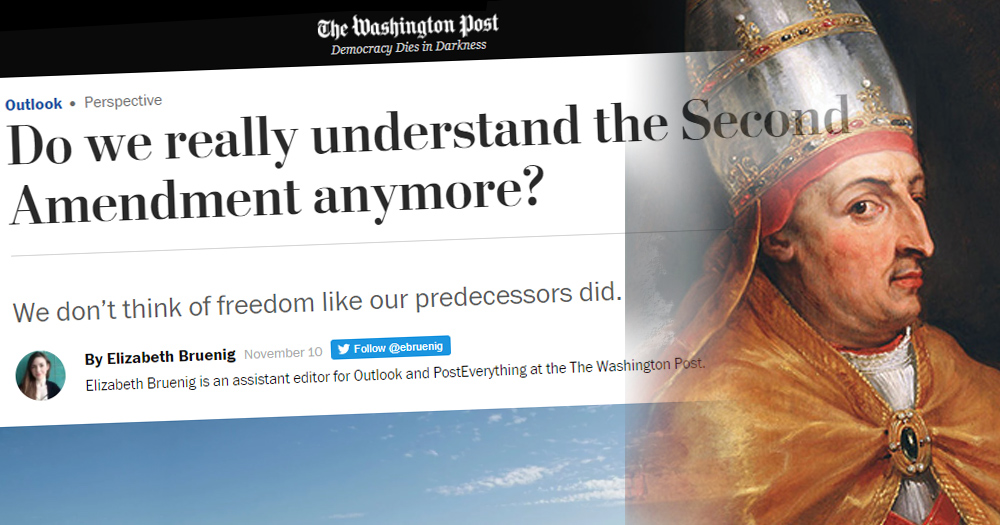
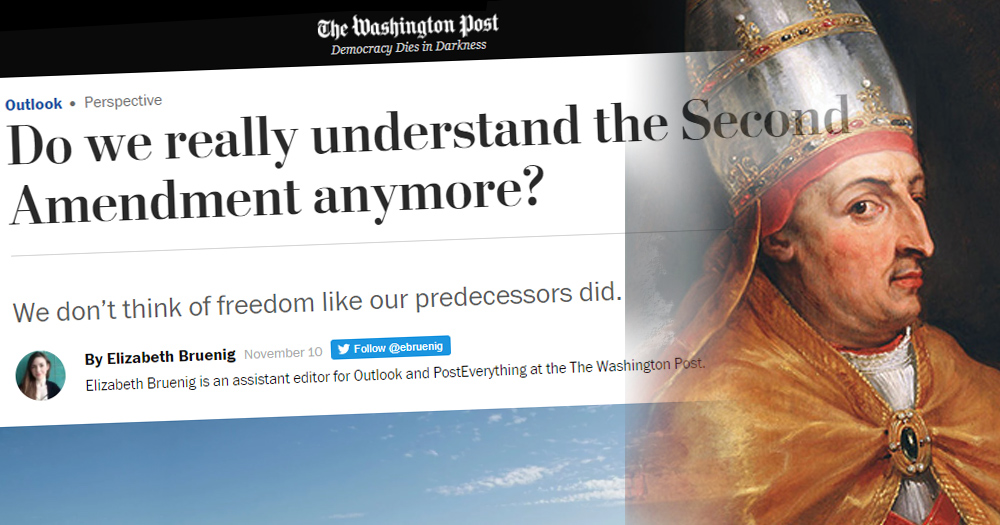
Meanwhile, in the Washington Post’s Outlook section, Elizabeth Bruenig takes a more . . . philosophical perspective. She contends that “Western thought moved from seeing freedom as a means to an end — what philosophers call ‘the good’ — to seeing freedom as an end in itself. Thanks to our liberal heritage, we regard freedom as an intrinsic good, perhaps the highest one of all. The more of it we can get, the better off we are. Right?”

Right!

But Bruenig’s answer isn’t in the affirmative.

Instead, she points to Vatican elections during the Middle Ages in which “canon law enshrined the right of eligible individuals to cast their votes. But their choices . . . could simply be overturned [by church officials]. Freedom mattered, in other words, but was always subordinate to the highest good, which could sometimes place limits on liberty.”

Ah, the Post advises us to embrace the Middle Ages . . . just so our freedom doesn’t get out-of-hand.

Bruenig also thinks that “we largely lack the framework to ask what gun ownership is for. . . .”

Huh? The Second Amendment answers that gun ownership is “necessary to the security of a free state.”

In terms of both scholarship and insight, the Founders’ constitutionalism far outshines the Post’s shiny new neo-medievalism.

This is Common Sense. I’m Paul Jacob.


PDF for printing


Categories
Accountability crime and punishment general freedom moral hazard nannyism national politics & policies Second Amendment rights too much government U.S. Constitution

Government Control

When do we say enough is enough?” asked California Senator Kamala Harris after Devon Patrick Kelley murdered 26 churchgoing Texans in cold blood, last Sunday.

“The terrifying fact is that no one is safe so long as Congress chooses to do absolutely nothing in the face of this epidemic,” argued Connecticut Senator Chris Murphy.

President Trump, on the other hand, not only pointed out that criminals will violate gun laws to acquire weapons, he speculated that had Stephen Willeford, the former National Rifle Association instructor, not come upon the scene, armed, “instead of having 26 dead, you would have had hundreds more dead.”

After previous mass shootings, Democrats pushed legislation that, even if it had been the law, would not have prevented that particular killer from obtaining the weapons. This time it’s different, since the killer should not, by current law, have been allowed to purchase the firearms he used. Kelley’s conviction for domestic violence, while serving in the Air Force, disqualified him.*

But the Air Force did not do its job, failing to report his record to the FBI. So the background check found . . . nothing.

The Pentagon has known for at least two decades about failures to give military criminal history information to the FBI,” the Associated Press informed, “including the type of information the Air Force didn’t report about the Texas church gunman.  . . .”

The Obama administration, through its command of the military, failed to execute the law designed to keep guns out of dangerous hands. And it sounds like this failure dates back to Bush and Clinton days.

Where does the buck stop?

We don’t need gun control; we need government control.

This is Common Sense. I’m Paul Jacob.


* Note also that the murderer, as Ben Shapiro recounted at National Review: “escaped from a mental institution in 2012, threatened his superior officers and attempted to smuggle weapons onto a military base to carry out those threats, cracked the skull of his infant stepson, beat his wife, abused a dog.”


PDF for printing


Categories
Accountability First Amendment rights folly media and media people moral hazard national politics & policies too much government U.S. Constitution

Our Royals Are Not Amused

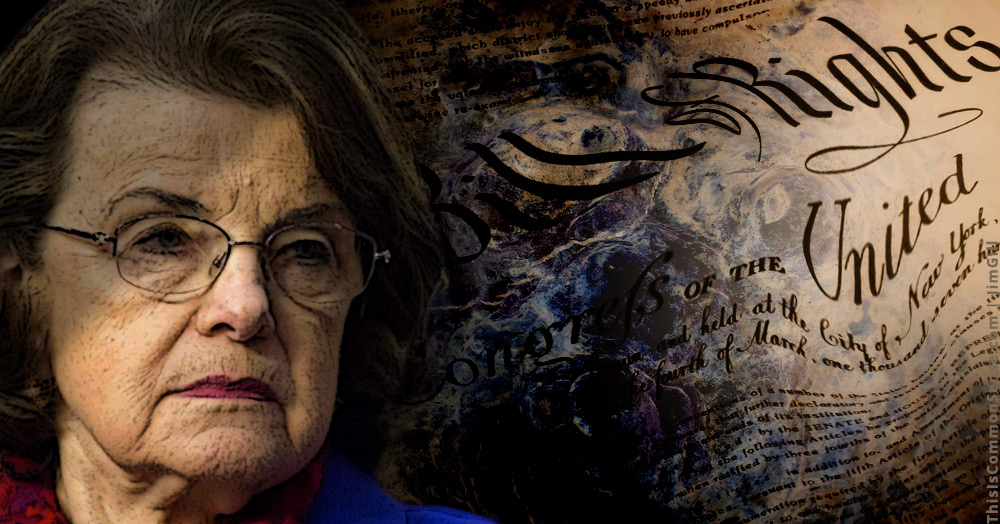
“You created these platforms,” Sen. Dianne Feinstein (D-CA) informed the top legal minds at Facebook, Twitter, and Google, “and now they’re being misused.”

“And you have to be the ones who do something about it — or we will.”

Take that as a threat.

But also take it as the grand moment when the Establishment showed its hand.

Consider: Facebook, Twitter, and YouTube (a Google product) are “media platforms.” So are books, libraries, newspapers and newsstands. Imagine being a king right after Johannes Gutenberg invented the printing press. Very quickly, the world changed.

People thought differently. And they began demanding change from government. The sovereigns had to make room for subjects-turned-citizens.

Royalty and aristocracy did try to regulate the new platforms of information and opinion. Censorship was all-too-common. The rulers killed upstarts for writing the wrong things, saying the wrong things.

So, which side would you be on, Mrs. Feinstein?

That is Scott Shackford’s basic take on this. I’m with him.

I just wish to expand: in my lifetime the media platforms of newspapers and television were regulated. Heavily. Mergers and business purchases were subject to government permission; the electromagnetic spectrum was licensed rather than treated as private property, and the actual content of radio and TV shows were regulated by the FCC.

And the Feinsteins of Washington got awfully secure in their positions. Had the regulation of American media done its trick?

Enter new media, uncorking the bottle of opinion.

No wonder the Establishment is scared.

We shouldn’t let them regulate political content on the Internet. Demand, instead, the opposite: a complete repeal of the regulation of business management — and non-criminal content regulation — of all media platforms

This is Common Sense. I’m Paul Jacob.


PDF for printing


Categories
folly general freedom ideological culture media and media people moral hazard nannyism national politics & policies Popular Regulating Protest U.S. Constitution

Force Over Persuasion

Today’s campus radicals assert that free speech is bad because it “gives voice” to people with hateful, dangerous views.

Does that argument seem at all familiar? It is the old RightThink rationale for censorship.

A recent Spiked “Unsafe Spaces” event at Rutgers (“Identity Politics: the New Racialism”) was interrupted by now-too-famiar shouts and out-of-turn questions and invective. Kmele Foster, one of the panelists, had been explaining how important free speech rights were to the civil rights protesters in the 1960s, and to Martin Luther King in particular.

At “that precise moment,” as Reason’s Matt Welch puts it, the shouts of “Black lives matter!” began. And continued.

But more interesting than this bullying? Some of the more coherent theses articulated by the interrupters. One woman, CampusReform relates,

yelled in response to the panelists that she doesn’t “need statistics,” later complaining that “the system” controls facts.

“It’s the system. It’s the institution,” she said. “Don’t tell me about facts. I don’t need no facts.”

Well, the moment you prove immune to any fact is the exact point in time that you’ve given up on rationality, free inquiry, and maybe even civilization itself.

It’s so 1984-ish.

And it demonstrates the old idea that, when you can no longer reason or allow others to express different opinions . . . or even discuss the factuality of this or that contention, you have only one other option: force.

Become bully.

Or tyrant.

Civilization is the triumph of persuasion over force. Being against free speech is to reverse that.

The acme of barbarism.

This is Common Sense. I’m Paul Jacob.


PDF for printing


Categories
folly ideological culture national politics & policies political challengers U.S. Constitution

O That Wacky Gerrymandering

Hillary Clinton: always wrong.

Oh, I’m sure that when she tells the maid “We need milk,” she’s accurate enough. Otherwise — forget it.

Her latest howlers pertain to the movement to convene a Convention of States. If two thirds of the states call for the convention, it “will be” convened, per the U.S. Constitution. If 38 states approve a convention-proposed amendment, it will be added to the Constitution.

Different pro-convention groups support different amendments, on everything from a balanced budget to spending limits to term limits. U.S. Term Limits is promoting a Term Limits Convention to propose an amendment for congressional term limits. 

A great idea.

Clinton, though, sees calamity: “The right wing, aided and funded by the Mercers, Koch brothers, etc. [sic], is very serious about calling a constitutional convention,” she warned recently.

“Part of their gerrymandering is to control state legislatures, elect Republican governors, and to call a constitutional convention [no, a convention of states] and,” the author of What Happened elaborates, “if you really get deep into what they are advocating, limits on the First Amendment, no limits on the Second Amendment, limits on criminal justice . . . [A] very insidious right-wing agenda.”

Gee, the old multiple-fallacies-and-vague-ominous-assertions-per-second trick!

First, how to “gerrymander” statewide gubernatorial elections?

Or “gerrymander” the enthusiasm of millions for restraints on government?

Or apply the districting concept to the Founders’ constitutional provision for end-running Congress?

As for the political issues she blunderingly raises, Clinton seems to regard any political disagreement whatever with herself as proof of billionaire-funded “right-wing conspiracy.”

Well, left-wing conspirators always say such things.

This is Common Sense. I’m Paul Jacob.


PDF for printing