Categories
Accountability media and media people national politics & policies U.S. Constitution

Jokesters in Power

Ronald Reagan was known to make a jest or two. After being shot, he joked with his surgeons about their partisanship. In front of a hot mic, he shocked the media by saying he had “signed legislation to outlaw Russia forever,” and that bombing would begin “in five minutes.”

The down-homey half-quips of George W. Bush turned malaprop into something almost endearing — to some. And Barack Obama’s appearances on talk shows were often well-crafted comedy routines.

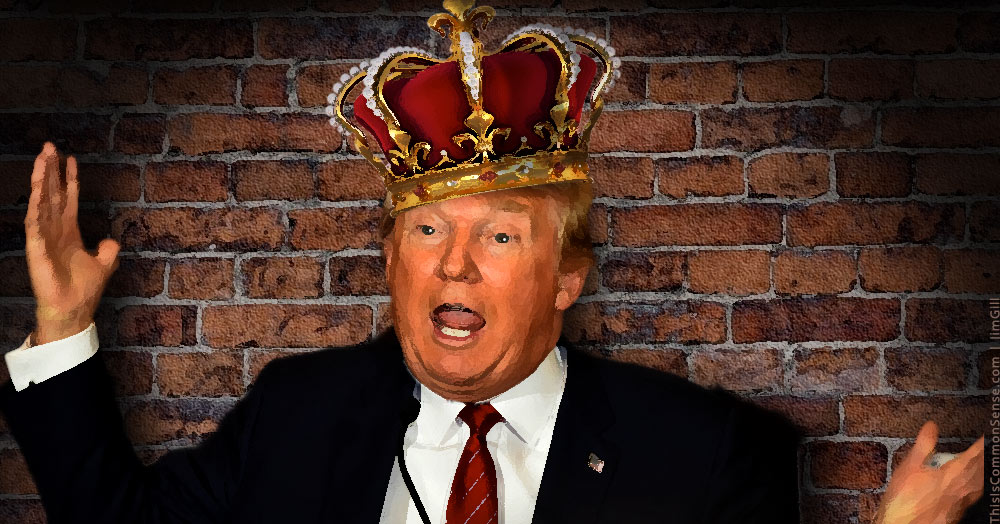
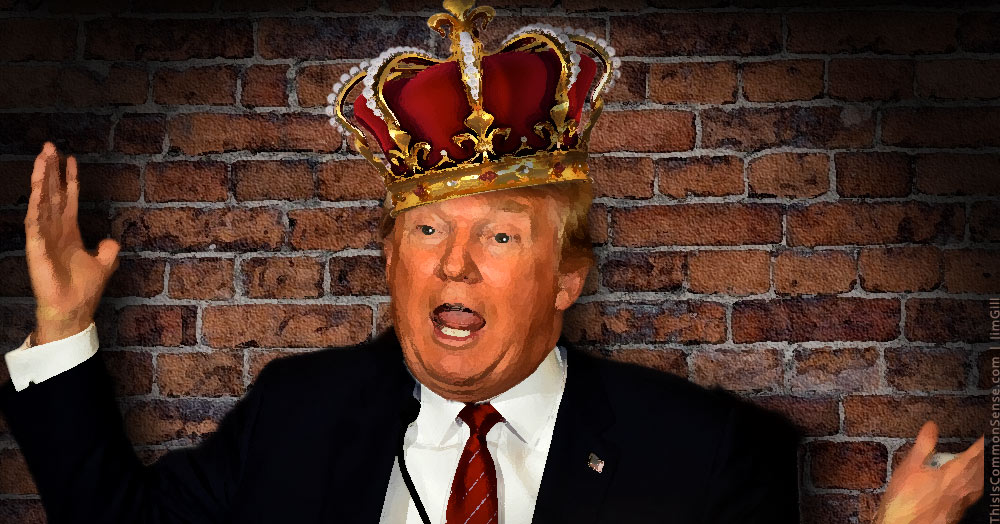
So, let’s not take President Donald Trump’s recent quip in honor of China’s President Xi Jingping too seriously.

Let’s not freak out just yet.

Sure, he seemed to favor Xi’s moves to remove the constitutional term limits placed upon him. But, not reported in much of the coverage, was the tone.

Trump was joking.

“He’s now president for life. President for life. No, he’s great,” Trump said. “And look, he was able to do that. I think it’s great. Maybe we’ll have to give that a shot some day.”

That is supposed to be funny. Trump does have good comic timing and delivery. Hillary Clinton not so much.* That may be one of the reasons he squeaked into the White House.

But to take it all seriously for a moment. What Trump is talking about is basically an elected king. Which is precisely what Alexander Hamilton first pitched in Philadelphia, so long ago. It was struck down — along with most of his nationalist agendaby the convention. But he did “give it a shot.”

And was it entirely unrelated that Thomas Jefferson’s first Vice President later gave Hamilton a shot?

Too soon?

This is Common Sense. I’m Paul Jacob.


* Just compare how Barack Obama killed with UFO material, and how Hillary seemed to be several degrees too clumsy at it.


PDF for printing


Categories
Accountability crime and punishment general freedom ideological culture media and media people nannyism national politics & policies responsibility Second Amendment rights too much government U.S. Constitution

Self-Defense, Implausible?

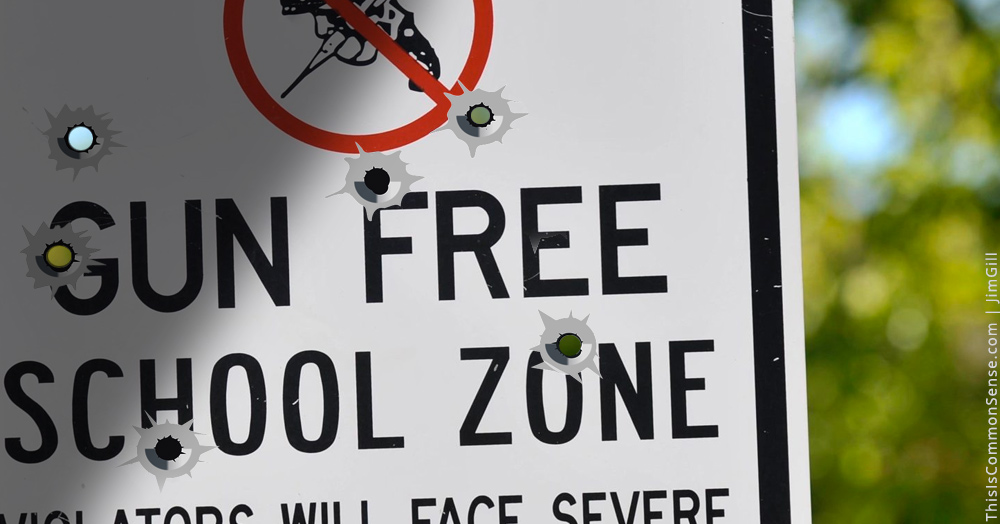
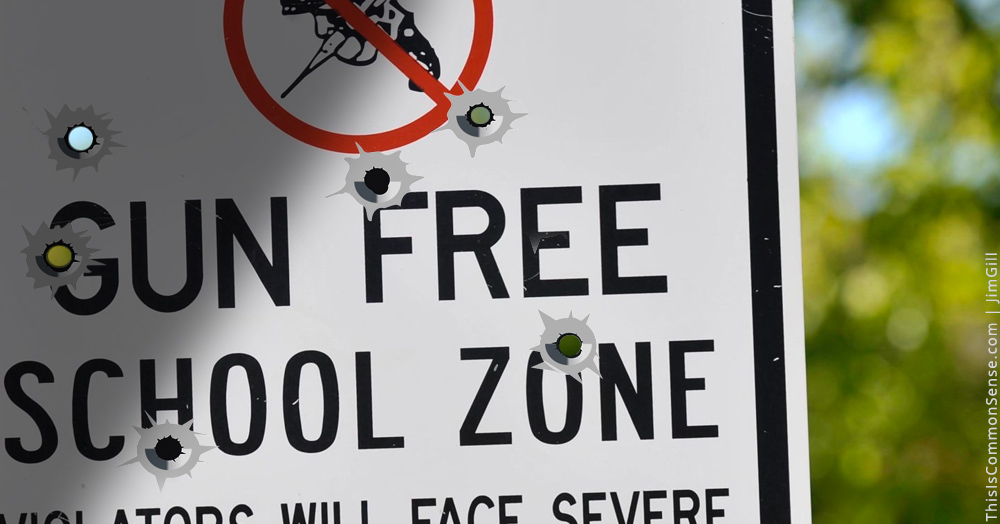
Don’t take a GUN-FREE ZONE sign to a gun fight.

Whenever there’s a horrific incident of mass murder, advocates of citizen disarmament blame the right to protect oneself against armed attackers. The thinking seems to be that if we make it illegal for all civilians to have guns, bad guys willing to kill people will also refrain from using guns as they try to kill people.

This is implausible.

And if you do not see its implausibility immediately regarding firearms, consider drugs. Not taking them, but the war on same. Drugs didn’t vanish upon prohibition. Neither would guns if prohibited.

President Trump argues that students would be safer were schools a harder target. Why not arm well-trained teachers? “If you had a teacher who was adept with the firearm, they could end the attack very quickly.” He’s right.

Not a new idea, of course. It’s been argued, for example, by the NRA, whose chairman says that the way to stop a bad guy with a gun is with a good guy with a gun.

This idea is being practiced right now — in Israel.

As Tzvi Lev argues at the Arutz Sheva 7 site, Israel proves the NRA’s point.

Even Israel — where Arab communities are “rife with illegal weapons” despite their illegality — has not always been quick to recognize that it’s better to have lots of armed civilians when terrorists start shooting at civilians. But after terrorists attacked a school in 1974, the government began arming and training teachers — somehow failing to defer to the terrorists’ preference for gun-free zones.

In both of the only-two school shootings in Israel since then, teachers killed the attackers.

This is Common Sense. I’m Paul Jacob.


PDF for printing


Categories
crime and punishment general freedom ideological culture media and media people moral hazard nannyism national politics & policies privacy responsibility Second Amendment rights too much government U.S. Constitution

He Applied Himself

“I need to make this count,” wrote a young man in Everett, Washington.

Unfortunately, it looks like he wasn’t attempting a big career-oriented project. He was planning a mass shooting.

“I need to get the biggest fatality number I possibly can,” is one of many damning journal passages the police have made public. Apparently he had settled on attacking the high school he attended. “I’ve been reviewing many mass shootings/bombings (and attempted bombings) I’m learning from past shooters/bombers mistakes.”

Ambition and rigor: missapplied.

Fortunately, his grandmother read his journal and discovered a rifle in his guitar case. She turned him into the police the Tuesday before the Florida shooting I wrote about last week. And maybe just in time.

Meanwhile, last week’s Parkland, Florida, shooting dominates the headlines. Fellow students and neighbors of the Florida shooting victims have ramped up their condemnations and demands — including at a horrorshow “town hall” on CNN.

Yet the nature of the difficulties in preventing such atrocities has become lost in the rhetoric and anger.*

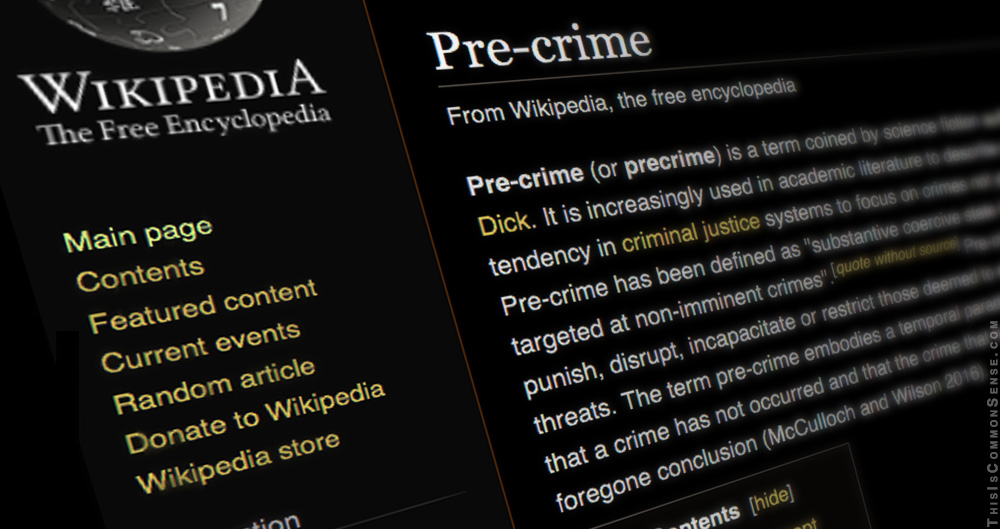
In a free society, we cannot arrest people before they commit a crime. In the Everett case, officials were “lucky”: despite the young man’s lack of a criminal record, they were able to charge him with a burglary they allege he committed the day before arrest — and his extensive planning notes are being taken as evidence for intent. He’s also been charged with attempted murder.

We should be in inquiry mode, right now. It could be helpful to know the exact motivations for both the Florida shooter and the Everett wannabe — and similar cases.

This is Common Sense. I’m Paul Jacob.
 

* Law enforcement is tasked with uncovering spree shooting plots today — and to protect, too. But the armed, uniformed school resource officer at the Parkland high school failed to protect. He heard the gunshots but never entered the building, while the shooter killed 17 innocents.


PDF for printing


Categories
Accountability folly general freedom government transparency ideological culture moral hazard national politics & policies responsibility too much government U.S. Constitution

Not Even with a Straight Face

Is American foreign policy so foreign to our values that even those who have served at the very pinnacle of national intelligence agencies have trouble telling the truth?

“Have we ever tried to meddle in other countries’ elections?” Laura Ingraham, host of Fox News’ The Ingraham Angle, asked James Woolsey, director of the Central Intelligence Agency (CIA) from 1993 to 1995.

“Oh, probably,” Mr. Woolsey replied. “But, uh, it was for the good of the system, in order to avoid communists from taking over. For example, in Europe in ’47-’48-’49, the Greeks and the Italians, we, the CIA—”

“We don’t do that now, though?” Ingraham interjected. “We don’t mess around in other people’s elections, Jim?”

“Well . . . urrrrr, yum, yum, yum, um, um,” the old spymaster offered to laughter from both Ingraham and her studio cameramen. “Only for a very good cause,” he added with a sly grin, “and the interests of democracy.”

Interests. Of. Democracy.

Ha. Ha ha. Laughing yet?

Foreign Policy tells us that documents declassified in 2017 “shed light on the Central Intelligence Agency’s central role in the 1953 coup that brought down [elected] Iranian Prime Minister Muhammad Mossadegh . . . poisoning U.S.-Iran relations into the 21st century.”

Need more? There’s a handy database that lists undemocratic and illegal* shenanigans going on and on through the ’60s, ’70s, ’80s, up through President Obama to today.

“This broader history of election meddling has largely been missing from the flood of reporting on the Russian intervention . . .” noted the New York Times last December.

Of course, our government’s interference doesn’t justify Russian government interference. But, we can only (possibly) control our politicians.

This is Common Sense. I’m Paul Jacob.
 

* “Meddling in other’s elections is a violation of international law,” Steve Baldwin writes in The American Spectator. “More importantly, U.S. law prohibits the use of tax dollars to influence foreign elections.”


PDF for printing


Categories
Accountability crime and punishment general freedom government transparency moral hazard national politics & policies privacy property rights too much government U.S. Constitution

Thwarting Cops Who Are Robbers

“Carrying cash is not a crime,” Institute for Justice attorney Dan Alban informs us, “yet too often the government treats it like one.”

Musician Phil Parhamovich learned that the hard way. He was porting his life savings, almost $92,000 — earmarked for a down payment on a recording studio — when cop-robbers of the Wyoming Highway Patrol stopped him for not wearing a seat belt.

It turned out to be an extremely expensive infraction. The officers intimated that it was illegal to travel with so much cash and pressured him to hand it over. Scared and believing that his alternative was jail, Phil signed a preprinted waiver letting them grab his life savings.

Preprinted waiver? This means it’s routine for these guys to try to legitimate their actions as they premeditatedly intimidate and rob people.

The state of Wyoming tried to keep the money. Fortunately, the Institute for Justice took Phil’s case, and a judge accepted the facts presented by Phil and his IJ lawyer. After months of tribulation and suspense, the robbery victim got his money back.

Another win for the good guys.

Thankfully, the Institute for Justice’s freedom-defenders have won a great number of such cases. Yet, IJ lawyers certainly cannot litigate all the forfeiture injustices being committed by government  authorities all across the country.

That’s why the group is pushing to reform civil asset forfeiture laws, requiring a criminal conviction before property can be forfeited. 

And you can help. How? Launch efforts in your town or state, or work to push infant efforts to a higher level. Take the initiative. 

This is Common Sense. I’m Paul Jacob.

PDF for printing


Categories
Accountability crime and punishment general freedom ideological culture media and media people moral hazard nannyism national politics & policies responsibility Second Amendment rights too much government U.S. Constitution

Killer Inlaudabilis

On the day that Alexander the Great was born, or so the ancients tell us, a man named Herostratus burned down one of the Seven Wonders of the World, the Temple of Artemis at Ephesus.

Why? Just for the infamy.

Which is why the Ephesians proscribed mention of the man’s name. That is called a damnatio.* Obviously, that damnatio didn’t stick, for we know his name now. How? Historian Theopompus recorded it for our . . . edification? Vilification?

I say we should follow Ephesian example and not mention by name the recent Florida school shooter/murderer of students. There should be a widespread damnatio in the press and blogosphere against the young man. Let’s not to give him his infamy, and not encourage copycats — nor in any way normalize his horrible act.

Is this a “solution” to the problem of school shootings? Probably not. But there may be none — at least nothing sure-fire.

Yes, a non-blundering FBI might’ve helped.** But virtue-signaling/grandstanding calls for unnamed gun control measures won’t. And treating “mental health” issues more “professionally,” particularly by easing up involuntary commitment law, is probably a recipe for putting away innocent and unpopular people.

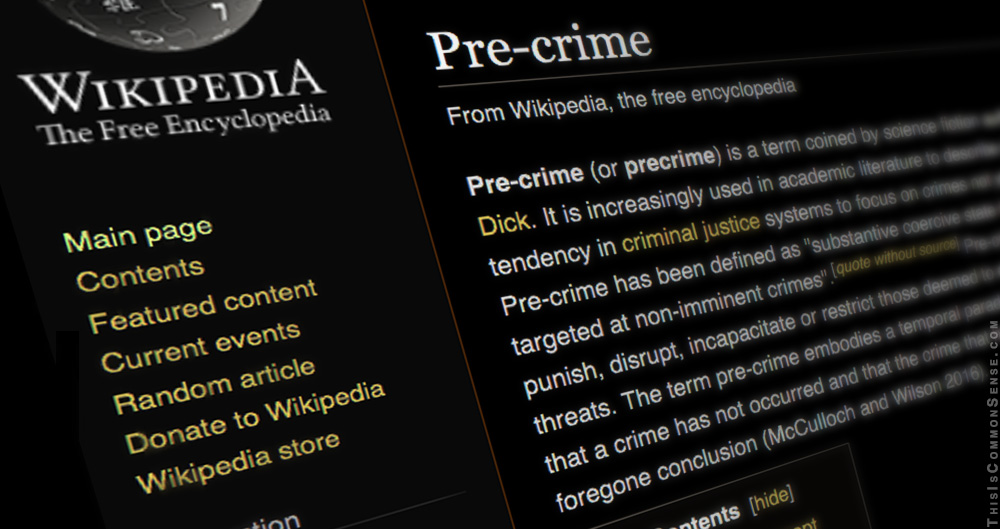
Pre-crime” is itself criminal.

So, what to do? Maybe it is this: “Notice those around you who seem isolated, and engage them,” as Robert Myers advises. It is loneliness, he argues, that “causes these shooters to lash out. People with solid connections to other people don’t indiscriminately fire guns at strangers.”

But that’s not an after-the-fact solution.

This is Common Sense. I’m Paul Jacob.
 

* FYI, the arsonist’s status as an unspeakable person was called inlaudabilis.

** As if to fit an established pattern, the FBI failed to take seriously enough an early citizen-initiated alert regarding the young man who went on to commit the mass shooting. Prophecy is a tough biz; it is no doubt easier to connect the dots looking back after the fact.


PDF for printing


Categories
First Amendment rights free trade & free markets general freedom initiative, referendum, and recall nannyism national politics & policies privacy property rights Second Amendment rights Tenth Amendment federalism too much government U.S. Constitution

Winning Too Much?

“We’re Number 17!!!”

This lacks a certain triumphant note.

It is nothing like the “We’re Number 1!” the Swiss are now hollering as they pump their arms into the air, waving giant #1 foam fingers against the backdrop of snow-covered Alps.

Actually, knowing the Swiss, they are probably a bit more restrained. Still, you get the point.

Number 1 in what, you ask? Creamy, delicious chocolate, perhaps? Banking? Skiing?

Freedom.

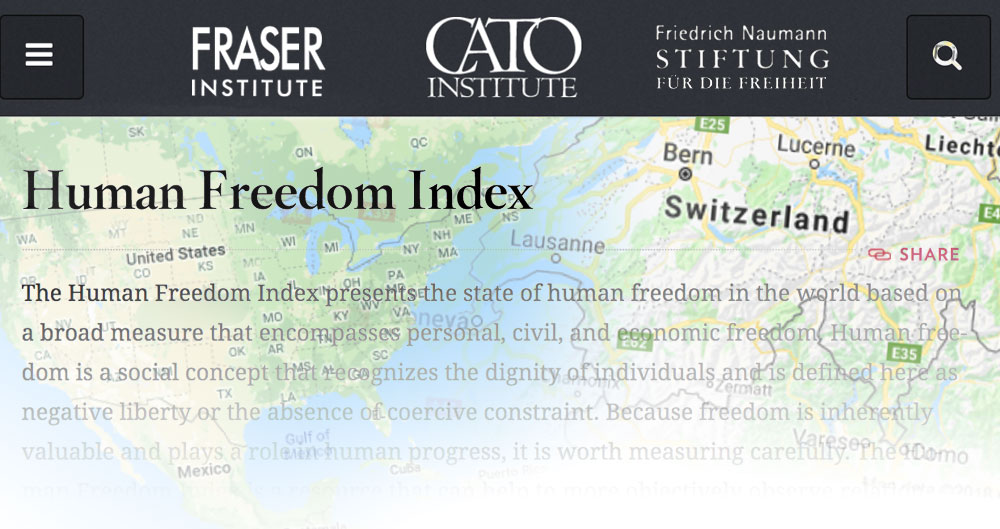
The Human Freedom Index 2017, jointly published by the institutes Cato, Fraser, and Liberales, is hot off the presses. The report ranks the countries of the world on “personal, civil, and economic freedom.”

This year, Switzerland switched places with Hong Kong, which had come in first the year before. The U.S. moved up from 23rd place in 2016, but down from 2008, when we were challenging Top 10 status at Number 11.

“Weak areas [for the U.S.] include rule of law, size of government, the legal system and property rights,” according to a Cato video.

Let’s compare Switzerland to the United States. The 1848 Swiss Constitution creates 26 sovereign cantons (states), greatly influenced by our system of federalism. In the 20th century, Americans in 26 states and most localities borrowed from the Swiss, establishing a system of direct democratic checks on government — what we call ballot initiatives and referendums.

Both countries have constitutional limits on government, protecting individual rights — even from fully democratic tyranny. But in the freest nation in the world, Switzerland, citizens possess a powerful direct democratic check on their government at all levels . . . while we do not.

After all, we’re Number 17.

This is Common Sense. I’m Paul Jacob.

PDF for printing


Categories
Accountability crime and punishment folly government transparency ideological culture media and media people national politics & policies U.S. Constitution

Defiance?

“Once the party of law and order,” screamed the Washington Post’s top-of-the-front-page Sunday headline, “Republicans are now challenging it.”

The story’s lede: “Republican leaders’ open defiance last week of the FBI over the release of a hotly disputed memo revealed how the GOP, which has long positioned itself as the party of law and order, has become an adversary of federal law enforcement as the party continues its quest to protect President Trump from the Russia investigation.”

Huh?

Defiance,* by definition, is “bold disobedience.” But the Constitution tasks Congress with control (by oversight and purse string) of the Federal Bureau of Investigation and the Department of Justice. Because subservient, it is the FBI and DoJ that can disobey. Not Congress.

While some Republicans seemingly switched sides on the appropriateness of criticizing the FBI over the Nunes memo release — congratulations are in order! — the same point, reversed, can be made (even humorously) about some on the Left now condemning such criticism.

Criticizing the government — including law enforcement agencies — has always been as American as apple pie.

The Post supports an ever-increasing role for the federal government, favoring Democrats. But now, Trump Derangement Syndrome has apparently pushed the company-town paper over the edge . . . to Media Madness (the title of Howard Kurtz’s new book, which the paper sophomorically savaged).

How ridiculous to characterize Republicans as enemies of “federal law enforcement” because they believe some within the FBI acted improperly, perhaps unlawfully.**

The Post should remember that its journalistic street cred didn’t come from reporting partisan spin as fact, but from what some saw as “defying” the president and publishing “national secrets” in search of the truth

This is Common Sense. I’m Paul Jacob.
 

* The Post wasn’t alone. Politico echoed the message in its story, “GOP defies FBI, releases secret Russia memo to partisan fury,” and so did other media outlets.

** Moreover, Republican leaders have been clear that the memo does not impact Special Counsel Robert Mueller’s investigation.


PDF for printing


Categories
Accountability crime and punishment First Amendment rights general freedom government transparency local leaders moral hazard Regulating Protest too much government U.S. Constitution

Lock Her Up

“Who Are We?” I asked Sunday at Townhall.com.

Today’s question: What have we come to?

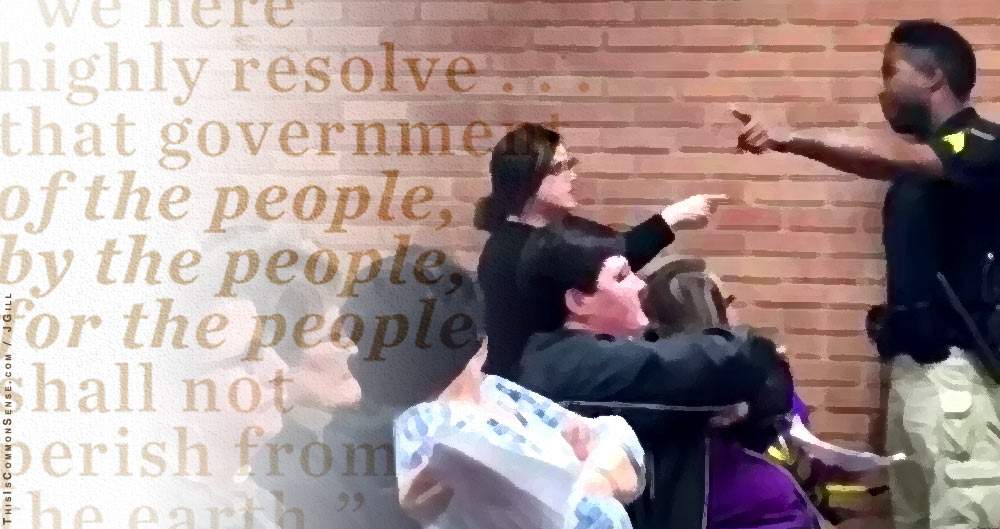
Under a seemingly click-bait headline in The Atlantic, “Can Government Officials Have You Arrested for Speaking to Them?” Garrett Epps examines last week’s outrageous handcuffing and arrest of a Louisiana teacher, Deyshia Hargrave, for speech displeasing to the Vermilion Parish school board at a public meeting.

The elementary school teacher complained about a $30,000 raise the board was giving the superintendent, noting that teachers had not seen an increase in nearly a decade. After asserting that the raise would be “basically taken out of the pockets of teachers,” she was ruled out of order by the school board president and then asked to leave the premises. She calmly left the meeting room . . . only to be forced to the floor, handcuffed and arrested once in the hallway.

Police claimed the arrest was for “remaining after having been forbidden” and “resisting an officer.”

The school district announced it won’t press charges. Very funny. Anyone can see from the video that her treatment was excessive.

Next month, the U.S. Supreme Court will hear oral arguments in Lozman v. Riviera Beach, Florida, where an arrest was clearly retaliatory, but the city is newly claiming another violation it could have used to arrest Mr. Lozman.

Does this after-the-fact adding on of charges provide governments with an escape clause? As Epps argues, a Lozman decision “could either rein in, or embolden, the tiny-handed tyrants who rule county buildings and city halls around the country.”

If respectfully challenging our so-called public servants in meetings designed for that can lead to being arrested, handcuffed and dragged off, we no longer live in ‘the land of the free.’

This is Common Sense. I’m Paul Jacob.

PDF for printing


Categories
general freedom media and media people national politics & policies too much government U.S. Constitution

Happy Birthday, America!

What? Oh, sure, I know the United States of America has its birthday on July 4th, that day in 1776 when the Second Continental Congress adopted the Declaration of Independence.

Let’s agree I’m early. (Oh, how I wish it were July.)

But the interesting thing about history is how we get to those moments wherein the great “we” declare our independence or fill the streets or storm the beaches — or the polls. The many big, important days that lead to THE day.

Today is such a date, because 242 years ago on January 10, 1776, Thomas Paine published Common Sense. Without this day 242 years ago, we wouldn’t have had Independence Day six months later.

Using common and direct language, and speaking to all the “inhabitants of America,” Common Sense made the case for both independence from Britain and the establishment of a democratic republic. Boy, did it make the case. On a per capita basis, Paine’s pamphlet is the bestselling American publication in history.

His pamphlet or parts were read publicly, reprinted in newspapers and spread throughout the colonies. This common man — barely an American,* having landed on our shores in November 1774 — used the universal language, speaking truth to power.

“Every spot of the old world is overrun with oppression,” Paine told his fellow Americans. “Freedom hath been hunted round the globe. Asia, and Africa, have long expelled her. Europe regards her like a stranger, and England hath given her warning to depart. O! receive the fugitive, and prepare in time an asylum for mankind.”

The original idea of these United States was freedom.

And that, my friends, is Common Sense. (I’m Paul Jacob.)


* Of course, this makes Paine almost quintessentially American.


PDF for printing