Categories
ideological culture media and media people moral hazard

Is This Even Funny?

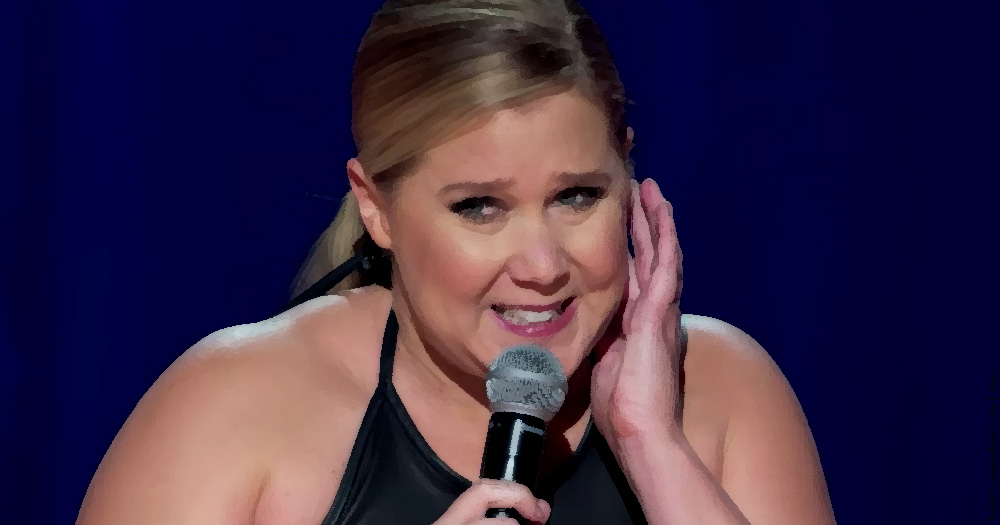
Stand-up comic Amy Schumer made headlines in Variety, this week, for her re-negotiations with Netflix over her recent comedy special, The Leather Special.

It initially garnered her a “mere” $11 million, while, Variety reported, comedians “Chris Rock and Dave Chappelle were given $20 million per special as part of their deals with Netflix,” according to a summary at Vulture.com.* “Schumer then went back and negotiated for ‘significantly more compensation,’” scuttlebutt has it.

After-the-contract negotiations seem weird to me . . . almost . . . indecent.

But then, this might be apt, considering Schumer’s characteristic form of humor, which is almost relentlessly of an intimate sexual nature. Like many another Netflix watcher, I could not finish her special. “Indecent” is the nice word for it.**

The special was so relentlessly panned that Netflix created a new feedback system to discourage viewers from leaving severely negative criticisms and evaluations. It was a big deal months back.

So why did she think she could get more? Though she now denies it, the early reports said she demanded some sort of parity with Rock and Chappelle. And that “equal pay” for “equal work” ethic does seem to be behind the very idea of her ex post negotiating strategy.

The thing is, Rock and Chappelle got more money, obviously, because their ability to make money for their venues is amply proven. Schumer, though she is not without talent and definitely has her partisans, is not as big an audience draw.

Like wages in the normal labor market, it’s about productivity.

And you’d have to pay me to watch The Leather Special in its entirety.

This is Common Sense. I’m Paul Jacob.


* Variety is behind a paywall. I’m quoting Vulture because, like any good scavenger, I’m not paying for Variety.

** No idea whether I would have made it through a special with Chris Rock or Dave Chappelle. I get the impression I’m not in the target audience.
PDF for printing


Categories
Accountability ideological culture media and media people moral hazard national politics & policies

One Way to Do It

While reading CBS’s recent story on Iceland’s success at reducing the number of Down syndrome cases, I was reminded of the Amazon Prime series Man in the High Castle.

The show, based on the celebrated alternative history novel by Philip K. Dick (1928–1982), explores a timeline wherein the Axis powers won World War II. The United States is divided between the Greater Nazi Reich and the Empire of Japan.

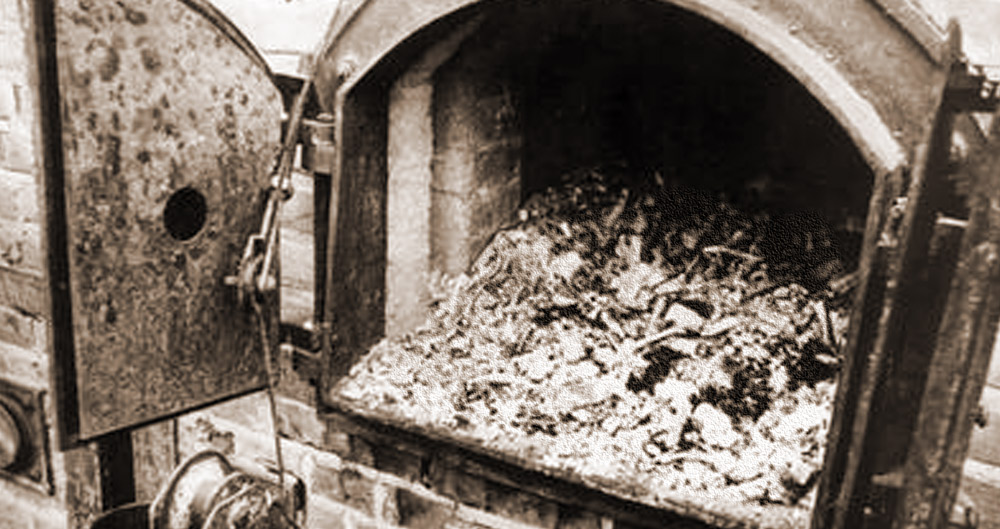
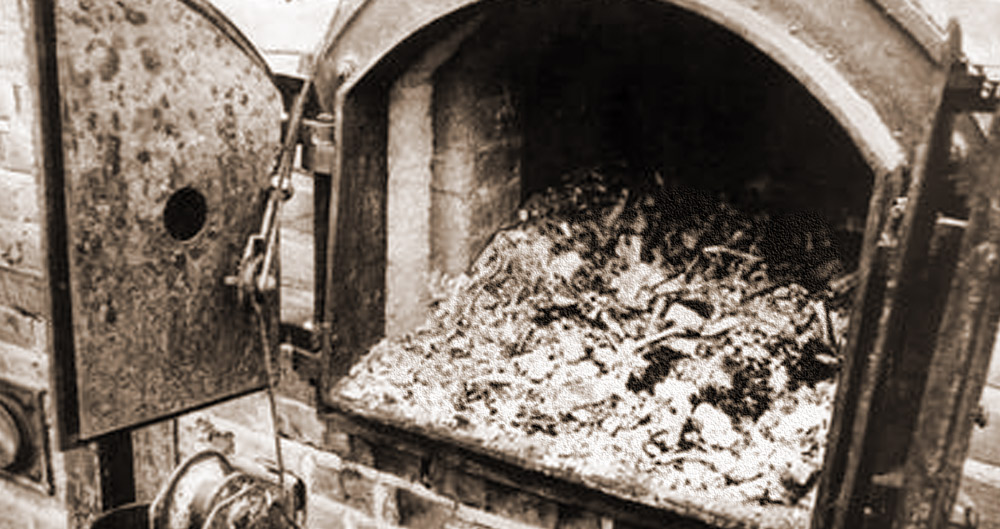
In one scene, one of the protagonists — a hero? a villain? — is stalled on a Midwest country roadside. He smells something in the air. Smoke. Ash.

The very American sheriff explains: it is a local hospital destroying defective humans. The weak, the sick, the disabled.

And we, the viewers, recoil: how evil. Nazis actually execute the weak, the sick, the disabled. Well, they did, in history, not just fiction.

But, as CBS explains, the reason Down syndrome cases are disappearing all over the place, and in Iceland most of all, is not a new cure. Chalk it up to the rise of prenatal screenings. We see fewer Down syndrome people because, before birth, they are executed. Aborted.

In our non-fictional timeline, many Americans are incensed that a few folks proclaiming to be Nazis have been “allowed” to demonstrate in public.

Nazism is evil. I agree.

But how do these morally horrified people react about the very “progressive” and culturally acceptable practice of killing the unwanted?

Think I’ve gone over the top, have abused a revered author to make a point alien to his own? Well, please read Dick’s “The Pre-Persons,” a story about abortion, way post-natal . . . until the age at which a person can understand algebra.*

Quite the moral calculation we make, eh?

This is Common Sense. I’m Paul Jacob.


* That could mean it’s open season for murder as states are moving to drop algebra requirements because so many fail to master the subject. 


PDF for printing


Categories
Accountability folly general freedom ideological culture media and media people moral hazard nannyism national politics & policies too much government U.S. Constitution

Statues and Limitations

“Should they take down the Jefferson Memorial?”

That is what PBS’s Charlie Rose asked Al Sharpton. Now, the “Reverend” is not my go-to source for political insight, but his answer* caught my attention.

“I think that people need to understand that, when people that were enslaved and robbed of even the right to marry and had forced sex with their slave masters, this is personal to us,” replied Rev. Sharpton. “My great-grandfather was a slave in South Carolina . . . Our families were victims of this.”

Asked if this precluded “public monuments” for “everyone associated with slavery,” Sharpton argued: “When you look at the fact that public monuments are supported by public funds, you are asking me to subsidize the insult to my family.”

One can attack the messenger, Sharpton, sure. But what if we instead think of him as our neighbor? I certainly wouldn’t want to insult a neighbor, much less make him pay for the privilege.

Notably, the Reverend embraced privatization, suggesting, “You have private museums.” Privatizing controversial monuments would certainly solve Sharpton’s stated problem.

Of course, the logic behind taking down statues or dismantling the Jefferson Memorial — or merely privatizing them — might also lead to changing the names of cities, counties and states, rivers and mountains. And it’s not just Washington and Jefferson — twelve presidents were slave owners, including Union General U.S. Grant.

Who knows how many are undeservedly memorialized?

Frankly, I’ve never liked the name of my Virginia county: Prince William. A liberty-loving people ought not be stuck with such a monarchial brand.

Let the people decide.

But by vote, not street brawl.

This is Common Sense. I’m Paul Jacob.


* This exchange begins at the 15:22 mark in the interview.


PDF for printing


Categories
Accountability general freedom ideological culture media and media people moral hazard national politics & policies Regulating Protest

Gatekeeping 2.0

There once was opinion hegemony, almost a monopoly. Official gatekeepers kept unwanted ideas — including some of mine, including many I strongly oppose — out of public consideration.

Then came the online media revolution, which switched influence from corporate, academic-approved media outlets to truly new media, like Facebook, Twitter and YouTube.

And now? The counter-revolution.

We saw it obviously in the downgrade and then banning of Milo Yiannopoulis’s Twitter, last year. Since then, new measures surface on a regular basis.

We helots, we commonfolk, must not be allowed actually to affect an election!

Or the hearts and inquiring minds of Americans, Europeans, and others worldwide.

Unless that opinion has received the imprimatur of the Center-Left.

I’ve written about this return of the Gatekeeper mentality before. The latest malefactor is YouTube, which locked Dr. Jordan Peterson out of his account this week* as well as put in place new policies to hobble the social sharing elements of YouTube.**

A week or so earlier, Patreon, an online crowdfunding patronage web service I’ve been thinking about trying out, cancelled independent journalist Lauren Southern’s account. Patreon managers charged that her most recent endeavor might cause “loss of life,” but, tellingly, “showed no evidence or proof, are allowing no appeal and have acted as judge, jury and executioner” — as one concerned netizen not inaccurately summarized.

The company’s CEO calmly explained himself to Dave Rubin on YouTube. Does he convince you?

I catch a whiff of panic.

This is Common Sense. I’m Paul Jacob.


* Dr. Peterson’s account has since been reinstated, no explanation given.

** You can learn all this and more on YouTube itself — so the platform hasn’t been shut down as such. Instead, a new Artificial Intelligence will restrict videos that do not even break YouTube terms of service, removing Likes, Comments, and Search features.


PDF for printing


Categories
education and schooling free trade & free markets general freedom ideological culture media and media people national politics & policies privacy property rights responsibility too much government U.S. Constitution

According to Economics

“Everywhere you look, economics is despised,” writes Tom Woods in his Tuesday email letter.

You know what isn’t despised? A daily email letter.*

But I digress; back to economics.

“The gimme-free-stuff people hate it because they don’t like being told that there might be undesirable side effects from seizing other people’s things.”

Well, true enough. But turn it around: many people demand free stuff at least in part because they do not understand the bigger picture . . . which Mr. Woods ably provides in his daily podcast and on his weekly Contra Krugman podcast with economist Bob Murphy.

“Politicians hate it, because it imposes logical constraints on what political activity can accomplish.”

True, but, like many in the general public (from whence they come), politicians’ prior lack of economic knowledge also leads, in part, to their hubris.

“Even some folks in the business world hate it, because (1) they’d rather agitate for special privileges than hear the case for free markets, and (2) they’d rather have low interest rates than be warned about the causes of the business cycle.”

Yes, too true. But, again, business people are generally just people, most of whom haven’t even been exposed to something beyond boring and misleading textbook econ, if that. Mr. Woods knows that, since that’s what his mission is, exposing more folks to ideas beyond what he calls “the index card of allowable opinion.”

Well, I’m all about allowing the unallowable — if it’s right!

This is Common Sense. I’m Paul Jacob.


* Historian Woods is now doing what I’ve been doing since 1999, providing a daily common-sense thought that is short and easy-to-read and dropped into your email box every weekday. Mine goes up online at ThisIsCommonSense.com; I don’t see his on his website . . . but I do see a lot of books and podcasts!


Printable PDF


Categories
Accountability folly free trade & free markets ideological culture media and media people national politics & policies

Next Bubble to Pop?

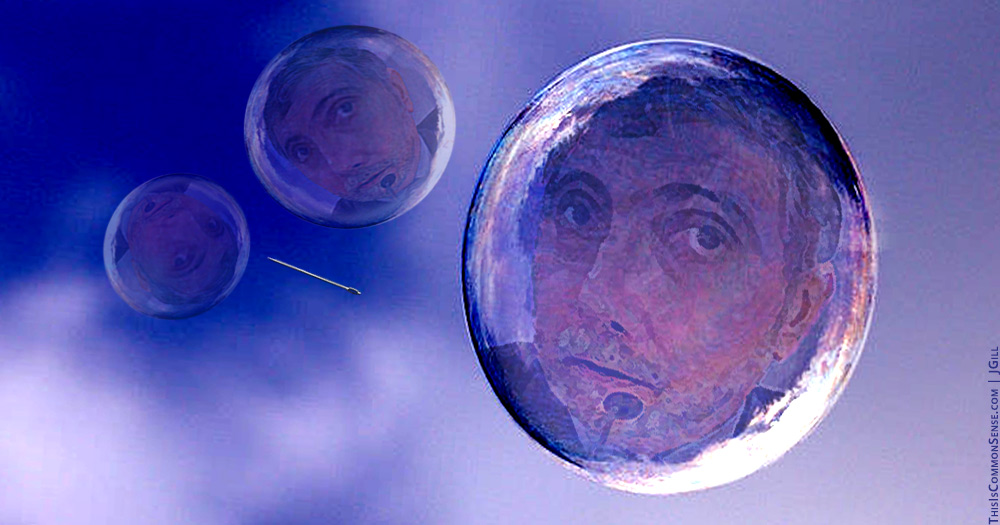
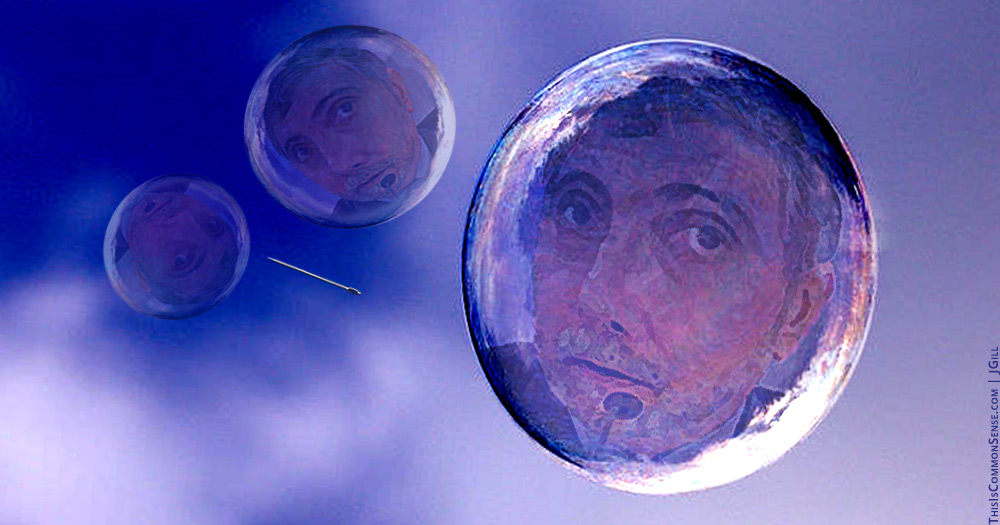
There was a great and wondrous moment, a decade and a half ago, when economist Paul Krugman, Nobel Laureate and New York Times’s unregistered shill for the Democratic Party, suggested that what the economy really needed was another housing bubble.

What he wrote, specifically, was this: “To fight this recession, the Fed needs more than a snapback; it needs soaring household spending to offset moribund business investment. And to do that, as Paul McCulley of Pimco put it, Alan Greenspan needs to create a housing bubble to replace the Nasdaq bubble.”

Krugman later reinterpreted that statement in a clever (if not convincingly honest) way. After the subprime loan industry collapsed in 2008, he attributed that bust to financial market malfeasance, not the Fed-inflated bubble we got . . . and that he had previously called for.

Now we are looking at several ready-to-burst bubbles:

  • The student loan debt problem seems scary.
  • The sovereign debt problem is undoubtedly more dangerous and far larger, but is perhaps still able to take on more fake money — all the world’s 1s and 0s have to go somewhere!
  • So the current bets seem to be on a huge auto loan industry bubble, about to pop.

Loan terms have increased in duration, and the average amount new car buyers are financing has jumped over 17 percent in five years. The idea has been “to continually lower monthly payments,” says David Stockman, “so people can get behind the wheels of vehicles they can’t really afford.”*

Which bubble does Krugman favor? I don’t have the stomach to check.

But, be certain, as we play pop goes the bubble, he’ll play pop goes the weasel.

This is Common Sense. I’m Paul Jacob.


* Stockman seems to be echoing warnings made by Eric Peters, of Eric Peters Autos.


Printable PDF


Categories
folly ideological culture media and media people meme national politics & policies

CNN, You’ve Been Trolled

The Cable News Network, known popularly and un- as CNN — and satirically as the “Clinton News Network” and “Fake News” — so hysterically hates the president that it has become completely unhinged.

Well, unhinged from decency and journalistic standards, anyway.

The latest slips downward?

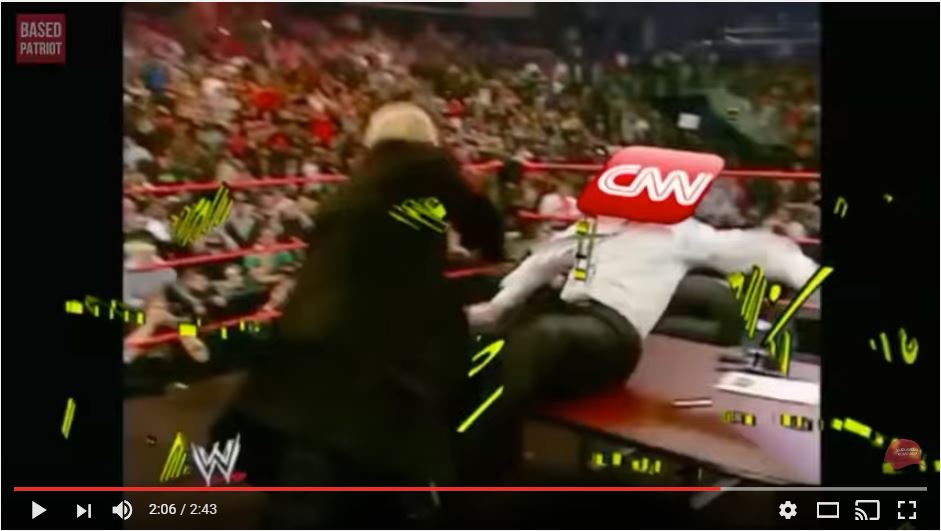
First, some pseudonymous guy* on Reddit created a little gif** that placed a CNN-logo on the head of a wrestler whom Donald Trump “took down” in some weird bit of nonsense publicity the entertainer-entrepreneur was prone to, pre-presidency. Trump then retweeted a version of the gif, calling CNN (once again) “fake news.” This made CNN look silly,*** so CNN tracked the originator down and pressured him to make a humiliating apology — for it and other, more tasteless contributions. He deleted most of what he had done on Reddit.

CNN looks petty: a bully. And clueless about the free-for-all that is the Internet.

The Twitterverse erupted against the news outfit.

This went super-viral on July 4, the same day that CNN tried to humiliate Mr. Trump by tweeting a quote from Abraham Lincoln: “Let the people know the facts, and the country will be safe.”

How apt!

And yet . . . Lincoln did not say it. Not exactly. The “fake news” network faked a presidential quote.

CNN apparently doesn’t understand that responding to trolls feeds the trolls and makes you look bad, to boot.

I suppose you could blame Trump for all this. His ridiculous tweets and whoppers have so corrupted the culture that his enemies (CNN being the obvious media leader) have adopted his methods.

But I won’t. Not this time.

Just blame the people at CNN.

This is Common Sense. I’m Paul Jacob.


* He referred to himself as a “shitposter,” which is what satirists and trolls on the Web are called.

** A “gif” is an image file, and has been around since the beginning of the World Wide Web. Nowadays, when we talk about “gifs” we usually are referring to brief animated gifs.

*** Frankly, it made the president look silly, too.


PDF for printing

CNN, Trump, meme


Categories
Accountability crime and punishment government transparency media and media people national politics & policies responsibility

A Handy Evasion

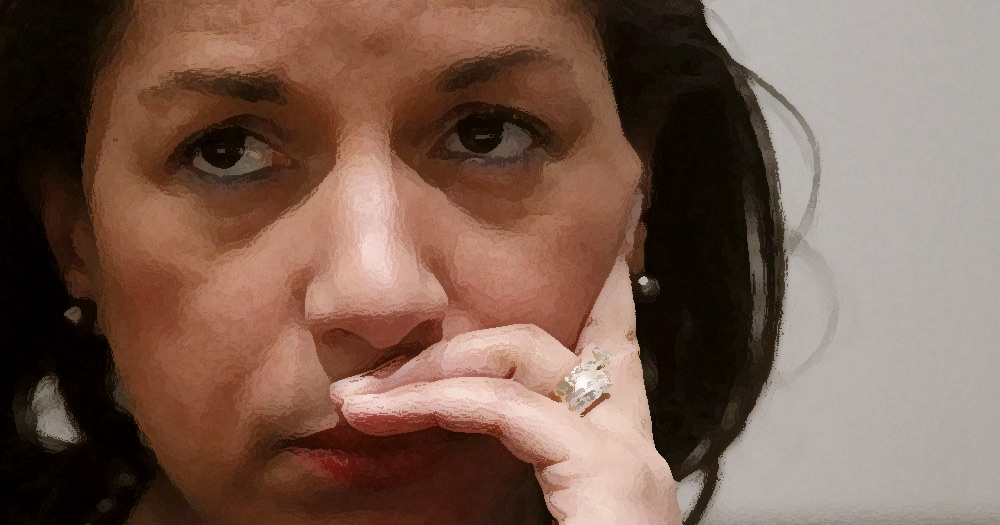
Susan Rice, National Security Advisor in President Barack Obama’s administration (2013 – 2017), is being picked on, she speculates, for reasons pertaining to her race and gender.

Handy evasion.

At issue is not her infamous prevarication in the Benghazi affair. We are used to being lied to about foreign policy, so that was barely a shock.

What is news now? The Trump-Russia story.

Background: Ever since her defeat to Donald Trump, former Secretary of State Hillary Clinton has provided the very model of how to deflect attention from one’s own defects. She’s blamed FBI Director James Comey, the vast right wing conspiracy, and, of course, Russia.*

Amusingly, the Russia biz still boils down to how Russian hackers, apparently directed from high in the hierarchy of the Eastern warlord state, illegally liberated information from private servers. Those revealed emails showed Mrs. Clinton and her campaign in a negative light. Excuse-makers call this “hacking the election.”**

It turns out, the biggest crimes committed during the campaign, and somewhat regarding Russia, were engaged in by the Obama Administration, perhaps especially by Rice herself. She is accused of illegally surveilling the Trump campaign and those around it by “unmasking” their identities in the course of surveillance reports, which are legally required to be anonymous . . . when catching in the net folks tangential to the target.

The law requires FISA court go-aheads for such identifications. And the Obama administration was roundly reprimanded by a FISA court for not following protocols.

In any case, the idea that only women and African-Americans are hounded by opposition parties and the press does not hold up to scrutiny.

Nixon, anyone?

This is Common Sense. I’m Paul Jacob.


* Her team has also blamed President Barack Obama

** A private server was hacked, not an election.


Printable PDF


Categories
ideological culture incumbents local leaders media and media people national politics & policies

Monied Hopes Dashed

Democrats had high hopes. Their come-back after the 2016 defeats seemed near at hand. After all, Trump is proving increasingly erratic and incompetent, and the Republican mis-handling of the ObamaCare repeal appears to be a disaster of ginormous proportions.

How could they not start taking seats in Congress back?

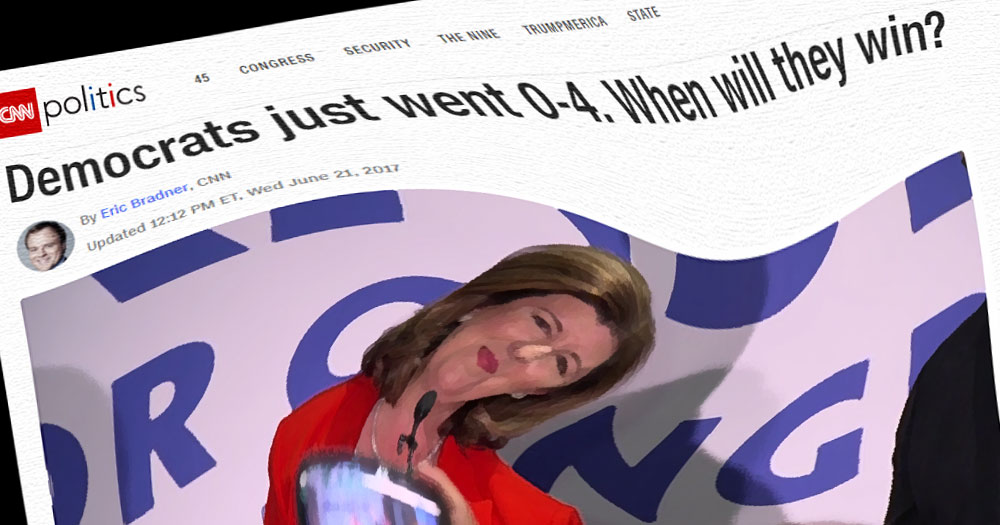
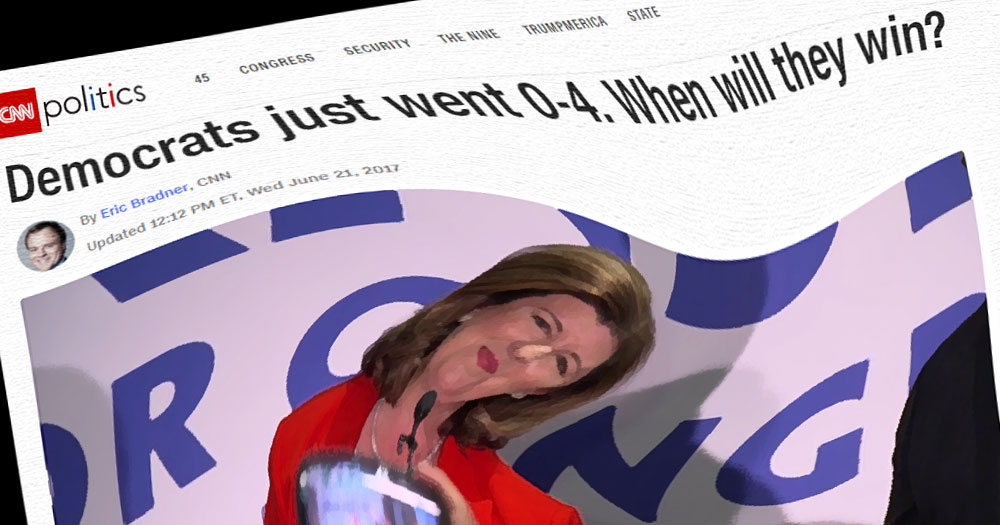
There were four open seats requiring new votes this late Spring. “Democrats tried an inoffensive moderate message in Georgia,” CNN’s Eric Bradner informs us. “They ran a banjo-strumming populist in Montana. They called in the cavalry in South Carolina and tried to catch their foe sleeping through a long-shot in Kansas.”

Democrats failed, 0-4.

Why? Well, the congressional vacancies were made by the new president’s appointments, and he may have targeted those districts that were especially safe. Nevertheless, CNN notes, “[t]he party got closer than it has in decades to winning some of the four seats — a sign they’ve closed their gaps with Republicans in both suburban and rural areas. . . .”

But there is a lesson here that CNN did not draw from the debacle. The much-lamented Georgia race, in which Jon Ossoff lost to Republican Karen Handel, was a race in which Ossoff out-spent Handel six to one in what is called “the most expensive House race in history.” And yet, somewhat oddly and perhaps hypocritically, Ossoff, the bigger spender, went on air complaining about money in politics.

All that moolah did not push him over the top. Ossoff and the Democrats — as well as the feckless Republican majority — might look for fewer excuses and stand for something voters actually want.

This is Common Sense. I’m Paul Jacob.


PDF for printing


Categories
Accountability crime and punishment folly general freedom media and media people moral hazard nannyism responsibility too much government

Another Push for Censorship

It’s almost as if politicians are hell-bent on expanding government at the expense of our freedoms . . . and grandstanding to ‘look like they are doing something.’

The two proclivities are not unrelated.

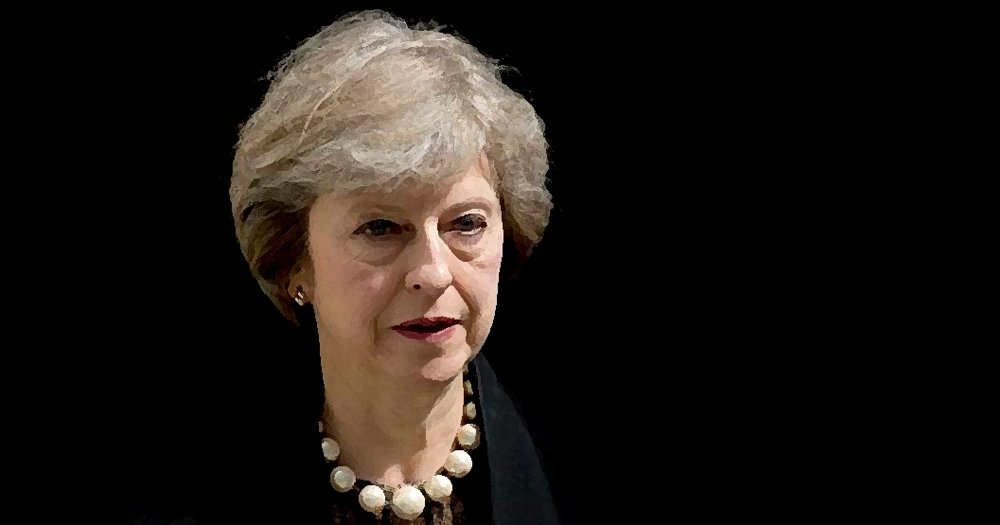
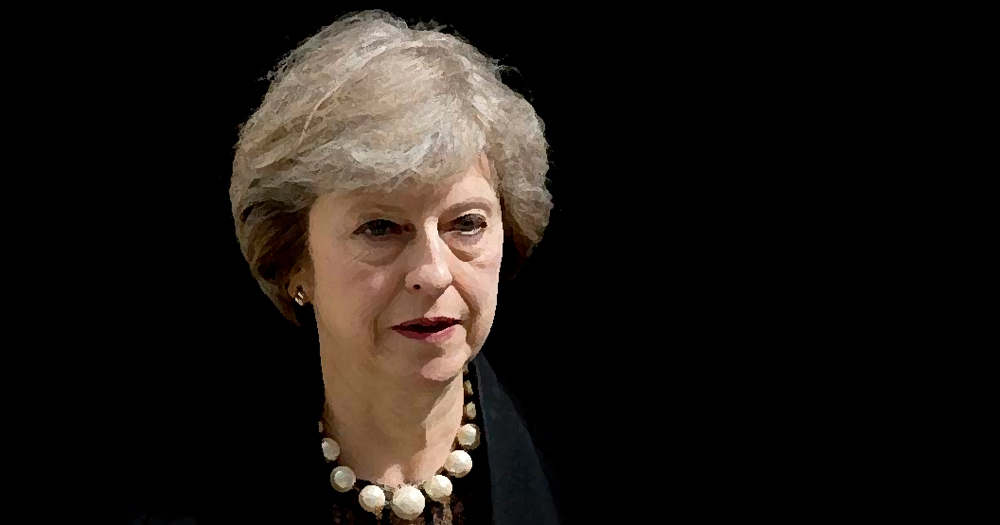
Take Theresa May, Great Britain’s Tory Prime Minister. After yet another terrorist attack in her country, this time on the London Bridge, she re-iterated her party’s intent to censor the Internet.

“We cannot allow this ideology the safe space it needs to breed,” May said on Sunday. But this “safe space,” she went on, “is precisely what the Internet, and the big companies that provide Internet-based services, provide.”

Now, blaming ISPs and social platforms is a crude form of business scapegoating—something I would expect from her opponent in the upcoming elections, Jeremy Corbyn, the much-loathed (but inching ahead in the polls) top banana of Labour.

As a conservative, May should understand markets and the limitations of government interventionism a bit better than a nearcommunist. She might recall that previous attempts to regulate the means of communication almost never to work, and, in those few cases when they do, never stay scaled to the original target issue.

They expand. To cover more than just terrorism, as in this case.

What’s more, Jim Killock of the Open Rights Group makes the case that such a move would likely “push these vile networks into even darker corners of the web, where they will be even harder to observe” — scuttling the alleged purpose of the Conservative Party’s longed-for censorship.

May knows this. But she is a politician. She has power, and she wants to keep it.

It’s almost as if power corrupts or something.

This is Common Sense. I’m Paul Jacob.


Printable PDF