Categories
education and schooling general freedom media and media people

People Lover

Steven Mosher loves people.

Mosher is a student of China who, according to the bio at his Population Research Institute website, pop​.org, “has worked tirelessly since 1979 to fight coercive population control programs. . . .”

In 1979, the Chinese government let him pursue research in a village where he observed many instances of compulsory abortions under the country’s one-​child policy. Some of the women were in their eighth or ninth month of pregnancy.

Perhaps the Chinese government expected Mosher to produce rosy-​eyed, footnoted rationalizations of what he saw. When he published his unvarnished findings in a Taiwanese magazine, officials complained to the U.S. Embassy and to Stanford University.

Stanford appeased China by denying Mosher his PhD. I note the university’s injustice in part because Mosher tends to omit this detail. But it should not be forgotten.

Back then, he said he “did what was right to do. I told the truth.”

He opposes population control because, in his view, people are a good thing, not a bad thing.

This viewpoint is beautifully conveyed in a video on the pop​.org home page, in which Mosher says that people “are the ultimate resource, the one resource that you cannot do without.” The Institute works to expose “the myth of overpopulation” and the violations of human rights that occur in the name of population control.

The prolific scholar argues that people “can become the agents of their own development without having to sacrifice their children in the process.”

My wife and I glad to hear it. We’ll let the kids know.

This is Common Sense. I’m Paul Jacob.


PDF for printing

Illustration created with PicFinder​.ai and DALL-E2

See all recent commentary
(simplified and organized)

See recent popular posts
Categories
education and schooling general freedom ideological culture

Down-​Shifted Demographics

Until recently, the most obvious demographic trend has been the “squaring of the curve”: more people were hitting an apparently natural limit in their eighties and nineties, rather than dying off in their forties, fifties, and sixties.

Now, however, longevity stats are showing a new feature. A graph in a fascinating article puts it like this: “Americans die earlier than the English across the income distribution, despite typically earning significantly more,” with the article quickly clarifying the specifics: “America’s mortality problem is driven primarily by deaths among the young.”

The most vulnerable members of traditional society are newborns and the aged. But now it’s those reaching their alleged prime: “one in 25 American five-​year-​olds today will not make it to their 40th birthday.”

Is it COVID? No. This trend is older than 2020, and remember, in the recent pandemic it was the aged, not the young, who experienced higher rates of morality.

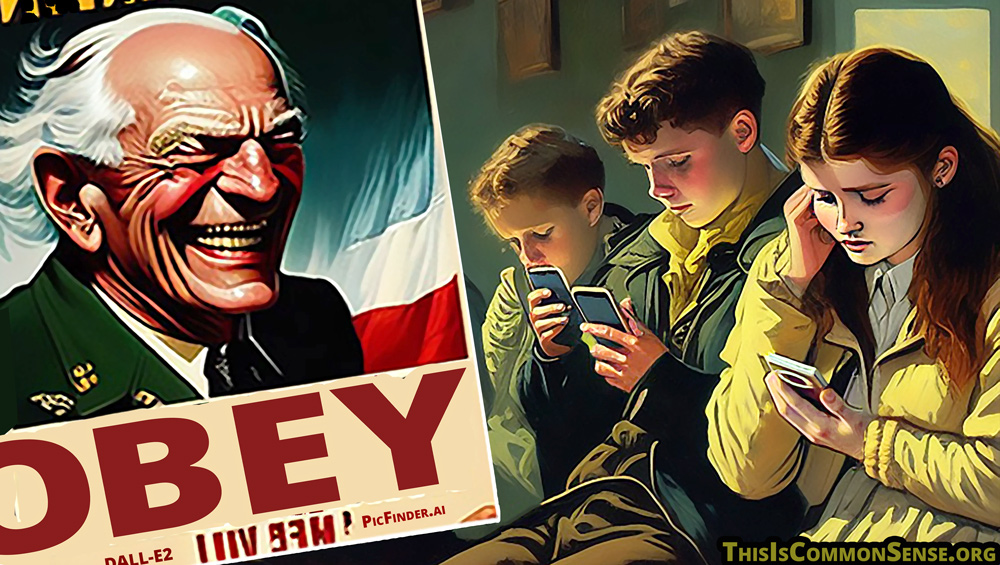
An article by Zach Rausch and Jon Haidt suggests that the problem may loom beyond America, for their work shows that “The Teen Mental Illness Epidemic Is International,” and I don’t think it is at all out of bounds to take higher youth rates of suicidality, desperate recreational drug use, and expressed anxiety and despair — and skyrocketing transgender rates, too — as stressors related to increased death rates. 

It is vital to study these things, for their main conclusion is startling and a general sign of deep cultural decay: “Teen mental health plummeted across the Western world in the early 2010s, particularly for girls and particularly in the most individualistic nations.”

We should ask ourselves: could this be related to the rise of a gerontocracy?

A society run by old people for old people may have nasty inter-​generational side effects.

This is Common Sense. I’m Paul Jacob.


PDF for printing

Illustration created with PicFinder​.ai and DALL-E2

See all recent commentary
(simplified and organized)

See recent popular posts

Categories
education and schooling general freedom national politics & policies

The Explosion in Alternatives

“Across the country, we’re in the midst of an unprecedented explosion in homeschooling and alternative education,” Sharyl Attkinson reported last Sunday on her weekly news program, Full Measure, citing a “mass exodus from America’s public schools.”

And it’s not just about pandemic measures like mask mandates. In February, San Francisco voters overwhelmingly recalled three school board members over their fixation on wokeness to the exclusion of in-​person education. And the school board’s antics in liberal Loudoun County, Virginia, turned last year’s race for governor into a referendum on whether parents have any say-​so at all. 

They do, apparently

Though I have covered the enormous growth of alternative education during the pandemic — here and here, for instance — I have been looking for more specifics. 

“Relative to pre-​pandemic levels,” Corey DeAngelis with the American Federation for Children told Attkisson, “homeschooling has at least doubled,” and now accounts for “closer to 4 million students.”

Too good to be true? I double-​checked. The U.S. Census Bureau used the same language as Attkisson and DeAngelis: “the global COVID-​19 pandemic has sparked new interest in homeschooling and the appeal of alternative school arrangements has suddenly exploded.”

At the end of the 2019 – 2020 school year, “about 5.4% of U.S. households with school-​aged children reported homeschooling,” according to their Household Pulse Survey. “By fall, 11.1% of households with school-​age children reported homeschooling.”

The increase was five-​fold for “respondents identified as Black or African American,” with 16.1% homeschooling.

“Still more students have left for religious schools,” reminds DeAngelis, “or other private schools.”

Attkisson also pointed to a jump in support for school choice.

Parents of the world unite. 

This is Common Sense. I’m Paul Jacob.


PDF for printing

See all recent commentary
(simplified and organized)

See recent popular posts
Categories
local leaders

Political Intimidation Unmasked

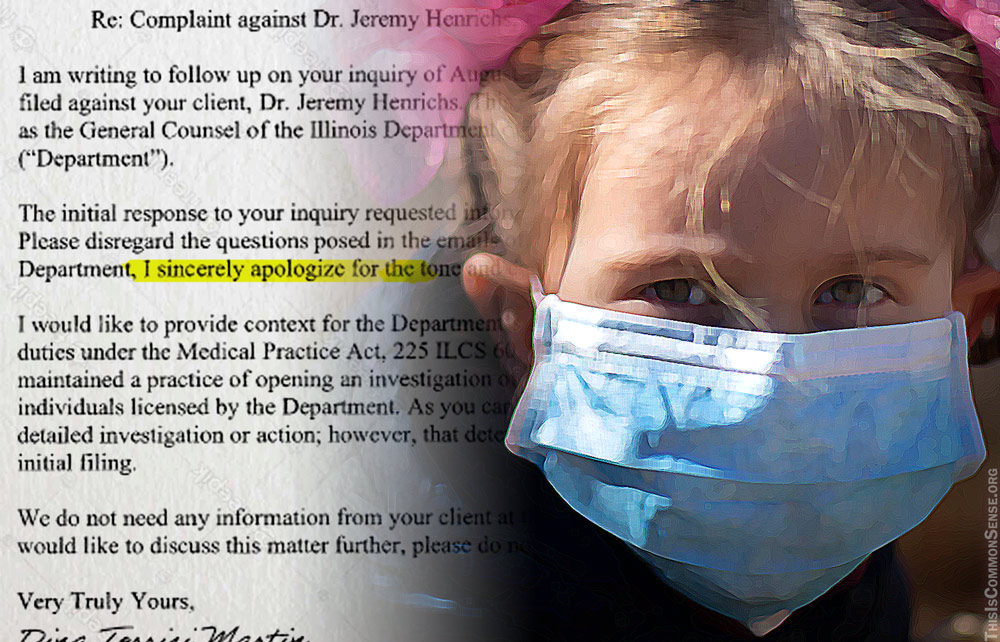
Last week, Illinois state regulators threatened Dr. Jeremy Henrichs with “personal and professional consequences,” specifically loss of his medical license, if he continued to oppose mandatory mask-​wearing in schools.

Henrichs is a board of education member and a medical doctor.

He questioned the necessity of masks. Why? On the basis of his best medical judgment — and he is hardly alone in seeing good reasons to oppose mask mandates, especially for children. In response, the Illinois Department of Financial and Professional Regulation “has threatened my medical licensure unless I expressly support and enforce a mask mandate for all students.”

In his public protest, Henrichs added that it’s bad for democracy when people tolerate this kind of intimidation.

Fortunately, in this particular case the intimidation is not being tolerated, for state lawmakers called for hearings on the matter.

The agency that threatened Dr. Henrichs soon apologized, apparently ending the threat to him. (According to the letter of apology, though, the complaint won’t be formally closed until the Medical Disciplinary Board meets on September 1.)

In addition, the entire Mahomet-​Seymour school board of which Henrichs is a member has signed an op-​ed defending him.

Their op-​ed argues that board members should be “free to express their opinions, debate with their colleagues . . . and vote their conscience without the threat of coercion. . . .”

So it’s looking good for Dr. Henrichs. But power-​holders with censorious mentalities are still out there, eager to crack down on speech with which they disagree.

Whenever they can get away with it. 

This is Common Sense. I’m Paul Jacob.


PDF for printing

See all recent commentary
(simplified and organized)

See recent popular posts
Categories
general freedom ideological culture Popular too much government

Who Benefits From Our Fears?

“Think of the children!”

I have daughters. And neighbors, nephews, nieces, cousins, friends with children. And friends who used to be children. But when the command to “think of the children” is screamed out by freaked-​out paranoiacs demanding more laws, more punishments, more prison time, more surveillance — and consequently less freedom — I try to think responsibly.

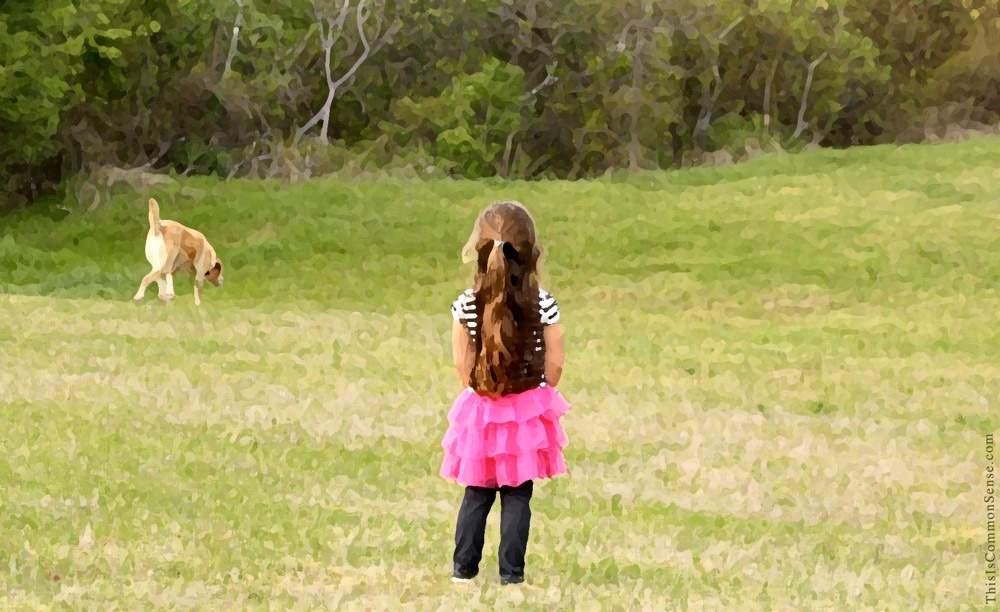
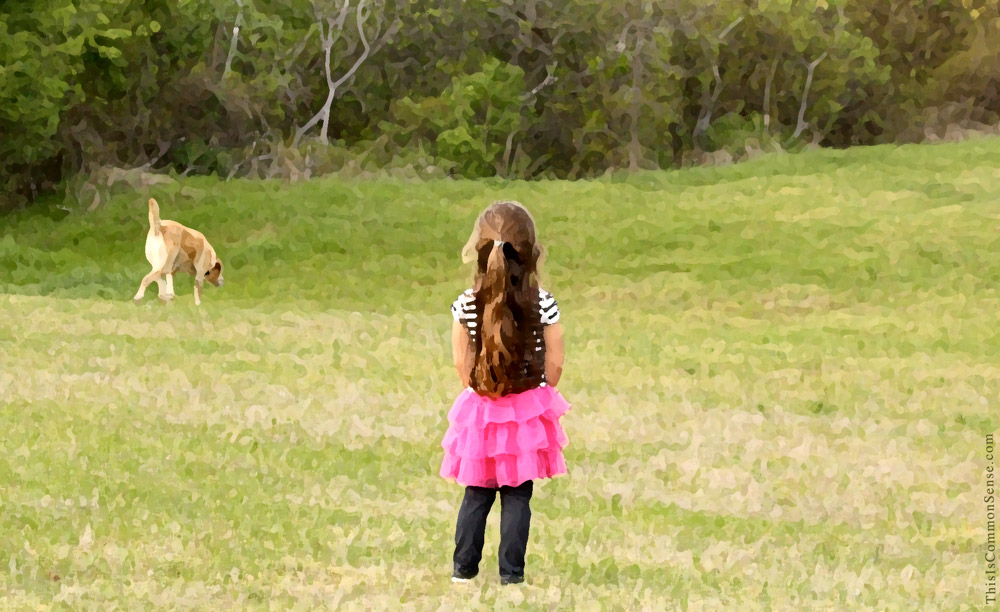
As did one Corey Widen, when she “let her 8‑year-​old do the most normal, cheerful thing in the world — walk the dog around the block.” Lenore Skenazy tells the tale in Reason. “After the girl returned home, the doorbell rang. It was the police.”

Someone in Widen’s Wilmette, Illinois, community had seen the child and dog walking around “unsupervised” and called 911.

The thing, there was no lack of supervision, here. The child was supervising the dog.

What could be more natural?

The neighbor could have walked outside and smiled at the kid and talked about the dog and, in general, been a good neighbor.

Think of it as a peaceful order of supervision.

Instead: in came the police.

Then, after the police let it go, the Department of Children and Family Services stepped in to “investigate.”

Because nothing says DANGER more than a kid walking a dog.

Skenazy notes that this attitude is commonly justified by crimes against kids. And yet, Ms. Skenazy notes, crime in Wilmette has gone down dramatically over the years. As it has most elsewhere.

The culture has become more paranoid.

Who is served by this?

Authoritarians. Haters of freedom. Demagogues.

Certainly not kids, for kids cloistered from simple responsibilities cannot grow up to take on real responsibilities.

Think of the …  future adults.

This is Common Sense. I’m Paul Jacob.


PDF for printing


Categories
crime and punishment education and schooling folly general freedom moral hazard privacy responsibility too much government U.S. Constitution

Ecstatic with Independence

Utah’s legislature unanimously passed it; the governor signed it — the nation’s first measure protecting what’s become known as “free-​range parenting.” 

It was once known simply as “parenting.”

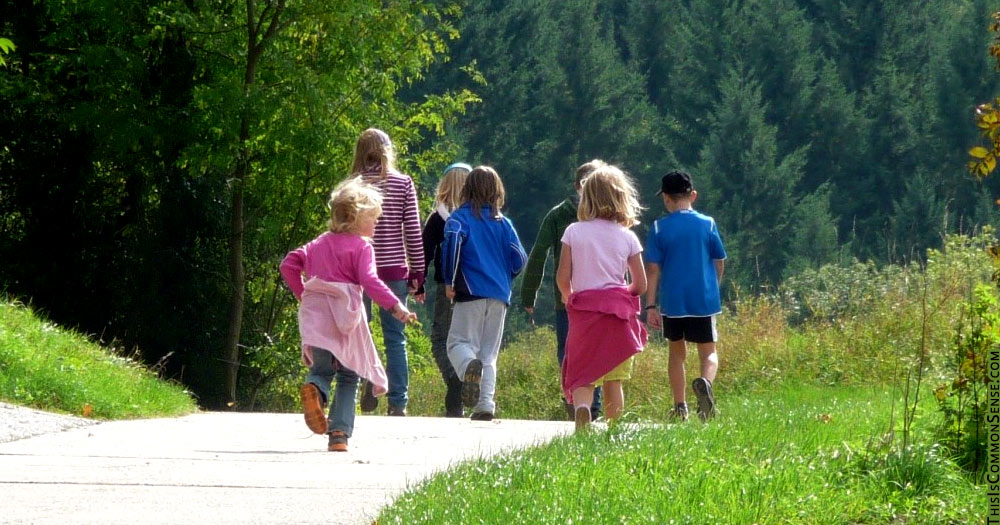
Certain activities are now exempt from a state law criminalizing child neglect. Children may legally “walk, run or bike to and from school, travel to commercial or recreational facilities, play outside and remain at home unattended” — thereby allowing “a child, whose basic needs are met and who is of sufficient age and maturity to avoid harm or unreasonable risk of harm, to engage in independent activities …”

Back in the day, we apparently played outside in a sort of statutory limbo.

Do we really need a law saying kids can walk on a public street? 

Sadly, yes: government agencies across the country are grossly violating the most basic rights of parents to rear independent children.

Regular readers may recall my 2015 defenses* of the Meitiv parents against the absurd charge of “unsubstantiated neglect” leveled against them by Montgomery County (Maryland) Child Protective Services. Ultimately, Maryland authorities acknowledged that permitting one’s kids (in the Meitivs’ case, a 10- and a 6‑year-​old) to walk on a public sidewalk (from a local park) wasn’t prima facie evidence of a crime. 

The current free-​range parenting movement was launched in 2008 when Lenore Skenazy publicly admitted — to mass shock and condemnation — to allowing her 9‑year-​old son to take a trip alone on New York City’s subway.

“My son got home,” she wrote in the New York Sun, “ecstatic with independence.”

Notice how rare it is to find anyone ecstatic with dependence.

Lesson? An old one: Happiness must be pursued with freedom.

This is Common Sense. I’m Paul Jacob.


* My writings on the Meitivs’ battle to keep their kids:


PDF for printing


Categories
Accountability crime and punishment education and schooling ideological culture moral hazard

The Damage Done

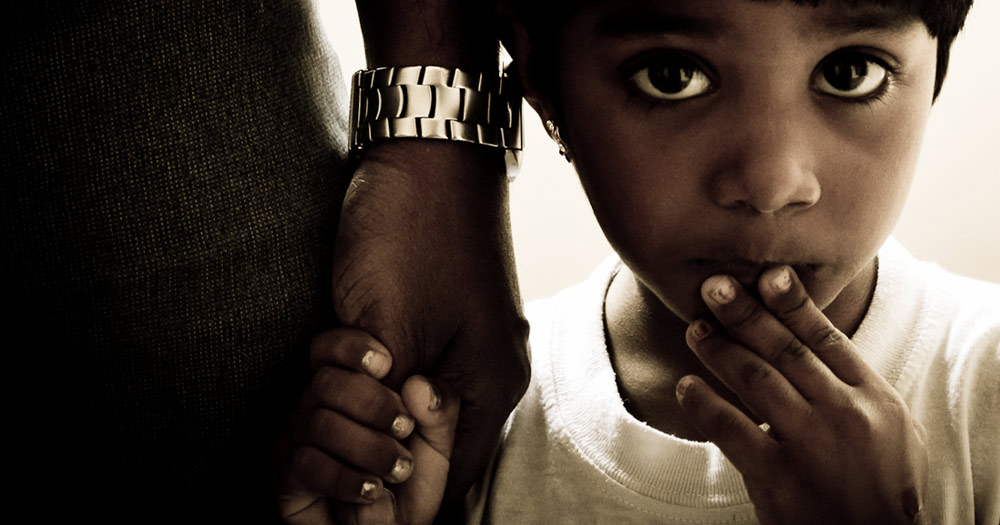
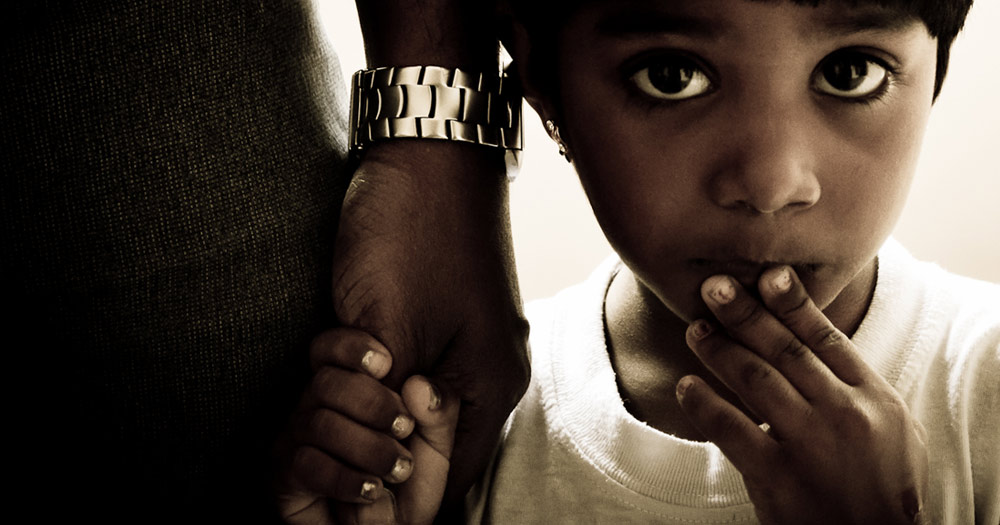
In his Washington Post op-​ed, “The dangerous myth of the ‘missing black father,’” Mychal Denzel Smith argues that “responsible fatherhood only goes so far in a world plagued by institutionalized oppression.”

He asks:

If black children were raised in an environment that focused not on bemoaning their lack of fathers but on filling their lives with the nurturing love we all need to thrive, what difference would an absent father make? If they woke up in homes where electricity, running water and food were never scarce, went to schools with teachers and counselors who provided everything they needed to learn, then went home to caretakers of any gender who weren’t too exhausted to sit and talk and do homework with them, and no one ever said their lives were incomplete because they didn’t have a father, would they hold on to the  pain of lack well into adulthood?”

Hmmm. The first question answers itself. If all children get everything they “need to thrive,” it is assumed they’ll thrive. The second question is impossible to know … at least until the creation of that perfect utopia with universal material abundance, a flawless education system and indefatigable single-parents.

Fatherlessness is not just a black problem. And let’s agree there are great single-​parent (or no-​parent) homes as well as terrible two-​parent homes.

Still, fathers are nice. Oftentimes they help children thrive, in part by providing “electricity, running water and food” as well as “love” — both tough and nurturing. Proclaiming that fathers would not matter in a society where everything’s automatically supplied is … simple-minded.

Often called socialism.

Smith raises the issues of “racist drug laws, prosecutorial protection of police officers who kill, mass school closures … the poisoning of their water.” He’s right: having a father won’t magically solve those.

But it would solve the problem of not having a father.

This is Common Sense. I’m Paul Jacob.


Printable PDF

black, father, racism, children, race


Original photo by Sunil Soundarapandian on Flickr


Categories
Accountability education and schooling general freedom ideological culture national politics & policies

Parents in Context

Consider the intersection of freedom and decontextualized fragments.

The specific “decontextualized fragments” in question appear in great and not-​so-​great works of literature, assigned in public schools for young adults to read: a graphic rape scene in Toni Morrison’s Beloved; racial slurs in Huckleberry Finn; sex, violence.

“Virginia regulators are drafting rules that would require school districts to red-​flag objectionable teaching material and make it easier for parents to control what books their children see in the classroom,” reports the Washington Post.

Those regulations won’t be finalized for a year or more (because government bureaucracies are painfully slow). Yet an “earlier version of the language released on a state website drew hundreds of comments from the public,” the Post informs.

“Most parents were supportive of the change.…”

Teachers? Against.

Stafford County Public Schools literacy coordinator Sarah Crain worries about literature being wrongly labeled “sexually explicit.” To “reduce a book or a work down to something that is a mere decontextualized fragment of the work,” she argues, “actually impedes the ability for teachers and parents to have informed conversations.”

What about freedom?

Well, public schools aren’t primarily about freedom.

Teachers have a job to do; students follow instruction.

And it is pretty easy to see one reason for the opposition by “the professionals”: the new rules would entail more work.

Nonetheless, parents and their kids deserve as much choice as can be provided. And in every context.

Here, freedom means acknowledging the right of parents to decide. Not experts. Parents.

This is Common Sense. I’m Paul Jacob.


Printable PDF

education, parents, children, Virginia, freedom


Original photo credit: wealhtheow on Flickr


Categories
crime and punishment folly ideological culture responsibility too much government

Pincher, Pinchee

Limited government sports several rationales. The need for it pertains on many levels. One such level we don’t think about enough? This: Not every rights violation warrants calling in the law.

Take the strange case of Breana Evans, 12-​year-​old assailant, charged with misdemeanor battery.

What did she do?

She pinched the gluteal posterior of a boy she did not know.

Now, pinching the butt-​end of strangers is a breach not only of decorum (to the extent that this standard we call “decorum” even exists any more), but of a pinchee’s rights.

Yet it was a mere pinch.

And the boy did not press charges.

The school’s “resource deputy” did not arrest her; she was merely suspended from school.

It would have remained a minor matter (so to speak) had not the boy’s mother “insisted to police that he was the victim of battery, and so they had no choice but to arrest Breana,” as Robby Soave explained over at Reason. “She was Mirandized and put in a patrol car. They took her mugshot and booked her into juvenile detention.”

The escalation of the dispute over carnal rites and personal rights into a matter fit for the police is, it seems to me, a grave result of a sort of cultural hysteria about all sorts of things. The willingness of some adults to push children through our harsh, bureaucratic, and often ruthless criminal justice system is sad to behold.

It is more indecent than a pinch.

This is Common Sense. I’m Paul Jacob.


Printable PDF

police, crime, law, rights, pinch, juvenile, illustration


Common Sense Needs Your Help!

Also, please consider showing your appreciation by dropping something in our tip jar  (this link will take you to the Citizens in Charge donation page… and your contribution will go to the support of the Common Sense website). Maintaining this site takes time and money.

Your help in spreading the message of common sense and liberty is very much appreciated!


Categories
folly general freedom nannyism

A Spring in Their Step?

The “Free State” — Maryland — just got a little freer.

Deborah Ramelmeier, Social Services Administration head honcho, has laid forth from her mighty public perch in Maryland’s Department of Human Resources an official directive to the state’s Child Protective Services (CPS).

She finally addressed the issues in the Meitiv case.

You’ll recall that Danielle and Alexander Meitiv allowed their 10-​year old son and 6‑year old daughter to walk home together, without a parent or guardian or attorney present, from a public park a mile away. Silver Spring police snatched the two children off the street last December and so began a Maryland CPS investigation for neglect.

In April, the Meitiv kids were again caught flagrantly walking home from a park. This time they were held for more than five hours by police, then CPS, before their frantic parents were informed and the family reunited.

In the midst of threats, accusations, and fears, the CPS neglected to do the one sensible thing you’d expect: articulate a policy position defining just when or how or even if ever children are allowed out in public without constant and direct adult supervision.

That smidgen of sanity came last week, in Ms. Ramelmeier’s otherwise boring, bureaucratic 23-​page directive. “Children playing outside or walking unsupervised does not meet the criteria for a CPS response absent specific information supporting the conclusion that the child has been harmed or is at substantial risk of harm if they continue to be unsupervised.”

Shazam! Just like that, “playing outside” and “walking unsupervised” are once again legal.

The children won’t be arrested! And their parents won’t be investigated or threatened with losing their little ones!

This is Common Sense. I’m Paul Jacob.


Printable PDF

Free State