Categories
incumbents representation

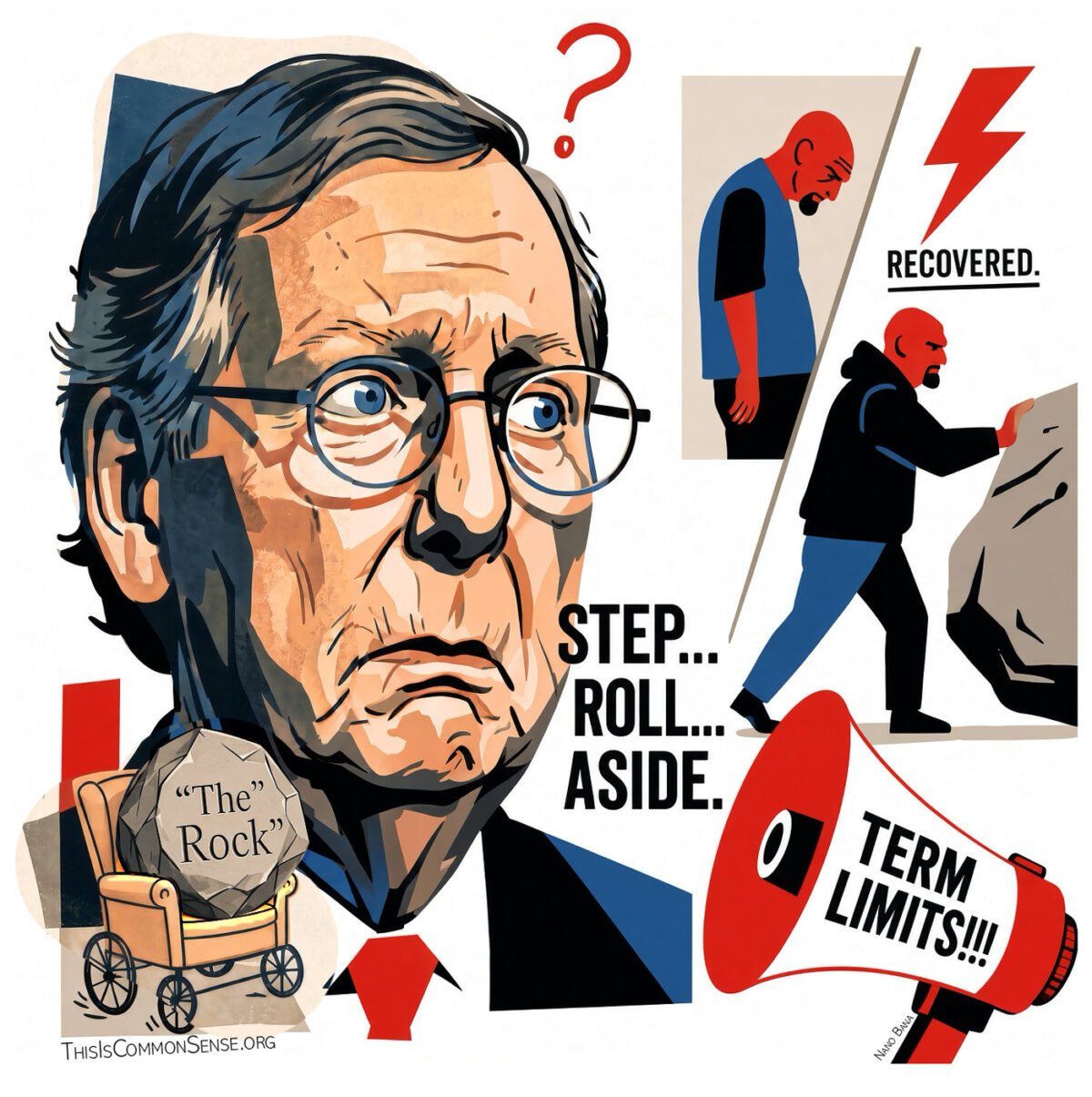
To Be a Rock and Not to Roll

Call him “The Rock.”

That’s what John Kennedy, Louisiana’s wittiest U.S. senator, dubbed Mitch McConnell, yesterday.

Why? From the Wall Street Journal’s write-up, it must be the Kentucky’s senator’s fortitude and resilience that qualify him as hard and stony. The 84-year-old lame duck solon was rolled into the Capitol after a three-month absence, and it appears that everyone was nice to the wheelchair-bound octogenarian.

“Time to get back to work,” he said.

“His words,” explains the Journal, “weren’t clearly enunciated and at times were hard to make out.” Which probably explains why his staff wouldn’t allow reporters to video-record the senator’s short remarks — less evidence to share on social media, audio alone possessing so much less viral cachet.

“McConnell’s absence, which was unusual but not unprecedented, again prompted questions about whether lawmakers with significant health issues should remain in office or step aside,” we are told. 

Sure. We talk about age limits, too. But term limits would generally rein such abuses in. The less time in office, the less likely one is to die in office.

Or suffer a stroke. Or experience a debilitating fall, as in the official story regarding McConnell.

Of course, neither term limits nor age limits directly deal with the illness issue. Which may be a good thing. Senator John Fetterman (D.-Penn.) suffered a stroke on the campaign trail, making his election later in 2022 seem . . . imprudent. He has since recovered impressively, going on to become one of the more independent voices in Washington.

Sure, McConnell should step . . . roll . . . aside. Let someone else do the job. But, as it is, he serves as a stark reminder of the gerontocracy.

This is Common Sense. I’m Paul Jacob.


PDF for printing

Illustration created with Nano Banana / Grok Imagine

See all recent commentary
(simplified and organized)
See recent popular posts

Categories
education and schooling general freedom ideological culture

Down-Shifted Demographics

Until recently, the most obvious demographic trend has been the “squaring of the curve”: more people were hitting an apparently natural limit in their eighties and nineties, rather than dying off in their forties, fifties, and sixties.

Now, however, longevity stats are showing a new feature. A graph in a fascinating article puts it like this: “Americans die earlier than the English across the income distribution, despite typically earning significantly more,” with the article quickly clarifying the specifics: “America’s mortality problem is driven primarily by deaths among the young.”

The most vulnerable members of traditional society are newborns and the aged. But now it’s those reaching their alleged prime: “one in 25 American five-year-olds today will not make it to their 40th birthday.”

Is it COVID? No. This trend is older than 2020, and remember, in the recent pandemic it was the aged, not the young, who experienced higher rates of morality.

An article by Zach Rausch and Jon Haidt suggests that the problem may loom beyond America, for their work shows that “The Teen Mental Illness Epidemic Is International,” and I don’t think it is at all out of bounds to take higher youth rates of suicidality, desperate recreational drug use, and expressed anxiety and despair — and skyrocketing transgender rates, too — as stressors related to increased death rates. 

It is vital to study these things, for their main conclusion is startling and a general sign of deep cultural decay: “Teen mental health plummeted across the Western world in the early 2010s, particularly for girls and particularly in the most individualistic nations.”

We should ask ourselves: could this be related to the rise of a gerontocracy?

A society run by old people for old people may have nasty inter-generational side effects.

This is Common Sense. I’m Paul Jacob.


PDF for printing

Illustration created with PicFinder.ai and DALL-E2

See all recent commentary
(simplified and organized)
See recent popular posts