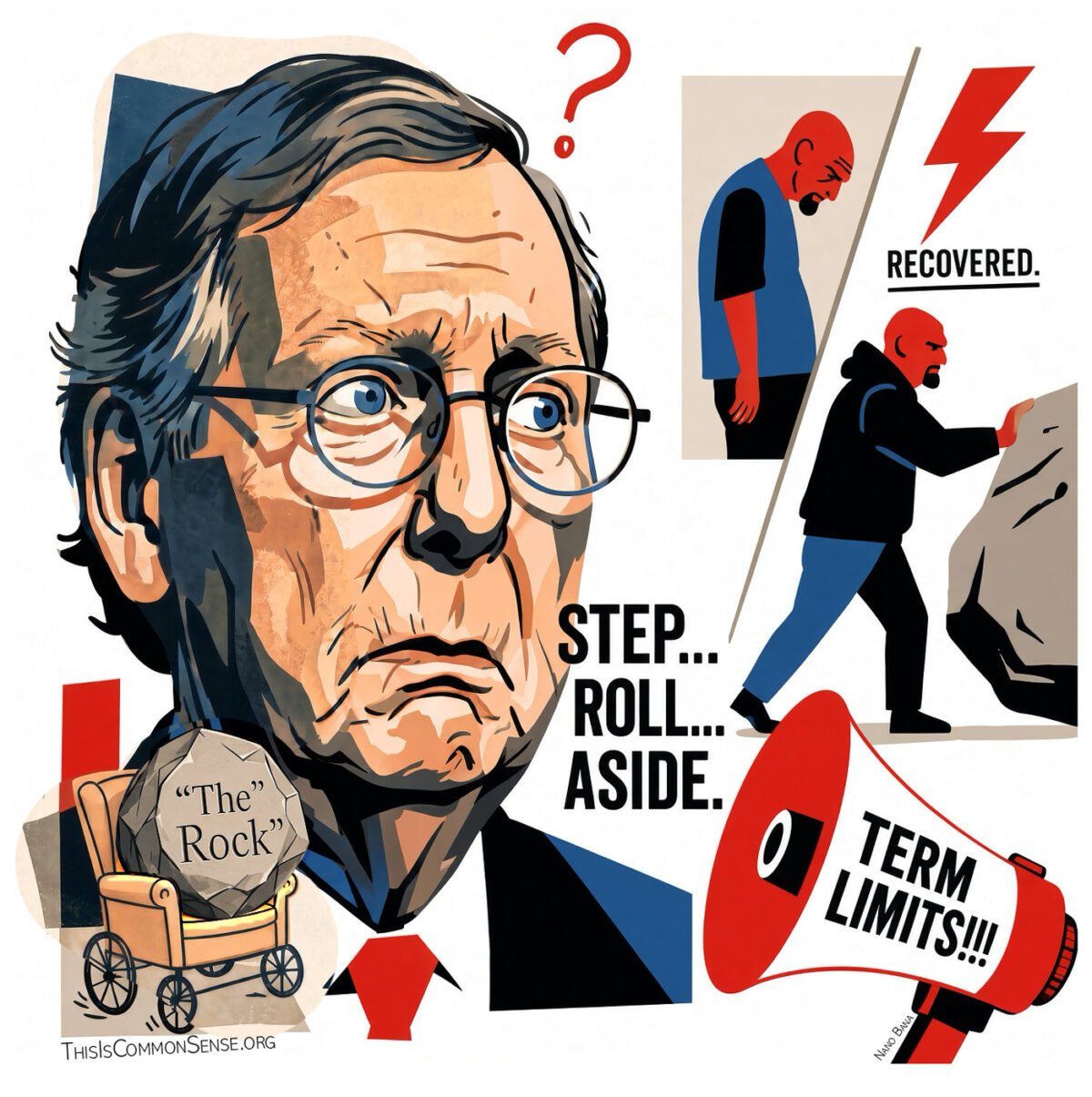
Call him “The Rock.”
That’s what John Kennedy, Louisiana’s wittiest U.S. senator, dubbed Mitch McConnell, yesterday.
Why? From the Wall Street Journal’s write-up, it must be the Kentucky’s senator’s fortitude and resilience that qualify him as hard and stony. The 84-year-old lame duck solon was rolled into the Capitol after a three-month absence, and it appears that everyone was nice to the wheelchair-bound octogenarian.
“Time to get back to work,” he said.
“His words,” explains the Journal, “weren’t clearly enunciated and at times were hard to make out.” Which probably explains why his staff wouldn’t allow reporters to video-record the senator’s short remarks — less evidence to share on social media, audio alone possessing so much less viral cachet.
“McConnell’s absence, which was unusual but not unprecedented, again prompted questions about whether lawmakers with significant health issues should remain in office or step aside,” we are told.
Sure. We talk about age limits, too. But term limits would generally rein such abuses in. The less time in office, the less likely one is to die
Or suffer a stroke. Or experience a debilitating fall, as in the official story regarding McConnell.
Of course, neither term limits nor age limits directly deal with the illness issue. Which may be a good thing. Senator John Fetterman (D.-Penn.) suffered a stroke on the campaign trail, making his election later in 2022 seem . . . imprudent. He has since recovered impressively, going on to become one of the more independent voices in Washington.
Sure, McConnell should step . . . roll . . . aside. Let someone else do the job. But, as it is, he serves as a stark reminder of the gerontocracy.
This is Common Sense. I’m Paul Jacob.
Illustration created with Nano Banana / Grok Imagine
See all recent commentary
(simplified and organized)
See recent popular posts
2 replies on “To Be a Rock and Not to Roll”
Term limits constructively change the incentives both of politicians and of voters. Age limits, instead, crudely use age as a proxy for competence.
Gerontocracy is an issue because incumbency and seniority produce advantages that can offset decrepitude; term limits could do a fine job of reducing those advantages.
McConnell was of course discouraged from leaving office after his collapse because the margin of Republican majority in the Senate would have been reduced by two, with the number of Republicans dropping by one and the number of Democrats increasing by one as the Governor chose McConnell’s replacement. But this matter wasn’t one of age, as it would have happened had instead Senator Paul been terribly hurt.
Mitch McConnell is not seeking reelection. Kentucky will have a new senator in January,. Who complained when John McCain went home to Arizona for cancer treatment and then had to be carried into the Senate on a stretcher to cast a deciding vote? (Democrats were delighted.) In any case, the gerontocracy has been with us for decades. The oldest baby boomer couldn’t vote in a congressional election before 1968. Five years earlier, the Speaker of the House was 71 and the president pro tempore of the Senate was 86. These men were first and second in the presidential line of succession after the JFK assassination,