Categories
budgets & spending cuts international affairs political economy

Was Milei Bailed Out?

You saw it on the news, newscasters almost gloating: Argentina’s peso plunged — triggered by  low reserves and political defeats for President Javier Milei.

Then the U.S. Treasury under Secretary Scott Bessent finalized a $20 billion currency swap line with Argentina’s central bank. This was on top of direct U.S. purchases of pesos in the market and plans for another $20 billion from private sources. The deal was seen as a U.S. strategic play to counter instability in Latin America.

Some called it a bailout.

Were Milei’s radical reforms saved at the expense of the U.S. taxpayer?

Bessant was asked this, yesterday, directly on MSNBC, and had a response: “Do you know what a swap line is?”

I had to brush up on it. (I don’t engage in any cross-currency swaps, understandably, not being a major corporation, a central bank, or a sovereign state.) A currency swap is a financial agreement between two parties to exchange principal amounts and interest payments in different currencies over a set period — a temporary loan in one currency backed by collateral in another, designed to provide liquidity, hedge exchange rate risks, or access cheaper funding without the full risks of outright borrowing.

“In most bailouts you don’t make money,” Bessent said. “The U.S. government made money.”

In an exchange, both parties gain. But in any exchange involving extended spans of time, there is risk, so any initial win for Treasury could be wasted by a failure of Milei’s course.

Unlike American politicians opposing inflation, Milei’s been quite honest with Argentinians: “To cure inflation, you have to go through a recession. There is no way around it.” So why Milei didn’t just peg the Argentine peso directly to the U.S.; why a “crawling peg” rather than strict? Milei has been clear: he lacked political clout.

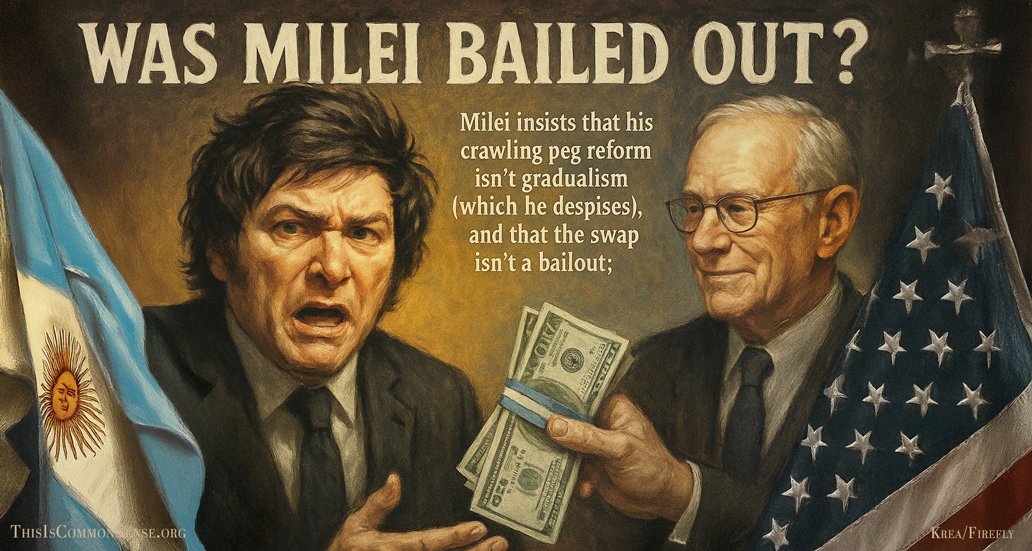
Milei insists that his crawling peg reform isn’t gradualism (which he despises), and that the swap isn’t a bailout; Bessant agrees, saying the swap’s “a profitable move for America.”

This is Common Sense. I’m Paul Jacob.


Note: Milei’s party gained in the most recent election.

PDF for printing

Illustration created with Krea and Firefly

See all recent commentary
(simplified and organized)
See recent popular posts
Categories
Common Sense

Higher Ed Jubilee?

“Everything is beautiful in its own way,” goes Ray Stevens’s hit song of 1970. But still, pay your bills. 

That’s what I thought reading a Fox Business story on a recent poll in which 42 percent of Americans, a plurality, thought that “President Trump’s administration should forgive all federal student debt in order to help stimulate the economy.”

Roughly 37 percent disagree, at least. Twenty-one percent were undecided.

For starters, justifying a huge financial giveaway to some citizens at the expense of other citizens as a way to help “stimulate the economy”? A sad commentary on the state of civic discussion.

Of course, this particular voter survey may have been concocted as nothing more than some capitalist PR plot by MoneyTips.com. Still, the numbers are believable, and with total student debt reaching $1.3 trillion — owed by some 44 million Americans — the subject is certain to come up again.

Let’s not forget, Bernie Sanders declared it a sin against public policy that Americans were not provided a free university-level education. I can hear his future oration, “We bailed out the banks for the one-percent. We can bail out the students!”

It should be a popular position on college campuses, cui bono and all.

“Drilling into the data, we found millennials (18-29) were especially passionate about student loan debt forgiveness, strongly agreeing with the idea nearly twice as much as those 50 and older,” confirmed MoneyTips co-founder Michael Dubrow. “Even if older people are still paying off their loans, younger people paid more and borrowed more for higher education.”

This sounds like a good reason to cut current subsidies, not increase them.

No. More. Bailouts.

This is Common Sense. I’m Paul Jacob.


Printable PDF


Categories
folly free trade & free markets meme moral hazard national politics & policies too much government

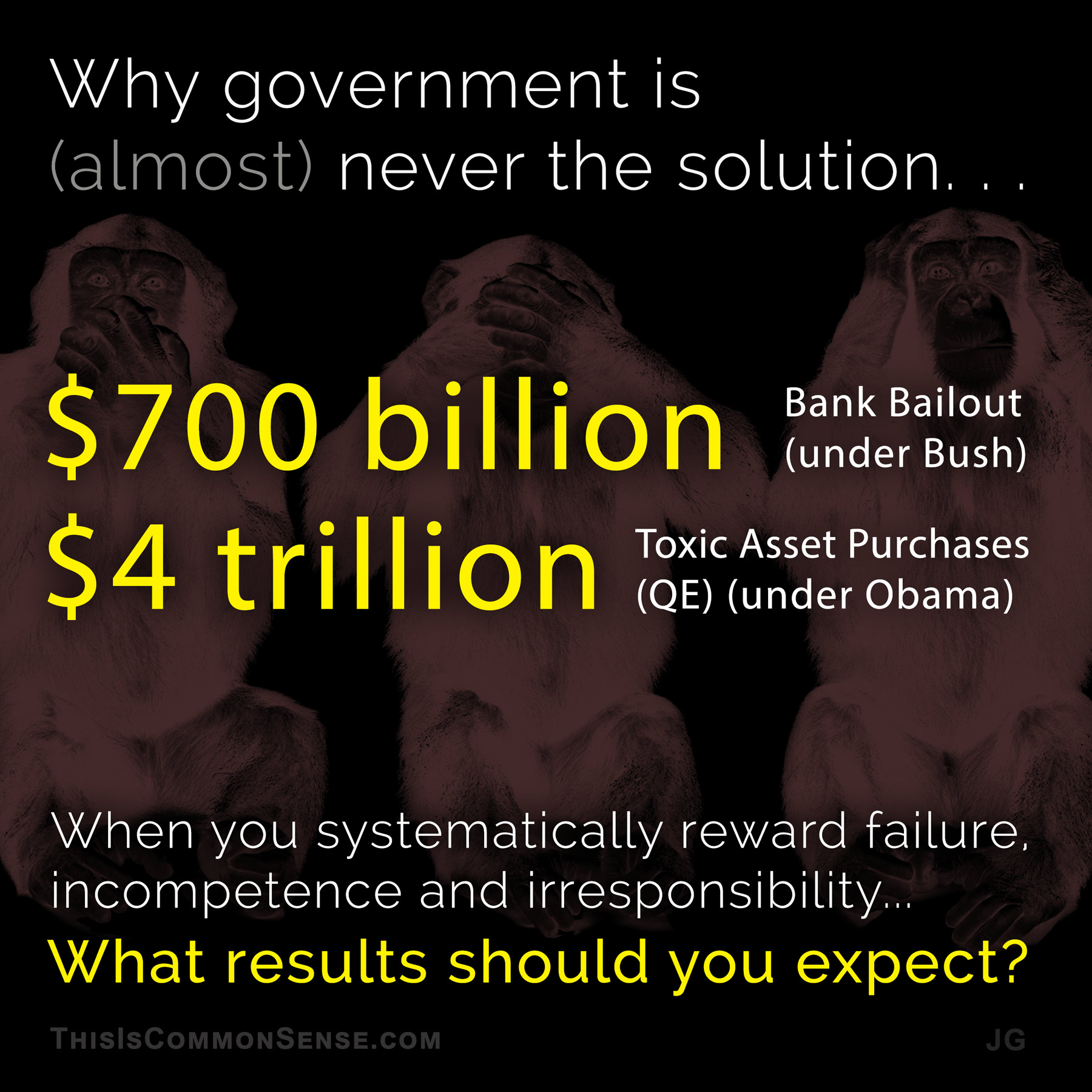
Why government is (almost) never the solution. . .

When you systematically reward failure, incompetence and irresponsibility…what results should you expect?

Bank Bailout

QE – Toxic Asset Government Purchases

Moral Hazard


Click below to get a high resolution version of this image:

big government, solutions, toxic assets, bank bailout, meme, illustration, Jim Gill, Paul Jacob, Common Sense


Categories
free trade & free markets national politics & policies

Our Fairy-Tale Economy

Everybody seems to hanker to get something for nothing. Because of that universal desire, and our inability to satisfy it, we have all these fairy tales about the tragic costs of magic.

Yes, the cost of something-for-nothing can be shockingly high. In some savvy tales, audacious hopefuls wind up giving away first-born children to pay for their something-for-nothing.

For half a year, our leaders have gone on a something-for-nothing binge, throwing money at a downturned economy. Lots of money. Trillions.

Where does it come from?

Magic?

Not exactly. Politicians and financiers use complicated tricky maneuvers to gain money they don’t have.

With the help of the Federal Reserve, they can sorta create money. But that creation has costs. It makes the money less valuable. We don’t always see this right away. Right now people are switching away from spending, so a lot of new money goes into savings. When people start spending again, though, prices will rise and money’s value will plunge. Gold into lead.

Politicians also get money by borrowing. But that also comes at a cost: It must be paid back. Here, politicians play an old fairy tale game, not exactly giving up their first-born, but saddling our children and grandchildren with debt. It’s a mean, wicked stepmother kind of policy.

Maybe we should be reading more fairy tales these days. For the realism.

This is Common Sense. I’m Paul Jacob.

Categories
national politics & policies too much government

Bailing Out of the Bailout

Freedom lovers would like to bail out of Washington’s endless bailout . . . that is, the government takeover of the economy.

The big spenders often won’t even debate the matter. Radio talker Rush Limbaugh is catching flak for saying he doesn’t want President Obama’s scheme to “work,” which sounds goofy until you realize that many of Limbaugh’s critics, including the White House, carefully ignore Limbaugh’s point. Economic upturn, great. Permanent loss of our freedom and permanent expansion of government, not great.

GOP congressmen aren’t exactly the most credible messengers when it comes to opposing massive new spending and intervention in the economy. But I’d rather see them repent and fight than repent and slink away in embarrassment.

Some Republican congressman are indeed fighting the good fight. And some of the nation’s GOP governors are too. Louisiana’s Bobby Jindal just turned down $100 million in bailout funds that he argues would result in permanently higher taxes for Louisiana businesses.

In a message distributed by Townhall, South Carolina Governor Mark Sanford notes that the trillion or more dollars “in so-called ‘stimulus’ money . . . is really little more than a social policy wish  list of the Left.”

We live in dangerous and interesting times. The only wish list worth pushing, now, is establishing the economic ground rules — and Constitutional principles — that should have been guiding us all along.

This is Common Sense. I’m Paul Jacob.

Categories
Accountability free trade & free markets too much government

Able to Raise Keynes

Recently on This American Life, economists told NPR listeners how the then-upcoming stimulus bill would amount to the very first legitimate and full test ever of Keynesian ideas.

Sure, politicians have been using John Maynard Keynes’s notions as an excuse to deficit spend ever since the Great Depression. But then, Lord Keynes had wanted politicians to spend even more, more than they dared.

Now, President Obama and our Democratic Congress have decided to spend enough billions, or trillions, to really do the trick.

Switch to Larry King’s latest interview with Bill Clinton. Our former prez assured us that the stimulus bill “would do what it is supposed to,” and he mentioned three things, only one of them vaguely about stimulus. He said the bill was better seen as a “bridge over troubled waters.”

Clinton said the real issue was declining asset values, which Congress would address later.

At Mises.org, Stephan Kinsella asked how this could amount to Keynesianism. Clinton used a different lingo entirely.

Here’s how: It’s not that the bill will give us Keynesian stimulus. It’s that it has stimulated politicians in the old, old Keynesian way.

Congressional Democrats know that the stimulus won’t work. So they are preparing the spin now. From them we heard the official excuse for the bill. From Clinton, the future excuse.

Politicians know zip about the economy. They just know how to spend our money. And our great, great, great grandchildren’s.

This is Common Sense. I’m Paul Jacob.

Categories
free trade & free markets government transparency

Keep Bailing?

Not too happy about the $700 billion financial bailout or billions more for the Big Three automakers? Don’t worry, that’s just peanuts!

The overall government “bailout” is quite a bit larger — as in ten times larger. The federal government — in other words, you and me (and our rulers) — is ready to provide more than $7.7 trillion to bailout whoever might need to be bailed out.

This includes $3.2 trillion already taken from the Federal Reserve by financial institutions. And it also includes money from the Federal Deposit Insurance Corporation and Federal Housing Administration mortgage guarantees.

The total amount of $7.7 trillion is equivalent to half our yearly gross national product. So, should families, when they get in financial trouble, borrow and spend half their yearly income? No, I think this is one of those “don’t try this at home” type deals.

When Congress approved the legislation for $700 billion to establish the Troubled Asset Relief Program (TARP), there was talk of the need for transparency. But there has been precious little transparency for all this other money spewing forth from the Federal Reserve and various government entities.

Paul Kasriel, chief economist at Chicago-based Northern Trust Corp. says, “given that the Fed is taking on a huge amount of credit risk now, it would seem to me as a taxpayer there should be more transparency.”

Yes, how about a smidgen of transparency? Or better yet, an end to all these bailouts.

This is Common Sense. I’m Paul Jacob.

Categories
free trade & free markets too much government

Unintended Consequences!!!

Here’s a revelation: A story headlined, “Bailout funds being spent in ways Congress never foresaw.”

What? Our omniscient congressmen failed to forecast the fate of their latest multifarious munificence?

You know, whenever I myself spend hundreds of billions on random questionable socialistic takeovers of the economy, I always demand an itemized account of exactly what I will get in return. Always.

It seems that the $700 billion just authorized by Congress is not only being spent on buying up troubled mortgages but is changing into a “broader bailout of all sorts of troubled businesses.” Some banks used the money to buy other banks instead of to “spur more lending.” And other recipients are paying dividends to stockholders.

Apparently, various central planners of our economy expected those receiving the money to use it in more publicly spirited fashion.

Such caviling ignores the real problem, which is more basic. You can’t cure the effects of gignormous debt creation and gignormous subsidizing of unwise enterprises with even more gignormous debt creation and gignormous subsidizing.

If massive intervention in markets caused the economy to curdle, roll back the massive intervention. Let investors take risks with their own money.

But don’t get drunk all over again, faster and harder, and expect that this time there won’t be any hangover.

This is Common Sense. I’m Paul Jacob.

Categories
national politics & policies Tenth Amendment federalism too much government

Unbefreakinlievable

Now what?

Well, now the governors are going to Washington to beg for bailouts. New York Governor Paterson and New Jersey Governor Corzine have schlepped their way up to the Hill to explain that they are “cutting all [they] can” from their bloated budgets, and to demand some “relief.”

I don’t believe that the notoriously corrupt governments of New York and New Jersey have pared their budgets to the bone. Or that the only way to cut another dollar is to throw some little old lady out onto the street.

I also don’t believe that the federal government has some magical way of getting money that state governments don’t have. It all comes from the same group of us taxpayers. Unless these governors are talking about taking cash from other states, where else would the money come from? Where but out of thin air — borrowing plus the trusty old printing press?

The feds are wearing the same blinkers as these gubernatorial guys. For example, the wizards at the Federal Reserve are struggling to bring interest rates to zero — as if cheap credit in the past had nothing to do with all the misbegotten easy mortgage loans spawning the present crisis.

Now, I put it to you: If fiscal irresponsibility can be increased from mammoth to infinity, will that, at last, solve the problem? If the Fed were to drop-ship crates of cash and credit cards onto every neighborhood in America, will that, at last, solve the problem?

Unbefreakinlievable.

We need some Common Sense. I’m Paul Jacob.

Categories
Accountability initiative, referendum, and recall

Why the People

Some people wonder at my support for initiative and referendum. They don’t place much trust in their neighbors to run their lives. They fear what de Tocqueville called “the tyranny of the majority.”

And hey: I don’t trust fellow voters to run my life, either. But I trust voters to let me be free to run my own life more a lot more than I trust politicians.

Voters will choose less government more often than their representatives will.

And less government, in today’s context, means better government.

This was most notably demonstrated in late September. The U.S. House of Representatives voted on the Bush administration’s proposed bailout of the mortgage industry, the biggest takeover of private property in world history.

To politicians, it made a whole heckuva a lot of sense. To Americans who wrote and phoned Congress, the bailout appeared just as it was: a quickie, panic “fix” that merely lined the pockets of a sector of the investor population.

It was a subsidy, socializing risk while letting profit remain private.

Enough Americans notified enough of their reps to convince them to take a stand, defeating the bailout. The letters came in, ten to one against the bill.

Of course, the next week Congress voted in the bailout, adding injury, in the form of a bigger price tag, to the insult of ignoring constituents.

Once again, politicians ignored the people. That’s never good government.

This is Common Sense. I’m Paul Jacob.