Categories
Accountability First Amendment rights general freedom ideological culture media and media people moral hazard nannyism national politics & policies Regulating Protest too much government

Dbl Standard Destruction Co.

Addison Barnes has just won a court case against Liberty High School of Hillsboro, Oregon. The court ruled that the school acted wrongfully when, early this year, it suspended him for wearing a “disruptive” T-shirt heralding a “Donald J. Trump Border Wall Construction Co.” 

Addison was awarded $25,000 for legal expenses, and the school has apologized to him, sort of, for the suspension.

“I brought this case to stand up for myself and other students who might be afraid to express their right-of-center views,” Addison says. “Everyone knows that if a student wears an anti-Trump shirt to school, the teachers won’t think twice about it. But when I wore a pro-Trump shirt, I got suspended. That’s not right.”

No, it’s not.

The outcome is imperfect. The apology offered by Liberty High does not acknowledge the glaring injustice of the suspension. It simply asserts that the school got the “balancing act” wrong between making students feel welcome and making them feel safe. (Because it is “unsafe” per se for kids to peacefully express political disagreements?) Nor was the teacher who imposed the suspension obliged to apologize personally.

Ideally, all schools would be privately owned, privately run. Then they could openly promulgate whatever silly policies they wished about what students may display on T-shirts, if anything. Market pressures would tend to discourage indefensible rules. 

But today’s schooling system is not ideal.

Have you noticed?

Meantime, let’s hope that the court’s decision will discourage other schools from imposing similar double standards.

This is Common Sense. I’m Paul Jacob.



PDF for printing


Categories
Accountability government transparency insider corruption local leaders media and media people nannyism national politics & policies political challengers Regulating Protest responsibility

Not Fine with Feinstein?

Could it be that Sen. Dianne Feinstein, Democrat of California, may not be liberal enough?

The San Francisco Democrat has ostensibly represented the Golden State in the United States Senate for the last 26 years. Before that, Feinstein spent eight years on San Francisco’s Board of Supervisors and then a decade as mayor.

Now, after 44 consecutive years as a public official, what does the 85-year-old Feinstein seek? More. That is, another six-year lease on her powerful perch in the U.S. Senate.

But the Executive Board of the California Democratic Party — Feinstein’s Party — just said, “No way!”

A whopping 65 percent of the 333-member board opted for State Sen. Kevin de León, a fellow Democrat seen as more “progressive.” Only seven percent supported endorsing Feinstein.

Keep in mind that Feinstein is already on the November ballot. She was the leading vote-getter in California’s primary last month. Yet, she received only 44 percent of the vote: a majority does favor someone else.

In February, 2,700 activists at the State Democratic Party Convention in San Diego voted 54 to 37 percent for State Sen. De León over U.S. Sen. Feinstein.

“Feinstein, who spends much of her time in Washington, has had a distant relationship with party activists for years,” noted the Los Angeles Times report.

Still, what Democratic Party activists want may not matter so much. Mrs. Feinstein enjoys tremendous name recognition and, according to the Times, has “$7 million in campaign cash socked away as of May, ten times what De León had.”

That money seems to be Sen. Feinstein’s real base of support.

This is Common Sense. I’m Paul Jacob.



PDF for printing


Categories
Accountability crime and punishment government transparency media and media people moral hazard national politics & policies Regulating Protest responsibility

The Deeply State

FBI agent Peter Strzok is offended.

Deeply.

He takes pains to clarify: he sent emails during the last presidential campaign expressing a willingness and readiness and commitment to preventing a Trump Presidency because he, Agent Strzok, is patriotic.

Deeply.

During yesterday’s contentious congressional interrogation, fielding questions regarding just how anti-Trump he was during the last presidential campaign, Peter Strzok denied that his obvious and admitted political bias affected his professional conduct.

“Like many people, I had and expressed personal political opinions during an extraordinary presidential election,” said Agent Strzok. “My opinions were expressed out of deep patriotism.”

But it wasn’t just a matter of expression, was it? One text message was an assurance that he would “stop” Trump’s election. When challenged on this, Strzok admitted that his memory was faulty.

Deeply?

“At no time, in any text,” Strzok said, decisively, “did those personal beliefs enter into the realm of any action I took.”

When a citizen expresses a credible threat to a president, federal agents investigate. His exchange with his “girlfriend,” Lisa Page, was not what we now call an “existential threat,” of course. Ms. Page had texted her worry about a Trump win: the man was “not ever going to become president, right? Right?!” Strzok’s reply was not vague: “No. No he won’t. We’ll stop it.” The threat is, at most, covert-political, back-room. FBI-ish. The couple were, after all, a part of an investigation into Donald Trump’s alleged Russian connection.

Though one could easily understand a married man assuring his inamorata simply to puff himself up in her eyes, this assurance sure looks different to our eyes — it cannot help but make us suspicious.

Deeply.  

This is Common Sense. I’m Paul Jacob.



PDF for printing


Categories
Accountability First Amendment rights folly general freedom ideological culture media and media people moral hazard nannyism national politics & policies Regulating Protest too much government U.S. Constitution

Freedom “Weaponized”

Justice Elena Kagan has a way with words. The conservative majority on the court, she said after two recent rulings, is “weaponizing the First Amendment.”

What a phrase! But what does it mean?

“Conservative groups, borrowing and building on arguments developed by liberals,” explains The New York Times, “have used the First Amendment to justify unlimited campaign spending, discrimination against gay couples and attacks on the regulation of tobacco, pharmaceuticals and guns.”

First: if “liberals” now find themselves not supporting the idea of particular freedoms, or freedom in general, are they really “liberal”?

Second: “borrowing arguments” is what we expect to happen. Logic isn’t partisan.

Third: the point of the Bill of Rights is to “weaponize” the defense of freedom.

Remember, it is freedom of speech; freedom of the press; freedom of association; freedom of exercising one’s religion. The First Amendment weaponizes their defense by disallowing Congress from legislating against them.

Now, it has long been a “problem” that these listed freedoms blend together. They all work together or don’t work at all. And each points to freedom more broadly.

Kagan wants to read freedoms narrowly — though liberals historically have, indeed, read them broadly.

She’s objecting to two recent rulings. The first prohibits states from requiring pregnancy centers to talk up abortion options to their clients. An obvious free speech issue. The second prohibits governments from backing unions in their extraction of “agency fees” from non-members. An incontrovertible issue of freedom of association.

Kagan and The New York Times apparently think that “liberalism” means defending some freedoms in some contexts, but denying freedom in others.

This is Common Sense. I’m Paul Jacob.



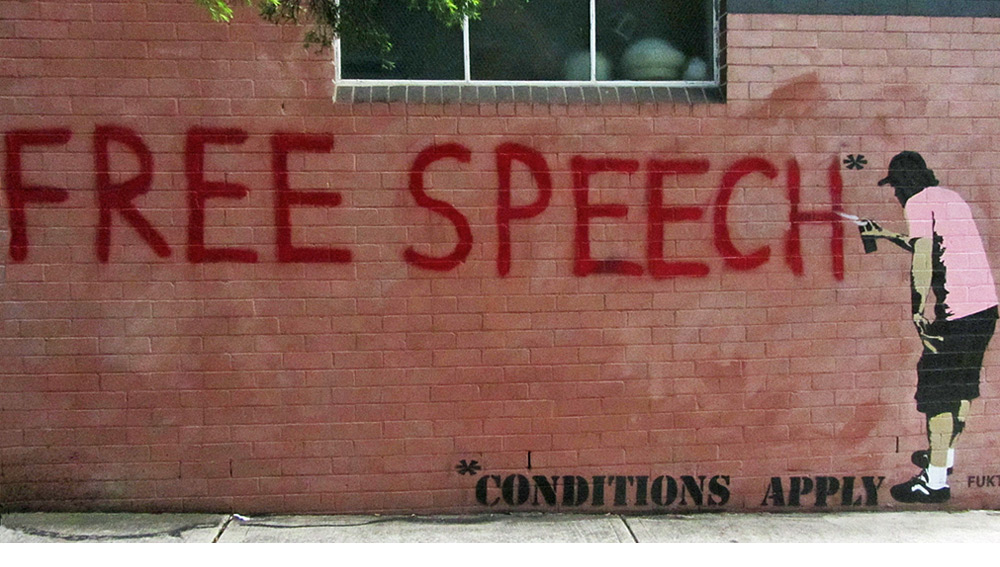
Illustration by Newtown grafitti


Categories
crime and punishment general freedom ideological culture moral hazard nannyism political challengers privacy Regulating Protest too much government

Don’t Enable Tyrants

If I deliberately help somebody to do evil things — and nobody is holding a gun to my head — I am thereby doing evil myself.

A person should not let himself be in that position. Not even if he’s “just doing my job” and looking for a non-evil job would be demonstrably inconvenient. To have a motive for doing a bad thing is not by itself exculpatory.

What provokes this observation is a newly amplified assault by the Venezuelan government on the rights of its citizens. The government is seeking to violate the right to peacefully read stuff on the Web by blocking Tor software, which allows users to elude government surveillance and reach banned websites.

Venezuelan dictators Chavez, now dead, and Maduro, still there, have never hesitated to stomp freedom in the name of a spurious greater good. Somebody like Maduro is certainly unscrupulous enough to go after Tor for thwarting censorship. So he fulfills that requirement. I doubt that he possesses very extensive programming ability.

Tor may not be perfect, but it’s pretty robust. You need substantial resources, such as those at the disposal of a government, to stop it. You also need to know what you’re doing. The coders on Venezuela’s stop-Tor team are probably smart enough to grasp the purpose of their work.

They and all other such collaborators should defect to the other side: that of programmers working to protect innocent people from government-sponsored cyber-assault.

This is Common Sense. I’m Paul Jacob.



PDF for printing


Categories
Accountability crime and punishment First Amendment rights general freedom ideological culture national politics & policies political challengers Regulating Protest

Assaults Not Allowed

Have Americans forgotten that freedom makes getting along easier?

We do not all have to like each other. We do not even all have to be nice to each other. We just don’t have license to hit or hornswoggle our fellows. Hate speech may be bad, but it is hate assaults — not talk — that should be punished by law.

Yes, free people are at liberty to insult each other, call each other nasty names, even demean each other. And those insulted, besmirched, and dissed may return in kind or shrug the negatives off.

But we needn’t let it go at that.

Bill Ottman, founder and CEO of Minds.com, reminds us that there is more than one way to skin a hate. When coming across vile nonsense and worse, “the most important question is how we deal with these situations,” he writes.

We may be able to find the answer in the work of Daryl Davis, a famous blues musician with a hobby of  befriending members of the Ku Klux Klan. According to him: “Once the friendship blossoms, the klansmen realize that their hate may be misguided.” By having dinner with Klansmen, he has inspired over 200 members to give up their robes.

Ottman goes on to call for a concerted effort to reclaim a future for “internet freedom and human rights.” That’s a good idea.

Don’t accept the premise that, to get along, we must squelch speech. Instead, ignore disagreeable people trying to make us feel bad.

And look for ways to persuade those who hate us.

We can be adults about this. And keep freedom of speech.

This is Common Sense. I’m Paul Jacob.


PDF for printing


Categories
Accountability crime and punishment general freedom ideological culture media and media people moral hazard nannyism national politics & policies privacy Regulating Protest Second Amendment rights U.S. Constitution

Brownells Defends Itself

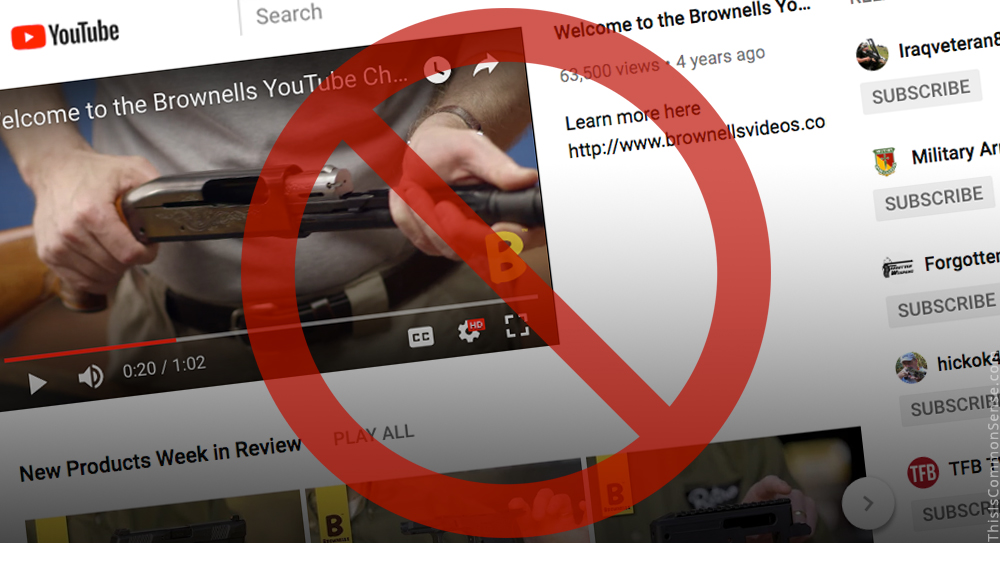
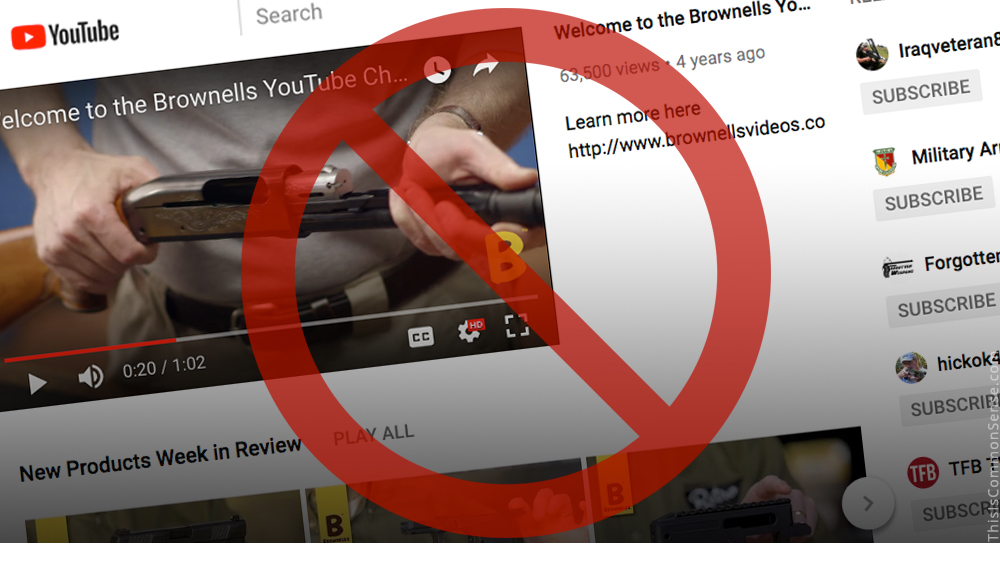
I’m glad to be able to say this: Brownells has, present tense, a YouTube channel. Especially glad because, on June 9, Google had shut that channel down without warning or explanation.

Brownells is a family-owned supplier of firearms, firearm parts and accessories, gunsmithing tools, and emergency gear. Well-known and well-regarded by shooters, hobbyists and gunsmiths, the company has a website and a YouTube channel that serves as a “portal to everything shooting and hunting,” as Pete Brownell explains.

Brownells’ YouTube channel is substantial, with almost 1,800 instructional videos and some 71,000 subscribers. Patrons stress that there’s nothing outré, radical, or offensive about the offerings — unless you’re reflexively anti-Second Amendment, I guess.

We’ve got no smoking gun in the form of an explicit admission from Google. But we may plausibly suspect that the firm terminated this YouTube channel for ideological reasons. Perhaps Google shot from the hip here in reaction to the recent spate of school shootings, without pausing to properly distinguish between promoting responsible gun ownership and promoting murder.

We may also never know whether Google expected Brownells to meekly accept the arbitrary snuffing of a resource it had spent so much time and energy developing. In any case, Brownells used Twitter and other forums to urge supporters to call Google and object.

The self-defense paid off. On June 11, Google undeleted the channel. The protests against injustice must have been too many to ignore.

YouTube is no longer a mere platform for video sharing. It has taken political controversy and complaints as excuses to editorialize.

Were it a government, I’d say “censor.”

This is Common Sense. I’m Paul Jacob.


PDF for printing


Categories
Accountability general freedom ideological culture insider corruption media and media people property rights Regulating Protest

Ortega’s Got to Go

Sometimes “if it bleeds, it leads” fails us. Only a few news outlets have given much attention to Nicaragua’s ongoing atrocities.

Weeks ago, mothers of some of the 76 people, mainly students, already killed protesting despot Daniel Ortega, were leading a march demanding justice . . . “when gunmen opened fire on the crowd.” The Washington Post report continued, “Witnesses have accused police and their civilian allies of initiating the violence that left as many as 18 people dead and more than 200 wounded.”

The June 2 headline summed up the last seven weeks: “At least 100 killed in Nicaragua as political violence intensifies.”

But time and tyranny march on. “Every day they’re killing more people,” an attorney with the Nicaraguan Center for Human Rights told the Post. Friday, the group updated the death toll to 137.

Then on Saturday, the English-language Today Nicaragua informed that a 60-year-old man was cut down by a government sniper in Masaya, the former Sandinista stronghold, which is “now under almost total rebel control.”

What can we do?

We can educate ourselves on what’s happening — and pester more news organizations to cover Nicaragua.

We can learn from the experiences in Cuba, in Venezuela, and now in Nicaragua, that leaders seeking awesome powers to remake society to supposedly benefit the poor are ultimately batting zero in helping the poor. Instead, they’re busy at the plate for themselves.

And we can add our voices to Amnesty International’s condemnation of what it calls “the systematic ‘shoot-to-kill’ policy of President Ortega’s government.”

When governments open fire on peaceful protesters, it is past time for those governments to go.

This is Common Sense. I’m Paul Jacob.



PDF for printing


Categories
Accountability general freedom incumbents insider corruption local leaders moral hazard political challengers Regulating Protest term limits

Missouri Shows Article V Action

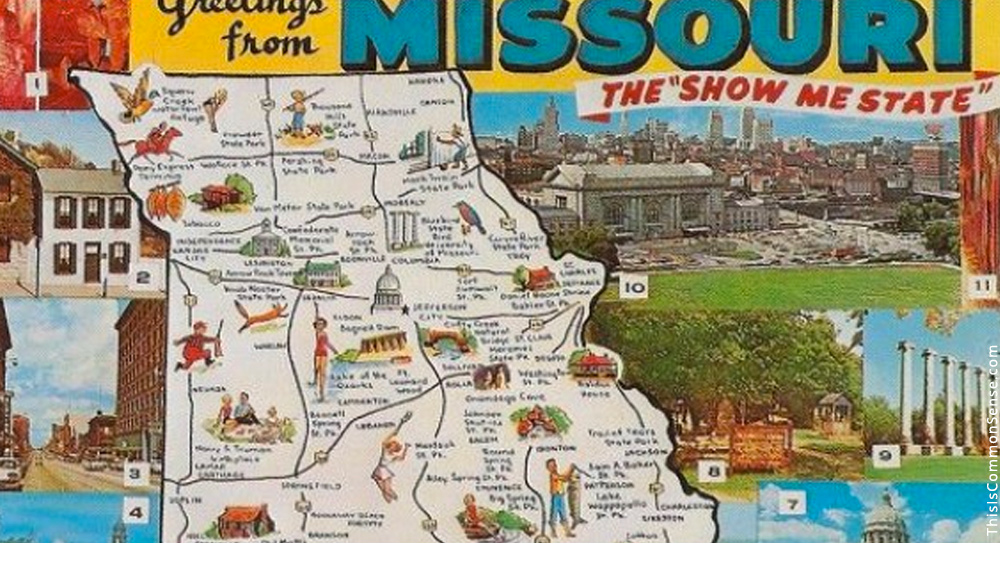
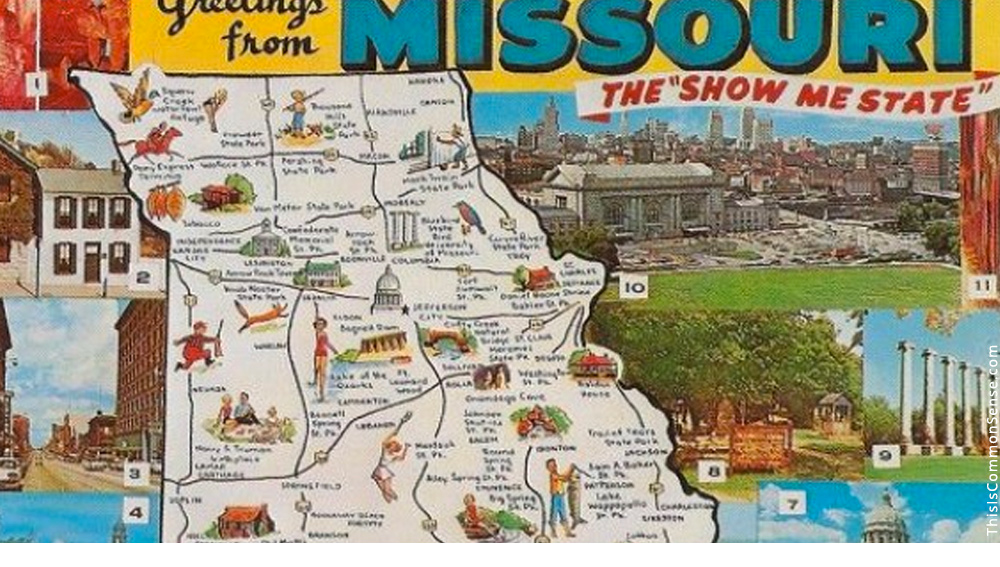
There’s good news and there’s good news from the Show Me State.

First the good news. The Missouri House declined to follow the lead of the Missouri Senate during its recent legislative session in advancing a ballot measure to make a travesty, mockery and sham of state legislative term limits.

The proposed weakening of the limits would have doubled maximum legislative tenure from eight years to 16 years. Further, it would also have excluded terms already served from counting toward the new limit.

Had the measure ultimately been enacted, some incumbents would have been able to sit in a single seat for up to 24 years. This assault on term limits is dead . . . at least until next year.

Now the good news. The lawmakers deserve high praise for issuing a formal call for an amendment convention to consider the single subject of congressional term limits, making Missouri the third state to do so (after Florida and Alabama). In mid-May, the resolution for a Term Limits Convention easily passed in both chambers.

Thanks to a provision in Article V of the Constitution, if two thirds of the states (34 states) submit a similar application to convene a term limits amendment convention, the convention must be convened. The amendment that the convention produces would then be submitted to the states for ratification. Three fourths (38) are required to ratify.

We’re only in the first-steps stage here, but first steps are crucial.

Thanks for showing us how to do it, Missouri.

This is Common Sense. I’m Paul Jacob.



PDF for printing

Missouri, show me, Article V, term limits, legislature, congress,


Categories
crime and punishment general freedom ideological culture initiative, referendum, and recall local leaders national politics & policies political challengers property rights Regulating Protest too much government

A Sanctuary from Centralization

Defiance . . . nullification. It is a trend.

I take it as a sign of our contentious times that we now witness states in open rebellion against centralized control from the Imperial City of Washington, D.C., while cities and counties are also rattling the chains set by their respective state capitals.

The sweep of marijuana decriminalization and legalization is only the most obvious. The rise of “sanctuary cities” defying federal government immigration laws — often backed up by state legislatures — has been a contentious issue, with progressives supporting this sort of nullification and conservatives opposing it.

But the latest development does not hail from the left.

In Illinois, a number of rural governments have taken a cue from the immigration debate by “declaring themselves sanctuary counties for gun owners,” we learn from the AP’s Don Babwin, writing in the Chicago Tribune. “The resolutions are meant to put the Democratic-controlled Legislature on notice that if it passes a host of gun bills . . . the counties might bar their employees from enforcing the new laws.”

An Effingham County Board Member calls “sanctuary” an attention-getting “buzzword,” reporting that “at least 20 Illinois counties and local officials in Oregon and Washington have asked for copies of Effingham County’s resolution.”

Now, cities and counties do not have an analogous relationship to their state governments as do states to the federal government: the states created the “United States of America,” while cities and counties are also state creations.

Yet this move is important. It shows a growing recognition of the tyrannical nature of centralized power.

And the usefulness of decentralization.

This is Common Sense. I’m Paul Jacob.

 

PDF for printing