Categories
Common Sense general freedom ideological culture

Two Days & 50 Years

Tomorrow is Independence Day in these United States.

But so was yesterday.

It was in the papers:

This day the Continental Congress declared the United Colonies Free and Independent States.

Pennsylvania Evening Post, July 2, 1776.

For it was two days before revising and accepting Thomas Jefferson’s Declaration of Independence that Congress officially declared its independence from King George III.

This Common Sense site has explained this quirk of history before. The Lee Resolution of July 2 declared that

  • the colonies should be “free and independent States”
  • they were “absolved from all allegiance to the British Crown” and that the connections should be “totally dissolved”
  • New “foreign Alliances” should be formed
  • And a “plan of confederation be prepared and transmitted to the respective Colonies for their consideration and approbation.”

Congress also commanded that a declaration be drawn up, and it was done quickly, accepted two days later.

The confederation document, on the other hand, took another year to work up, and four years beyond that to adopt.

John Adams, for all his faults as the Second President under the later U.S. Constitution, was a true friend of liberty and regarded the day as historic. “The second day of July, 1776,” he prophesied, writing to his wife on July 3, 1776,

will be the most memorable epoch in the history of America. I am apt to believe that it will be celebrated by succeeding generations as the great anniversary festival. It ought to be commemorated as the day of deliverance, by solemn acts of devotion to God Almighty. It ought to be solemnized with pomp and parade, with shows, games, sports, guns, bells, bonfires, and illuminations, from one end of this continent to the other, from this time forward forever more.

He was off by two days. It was the Fourth that would be celebrated.

Fifty years later he was off by much less: he died on July 4, 1826, uttering “Thomas — Jefferson — still surv —”

Jefferson had died a few hours earlier.

This is Common Sense. I’m Paul Jacob.


PDF for printing

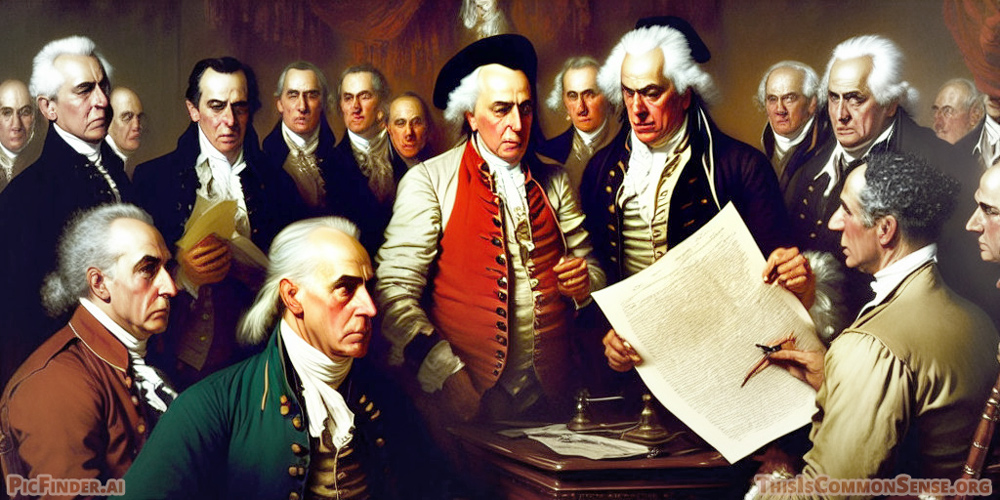
Illustration created with PicFinder​.ai

See all recent commentary
(simplified and organized)
See recent popular posts
Categories
general freedom ideological culture media and media people

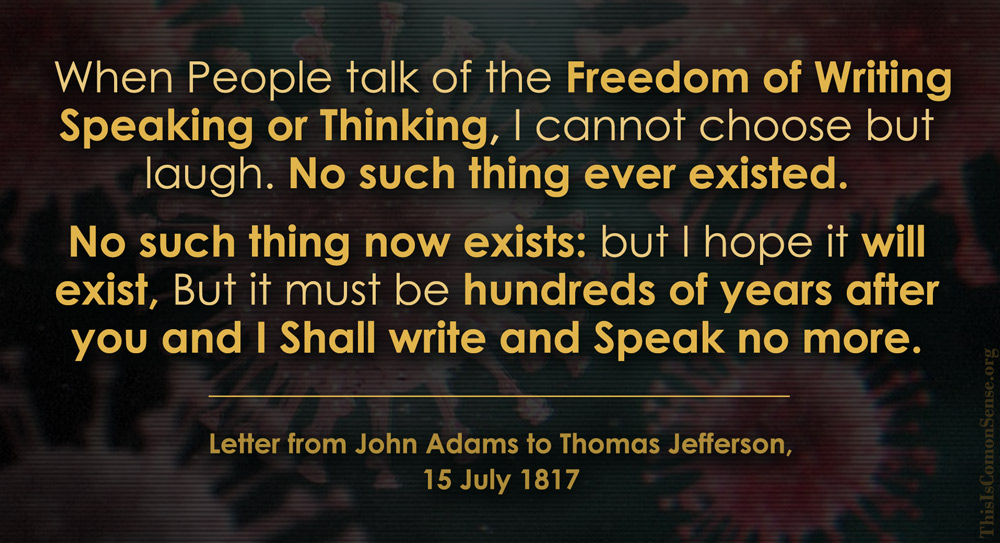
Lockdown and Shut Up

“I think it’s a shame,” HBO comedian Bill Maher told Dr. David Katz, “that people like you who sound reasonable — maybe it’s not the exact one true opinion you hear somewhere else — has to go on Fox News to say it.”

For years, I have told liberal friends that they miss important stories by not paying attention to Fox, because most other TV media eschew non-​progressive perspectives they oppose (but perhaps fear we might support).

Last month, Katz wroteNew York Times op-​ed, entitled, “Is Our Fight Against Coronavirus Worse Than the Disease?” Rather than the current lockdown strategy, the physician advocates “a middle path” where “high-​risk people are protected from exposure” and “low-​risk people go out in the world.”

Once upon a time, social media promised regular folks a chance to communicate and even organize without government interference or media filters. 

Not so much these days. 

Last week, I decried Facebook removing posts informing people about planned anti-​lockdown protests, reportedly “on the instruction of governments” in California, New Jersey, and Nebraska because those protests might violate “stay-​at-​home orders.”

This week, YouTube removed a video that you and I must not see, with California Drs. Dan Erickson and Artin Massihi explaining why they think the lockdowns are bad policy.* 

“Anything that would go against World Health Organization recommendations,” clarified YouTube CEO Susan Wojcicki, “would be a violation of our policy” — and will be blocked. 

Our society’s first principle is freedom of expression.

The idea? Unfettered information will best lead us to the truth. 

Increasingly, our social media and news outfits no longer trust us with information not heavily controlled by them. 

Which means we cannot trust them.

This is Common Sense. I’m Paul Jacob.


* The doctors also confirm, as I suggested might happen, that medical personnel are being pressured to “add COVID” to death reports. 

PDF for printing

John Adams, Thomas Jefferson, free speech, 1st Amendment, First Amendment,

See all recent commentary
(simplified and organized)
See recent popular posts
Categories
term limits

Democratic-​Republican Day

“We live in a republic,” I often hear, “not a democracy!”

Sometimes it seems like we live in neither.

Today is the first National Term Limits Day. Its proponents aim to style February 27th as an annual event. 

It’s a new thing. 

But term limits themselves are not new.

For instance, 68 years ago today, the 22nd Amendment was ratified, limiting the president to two lifetime terms.

Long, long before that, ancient Athens — often called a democracy — term-​limited elected offices, as was done in Rome — which was called a republic.*

The idea being that, if the people are to rule, in even a loose sense, those who hold office must not be permanently perched, able to acquire increasing amounts of power and privilege.

To accomplish this, elections serve as ways to rotate people into and out of power. Unlike in hereditary monarchy or military rule, elections of “rulers” to positions of power require the establishment of terms in office, a set period of time that limits those in power by requiring elections to renew their service for another term, or peaceably to oust them.

A term limit takes the next step, disallowing an individual from staying in office for life by limiting the number of terms legally available.

Thomas Jefferson was upset that the new Constitution, devised in convention in 1787, did not have provisions ensuring “rotation in office,” via term limits. He was what was then called a “democratic republican.”**

Whether you call it “democracy” or “republic,” or something else, citizens being in charge of government is something we could use more of. The United States has term limits for the presidency, for 15 state legislatures, for elected officials in eight of the ten largest cities. We need them for Congress most of all.

This is Common Sense. I’m Paul Jacob.


* O’Keefe, Eric (2008), “Term Limits,” in Ronald Hamowy, The Encyclopedia of Libertarianism, Thousand Oaks: SAGE; Cato Institute. pp. 504 – 06. “Political scientist Mark Petracca has outlined the importance of rotation in the ancient Republics of Athens, Rome, Venice, and Florence.”

** Alexander Hamilton, infamously, leaned the other direction: in his first speech at that first constitutional convention he argued to elect a national king to serve for life. He was a nationalist, in those days called a “Federalist.”

PDF for printing

Thomas Jefferson, term limits, democracy, Democratic-Republican,

See all recent commentary
(simplified and organized)
See recent popular posts


Categories
Accountability folly general freedom ideological culture media and media people moral hazard nannyism national politics & policies too much government U.S. Constitution

Statues and Limitations

“Should they take down the Jefferson Memorial?” 

That is what PBS’s Charlie Rose asked Al Sharpton. Now, the “Reverend” is not my go-​to source for political insight, but his answer* caught my attention. 

“I think that people need to understand that, when people that were enslaved and robbed of even the right to marry and had forced sex with their slave masters, this is personal to us,” replied Rev. Sharpton. “My great-​grandfather was a slave in South Carolina … Our families were victims of this.”

Asked if this precluded “public monuments” for “everyone associated with slavery,” Sharpton argued: “When you look at the fact that public monuments are supported by public funds, you are asking me to subsidize the insult to my family.”

One can attack the messenger, Sharpton, sure. But what if we instead think of him as our neighbor? I certainly wouldn’t want to insult a neighbor, much less make him pay for the privilege. 

Notably, the Reverend embraced privatization, suggesting, “You have private museums.” Privatizing controversial monuments would certainly solve Sharpton’s stated problem.

Of course, the logic behind taking down statues or dismantling the Jefferson Memorial — or merely privatizing them — might also lead to changing the names of cities, counties and states, rivers and mountains. And it’s not just Washington and Jefferson — twelve presidents were slave owners, including Union General U.S. Grant.

Who knows how many are undeservedly memorialized?

Frankly, I’ve never liked the name of my Virginia county: Prince William. A liberty-​loving people ought not be stuck with such a monarchial brand.

Let the people decide. 

But by vote, not street brawl.

This is Common Sense. I’m Paul Jacob.


* This exchange begins at the 15:22 mark in the interview.


PDF for printing


Categories
general freedom individual achievement

Jefferson’s Achievements

In 1743, on April 2, Thomas Jefferson was born. But the old Julian calendar was superseded in 1752, so we now mark his birthday as April 13.

Thomas Jefferson wrote the first draft of the United States’ Declaration of Independence. He authored the State of Virginia’s Statue of Religious Freedom, which disestablished the Episcopalian Church, thus officially beginning the long process of what he referred to as “building a wall of separation between Church and State.”

He followed Patrick Henry as Governor of Virginia, and was in that position when it was attacked by British forces (led by Benedict Arnold and Gen. Cornwallis). He later served as the first Secretary of State of the new union, and then as its second Vice President and third President. He wrote one book, Notes on the State of Virginia (1785), and translated several others, including Volney’s Ruins of Empires (1802) and Destutt de Tracy’s A Treatise on Political Economy (1817). He designed the first campus of the University of Virginia, and managed its founding.

Thomas Jefferson was a man of achievement, yes; but mostly he is associated with the idea of freedom.

Yet, he was also a slave-​owner. His several attempts to limit the severity and extent of slavery were mostly beaten back. And his personal involvement with slaves (he likely sired several children with his late wife’s half sister, a slave) was even more tangled.

Some people say this disqualifies Jefferson from current praise.

I’m not in that camp. It seems to me less than honest not to esteem him for helping us declare that “all men are created equal” … and outright foolish to ignore Mr. Jefferson’s lifelong agitation for a more equal freedom under law.

This is Common Sense. I’m Paul Jacob.


Printable PDF

Thomas Jefferson, birthday, slavery, freedom


Common Sense Needs Your Help!

Also, please consider showing your appreciation by dropping something in our tip jar  (this link will take you to the Citizens in Charge donation page… and your contribution will go to the support of the Common Sense website). Maintaining this site takes time and money.

Your help in spreading the message of common sense and liberty is very much appreciated!


Categories
meme national politics & policies responsibility

Trump’s Empire?

The next president will take office as this year’s $544 billion deficit pushes up the U. S. national debt to nearly $20 trillion … which is chicken feed compared to nearly $127 trillion in unfunded liabilities racked up by our entitlement state.

And, on top of that, add our outrageous world policeman fees.

The Washington Post reports that, “thanks to various treaties and deals set up since 1945, the U.S. government might be legally obligated to defend countries containing 25 percent of the world’s population.”

And boy, has America, World Policeman, been active!  The U. S. military is well into a second decade of wars in Iraq and Afghanistan, engaged in ongoing armed conflict in Libya, Pakistan, Somalia, Syria and Yemen, and with ISIS and its terror, not seemingly degraded at all but growing.

No wonder, then, that the iconoclastic Donald J. Trump questioned — at a Washington Post editorial board meeting, just before the Brussels terrorist attacks — the wisdom of U.S. commitments to NATO, South Korea and Japan.

“NATO was set up when we were a richer country,” Trump explained. “We’re not a rich country. We’re borrowing, we’re borrowing all of this money. We’re borrowing money from China.…”

So why subsidize wealthy countries? “Well, if you look at Germany … Saudi Arabia … Japan … South Korea — I mean we spend billions of dollars on Saudi Arabia, and they have nothing but money.”

Lest I get my hopes up too high, it seems unlikely that Trump would change actual policy, but simply make “a much different deal with them, and it would be a much better deal.”

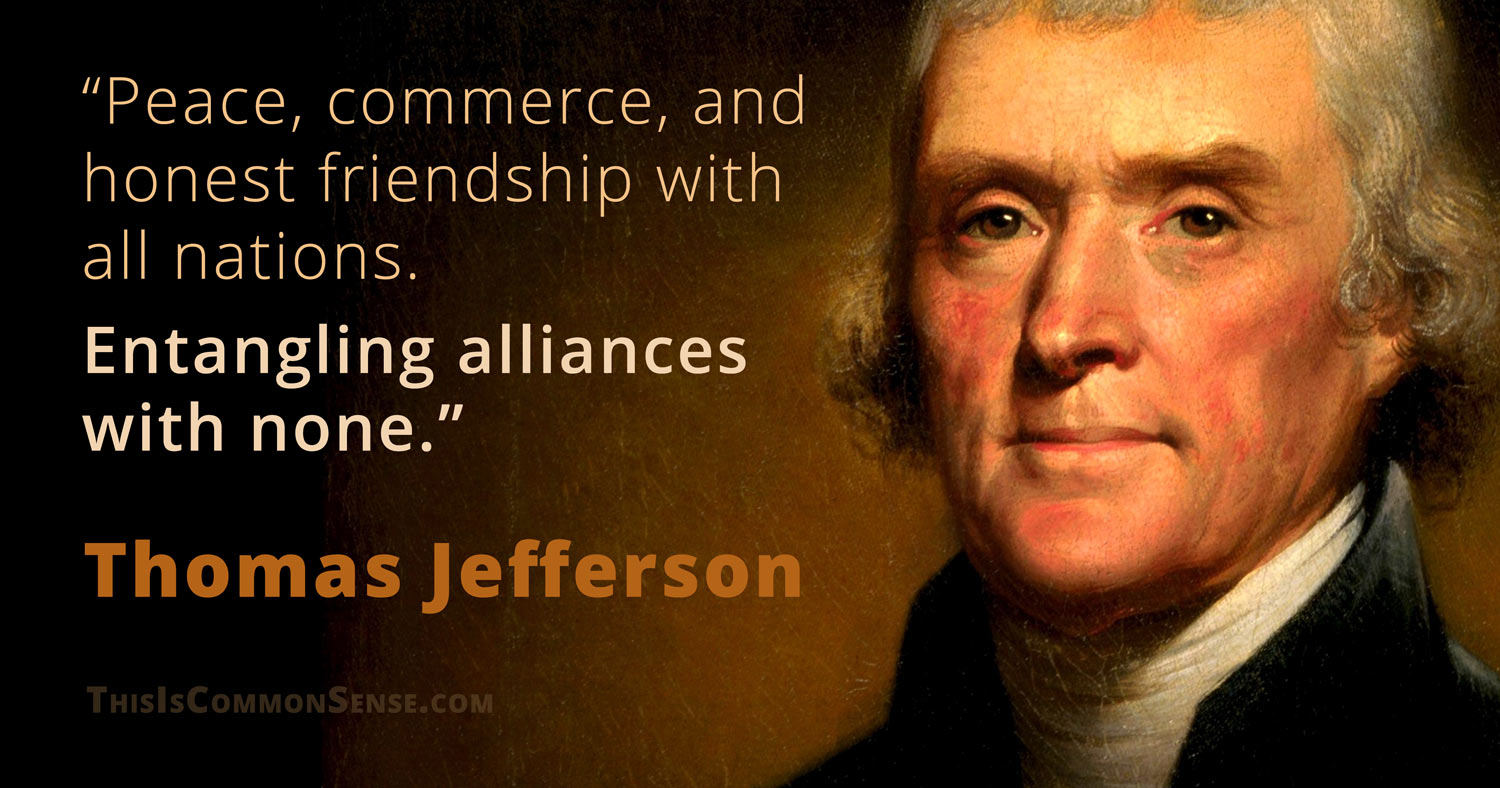
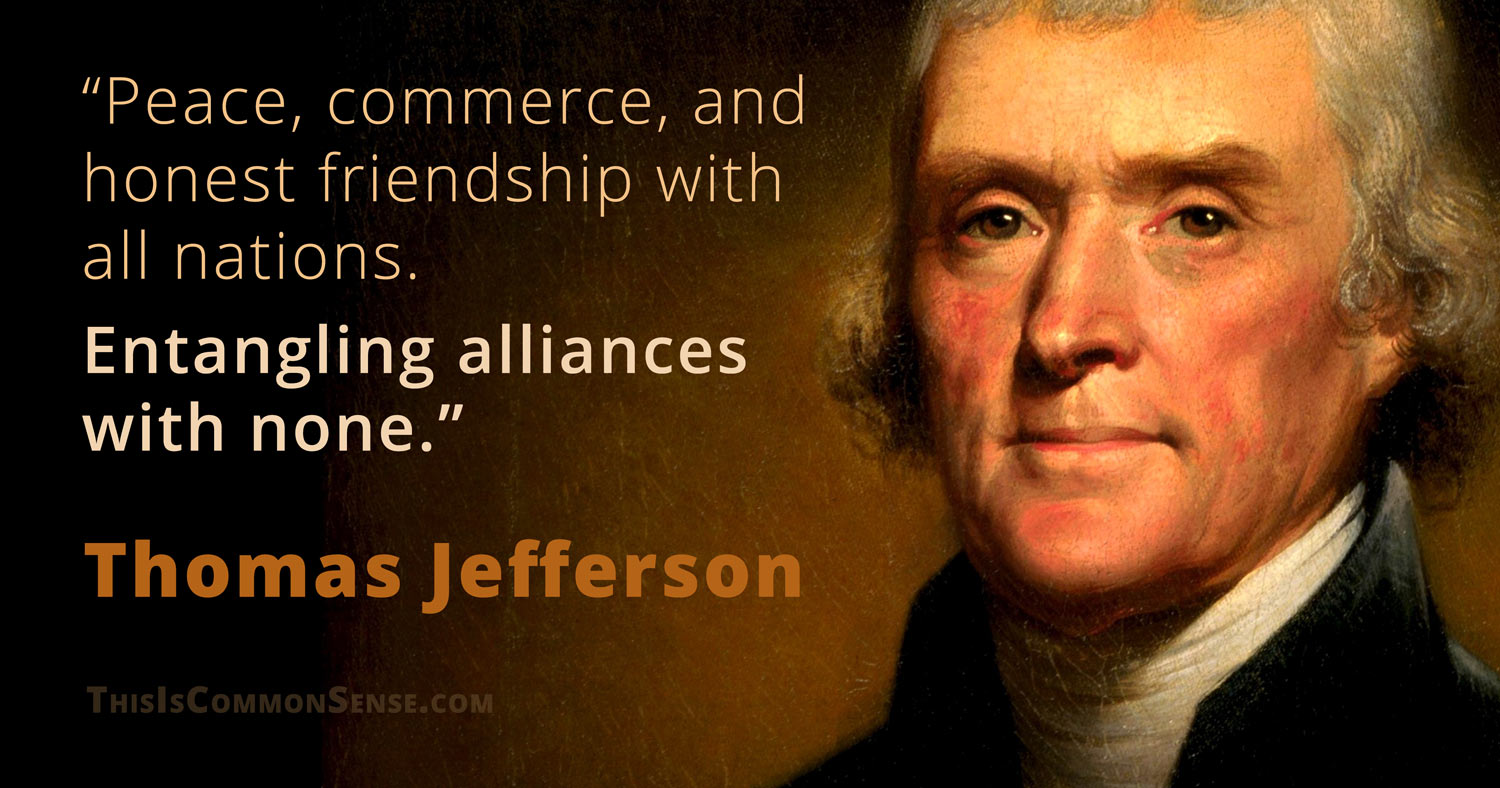
Here’s an even better deal, as our third president, Thomas Jefferson, articulated: “Peace, commerce, and honest friendship with all nations. Entangling alliances with none.”

It’s quite affordable.

This is Common Sense, I’m Paul Jacob.


Printable PDF

Donald Trump, Thomas Jefferson, empire, entangling alliances, meme


Common Sense Needs Your Help!

Also, please consider showing your appreciation by dropping something in our tip jar  (this link will take you to the Citizens in Charge donation page… and your contribution will go to the support of the Common Sense website). Maintaining this site takes time and money. Your help in spreading the message of common sense and liberty is very much appreciated!


Categories
general freedom individual achievement U.S. Constitution

The Ruins

We have just learned something interesting about the nastiest presidential election in American history.

No, not this year’s. It’s not the nastiest … yet.

It is about the election of 1800, when Thomas Jefferson beat back the Federalist Party and its Alien and Sedition Acts.

The Federalists made much of fears that the freethinking Jefferson would suppress Christianity. Some folks are said to have buried Bibles in their backyards, for safe keeping.

Overkill, sure. Jefferson was quite earnest in his support for religious freedom, as he famously wrote to the Danbury Baptists. (Jefferson garnered overwhelming Baptist support.) But he was a freethinker.

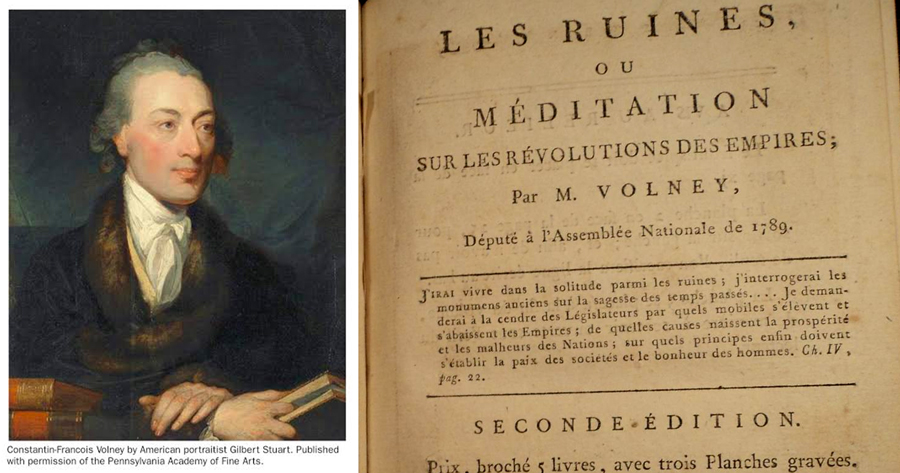
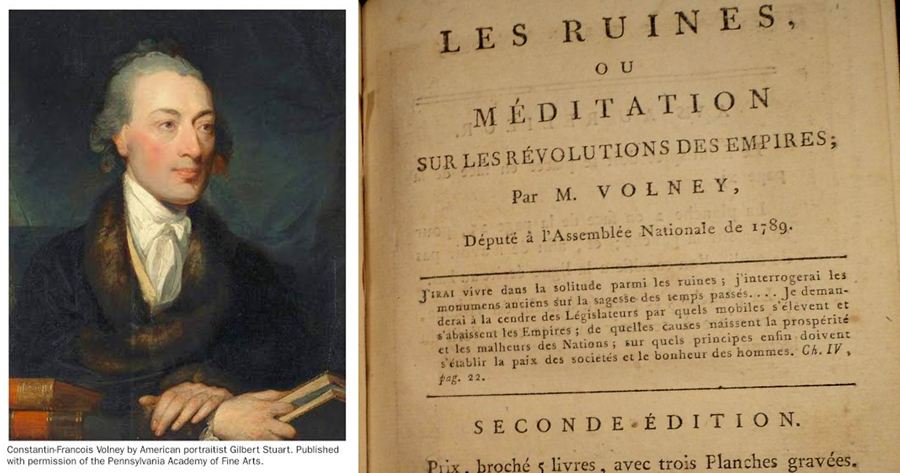
So much so that, in the year leading up to the big race, Jefferson translated all but the last chapters of C.-F. Volney’s The Ruins of Empires. This secret was uncovered recently by Thomas Christian Williams, who found in the Boston archives of the Massachussetts Historical Society many chapters of The Ruins, in English, in Jefferson’s hand. Williams wrote up his discovery in the March 2016 issue of The Skeptic, Michael Shermer’s journal.

The Ruins — once infamous, now almost forgotten — is mostly devoted to advancing a very deep view of the importance of limited government. Only the last few chapters, which Jefferson left to somebody else to translate, engage in a skeptical account of religion.

But note: Jefferson thought enough of Volney’s book to translate it himself, putting his political career at risk.

Oh, it also turns out that the Comte de Volney’s very presence in 1790s’ America served to spark the widespread panic about French spying … and thus President John Adams’s Alien Friends and Alien Enemies Acts!

This is Common Sense. I’m Paul Jacob.


Printable PDF

Volney, Jefferson, translation, Alien and Sedition Act, John Adams, Ruins of Empires


Common Sense Needs Your Help!

Please consider showing your appreciation by dropping something in our tip jar  (this link will take you to the Citizens in Charge donation page… and your contribution will go to the support of the Common Sense website). Maintaining this site takes time and money. Your help in spreading the message of common sense and liberty is very much appreciated!


Categories
meme

Term Limits and Jefferson

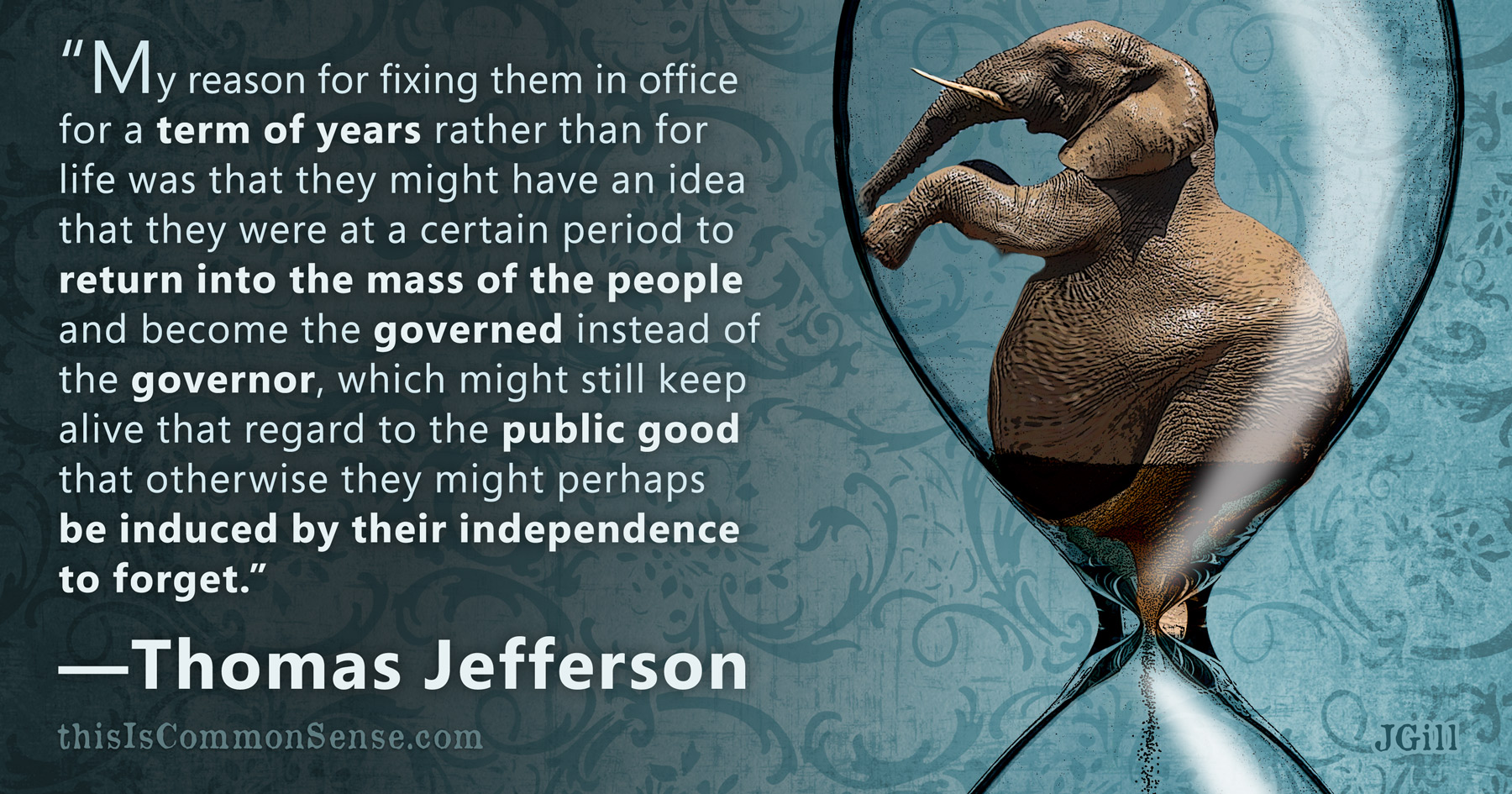
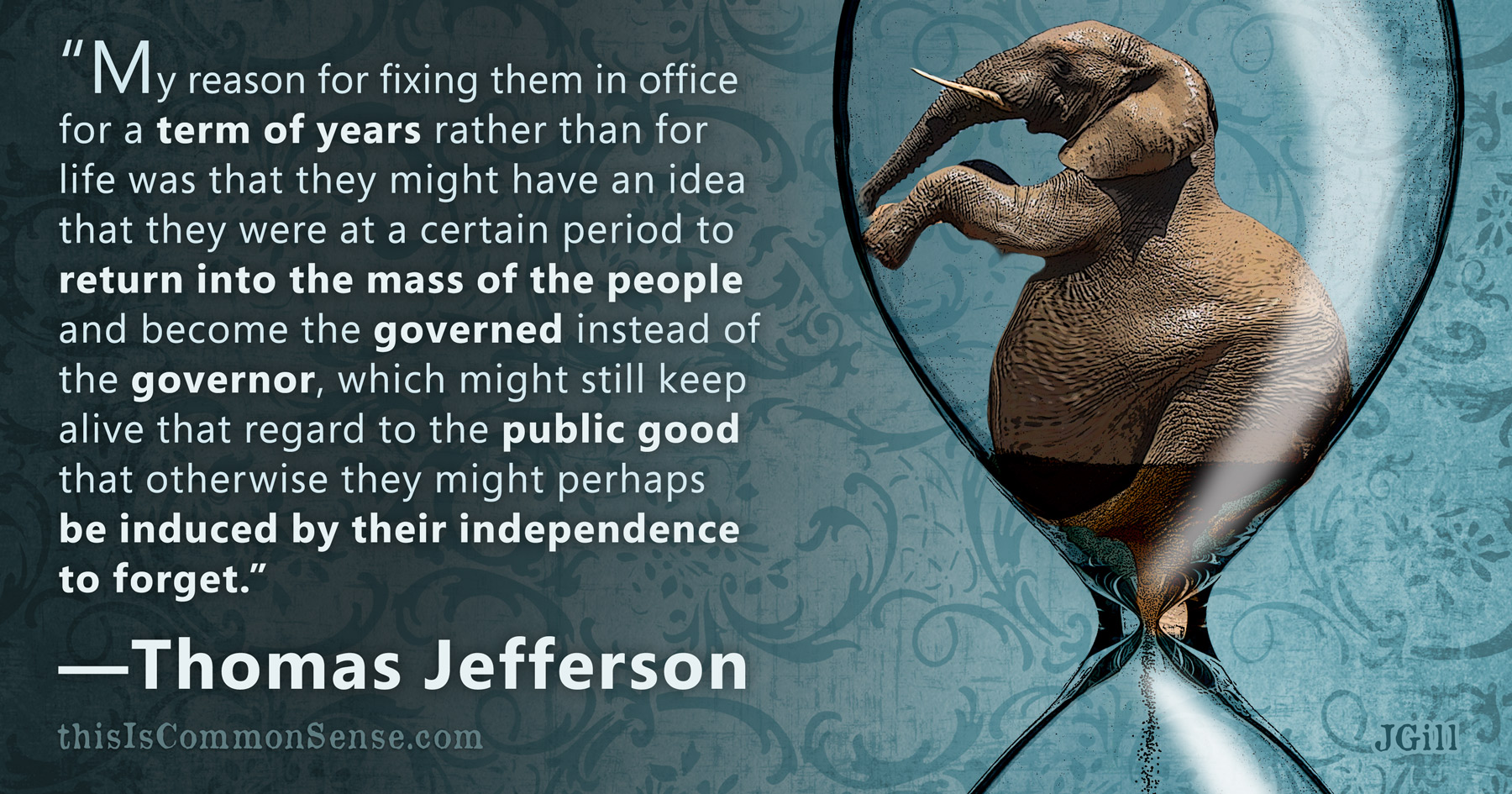
“My reason for fixing them in office for a term of years rather than for life was that they might have an idea that they were at a certain period to return into the mass of the people and become the governed instead of the governor, which might still keep alive that regard to the public good that otherwise they might perhapsbe induced by their independenceto forget.”

—Thomas Jefferson


Click for high resolution image

term limits, Jefferson, Thomas Jefferson, collage, photomontage, elephant, JGill, Paul Jacob, Common Sense


Categories
general freedom ideological culture political challengers

Opposites for Independence

Could any two men be more different than John Adams and Thomas Jefferson? And yet, I doubt if the United States would exist were it not for both. Somehow, they worked together when it counted. And worked against each other, when it seemed necessary.

Yet they respected each other (in their different ways), and before the end, after a long estrangement, became close friends.Thomas Jefferson

The story is well known: on his deathbed on July 4, 1826, Adams whispered, “Thomas Jefferson survives!” He was wrong. Jefferson had died earlier that day, on the 50th anniversary of the Declaration of Independence.

Adams was also wrong about Independence Day. On July 2, 1776, after the Lee Resolution for independence passed the Continental Congress, he wrote that “the second day of July” would become the day of “a great anniversary festival.” But “by 1777,” Steve Tally noted in Bland Ambition, his jovial history of the vice presidency, “people were already celebrating the Fourth of July.”

John AdamsBut give him his due: it was Adams who insisted that Jefferson write the Declaration, and it was indeed its words — especially that of its “mission statement” preamble — that resonate almost universally to this day. And gave birth to the annual festivities.

Adams, Tally tells us, was “short, round, peevish, a loudmouth, and frequently a bore.” Jefferson, on the other hand, was tall, handsome, polite, and much more popular. And a much better writer. Which is why he was given his great job, to produce the Declaration.

Great writer or no, it’s not as if the tall redhead’s initial draft was acceptable as it flowed from the pen. Adams, Franklin, and the whole congress got in on the editing job. “Jefferson liked to recall that his document survived further [extensive] editing,” Tally explains, “because of the meeting hall’s proximity to a livery stable.” Still, it’s obvious that Jefferson wasn’t the only genius in the room, and that without Adams’s tireless work, independence might not have gotten off the ground.Declaration of Independence

The later history of both men, in service to the country they helped found, is riddled with ambiguities and even horrible moral and political lapses. Adams was the kind of politician who not only opposed term limits, but opposed terms: he thought men raised to office should be kept there forever. Jefferson leaned not merely the other direction, but flirted with the notion of a revolution every generation.

I adhere to the anti-​federalist slogan of their day, “that where annual elections end, tyranny begins.”

Between the two extremes of these two great men, somehow, the republic survived. And thrived. Their correspondence is a mine of great wisdom, their biographies well worth reading.

Most of all, their legacy — of July 2 and July 4, 1776, and the universal rights of man — remains worth fighting for.

This is Common Sense. I’m Paul Jacob.

Categories
ideological culture national politics & policies Second Amendment rights Tenth Amendment federalism

Nullification Today

As the federal government lurches further out of control, wildly grasping to increase control over our lives, an old and controversial method of reining in our central government gains popularity: State nullification of federal law.

A recent Rasmussen survey asked whether “states have the right to block any federal laws they disagree with on legal grounds,” and 38 percent of likely voters surveyed said “Yes.”

Cutting to the quick of the Commerce Clause, a new Kansas law — Senate Bill 102, the Second Amendment Protection Act, signed by Governor Sam Brownback last month — states that firearms manufactured and owned in Kansas that do not cross state lines are not subject to federal law.

Of course, the Supreme Court thinks otherwise. In Wickard v. Filburn, the Court allowed the federal government to regulate darn near anything on the grounds that any conceivable act of consumption affects demand, and thus “commerce.” Goofy ruling? Yes. But by tradition it’s the Supreme Court justices who get the final word.

Yet even that has been denied by many constitutional theorists, including Thomas Jefferson and James Madison — “Mr. Constitution” himself — both of whom supported nullification, as recently explained by historian Tom Woods. No compact joined into by multiple parties may only be interpreted by one of the parties alone, unless specified to that effect. The Constitution doesn’t even mention judicial review, so the tradition of the Supreme Court’s final word is itself a matter of dispute.

Standing up for the status quo, Attorney General Eric Holder has written to Brownback against the new Kansas law, citing the Supremacy Clause. Problematic? Yes. But not easily dismissed.

Brownback has volleyed back.

At least we can expect the old issues of constitutional law to gain a new and lively hearing.

This is Common Sense. I’m Paul Jacob.