
Categories
Accountability general freedom government transparency initiative, referendum, and recall local leaders national politics & policies political challengers term limits

The Other Maine Thing

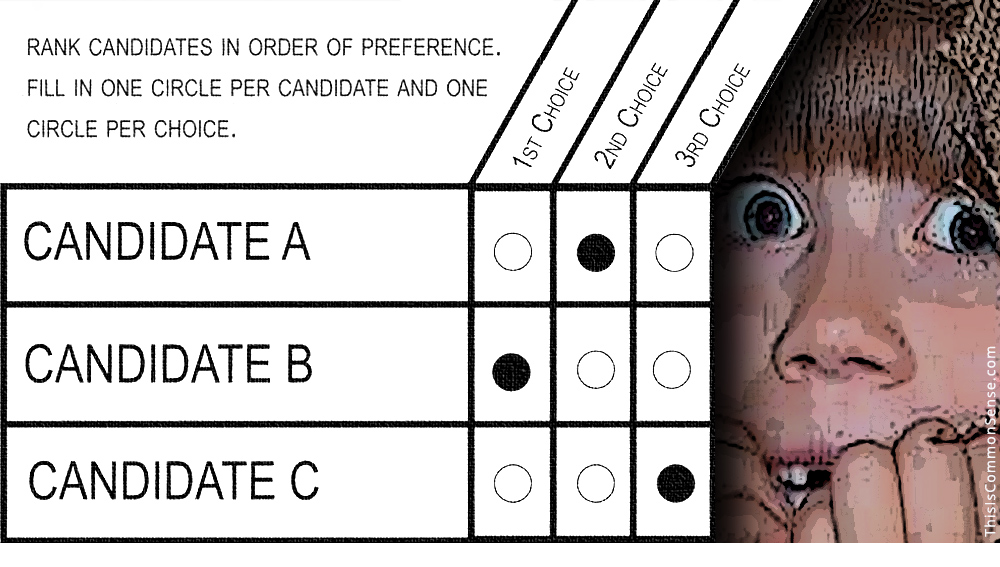
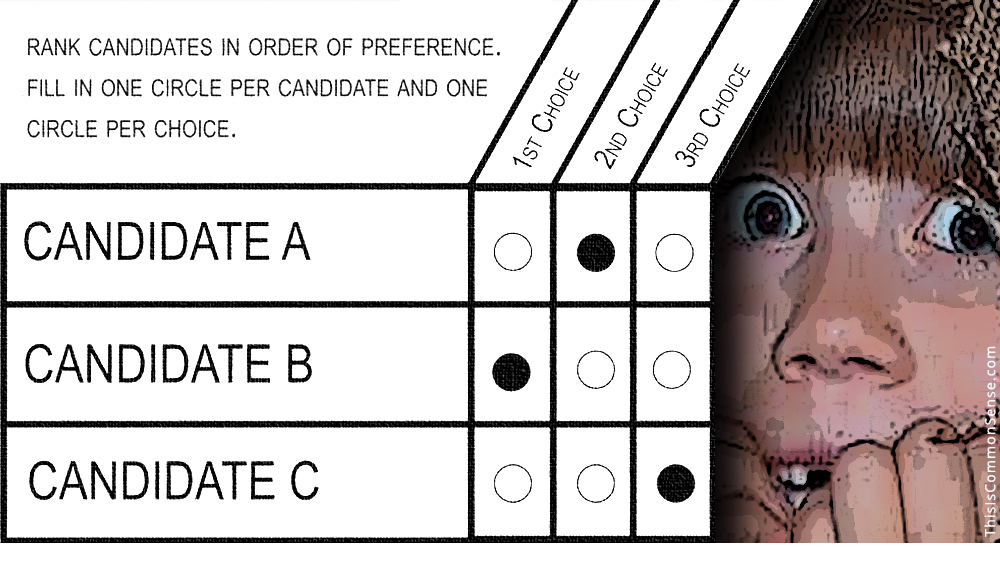
Tuesday’s biggest election news was the victory for Ranked Choice Voting (RCV) in Maine. This is the second statewide vote for this reform, which allows voters to rank the candidates by first choice, second choice and so on.*

Voters first passed it in 2016, but the next year the voters’ “representatives” in the legislature repealed the law, overturning their vote.

Undeterred, RCV supporters filed a referendum and again went out and gathered enough petition signatures to refer the legislature’s repeal to a vote of the people. On Tuesday, Maine’s voters vetoed the legislature, keeping Ranked Choice Voting.

Initiative and referendum sure are helpful.

RCV is not partisan; it requires the winner to have some level of support from a majority of voters and fixes the wasted vote problem. In Maine, however, the Republican Party opposed. On election day, Republican Gov. Paul LePage even threatened not to do his duty and certify the results.

Paul Jacobs (Vice chair of the [FairVote] Board) whom I once knew and thought was a good American,” a Republican friend posted on my Facebook page, “has helped unleash the hounds of Hell” . . . adding that “now the voters are so confused by the terrible procedure that voting will be a nightmare this Tuesday!”

Yet voters used the new voting system for the first time Tuesday in candidate primaries before deciding Question 1 on their ballot — about keeping RCV. As one Portland voter put it, “It’s pretty easy to do, despite the negative publicity.”

We need more control over government with our vote. And when voters speak, politicians should listen.

It wouldn’t hurt political activists to listen, too.

This is Common Sense. I’m Paul Jacob.



* I’ve discussed the idea in this space many times — there’s more information on how it works here.

PDF for printing


Categories
general freedom incumbents local leaders national politics & policies political challengers U.S. Constitution

The First Shall Be Last

We were taught in school that the first ten amendments to the Constitution make up the Bill of Rights. True enough.

But not completely true — as I pointed out at Townhall.

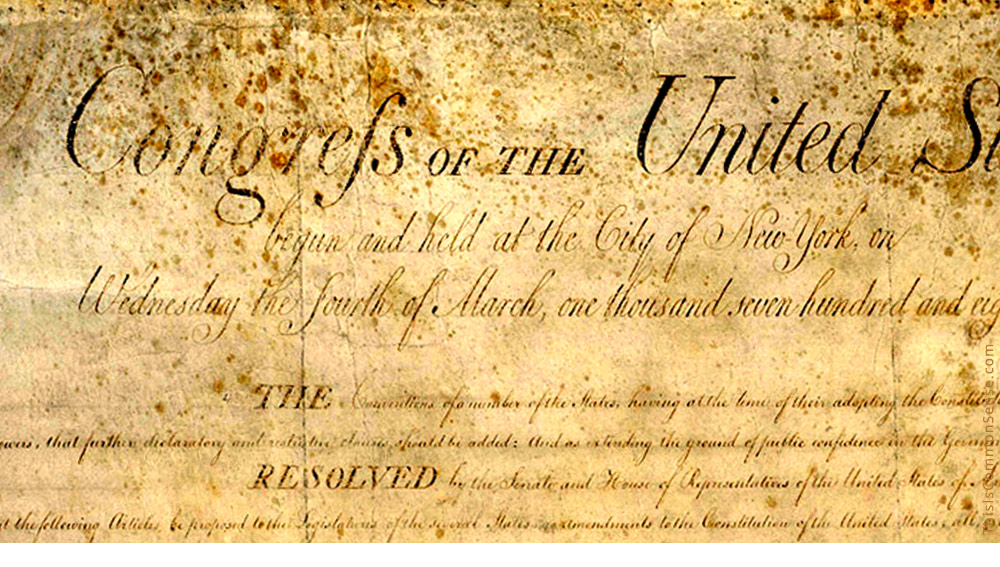
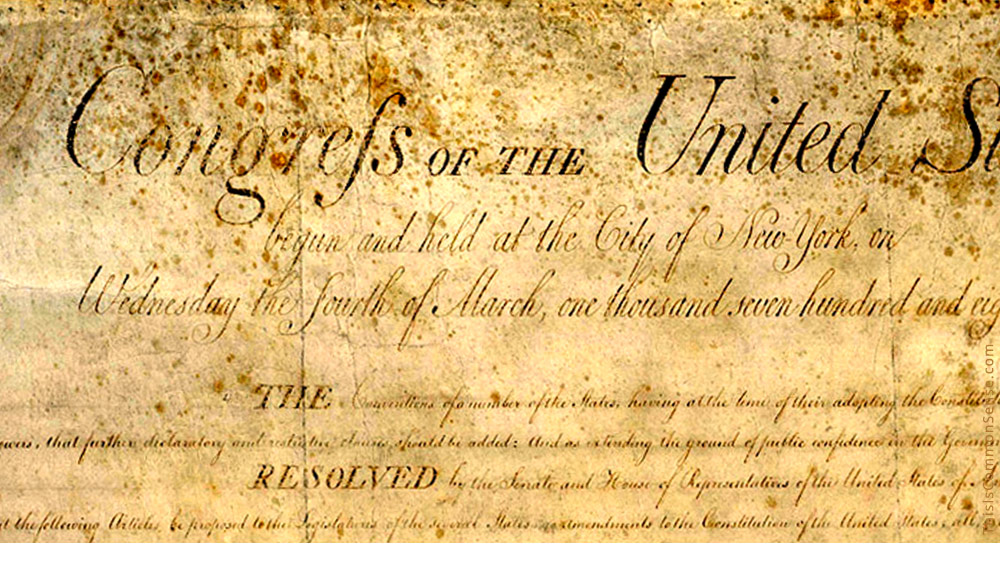
In 1789, Congress passed and sent to the states twelve constitutional amendments, called “articles.” Our current First Amendment was billed as Article the Third.

The first two of the original batch did not pass at that time: Article the First and Article the Second. That latter article, after more than two centuries of wandering around legislatures, was finally ratified by the necessary three-fourths of the states as the 27th Amendment to the Constitution. In 1992.*

As for the rejected Article the First, last Tuesday, Eugene M. LaVergne filed a motion, pro se, before a federal three-judge panel convened in the D.C. Circuit to hear his challenge to “the validity and Constitutionality of the 2010 Apportionment of the U.S. House of Representatives.” He and four other rabble-rousing New Jersey citizens are challenging the courts to acknowledge a surprising truth: the original Article the First was actually ratified.

On June 21, 1792, Kentucky’s legislature voted to ratify, making it the twelfth of fifteen states at that time to do so.

It’s a complicated story. One of the elements is a clerical error.

But rectifying this old mistake would have huge repercussions.

How huge? Currently the lower house of Congress has a mere 435 members. Were this amendment acknowledged, that number would soar to over 6,150 members.

And that would be a good thing.**

This is Common Sense. I’m Paul Jacob.


* Sadly, its sensible prohibition — “No law, varying the compensation for the services of the Senators and Representatives, shall take effect, until an election of representatives shall have intervened” — was immediately rendered toothless by the automatic cost of living salary adjustments congressmen had already provided themselves.

** Skeptical? Well, click here for a preview of more detailed arguments to come.

PDF for printing


Categories
Accountability general freedom incumbents insider corruption local leaders moral hazard political challengers Regulating Protest term limits

Missouri Shows Article V Action

There’s good news and there’s good news from the Show Me State.

First the good news. The Missouri House declined to follow the lead of the Missouri Senate during its recent legislative session in advancing a ballot measure to make a travesty, mockery and sham of state legislative term limits.

The proposed weakening of the limits would have doubled maximum legislative tenure from eight years to 16 years. Further, it would also have excluded terms already served from counting toward the new limit.

Had the measure ultimately been enacted, some incumbents would have been able to sit in a single seat for up to 24 years. This assault on term limits is dead . . . at least until next year.

Now the good news. The lawmakers deserve high praise for issuing a formal call for an amendment convention to consider the single subject of congressional term limits, making Missouri the third state to do so (after Florida and Alabama). In mid-May, the resolution for a Term Limits Convention easily passed in both chambers.

Thanks to a provision in Article V of the Constitution, if two thirds of the states (34 states) submit a similar application to convene a term limits amendment convention, the convention must be convened. The amendment that the convention produces would then be submitted to the states for ratification. Three fourths (38) are required to ratify.

We’re only in the first-steps stage here, but first steps are crucial.

Thanks for showing us how to do it, Missouri.

This is Common Sense. I’m Paul Jacob.


PDF for printing

Missouri, show me, Article V, term limits, legislature, congress,


Categories
crime and punishment general freedom ideological culture initiative, referendum, and recall local leaders national politics & policies political challengers property rights Regulating Protest too much government

A Sanctuary from Centralization

Defiance . . . nullification. It is a trend.

I take it as a sign of our contentious times that we now witness states in open rebellion against centralized control from the Imperial City of Washington, D.C., while cities and counties are also rattling the chains set by their respective state capitals.

The sweep of marijuana decriminalization and legalization is only the most obvious. The rise of “sanctuary cities” defying federal government immigration laws — often backed up by state legislatures — has been a contentious issue, with progressives supporting this sort of nullification and conservatives opposing it.

But the latest development does not hail from the left.

In Illinois, a number of rural governments have taken a cue from the immigration debate by “declaring themselves sanctuary counties for gun owners,” we learn from the AP’s Don Babwin, writing in the Chicago Tribune. “The resolutions are meant to put the Democratic-controlled Legislature on notice that if it passes a host of gun bills . . . the counties might bar their employees from enforcing the new laws.”

An Effingham County Board Member calls “sanctuary” an attention-getting “buzzword,” reporting that “at least 20 Illinois counties and local officials in Oregon and Washington have asked for copies of Effingham County’s resolution.”

Now, cities and counties do not have an analogous relationship to their state governments as do states to the federal government: the states created the “United States of America,” while cities and counties are also state creations.

Yet this move is important. It shows a growing recognition of the tyrannical nature of centralized power.

And the usefulness of decentralization.

This is Common Sense. I’m Paul Jacob.
 

PDF for printing


Categories
Accountability general freedom nannyism national politics & policies political challengers porkbarrel politics responsibility too much government U.S. Constitution

How Bernie’s Like Trump

Yesterday I made fun of Bernie Sanders’ jobs guarantee idea. Today, let’s take it seriously.

Not as policy, mind you. As propaganda.

It’s not worth talking about as a policy because there is no policy yet. “It is not clear when Sanders will announce the plan,” Fox News relates, “and a Sanders spokesperson told the Post that it was still being crafted.”

It is mere advocacy. A press release. Vaporware.

But that’s the key to it, really. The jobs guarantee isn’t policy.

It’s a ploy.

Bernie Sanders knows there is hardly a hope of passing such a bill. He probably understands that the current fiscal mess precludes it. He might even understand that it is literally a horrible notion, the worst policy idea in the world, and he would still have reason to pitch for it relentlessly.

Because what he is really after is the hiking of the national minimum wage to $15/hr. That is the next Democratic ratcheting up of government. And by insisting that the government guarantee $15/hr jobs, he is readying everyone to accept, as a compromise, the hiking of the minimum wage to that very figure.

Yesterday I noted a link between socialism and slavery. But minimum wages link up not with slavery but unemployment.

Which Bernie knows all too well. Before he got in politics, he was a layabout, a bum.

Not like President Trump at all, that way.

But by fixing on one key, “anchor” concept ($15/hr) and demanding the Moon, he might just get his mere lunacy, er, minimum wage hike.

And that is a Trumpian* ploy.

This is Common Sense. I’m Paul Jacob.


* Though Trump’s better. His “linguistic killshots” are far more memorable . . . because funny and (usually) visual.


PDF for printing


Categories
Accountability folly general freedom incumbents media and media people moral hazard nannyism national politics & policies political challengers porkbarrel politics responsibility too much government

Twirling Towards Freedom?

Does Bernie Sanders remind you of “Citizen Kang”?

Vermont’s [S]ocialist Senator is whipping up a new plan for America: to “guarantee a job with at least a $15-per-hour wage and health benefits to every adult American ‘who wants or needs one,’” we are told.

What was it that the slavering alien Kang promised* in The Simpsonseighth season opening episode? Well, we know how that episode ended, with Homer Simpson revealing the ’90s’-era presidential candidates to be aliens in disguise, Kang being elected, humanity enslaved, and Homer uttering the immortal words “Don’t blame me, I voted for Kodos.”

And then Kodos, in cahoots with Kang, cracking the whip on Homer.

One shouldn’t have to read George Fitzhugh, the antebellum sociologist who attacked the very idea of free markets and free labor, insisting that slavery is a good thing and the very best form of socialism, to know that socialism and slavery go together hand in glove, whip in hand.

In an age of handouts for nothing, at least Sanders’ socialist proposal suggests productivity. But paying for it by nixing corporate “tax breaks”** is absurd. “Republicans have long opposed a federal jobs guarantee,” Fox News tells us, “saying such a plan would be too expensive and impractical.” And it’s productive people who would pay for it, making them de facto slaves to the system . . . even more than they are now.

But when socialists talk about “jobs,” worry about a more direct form of slavery.

And yes, I can imagine Bernie, with his four houses, flicking the whip.

I won’t be voting for him, if he runs.

Or for Kodos.

This is Common Sense. I’m Paul Jacob.

 

* Actually, Kang was known not for a promise but for his campaign speech (as Bill Clinton), saying, “[W]e must move forward, not backward; upward, not forward; and always twirling, twirling, twirling towards freedom!”

** The only funding source mentioned in the reports I read.


PDF for printing


Categories
ideological culture incumbents local leaders media and media people political challengers too much government

The Centre Cannot Hold

The British may spell their words in funny ways, but their political problems do not seem all that foreign. Their left-of-center party has gone far left, Marxoid left; their right-of-center party has gone ultra-incompetent.

A healthy majority of Brits disapprove of both parties. So, no wonder many Brits are looking to create a new one.

A new centrist political party, no less.

Over at The Economist, the columnist writing under the name “Bagehot” (pronounced “badget”) predicts that this hope will be dashed, for at least three reasons:

First, Britain already has a centrist party, and it is not doing very well.

Second, there sure are a lot of contenders — 35 new parties have been formed just this year, including one called, with humble brag, “Sensible” — and all that competition fractionalizes the vote.

Third, the country sports the same system of vote counting and elections as America does, first-past-the-post, which “is hard on startups.”

That last point is worth thinking about. In multi-candidate races, the British-American electoral system declares as winners those who obtain a bare plurality of votes — thus ignoring the preferences of those who vote for minor party candidates. This means that those who “waste” their votes not only hurt the candidacies they like as second-best but also insulate the second-best parties from those voters’ influence. So the parties become narrow-minded and unhinged from an interested group of voters.

Bagehot thinks Britain’s centrists need to rethink, conjure up some new ideas. But what they need to do first is fix a system that prods political parties away from new ideas. 

This is Common Sense. I’m Paul Jacob.


PDF for printing


Categories
ballot access general freedom initiative, referendum, and recall moral hazard nannyism national politics & policies political challengers responsibility term limits

The Yellow and White Lines

If I’ve heard it one million times, I’ve heard it ten: “We already have term limits; they’re called elections.” A statement usually offered as the beginning and end of wisdom regarding the problems term limits are designed to tackle.

Equally “profound” is the collateral claim that “the only term limits we need are an informed electorate.”

Such generalities “prove” too much. Any formal restraint of government could be thus airily dismissed.

  • “The only Bill of Rights we need is an informed electorate.”
  • “The only checks and balances we need are an informed electorate.”
  • “The only prerequisites for running for office we need are an informed electorate.”

If formal rules don’t matter, why write these things down or try to enforce them in light of principle and precedent? Just get your informed electorate and let the informed electorate handle it.

To preserve and strengthen our republic and our liberties, we do need an informed electorate. We also need many other things, including well-known, widely accepted, consultable, objective limits on government power.

One such limit limits terms.

Term limits on legislators, executives and even judges combat political corruption, empower informed voters, and give informed and capable electoral challengers more opportunities to effectively present their ideas.

The fact that a given political or cultural factor is crucial to the commonweal doesn’t mean that no other factors are also crucial.

Don’t tell drivers of cars that all they need are skills and gas.  You also need lines on the road — limits to keep us out of the ditch, and from head-on collisions.

This is Common Sense. I’m Paul Jacob.


PDF for printing


Categories
ballot access initiative, referendum, and recall local leaders political challengers Regulating Protest too much government

New-Fangled Vote Counting

Call me old-fashioned, but when you go to the pols to cast your vote on a ballot measure, your Yes vote should count for yes and your No vote for no.

And if you choose not to vote, your non-vote should count for neither yes nor no.

That’s just common sense. Right?

Well, meet its antithesis: Proposal 97, now being considered by Florida’s powerful Constitution Revision Commission (CRC).* Proposal 97 would count all those who do not cast a vote for or against a ballot measure as a No vote against it.

To pass a constitutional amendment in the Sunshine State already requires a supermajority vote of at least 60 percent of those who do cast a vote on the measure. Under Proposal 97, counting all those not voting on it as No votes, that percentage would necessarily go even higher. If 10 percent don’t vote, Yes would have to come in at 67 percent to win.

This is minority rule . . . with an extra perverse twist.

The supermajority requirement encourages big money interests to spend heavily against ballot initiatives — even when the issues have clear majority support — because if they can manage to lose by less than 20 points (60–40 percent), they win. Now all opponents need do is poison the water with the nastiest campaigning imaginable, causing more voters to throw up their hands or pinch their noses and avoid the issue . . .

. . . thus, being counted as voting No.

Don’t abstain. Stop Proposal 97. Tell them NO here.

This is Common Sense. I’m Paul Jacob.

 

* How powerful is the CRC? Every 20 years it meets with the awesome authority to refer constitutional amendments directly to the ballot — as many as it wishes and the amendments can be packaged to include several different subjects. No other state has a similar body. Of the 37 commission members, the governor appoints 15, the Senate president and the House speaker each appoint nine, the chief justice of the state supreme court appoints three and the attorney general is an automatic member.


PDF for printing


Categories
general freedom individual achievement local leaders political challengers responsibility

Liberty Rising?

“Let me make something very clear,” Nick Freitas stated unequivocally. “I don’t have a political career.”

Freitas, a Republican member of Virginia’s House of Delegates announcing his candidacy for the United States Senate, was responding to advice that running against incumbent Sen. Tim Kaine “could hurt [his] political career.”

It’s music to my ears. And to Matt Kibbe’s. The leader of Free the People calls Freitas “the most interesting liberty Republican you’ve never heard of.”

Yet, in Virginia’s conservative networks, Freitas has made quite a name for himself, defending the Second Amendment and fighting Medicaid expansion in a one-seat GOP-majority House.

“You can’t fix everything through government force and coercion,” he explained to Kibbe. “If the path we’re going down, which is just ‘let us manage the federal government as it continues to expand, as it continues to increase debt,’ that’s just not a Republican Party I’m interested in.”

Del. Freitas added that the American people seem similarly uninterested.

Perhaps he is simply telling us what we want to hear. He wouldn’t be the first bait-and-switch politician. But Freitas isn’t exactly playing for the bleachers by naming Calvin Coolidge rather than Ronald Reagan as “the best president of the 20th century.”

And he talks about individual liberty, which, he explains, is “based off the premise that I have a right to pursue happiness in accordance of what my definition of happiness is, so far as it doesn’t infringe on your right to do the same thing.”

He had me with “I don’t have a political career.”

This is Common Sense. I’m Paul Jacob.


PDF for printing