Categories
general freedom government transparency initiative, referendum, and recall local leaders moral hazard political challengers responsibility term limits too much government

Graceless Memphis Politicians

“We could care less about instant runoff voting,” fibbed Allan Wade, the city attorney for Memphis, Tennessee.

Wade was rebutting the recent Commercial Appeal revelation that Memphis’s “City Council worked behind the scenes to find a sponsor for legislation this year that could ban instant-runoff elections statewide.”

After long relying on the mayor’s lobbyists, was it purely coincidental that the council suddenly spent $120,000 on its own Nashville lobbyists?

One of the bill’s sponsors, Rep. Mark White (R-Memphis), missed the memo. He acknowledged being “approached . . . on the council’s behalf to ask if he would again sponsor the bill.” A lobbyist also confirmed to the Memphis Flyer that the council engaged him to push the ban on what is also known as ranked choice voting.

So, the city council is directly lobbying the Tennessee Legislature to overrule their city’s residents — who voted 71 percent YES for instant runoff voting in 2008.

And there’s a twist. The council has placed two measures that would repeal instant runoff voting on this November’s ballot, hoping to somehow convince voters to scrap the reform. Wait . . . why lobby the legislature when the voters are already set to make the decision?

Oooooooooohhhhhhhh!!!!!!!!!!!!!!!!!!!

“Now they are using our money to take away that choice from us,” protests Aaron Fowles with Save Instant Runoff Memphis.

This city council — in addition to their sneaky, anti-democratic assault on instant runoff voting — has also placed a measure on the ballot to weaken their own term limits, passed by an 80 percent vote.

To paraphrase Memphis’s King, these rabid-dog politicians ain’t never caught a rabbit and they ain’t no friends of ours.

This is Common Sense. I’m Paul Jacob.

 

P.S. After media coverage, a hearing on the Senate version of the bill to ban instant runoff voting, SB 2271, was abruptly postponed for three weeks.


PDF for printing


Categories
Accountability general freedom ideological culture media and media people national politics & policies political challengers porkbarrel politics Regulating Protest responsibility tax policy too much government

“Our Agenda Was Common Sense”

The Republican Party doesn’t need to bury the corpse. Its victim has been assimilated, like the Borg did with alien peoples in the Star Trek universe, or maybe it was just soaked up as if the GOP were a giant fungus amongus.

So, what’s dead? The Tea Party, which was killed by partisanship, says Matt Kibbe, President and Chief Community Organizer at Free the People. He admits that the movement’s obituary has been written many times, but, he argues, “this time is different. Republicans, now controlling both the legislative and executive branches, jammed through a ‘CRomnibus’ spending bill that strips any last vestiges of spending restraint from the budget process.”

Kibbe identifies the Tea Party’s central theme simply: “Our agenda was common sense: We demanded that Washington politicians stop spending our money like it was theirs, and keep out of our health care. But in Washington, common sense is often seen as radical.”

This, he insists, was not a partisan movement.

But only Republicans played to it. Kibbe calls Sarah Palin a “political huckster” who “helped hijack our purpose,” and fingers Mitt Romney as the man who scuttled Tea Party “political momentum” in 2012. “And then Donald Trump split the Tea Party right down the middle, and that was the end.”

Nail in the coffin? The recent budget deal.

Kibbe signs the autopsy, but assures us: “American principles of individual freedom, fiscal responsibility, and constitutionally limited government, are all still very much alive.”

I sure hope so. But it takes more than a handful of Freedom Caucus members on Capitol Hill to realize it in practice.

Like a new citizen movement.

This is Common Sense. I’m Paul Jacob.


PDF for printing


Categories
Accountability general freedom moral hazard nannyism political challengers too much government

How to Prevent Democracy

Quick — what is the very first thing government should do this year?

Maine’s Secretary of State Matthew Dunlap has urgent legislation. And just so you don’t get the wrong idea, “It’s really not a shadow effort to restrict the people’s right to petition their government,” he insists. “That is not our intent.”

Got that?

Citing voter and election official complaints — without documenting any specific person or incident — the secretary seeks to “virtually ban” signature gathering at the polls on Election Day. His special bill, L.D. 1726, would create a 50-foot buffer so that voters can get to the polls, cast their ballots, and rush back home without ever being approached by fellow citizens seeking their signatures to place an issue on the ballot.

Polling places, Dunlap thinks, should be more “civilized.”

“State lawmakers in recent years have lamented the number of citizen-initiated bills that have been approved by voters,” explained the Portland Press Herald, “including major changes to marijuana law, voting, taxation and the minimum wage in just the last two years alone.”

Legislators, apparently, do not like following laws enacted by voters.

It is interesting that the Ranked Choice Voting ballot initiative, which Mainers passed last November — and Dunlap strongly opposed — gathered tens of thousands of signatures at the polls. In a statement, that citizen committee declared, “Our constitutional right to direct democracy is under attack in Maine.”

Why would a Secretary of State so blatantly favor politicians over the people? In Maine, legislators choose the Secretary, not voters. It’s a bad system, lacking proper separation of powers.

Removed from the people.

This is Common Sense. I’m Paul Jacob.


PDF for printing


Categories
Accountability ballot access general freedom government transparency initiative, referendum, and recall local leaders national politics & policies political challengers responsibility tax policy term limits too much government

What Unlimited Government Costs Us

“Olympia can’t restrain itself,” Tim Eyman wrote the other day, a judgment on legislative irresponsibility hardly unique to the Evergreen State. Citizens around the country have cause to lament the difficulty of obtaining anything close to a good legislature.

Too often the merely “bad” would constitute a significant improvement.

Which is why legislators need to be put on a short leash. Limits on government must be written into law, where possible into either the U.S. Constitution or state constitutions, so the limits cannot be tampered with by legislators, good or bad.

Washington State initiative guru Tim Eyman, cited above, has made a career of working for just those kinds of limits. In 2007, Eyman and the citizen group Voters Want More Choices petitioned onto the statewide ballot a requirement that any tax increase must receive a two-thirds vote from both legislative chambers.

Voters passed the measure* in 2007, 2011 and 2012.

In an email to supporters this month, Eyman presents data — an “amazing real-world comparison” — to help us understand how effective the limits were . . . while they lasted.

He notes that “with the 2/3 rule in effect from 2008-2012, those 5 legislative sessions cost the taxpayers $6.894 billion” in increased taxes.

And he compares that to the five years (2013-2017) since the state’s highest court struck down the voters’ two-thirds mandate: “WITHOUT the 2/3 rule, those 5 legislative sessions cost the taxpayers $23.679 billion.”

“Without the fiscal discipline imposed by citizen initiatives,” Eyman concludes, “politicians cannot hold back.”

Now we have hard evidence for what unlimited government costs us: more than three times more!

This is Common Sense. I’m Paul Jacob.

 

* Washington State’s ballot initiative process allows voters to pass simple statutes but not constitutional amendments. For two years after passage, legislators must garner a two-thirds vote to override a ballot initiative. After those two years, only a simple majority is required.


PDF for printing


Categories
Accountability local leaders media and media people moral hazard national politics & policies political challengers responsibility term limits

Sic Transit Gloria Flake

Yesterday, a major American politician gave up.

Sort of.

Senator Jeff Flake, the junior member of the upper chamber from the State of Arizona, took to the Senate floor to announce that his “service in the Senate will conclude at the end of my term in early January, 2019.”

Actually, most of the speech was an appeal to President Trump.

Or a lambasting.

In either case, he was echoing his recent book, Conscience of a Conservative: A Rejection of Destructive Politics and a Return to Principle, which columnist David Brooks has described as a “thoughtful defense of traditional conservatism and a thorough assault on the way Donald Trump is betraying it.”

In the Age of Trump, anti-Trumpian manifestos are . . . controversial in GOP ranks. And his opposition has cost him. All bets were against him winning re-election.

“I believe that there are limits to what government can and should do,” Flake wrote in a letter to supporters, going on to say “that there are some problems that government cannot solve, and that human initiative is best when left unfettered, free from government interference or coercion.”

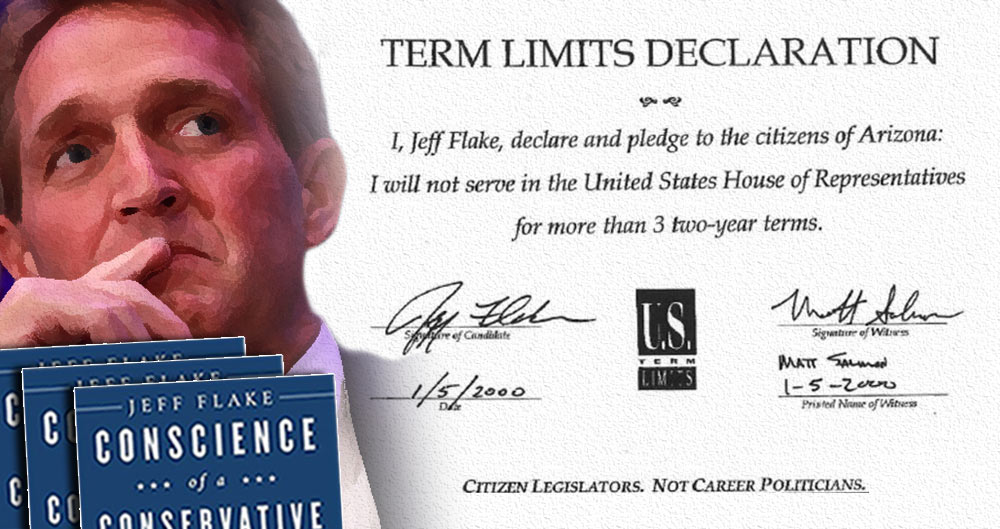
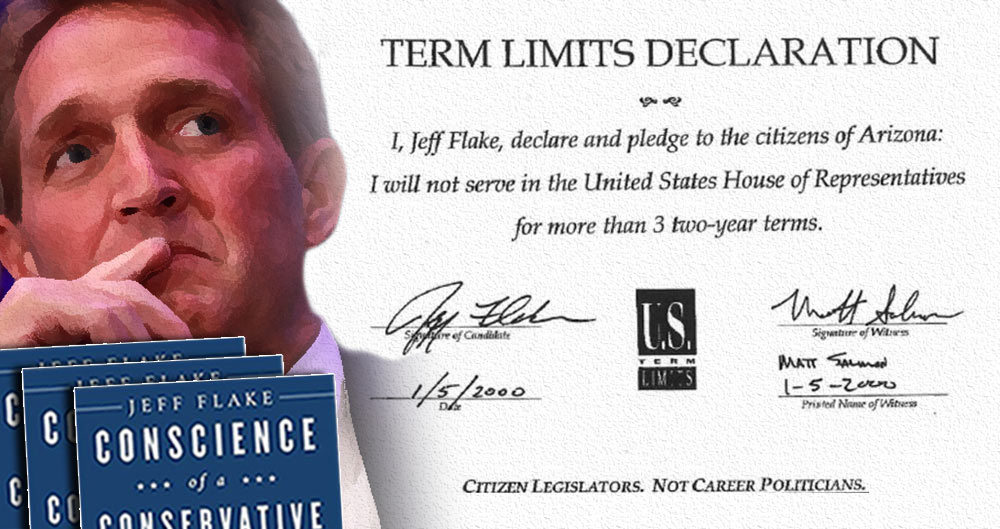
Solid principles. Principles I share. But how principled was Flake? He began his career promising to limit his own terms, in accordance with . . . conservative principles. And yet the man from Snowflake, Arizona, broke that promise in 2006, holding on to his House seat for three more terms.

For his remaining 14 months in the Senate, Flake can return to the principle he reminded himself of in yesterday’s speech: “Sustained incumbency is certainly not the point of seeking office.”

There’s life after Congress. And Jeff Flake can do good things in the real world.

This is Common Sense. I’m Paul Jacob.


PDF for printing


Categories
Accountability government transparency insider corruption local leaders moral hazard national politics & policies political challengers responsibility

Omission of Character

One downside to jumping to the wrong conclusion is that the failure to even look for the correct, accurate conclusion inevitably follows. 

This sleepy odd-year campaign for governor of Virginia has recently been riled by charges of racism. Democratic Party gubernatorial nominee Frank Northam made the “mistake” of “omitting the party’s candidate for Lt. Governor, Justin Fairfax, from a small printing of literature for union members about the Democrats’ statewide slate. 

Northam is white and Fairfax is black. 

“[A] slap in the face to Justin and to black voters,” is what Quentin James, who runs a PAC working to elect black candidates, called the removal of Fairfax from the literature. He added that it “reeks of subtle racism” and “sends a signal across the state, that we, as black voters, are expendable.”

Noting that black voters make up 20 percent of the state’s electorate, Think Progress dubbed Fairfax’s deletion: “mindboggling.”  

Was this a “dis” and did it really have anything to do with Fairfax being black?

Well, Fairfax labeled it a “mistake,” but his exclusion from the flyer was certainly not inadvertent. It was by clear-eyed design.

The Laborers’ International Union of North America (LiUNA), a $600,000 donor to the coordinated state Democratic campaign, requested that Fairfax be removed from literature their members will distribute. The union is at odds with Fairfax over his opposition to two state pipeline projects the union favors.

So, Northam didn’t throw Fairfax under the bus because Fairfax is black. No sirree. Northam threw Fairfax under the bus to placate a powerful, well-heeled special interest group.

Northam isn’t a racist. He’s just a self-interested, disloyal politician.

This is Common Sense. I’m Paul Jacob.


PDF for printing


Categories
Accountability general freedom government transparency incumbents initiative, referendum, and recall local leaders political challengers

Initiative Surplus?

Only nine out of 50 states can pay their bills and meet their obligations; 41 cannot, barring major tax increases or spending cuts.

That’s what we learn in last month’s “Financial State of the States” report from Truth in Accounting (TIA).

Alaska is in the best shape, “with $11 billion in assets to pay future bills”; New Jersey’s in the worst, needing “to come up with $208 billion in order to meet its promised obligations.”

Sheila Weinberg, TIA’s founder, works hard to counter governments’ creative accounting. It’s trickery, really, which “would be considered criminal for private sector corporations.” One gimmick is “promising to pay employee benefits in the future, but not fully funding the benefits programs as they rack up obligations.”*

Thankfully, TIA’s financial analysis includes items such as already-made pension and healthcare commitments.

Now, let’s expand the analysis, collating these findings to separate between initiative and non-initiative states**:

  • Seven of the nine states with a “taxpayer surplus” — where government can pay its bills and meet its obligations — have the ballot initiative process.
  • The 23 initiative states comprise 46 percent of the states. Yet, initiative states comprise a whopping 78 percent of financially healthy states.
  • Of the 20 states carrying a larger-than-average taxpayer burden, 15 states (75 percent) lack the initiative process.

Granted, this represents a correlation between states with citizen-initiated ballot measures and healthier fiscal policy, not necessarily causation. Still, I’m not surprised states where citizens have more say so are better governed.

This is Common Sense. I’m Paul Jacob.

 

* “This short term fix allows governments to artificially ‘balance their budgets’ by not counting certain obligations as official debt.”

** There are 23 initiative states and 27 non-initiative states. Two referendum-only states— Maryland and New Mexico — are considered non-initiative states, and so is Illinois. Illinois is considered a non-initiative state, because its ballot initiative process is so severely restricted as to be non-existent. Only one measure has ever appeared on the ballot.


PDF for printing


Categories
general freedom initiative, referendum, and recall political challengers Regulating Protest

Self-Determination, Anyone?

An election can be a clarifying event.

So can the suppression of an election.

Over the weekend, more than two million Catalans, greater than 40 percent of those eligible, voted in a referendum on independence from Spain. To which Spain’s Prime Minister Mariano Rajoy declared, “There was no independence referendum in Catalonia today.”

Rajoy certainly tried to stop it.

Spanish authorities shut down referendum websites and sent hordes of national police into the region to seize ballots and forcibly prevent people from voting. News reports are full of those police using rubber bullets on crowds, smashing their way into polling places and roughing up people.

Nearly a thousand citizens of Catalonia were injured in various clashes.

While the referendum result was a lopsided 90 percent opting for independence, previous polling shows Catalans split on the question. Perhaps the suppression worked best with those opposed to separation from Spain, who seem to have stayed home.

Let the people have a fair vote and follow the result. Anything less suggests support for the unthinkable: holding the Catalans in Spain against their will.  

Last week, Iraqi Kurds also held a referendum in which voters overwhelmingly favored separation — in this case from Iraq and for the formation of their own wholly independent nation. And, likewise, others, including the United States, tried to block the vote. Thankfully, not by force.

Yet. Turkey and Iran oppose an independent Kurdistan because they fear it will embolden demands by their own Kurdish populations for greater autonomy. Or independence.

In a world with respect for freedom, the principle is obvious: self-determination. Take it as far as you like.

Or even as far as Ludwig von Mises took it.*

This is Common Sense. I’m Paul Jacob. 

 

* “The right of self-determination,” Mises wrote in Liberalism (1927), “in regard to the question of membership in a state thus means: whenever the inhabitants of a particular territory, whether it be a single village, a whole district, or a series of adjacent districts, make it known, by a freely conducted plebiscite, that they no longer wish to remain united to the state to which they belong at the time, but wish either to form an independent state or to attach themselves to some other state, their wishes are to be respected and complied with. This is the only feasible and effective way of preventing revolutions and civil and international wars.”


PDF for printing


Categories
folly ideological culture national politics & policies political challengers U.S. Constitution

O That Wacky Gerrymandering

Hillary Clinton: always wrong.

Oh, I’m sure that when she tells the maid “We need milk,” she’s accurate enough. Otherwise — forget it.

Her latest howlers pertain to the movement to convene a Convention of States. If two thirds of the states call for the convention, it “will be” convened, per the U.S. Constitution. If 38 states approve a convention-proposed amendment, it will be added to the Constitution.

Different pro-convention groups support different amendments, on everything from a balanced budget to spending limits to term limits. U.S. Term Limits is promoting a Term Limits Convention to propose an amendment for congressional term limits. 

A great idea.

Clinton, though, sees calamity: “The right wing, aided and funded by the Mercers, Koch brothers, etc. [sic], is very serious about calling a constitutional convention,” she warned recently.

“Part of their gerrymandering is to control state legislatures, elect Republican governors, and to call a constitutional convention [no, a convention of states] and,” the author of What Happened elaborates, “if you really get deep into what they are advocating, limits on the First Amendment, no limits on the Second Amendment, limits on criminal justice . . . [A] very insidious right-wing agenda.”

Gee, the old multiple-fallacies-and-vague-ominous-assertions-per-second trick!

First, how to “gerrymander” statewide gubernatorial elections?

Or “gerrymander” the enthusiasm of millions for restraints on government?

Or apply the districting concept to the Founders’ constitutional provision for end-running Congress?

As for the political issues she blunderingly raises, Clinton seems to regard any political disagreement whatever with herself as proof of billionaire-funded “right-wing conspiracy.”

Well, left-wing conspirators always say such things.

This is Common Sense. I’m Paul Jacob.

PDF for printing


Categories
Accountability ideological culture local leaders national politics & policies political challengers responsibility

Crazy Like a … Spoiler

Seven Republican members of Congress — three in the last two weeks — have announced their retirement.* The Democrats, needing 24 additional seats to gain a majority, see an opening.

Steve Kornacki, MSNBC’s national political correspondent, calls these seven “pure retirements.” That is, these politicians aren’t seeking another office, they suffer from no scandal, and are “pretty good at getting re-elected”; they’re “just deciding to leave.” Kornacki notes that the GOP had eight pure retirements in 2006 when they lost the House, and the Democrats had eleven when their majority was destroyed in 2010.

On his MSNBC program, The 11th Hour, an exasperated Brian Williams complained, “On top of all that, since down is up and up is down, Bannon [is] threatening to — to use the verb of the moment — primary incumbent Republicans! Which is crazy.”

Williams refers to Steve Bannon, late of the Trump administration and now back at the helm of Breitbart News. Bannon is now working, as CNN reported, with “conservative mega-donor Robert Mercer, who is prepared to pour millions of dollars into attacks on GOP incumbents.” Incumbent Republicans thwarting Trump, that is.

“I don’t think anyone should be surprised,” remarked Ned Ryun, American Majority’s CEO. “It’s a natural reaction by the base to what they’ve perceived as a perhaps intentional inability to pass any Trump agenda items.”**  

Ah, more spoilers! This week we’ve talked about Libertarian spoilers; now, pro-Trump spoilers. And, for years, non-profit groups such as the Club for Growth and U.S. Term Limits have helped a challenger against an incumbent, and been dubbed dangerous to Republican hegemony for their trouble.

Seems what connects all these anti-establishment folks is a commitment to principle over power.

This is Common Sense. I’m Paul Jacob.
 

*  The retiring Republicans are Rep. Sam Johnson (R, TX-3), Rep. Lynn Jenkins (R, KS-2), Rep. Ileana Ros-Lehtinen (R, FL-27), Rep. John Duncan Jr. (R, TN-2), Rep. Dave Reichert (R, WA-9), Rep. Charlie Dent (R, PA-15), and Rep. Dave Trott (R, MI-11).

** Steve Kornacki responded to Brian Williams: “Absolutely unheard of for a nominee in either party to have that complete lack of support from Capitol Hill and then go out there and win the nomination [for president]. . . . You have this element where all these members of Congress, even though it’s a president of their party on paper, don’t really feel they’re part of this presidency.”


PDF for printing