Categories
Accountability folly ideological culture media and media people moral hazard nannyism national politics & policies too much government

Almost Right

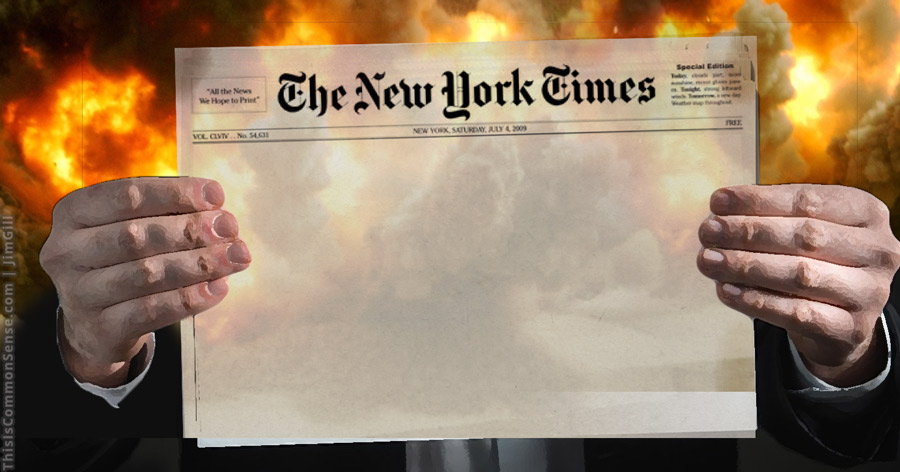
The popular fact-checking sites, such as Snopes and Politifact, cannot stick to the facts.

When Sen. Rand Paul (R-Ky) predicted that a recent repeal of “three regulations” would save “hundreds of millions of dollars and tens of thousands of jobs,” Politifact rated the statement “Half True,” on the grounds that, well, not all experts agreed.

In 2015, objecting to a reported low figure for the Clinton Foundation’s grants to other groups that actually did things, PunditFact gave a “Mostly false” judgment despite admitting that the statement was “technically true.”

NBC engaged in a similar move, admitting to the technical truth of a claim about unemployment, but said it was “extremely misleading.”

Snopes found reasons to tag a “Mixture” rating onto the simple fact that Omar Mateen, the Pulse nightclub mass murderer, was a registered Democrat. He was*.

The funny thing is, these sites are “Almost Right”: fact checking isn’t enough.

Facts can be true, but deceptively used.

Unfortunately, these “fact-checkers” repeatedly fail to clearly distinguish matters of fact from matters of context. They could offer a double analysis and double rating: True/False for the factual; Clear/Caution, to cover interpretations and implications.

Why don’t they?

Perhaps for the same reason the CIA is planning a Meme Warfare Center — to provide a “full spectrum meme generation, analysis, quality control/assurance and organic transmission apparatus”** — instead of a Center for the Analysis of Popular Argument: the idea is not to increase knowledge.

It is to maximize influence.

Which leaves us on meme patrol, ever vigilant.

This is Common Sense. I’m Paul Jacob.


* What Snopes did was speculate that the terrorist perhaps changed his mind after initially registering a decade before the shooting.

** I wrote more about this in Sunday’s Townhall column (from which this Common Sense foray is adapted; see relevant links here), and first broached the goofy/ominous CIA proposal with Saturday’s featured video.


Printable PDF


Categories
Accountability education and schooling free trade & free markets national politics & policies responsibility

The Leading Edge of Higher Ed

“People are paying tons of money to be kept out of the real world . . . being taught by people most of whom have never even worked in the business world. It’s kinda crazy.”

Well, yeah. There’s a lot of crazy in modern college life.

Which is one reason to work around it. That’s what Isaac Morehouse — quoted above — has done.

Morehouse is the founder of Praxis. You may have heard him on The Tom Woods Show or seen him interviewed on Fox News. “The mindset of ‘obey the rules, follow procedures, chase credentials, chase grades, and wait to be told what to do and you’ll be handed this magical ticket to a job,’” Morehouse told Fox’s Tucker Carlson, “it’s just not true.”

His alternative is simple: leverage the apprenticeship idea, combine it with counseling and instruction, and arrange with participating companies a guaranteed job at program’s end.

Our college system deserves a failing grade. Colleges sponge away fortunes (often borrowed) from students, while neglecting to train them to do much of anything but . . . college work.

This means not only that college grads have trouble finding work, but, as Mr. Morehouse discovered before he hit upon the Praxis idea, there are many, many companies trying to hire competent workers, but unable to find them.

A market opportunity!! Praxis unites demand and supply, connecting companies needing smart, energetic, cooperative workers with willing, eager young folks seeking meaningful (and well-paid) employment.

You can find a good overview of his effort — and a way to sign up! — at discoverpraxis.com.

Praxis’s testimonials are inspiring.

As the future should be.

This is Common Sense. I’m Paul Jacob.


Printable PDF


Categories
Accountability media and media people moral hazard national politics & policies responsibility

War on Page A-10

War was once big news. Now? Not so much.

Which may be a function of the never-ending War on Terror, no end in sight in Afghanistan and an Iraq War that is officially over . . . except for the fighting.

Last October, Green Party presidential candidate Jill Stein busied fact-checkers by claiming the U.S. was “bombing seven countries.” True, declared PolitiFact: Afghanistan, Iraq, Libya, Pakistan, Somalia, Syria and Yemen.

Yemen is better known after January’s raid that killed Navy SEAL Ryan Owens, wounded three other SEALs, and killed 14 to 25 Yemeni civilians, including children. Last week, during President Trump’s speech to Congress, Owens’s widow, Carryn, received a thunderous ovation.

But, as I argued at Townhall, “Ryan Owens and his widow and her three now fatherless children deserve more than applause.“ How about thoughtful policies and a Congress that holds the executive branch accountable?

Invading Iraq was a mistake. So was President Obama’s swerve over to destabilize Libya.

“We are not about to send American boys 9 or 10 thousand miles away from home to do what Asian boys ought to be doing for themselves,” President Lyndon Johnson once said . . . right before he sent more American soldiers to Vietnam.

Consider that U.S. Special Forces were deployed to 70 percent of the world’s nations in 2016. And, in recent weeks, President Trump asked for a $54 billion increase in military spending, and we have learned of Pentagon plans to seek a “significant increase in U.S. participation” against ISIS.

We owe it to those in uniform to ask tough questions, including: Is what we’re doing really worth a single American life?

This is Common Sense. I’m Paul Jacob.


Further reading:

Reason: Is the Military Really “Depleted” After Years of Record-High Spending?

The Atlantic: Fighting Terrorism With a Credit Card

The National Interest: America Is Never (Ever, Ever) Ending the War on Terror


Printable PDF


Categories
Accountability crime and punishment government transparency insider corruption local leaders moral hazard porkbarrel politics term limits

Another Political Crook

Last week, the other shoe dropped.

When last we touched upon Arkansas state legislator Micah Neal, he had pled guilty to steering hundreds of thousands of state tax dollars to a small private college in exchange for big, fat bribes.

He also implicated the state’s No. 1 term limits opponent, former State Senator Jon Woods, as chief hoodlum in the criminal scheme. Woods is best known for his dishonestly worded 2014 amendment responsible for hoodwinking voters into weakening term limits.*

And it is upon Woods that the shoe fell.

The fingered wheeling-and-dealing Woods, pursued by both the FBI and an angry electorate, chose not to run for re-election in 2016. Now he’s finally been indicted on 13 felony counts of fraud and bribery. Woods helped secure $600,000 in state funds to Ecclesia College, allegedly for tens of thousands in kickbacks.

“I do know this confirms what I’ve always suspected about Jon Woods,” wrote Max Brantley in the Arkansas Times. “He never had a job. He bragged about the good life he lived off state pay, per diem, travel and the hog slopping legislators enjoy. I should mention, too, that he was the architect of the so-called ethics amendment that provided a path to 1) longer terms in office; 2) higher pay; 3) an end-around an end to wining and dining restrictions despite the appearance that’s what voters had done.”

Former Sen. Woods does deserve a longer term . . . in jail.

This is Common Sense. I’m Paul Jacob.

* State term limits activists are currently gathering the more than 100,000 signatures they need on petitions to place their original, stricter term limits on the 2018 ballot and allow Arkansans an honest vote.


Printable PDF


Categories
Accountability government transparency national politics & policies responsibility

Overkill, Not Parsimony

Two truths: national defense is a necessity; national defense is a racket.

The latter is the case because the former is the case. Big spenders rely on “better safe than sorry” to always push the envelope, over-investing rather than under-investing.

So, we are trapped — and our new president knows this. Before Trump ran for office, he said that sequestration cuts to the Pentagon budget had not gone far enough. But when he threw his hat into the ring, he promised to “make our military so big, so powerful, so strong that nobody — absolutely nobody — is going to mess with us.”

President Trump now proposes over fifty billion dollars in new defense spending. More soldiers, more ships, more fighter jets.

John Stossel argues that Americans are not necessarily suckers for this game. At least, a majority does not support increasing military spending.

More importantly, Stossel challenges the whole “overkill always” strategy. “America is going broke, and our military already spends almost $600 billion dollars [annually],” Stossel says. “That’s more than the next seven nations spend — combined.”

Now would be a good time to not only rethink Middle East policy, but to re-consider our expensive role as world policeman (speaking of “national” defense). During the campaign, Trump was criticized for questioning our alliances and demanding more of our allies. But he was right. I hope he’ll get tough in prodding our allies to ultimately provide their own defense.

Even more basic? Demand an audit of the Pentagon before new funds are thrown into the five-sided money pit.

This is Common Sense. I’m Paul Jacob.


Printable PDF


Categories
Accountability initiative, referendum, and recall moral hazard nannyism responsibility

Whose Constitution Is It, Anyway?

Last November’s biggest mistake? Colorado voters passing Amendment 71. It makes the Rocky Mountain State’s constitution exceedingly more difficult for voters to amend through the initiative petition process.

And more like it may be in the offing. Legislation is moving in Florida to require a 66.7 percent vote to amend the state constitution. Already, a 60 percent vote is required, but legislators remain fearful voters can muster that.

The Ohio Modernization Commission, a legislatively created mix of legislators and insiders, is recommending a new constitutional amendment to — you guessed it — make it tougher for voters to pass amendments. Future voter-initiated amendments must pass twice, by a 55 percent supermajority.

There are also efforts to weaken citizen initiatives in Arizona and Maine.*

The big money behind Colorado’s Amendment 71 told whopper after whopper to win. They pretended to love and revere the constitution. Finally, they put former Denver Broncos Super Bowl champion quarterback John Elway on television — spot after spot — telling voters the amendment “protects our constitution.”

But . . . from whom?

You see, politicians and special interests don’t have to amend the state constitution to spend money on themselves or their cronies. From their perch in the state capitol, they can do that with a simple statute.

But you and I need the ability to pass constitutional amendments. Why? Only through the constitution can we limit the power of those same politicians — the power of government. Legislators can overrule a mere statutory ballot initiative (and often do).

That’s what this battle is all about. Politicians mean to limit our power to limit theirs.

This is Common Sense. I’m Paul Jacob.


* Thankfully, South Dakota legislators defeated several bills aimed at making it tougher to place initiatives on the ballot.


Printable PDF


Categories
Accountability folly free trade & free markets local leaders moral hazard nannyism porkbarrel politics responsibility too much government

Small Target, Big Subsidy

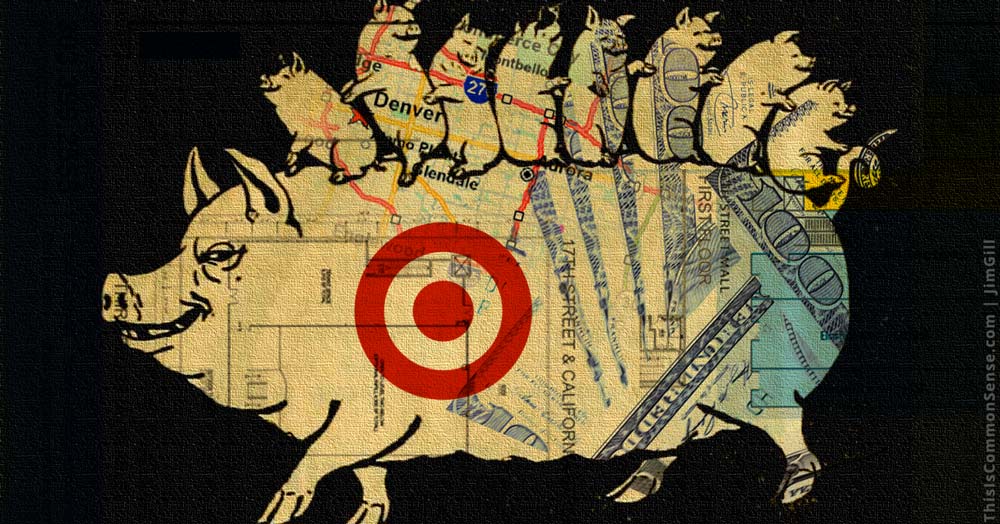
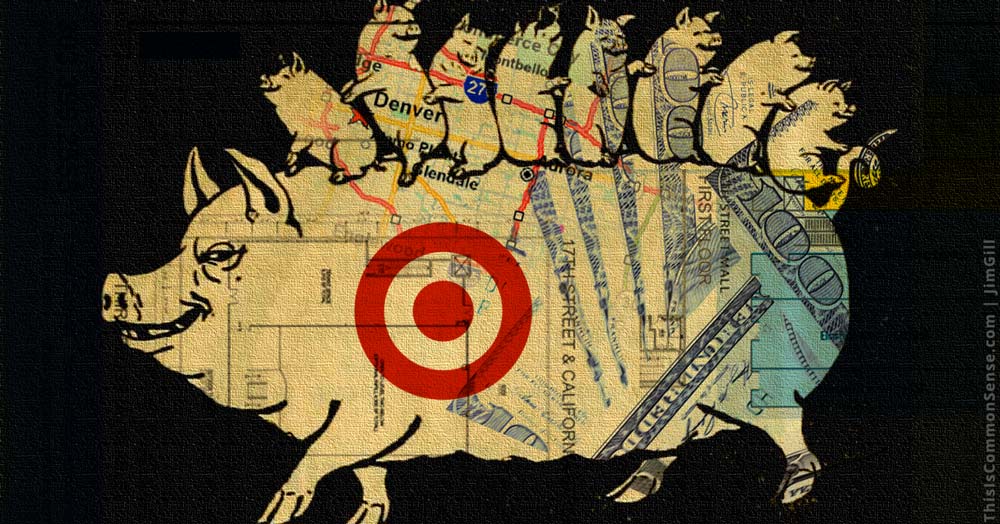
Something has gone wrong when, to get a tenant to move into an empty space in your prime-location building, you need a $4 million subsidy.

And when I say “prime location,” I’m not engaging in Trumpian over-statement. The downtown Denver, Colorado, property location sees over 35,000 pedestrians per day . . . and that’s with the primo slot empty.

But to get that slot filled, the owners have negotiated with the city government to nab a $2 million “incentive” to fix the place up for Target, which is thinking of leasing the location to put up a smaller-than-usual “flexible-format” store. Oh, and another $2 million for “operational” costs, which seems to be some kind of a loan to be paid back from taxes to be collected — and shared by the city for 20 years with the owners.

In other words, it’s the darnedest business deal you’ll ever see (and never get): up-front money not from a bank or investors, but from Denver’s city government “BIF” — Business Investment Fund — which is obviously part of a convoluted scheme fed by taxes and devised by . . . people I wouldn’t trust with my money.

Structuring deals like this is how modern cronies — er, cities — operate, I know. Am I alone in judging it corrupt on the surface and corrupting in the details?

If prime commercial property has gone unused for about a decade — as this three-storied mall space has — I’d think that maybe the owners have set the rents too high or the city has been a bit too greedy with taxes.

Or both.

This is Common Sense. I’m Paul Jacob.


Printable PDF


Categories
Accountability folly ideological culture media and media people national politics & policies political challengers

Bigly Truthiness

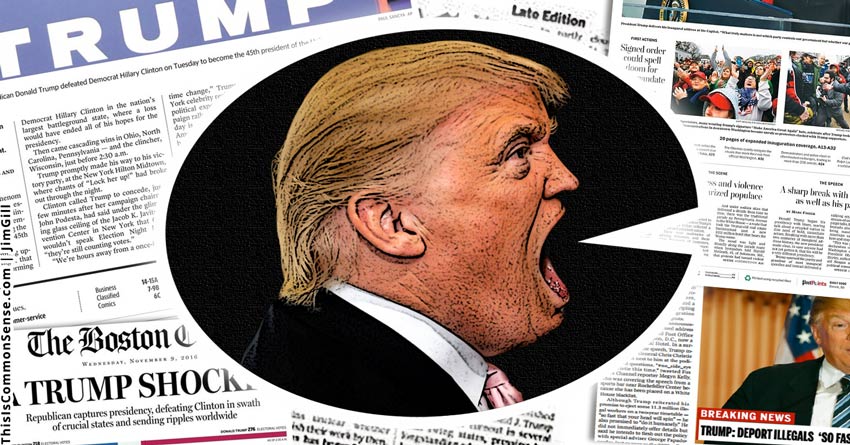
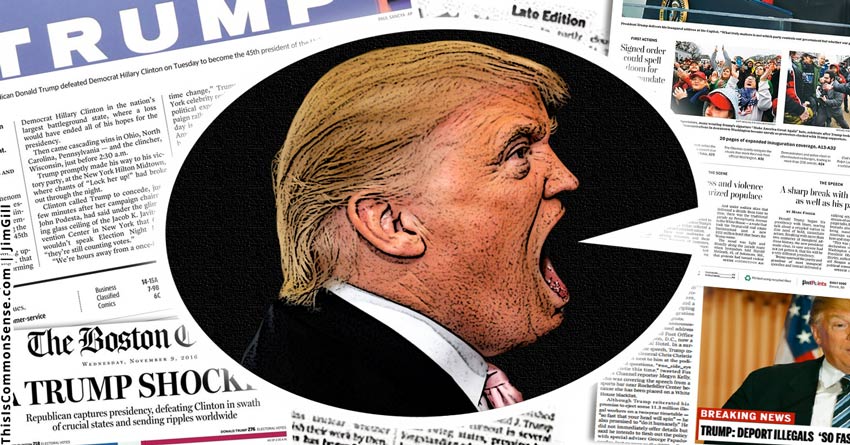
“Journalists should be tough when powerful people say untrue things,” writes the Books and Arts columnist for The Economist.

I’m with “Johnson,” that pseudonymous author, except for one thing. In calling President Trump a Big League liar, he himself seems to miss the whole truth, nothing but the truth.

At the very least, The Economist scrivener proves himself rather obtuse . . . especially for a column de plume tipping the hat to the great Samuel Johnson. Many of the Trumpian falsehoods he mentions are indeed whoppers. No doubt. But a few cry out for a more subtle reading.

After distinguishing between falsity, lying, and fantasizing, “Johnson” speculates that Trump may actually believe “his own guff.”

But then, about Trump’s murder rate statements, Johnson quickly runs off the rails: “Mr. Trump said something wildly wrong about something easily checkable, leaving an adviser, Kellyanne Conway, flailing to cover for him. . . .” But Conway did suggest that Trump may have been speaking about certain cities wherein the murder rate has gone up.

Trump often speaks as hyperbolist: murder has gone up in a few major cities; he relates the fact as if murder had gone up generally. This annoys sticklers. Me, included. But Trump’s been using the rhetoric of exaggeration.

You could call it the rhetoric of inexactitude.

It’s how he trolls.

Trump could also be charged with “truthiness,” comedian Stephen Colbert’s signature 2005 coinage about confidence in factoids for intuitive reasons, sans evidence.

But so might this “Johnson.” When subtle men miss homespun subtleties, one has to wonder whether they might miss it for . . . intuitive reasons.

This is Common Sense. I’m Paul Jacob.


Printable PDF


Categories
Accountability media and media people national politics & policies political challengers

Remember the Rigged Election?

Remember the 2016 presidential election?

You know, the contest that still bedevils us? The one allegedly rigged by the Russians and fake news? The one the outcome of which Michael Moore (and others) suggested, even this week, should be overturned by “the courts” simply by installing Hillary Clinton as president?

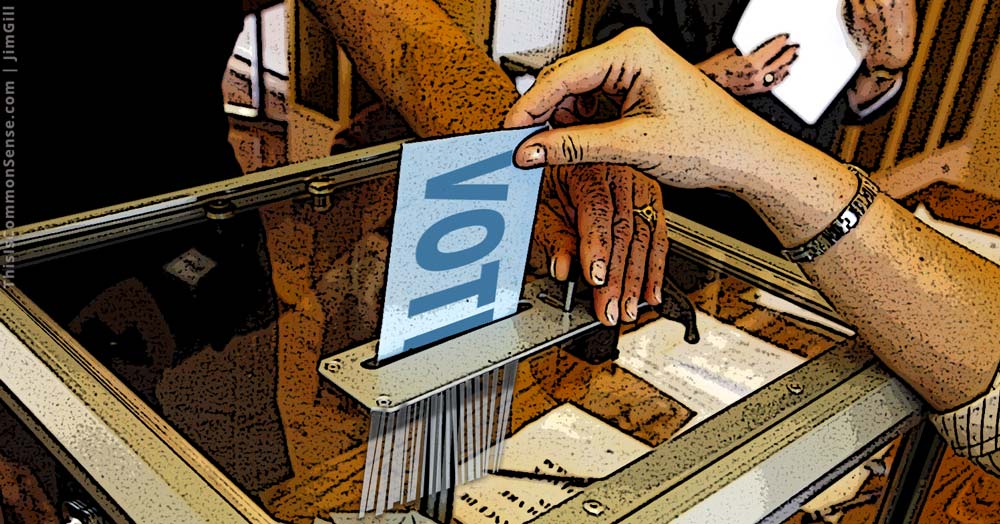
Turns out one major element of the election process was rigged: the debates run by the Commission on Presidential Debates.*

At least, U.S. District Judge Tanya Chutkan has ruled** that, “In sum, with respect to Plaintiffs’ allegation that the FEC acted arbitrarily and capriciously and contrary to law when it dismissed their two administrative complaints, this court agrees. . . .”

The plaintiffs*** are Level the Playing Field (LPF), the Green Party, the Libertarian National Committee, and Dr. Peter Ackerman. They sued the Federal Election Commission because the FEC, as the judge wrote, “stuck its head in the sand and ignored the evidence.” Prior to the lawsuit, LPF and others had filed complaints and asked the FEC to establish fair rules. They were told to go play in — er, far away from — traffic.

“The FEC was the defendant in the case,” explained IVN News, “but the real villain in the story is the Commission on Presidential Debates (CPD), a private organization . . . dominated by Democratic and Republican party stalwarts.”

Under federal law, the FEC, itself organized along bipartisan lines, is charged with ensuring that the CPD is using “objective” criteria, which doesn’t arbitrarily exclude independent and minor party candidates.

Now, thankfully, the court has ordered the FEC to come back, by April 3, with new thinking on how to ensure fair and open presidential debates.

This is Common Sense. I’m Paul Jacob.


* The problems with the presidential debate rules and the CPD itself were covered extensively last year in these four commentaries: “Smash the Duopoly,” “The Media’s Job,” “The Stupidity of 15,” and “The Two-Product Economic System.”

** Tellingly, there’s been scant news coverage of the court decision except by IVN News, the Independent Voter Network website, and . . . RT, the Russian government’s TV channel.

*** The case is Level the Playing Field, et al v. Federal Election Commission.


Printable PDF


Categories
Accountability folly ideological culture moral hazard nannyism national politics & policies responsibility too much government U.S. Constitution

Tough Luck, Chumps

Advertised as a big deal ahead of time, the debate didn’t get much play afterwards.

Especially from the Left blogosphere.

Why?

Billed as about the “future of ObamaCare,” it was really about what should replace ObamaCare.

The CNN debate pitted Sen. Ted Cruz, well-known Republican opponent of the Affordable Care Act*, against Sen. Bernie Sanders, well-known “independent” proponent of what he likes to call the “Medicare for All single-payer program.”

Upshot? While either Bernie or Ted may possibly be construed to have won, there was indeed one certain loser, ObamaCare itself.

Sen. Sanders conceded nearly every charge Sen. Cruz lobbed at the program. He merely countered with his support for treating health care “as a right, not a privilege” (a leftist farrago from days of yore) and moving on to single-payer medicine.

That’s how bad ObamaCare really is. Its chosen champion refused to champion it.

The basic tension was best summed up between “town hall” questioners Carol, suffering from multiple sclerosis, who asked Cruz to promise continued coverage for cases like hers, and LaRonda, a woman with a chain of hair care shops who cannot afford insurance for herself or her employees and also cannot expand her company because at 50 employees the ACA would force her to provide insurance.

Cruz expressed his sympathy for Carol, but seemed to meander around her request for a guarantee. He also evaded** a straightforward answer re: “healthcare as a right.”

Sanders was a tad more honest, in effect giving the “tough luck” answer that the entrepreneur just “should” pay*** for her employees’ medical insurance.

Well, we sure are all “paying” for ObamaCare, one way or another.

This is Common Sense. I’m Paul Jacob.


* Which is the same thing as ObamaCare. Some folks purportedly hate ObamaCare but love the ACA. No reader of Common Sense, of course.

** Cruz concluded the debate better, alluding to an old SNL skit about a recording session wherein the cowbell ringer always wanted “more cowbell” in every take. “It was government control that messed this all up. And Bernie and the Democrats’ solution is more cow bell, more cow bell.”

*** “[I]f you have more than 50 people, you know what, I think — I’m afraid to tell you — I think you will have to provide health insurance.”


Printable PDF