Categories
meme Thought

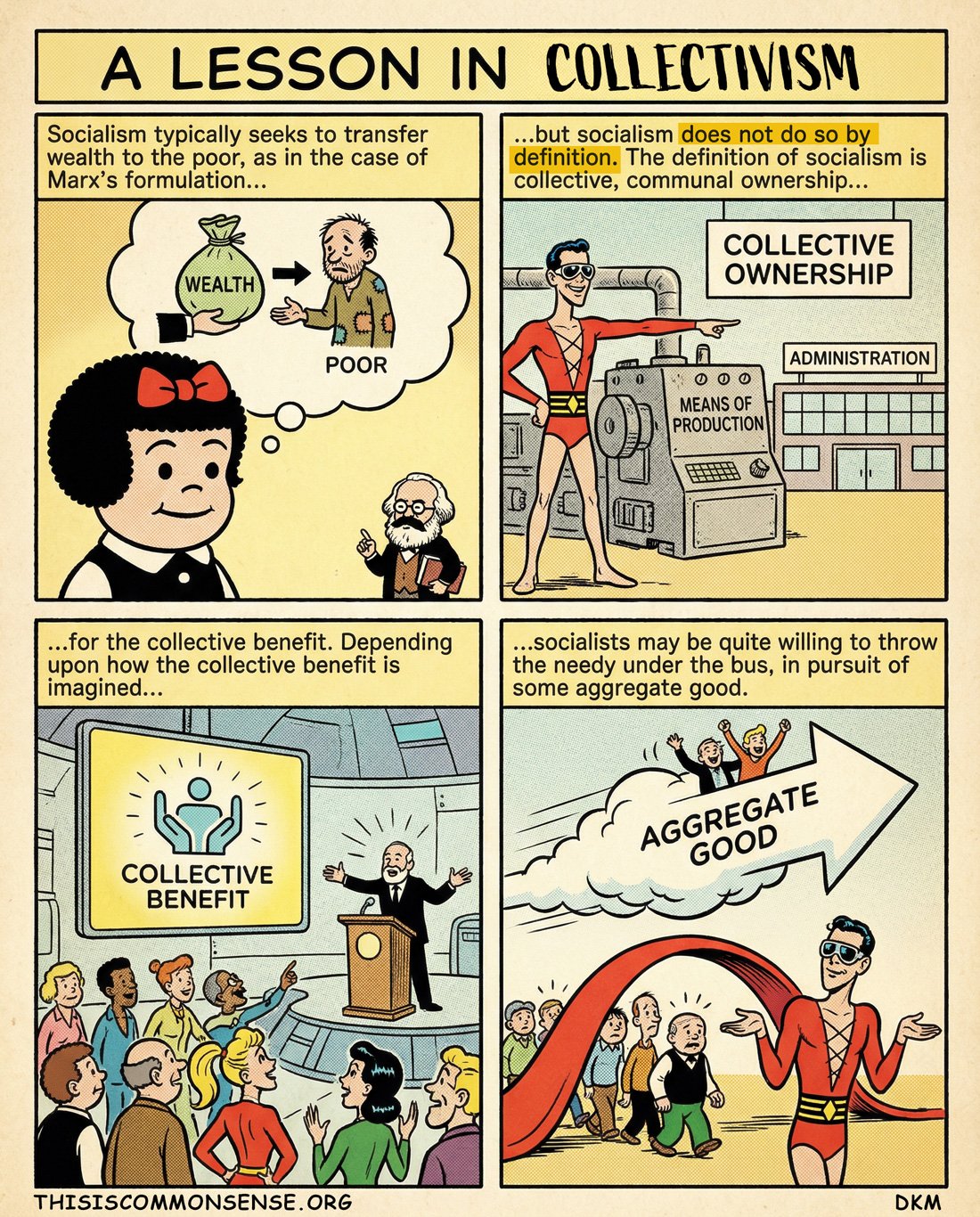
The Warmth of Collectivism

“Socialism typically seeks to transfer wealth to the poor, as in the case of Marx’s formulation; but socialism does not do so by definition. The definition of socialism is collective, communal ownership of the means of production and administration for the collective benefit. Depending upon how the collective benefit is imagined, socialists may be quite willing to throw the needy under the bus, in pursuit of some aggregate good.”

–DKM

Categories
general freedom media and media people national politics & policies

Awkward for Ideologues?

There’s good news about inequality?

In late March, George F. Will argued that the truth about inequality in America, according to his op-ed title, is “awkward for the left and right.”

He points to the reality of transfer payments in the United States. 

Ignoring that reality is what leads to awkwardness.

On the left, critics of capitalism portray low-income earners as a growing class of the impoverished . . . and high-income earners as a growing class of filthy rich. 

But by “not counting about 88 percent of government transfer payments that enlarge the buying power of lower-income households, and not counting taxes that lower the wealth of higher-income households, government statistics purport to prove that the average income in the top quintile of earners is 16.7 times that of the average in the bottom quintile. Counting transfers and taxes, however, the actual ratio is 4 to 1.”

So leftists ignore the “successes” of the very system they set up, the better to complain and demand more of what has already been done.

But what do rightists ignore?

That’s where Mr. Wills’s Washington Post editors (a class of professionals who usually determine titles and blurbs) may have given us the wrong impression. Most of his column explodes leftist interpretations of contemporary reality. But he does talk about “the populist right,”: the “national conservatives” who mimic the progressive left in favoring “industrial policy” that, he notices (as I’ve noticed here at Common Sense) “regressively funnels money upward to corporations.

“The populist right advocates protectionism (tariffs to shield corporations from competition), and the populist left advocates hundreds of billions of dollars of subsidies (for semiconductors, electric vehicles, solar panels, etc.).” Both favor the rich when it comes to regulations, while complaining about the rich in other contexts.

A poor way to help the poor.

This is Common Sense. I’m Paul Jacob.


PDF for printing

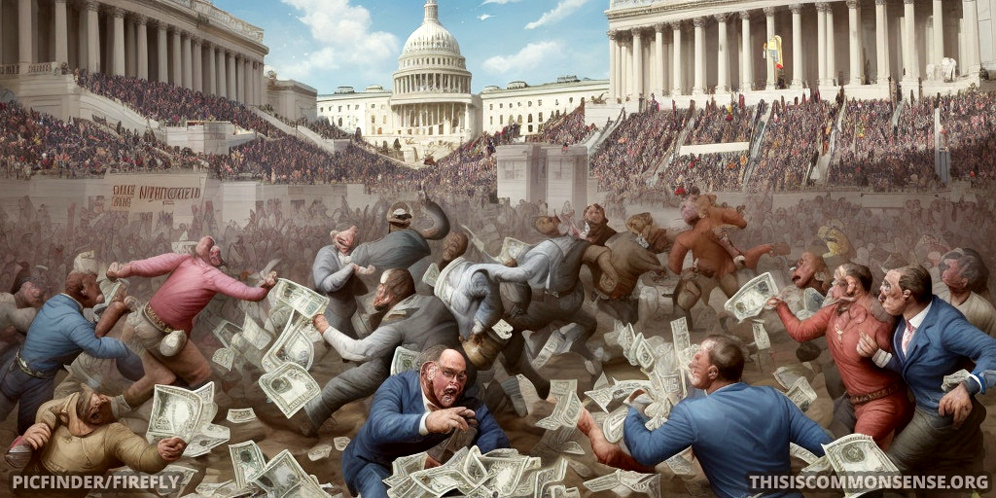
Illustration created with PicFinder and Firefly

See all recent commentary
(simplified and organized)
See recent popular posts

Categories
tax policy

Just Never Satisfied

The top federal income tax rate is currently 37 percent.

It’s been higher — 94 percent at one point during the Second World War, 91 percent in the 1950s . . . on income above a certain threshold.

Back in the 1890s, the federal government briefly taxed income at 2 percent. It was quickly struck down by the U.S. Supreme Court as unconstitutional. 

Those were the days.

In 1913, the 16th Amendment was ratified, giving Congress “power to lay and collect taxes on incomes” overriding the constitutional provisions that the high court had cited in 1895. The first federal rates were 1 percent for the lowest income bracket, 7 percent for the top bracket, on income above $500,000.*

By 1916, the lowest percentage was 2, the highest 25, on income above $2,000,000.

The good news: skyward tax rates aren’t set in stone. The bad news: once a precedent for a new tax has been established, you can expect worse to come.

So what happens if California Assemblyman Rob Bonda gets his way? He seeks a tax of “just” 0.4 percent on the accumulated wealth of “just” “the top 0.15%” wealthiest Californians, “about 30,000 people.” If these wealthiest leave the state, they would still be subject to the tax for ten years(!). 

Presumably, this latter, and quite brazen, aspect of an already brazen tax would be subject to constitutional challenges.

If Bonda’s proposal is enacted and upheld, would the scope of its reach stay put at 0.4 percent of holdings and 0.15 percent of Californian taxpayers?

It would not.

This is Common Sense. I’m Paul Jacob.


* That was a lot of money back then — worth $13 million today.

PDF for printing

Categories
education and schooling ideological culture moral hazard responsibility too much government

An Expert Explains Failure

The failures of the public high schools in the District of Columbia go on an on. It is quite a scandal, as I explained this weekend at Townhall.

And yet some “charter schools that serve large populations of children from low-income families,” notes the Washington Post, after providing much detail about the massive failures, “recorded big increases in scores.”

What hint about improving education does that fact give?

Well, Kevin Welner, a professor who heads the National Education Policy Center at the University of Colorado, has an interesting thought: “People want to read into these test scores lessons about what the schools are doing. But these scores, even the growth scores, depend a great deal on students’ opportunities to learn outside of school. If we address the poverty and racism, then we will see these test scores increase.”

Hmmm. Let’s review: (a) the problem is at home and (b) it cannot be overcome by the schools. Moreover, the esteemed professor perceives the cause of these detrimental home environments to be “racism and poverty.” 

Once upon a time, public education was proclaimed to be the great equalizer, allowing the disadvantaged to climb the economic ladder, and, if not wipe out poverty completely, to certainly dramatically reduce it. 

Now, we discover from a certified education expert that we had it backwards.

So maybe it is time to chuck the whole experiment and just try to educate kids.

Not “save” them, or society.

This is Common Sense. I’m Paul Jacob.


PDF for printing


Categories
free trade & free markets general freedom national politics & policies responsibility

The Poverty Retirement Non-plan

A “conundrum” is “an intricate and difficult problem” or “a question or problem having only a conjectural answer.”*

In his June 8 article, “The Jobs Conundrum,” economist Gerald P. O’Driscoll focuses on a very big problem that we do not have sure answers to, yet.

Unemployment figures are down, but the number of non-working adults in the prime of their lives is up. O’Driscoll explains: “Unemployment” is a term of art and does not mean simply the number of people not working. It comprises the number of people not working and who are looking for a job.” Many aren’t “unemployed” for the simple reason that they are not trying to be employed.

They are, I suppose you could say, in early retirement, mostly a kind of poverty retirement.

Economists call it a drop in “labor force participation.” It used to be that men in the prime of life not looking for work constituted a mere 6 percent of the population. Now it’s 15 percent.

O’Driscoll, I notice, doesn’t engage in much conjecture to explain why. He merely insists, instead, that the trend is big, unemployment figures don’t track it, and that it has huge consequences.

I’ve heard some interesting (and puzzling) theories about the whys, of course. Blame feminism; blame the welfare state; blame the Chinese!

But even before we settle on a definitive answer, many movers and shakers now contemplate establishing — and are even experimenting with — a universal basic income as a way to alleviate this problem.

My conjecture? It would make the problem worse.

This is Common Sense. I’m Paul Jacob.


* The original, primary meaning of “conundrum” — “a riddle whose answer is or involves a pun” — is not relevant to this pun-free column.


Printable PDF


Categories
free trade & free markets general freedom media and media people moral hazard nannyism property rights too much government

Of Salt and Socialism

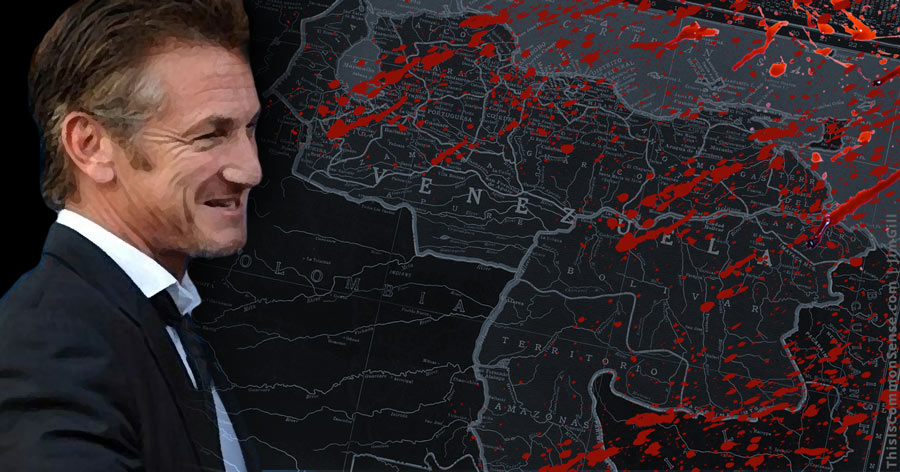
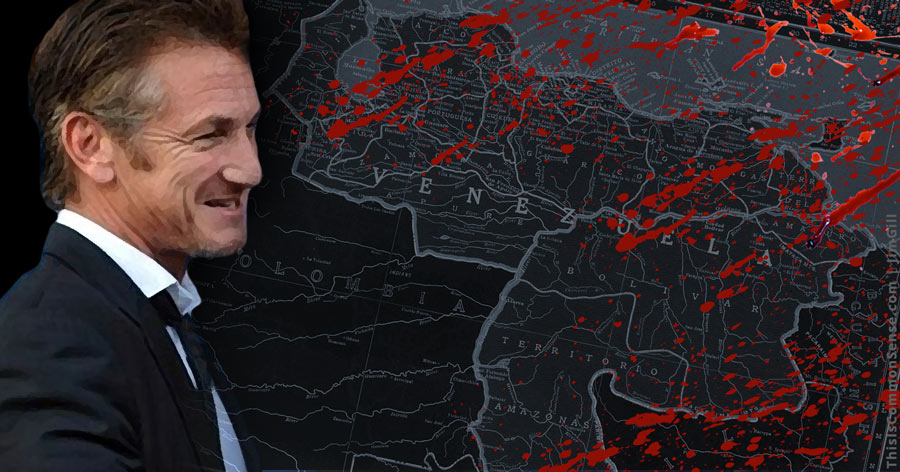
Nearly 75 percent of Venezuelans have lost 19 pounds or more in 2016. “People have become so desperate,” the Miami Herald reported recently, “that they are butchering and eating flamingos.”

While acknowledging the problem, TeleSUR, a television network based in Venezuela and funded by governments including Cuba, Ecuador, Nicaragua, and Venezuela, called the Herald’s story “kooky” and suggested taking reports “like alleged flamingo eating with a grain of salt.”

If, in socialist Venezuela, one could find a grain of salt.

In America, salt is necessary, too, when listening to our socialist Hollywood celebs blather about their kooky diets, for which some are blaming President Trump.*

Socialism kills. The deprivations in Venezuela are no joke, for along with economic chaos, Venezuelans are experiencing political repression on a grand scale. A new report from Luis Almagro, secretary general of the Organization of American States (OAS), documents the thousands arrested for protesting or “having posted something against the national government or a public official on Twitter.” The report details the “curtailment of civil, political and electoral freedoms” and “torture” and “censorship.”

Almagro calls for the suspension of Venezuela’s membership in the OAS, which is long overdue. The Human Rights Foundation demanded that nine years ago.

The Obama administration opposed such a move, as the Washington Post editorialized, in order to pursue “a legacy-making détente” with “the Castro regime in Cuba.”

At Townhall,** I urged Trump to support the effort to boot Venezuela out of the OAS, which might provide some assistance toward political change there . . . and Venezuelans eating more.

And perhaps to socialists in Hollywood and elsewhere eating crow . . . but not flamingo.

This is Common Sense. I’m Paul Jacob.


* I covered this last week, when I compared their Trump Diet nonsense to the “Maduro Diet,” named for Venezuelan President Nicolás Maduro, the socialist dictator presiding over the complete economic collapse of what, prior to socialism, had been South America’s richest country.

** From which this Common Sense is adapted.


Printable PDF
 

Categories
folly general freedom moral hazard nannyism national politics & policies responsibility

Town, County, Stasis

The savvier economists (and intellectuals like Steven Pinker) like to remind us that it is progress that must be explained; poverty is natural.

But when you see poverty settle in like an infestation of slime mold, staining a whole modern city or region, you begin to wonder. As Ron Bailey wonders in his excellent Reason report on West Virginia’s impoverished McDowell County . . .

WHY DON’T THESE PEOPLE JUST MOVE?

The feeling of being trapped in your community — in your hovel, in your own blighted life — does not come, these days, from mere poverty alone. I remember the Joads in The Grapes of Wrath; my family has a history. Once upon a time, folks in America, when industry ran out, left. Traveled. Migrated — to find work where industry boomed.

And sure, McDowell used to be much more populated. Bailey’s family left two generations ago.

But the stragglers?

Almost any community has its specific enticements.

But one thing becomes clear, as you read through Bailey’s sad survey (in part memoir, since he has family ties there): government is the worst culprit.

A lot of welfare goes into McDowell, and a huge percentage of the population is retired or on disability.

“If you get public assistance to supply your needs without any effort from you,” explains one young man who came back to his beleaguered hometown, “you’ve got no incentive to better yourself or your situation.”

Government subsidizes poverty. Sure, it prevents destitution. Utter misery. But it also traps people, robbing them of their wherewithal to get up and go and achieve something.

Modern government is in the stasis business. Our assistance programs don’t just assist.

A modern American nightmare.

This is Common Sense. I’m Paul Jacob.


Printable PDF

chained, West Virginia, poverty, welfare,


Categories
general freedom ideological culture nannyism national politics & policies Popular too much government U.S. Constitution

The Venezuela Chaos

I have friends who call themselves anarchists. Their theory? Government is always merely an open conspiracy of some to live at the expense of others.

Republicanism, on the other hand, proposes that if we limit government, we can hone it down to the level where there is no conspiracy, and everything the government does can plausibly help everybody.

Not just a few insiders.

Socialism is the opposite notion. Socialists seek to grow government so far that it “naturally” serves everybody, not only the few. It’s all about “equality,” you see.

Here’s what we know for sure: socialism, when really tried, is so awful that it makes anarchy-as-chaos sound good.

The latest socialist horror is Venezuela, which is getting worse every day. Now hospitals place newborns in cardboard boxes. There are no other supplies.

But that’s not all. The special program for feeding everybody? It’s now mainly for feeding just those close to the government — precisely as my anarchist friends say all government is:

Six months after the creation of the Local Committees of Supply and Production (Clap) that is designed to “distribute food directly to the people,” the government has decided to change its approach by threatening those using the program.

The Venezuelan government announced that it will suspend delivery of food packages to those who criticize its policies.

Are socialist out to prove anarchists right?

I bet most of my readers still put some hope in limiting government to serve all. Venezuelan socialism demonstrates how badly the opposite idea is, showing us that serving everybody by total government just decays into the folks allied closely with government warring against everybody else . . . who starve in plain sight.

This is Common Sense. I’m Paul Jacob.


Ask the next question.

Questions Answered:

What is the difference between a republic and a socialist state?

What do anarchists think of government?

What happens when government tries to do everything for everybody?

The Next Question:

How do we convince well-meaning socialists that total government cannot work for the benefit of everybody? (Since the examples of the USSR, Communist China, and Venezuela haven’t worked so far.)


Printable PDF

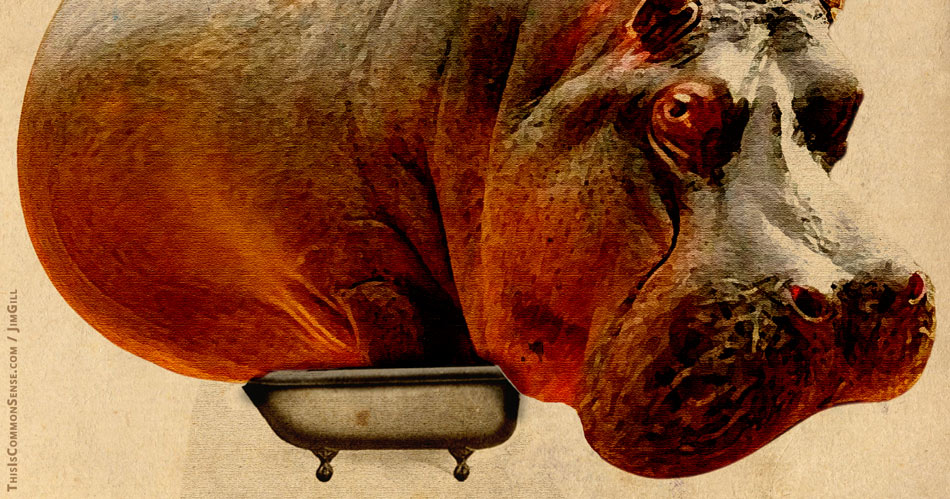
government, bathtub, Venezuela, illustration


Categories
Accountability crime and punishment general freedom moral hazard national politics & policies Regulating Protest responsibility too much government

Too Much – Part 2

Yesterday, we discovered that modern America asks police to do “too much.” Which prompts the next question: What should police stop doing?

Here are two immediate reforms where police can do less, while protecting the public more:

     (1) End the War on Drugs. Preventing violence and fraud is the rightful role of police. Not preventing people from engaging in activities that are peaceful, however misguided or self-harming. The criminalization of marijuana means more than 150 million Americans are criminals, warranting police involvement.

Now, Mr. Obama has released some convicts serving long drug-related sentences, but we need a president who will go much farther in changing law enforcement priorities.

     (2) Stop Using Civil Asset Forfeiture, whereby police steal people’s stuff without charging and convicting those people of any crime. Not only do federal agencies from Justice to the IRS take our property in violation of our rights, but the Feds encourage state and local police to join them in this bad behavior through their “equitable sharing” program.

While Obama has spoken against seizing assets without a criminal conviction, he hasn’t stopped it. And he could at the federal level, with a stroke of his pen — as I have advocated at Townhall. Ending civil asset forfeiture is an executive order actually within his constitutional power.

Would these two steps end all racism or violence or crime? No, no, no.

They would be, however, two steps forward toward a more principled, lawful and respectful style of policing that would better serve to unite rather than divide citizens and police.

It’s a different two-step than reformers have been witnessing.

This is Common Sense. I’m Paul Jacob.


Printable PDF

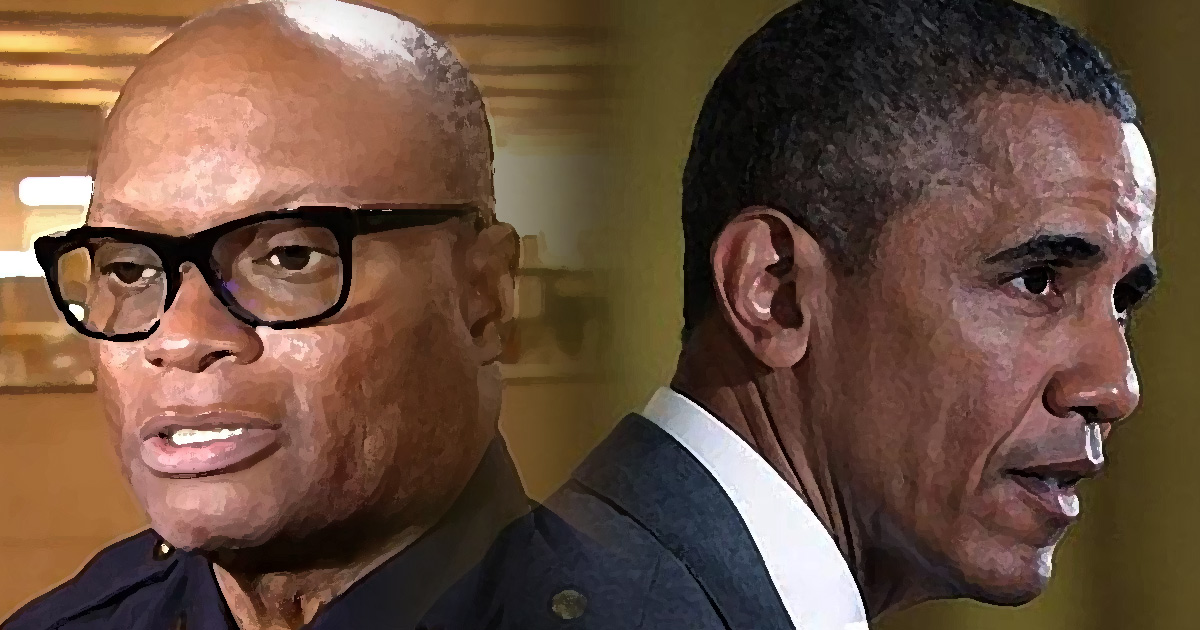
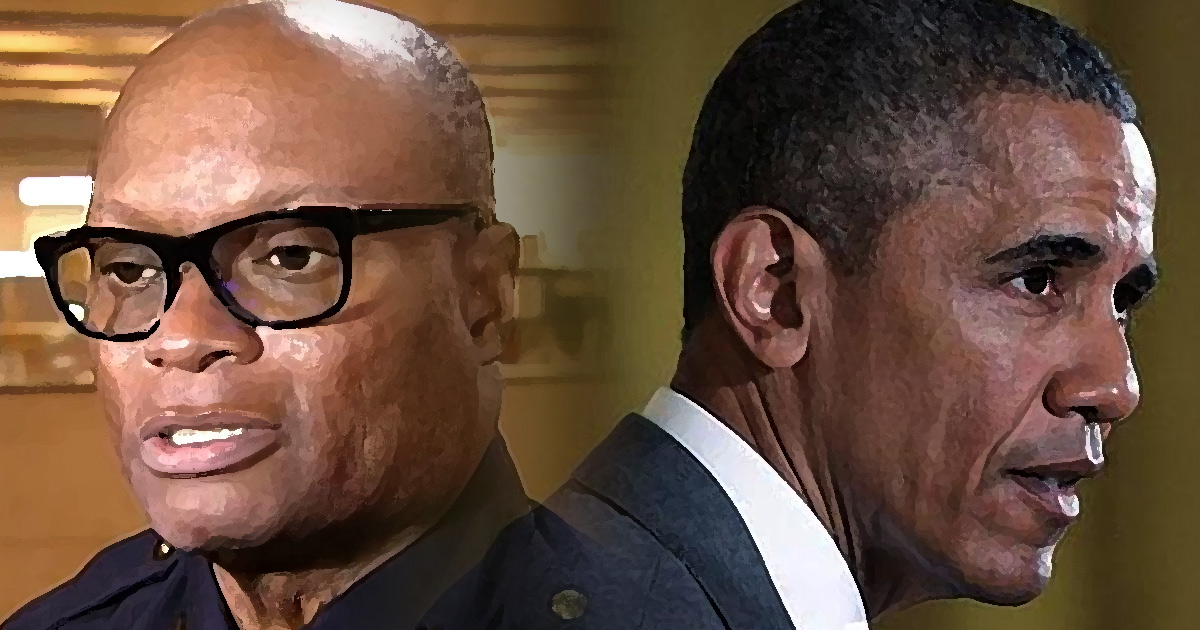
crime, police, Police Chief David BrownX poverty, President Barack Obama


Photo Credit: Tomasz Iwaniec


Categories
Accountability crime and punishment moral hazard national politics & policies responsibility too much government

Too Much

When President Obama said, “[W]e ask the police to do too much,” at the memorial service for the five slain Dallas policemen, he was echoing an idea previously expressed.

“We’re asking cops to do too much in this country,” Dallas Police Chief David Brown told reporters a day earlier. “Every societal failure, we put it off on the cops to solve,” he added, noting such problems as a lack of mental healthcare, rampant drug abuse, substandard schools and even roaming dogs.

So, what should police stop doing?

Plenty. But I’ll save that answer for tomorrow. Today, let’s pose another: Why so much crime, poverty, and violence in these communities?

Mr. Obama fingered not taxing-and-spending enough on benefits for the poor, including for “decent schools,” “gainful employment,” and “mental health programs.” Yet, after decades of expensive wars on poverty, illiteracy, drug abuse, etc., things have only gotten worse.

“We flood communities with so many guns,” the president intoned, “that it is easier for a teenager to buy a Glock, than get his hands on a computer or even a book.”

He’s playing fast and furious with the truth. Books are free at the library. Glocks cost money.

And who is this “we” he keeps bringing up?

Chief Brown mentioned a critical problem Obama did not: “Seventy percent of the African American community is being raised by single women.”

Police cannot solve all our problems, sure, but they especially cannot fix problems exacerbated by the welfare state and the educational system. Big government is no substitute for Mom and Dad.

Even freedom merely offers the opportunity to fix our own problems.

This is Common Sense. I’m Paul Jacob.


Printable PDF

Obama, Police Chief David Brown , police, abuse, poverty,