
Categories
crime and punishment

Cold War Casualty

The Cold War never quite ended. At least two countries still sport that old-​fashioned “Second World” status of ostensibly communist, definitely totalitarian, and utterly crazed leadership: North Korea and Cuba.

Alan Gross, age 65, was convicted of un-​Cuban activities in 2011, and has since been serving a 15-​year prison sentence. He was a subcontractor, working in Cuba, for the U.S. Agency for International Development. What, precisely, did he do “wrong”?

U.S. officials said Gross was merely trying to help Cubans bypass the island’s stringent restrictions on Internet access. But Cuban authorities say Gross was part of a plot to create “a Cuban spring” and destabilize the island’s single-​party communist government.

The two interpretations are not exactly at odds with one another. Sure, he was trying to bring the Internet to Cuba. And that’s why the communist government was suspicious: free information would likely bolster opposition to the commie way of stasis.

Which just goes to show how awful single-​party states are, how mind-​crushingly awful communism is: restrictive; vindictive; paranoid; cowardly.

These qualities are supposed to be absent from New Socialist Man, of course, qualities found only — at least, in ultra-​left theory — under capitalism and democracy.

But, instead, they serve as hallmarks of governments that cannot trust their subjects with even a smidgeon of freedom.

Gross is now reportedly weak, and has given up on life. Prison life in a prison society is not worth it, he says.

We can hope for a prisoner exchange. But really, what’s needed is a change of government in Cuba.

This is Common Sense. I’m Paul Jacob.

Categories
general freedom national politics & policies too much government

Flight to Freedom

One of the more inspiring perennial stories of my youth were of defectors, people who left their Communist-​controlled countries to reach freedom … on American soil.

Many, many Soviet and Eastern bloc subjects smuggled themselves out of their countries, or “jumped ship” while visiting the U.S. or other Western nations. The list of freedom seekers is long, impressive, and inspiring.

And this isn’t just “ancient history.”

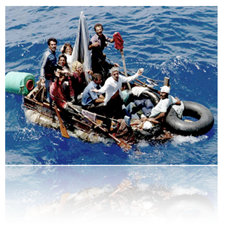
After an international tour, seven members of Cuba’s National Ballet were confirmed by homeland sources as “not having returned.” And a Cuban exile website has informed us that six of the defectors are now in the U.S., while the seventh remains in Mexico, where the troupe had broken free:

“We were intent on seeking a better artistic life and economic well-​being for our families,” Cafe Fuerte quoted one of the group, Annie Ruiz Diaz, as saying.

Correspondents say Cuba’s National Ballet has suffered from a number of high-​profile defections over the years, as performers stay abroad in search of greater creative and economic opportunities.

But this is only the tip of the proverbial floating mass of frozen water. In truth, thousands of people defect to the United States every year. Leaving their countries of origin, they flee poverty, tyranny, reckless government and outrageous criminality (too often these latter are the same thing), seeking the comparatively peaceful life found under a nation run by the rule of law.

Alas, defection is going the other way, too, as more and more Americans attempt to escape from increasingly burdensome taxation, oppressive regulations, and selective enforcement of innumerable laws.

We honor the heroic defectors from Cuba only by making the U.S. a place that fewer and fewer peaceful folks would be tempted to flee from.

This is Common Sense. I’m Paul Jacob.
Categories
general freedom

Libre from Cuba?

Some Cubans will soon be free to escape the Cuban dictatorship.

The Cuban government recently announced it would end exit visa requirements by mid-​January. After which, Cubans wanting to go abroad will simply need a passport and a visa from the country they’re headed to.

Some of them, at least.

Cuba won’t simply let its people go. Emigration will remain a privilege — one more often accorded now, but still a privilege — not a right. A privilege the government may revoke at will by invoking, for example, “national security” to stop dissidents who might cause trouble abroad. Skilled professionals may be kept to “preserve the human capital created by the Revolution” — you know, on the “You Didn’t Build That” principle.

For a government (whether a dictatorship or a prelude to one) to treat rights as mere provisional gifts is nothing new. The Weimar constitution of 1919 held the rights of the individual to be “inviolable” — unless a law were passed to violate them. (Article 114.) The German’s home was “an asylum and inviolable” — unless a law were passed to violate it. (115.) Freedom of speech, freedom of movement, etc., were all guaranteed — except when the state deemed otherwise.

Yes, Cuba’s loosening of emigration rules will be a boon for those Cubans free to leave under the new rules. But the situation resembles that of a prison in which everybody is wrongly incarcerated, from which half the inmates are one day graciously released. Well, great, except … shouldn’t they all be released?

This is Common Sense. I’m Paul Jacob.

Categories
term limits

Term Limits for Cuba?

You can’t cheer some victories — they just don’t seem real.

I mean, what can you make of the “victory” for term limits represented by Raul Castro’s endorsement of the reform during an endless speech at his country’s Sixth Communist Party Congress? 

Castro told fellow commies that political officials, including El Presidente, should be limited to two consecutive five-​year terms. Seems that with the Castro brothers about to shuffle off this mortal coil, decades of dictatorship have shrunk the pool of well-​tested vicious ranters experienced maligning capitalist running dogs and running the country into the ground.

The dear leader’s speech touted a laundry list of proposed changes to Cuba’s socialist system, including legalizing the sale of cars and homes, a possibility the party has been “studying.” Some of these reforms might take effect and make life a little easier for Cubans.

Perhaps Raul Castro, 79, reflecting on his ailing fratello’s disastrous half-​century dictatorship (1959 to 2008, more or less), has decided Cuba’s socialism and autocracy don’t really work after all.

It’s happened in other moribund societies.

But even if presidential term limits should (against all odds) be enacted before Raul kicks the bucket, they won’t mean much if his successor decides they don’t mean much. And like other critics of the regime, I doubt that Cuba will be the country to buck the trend of governments “restricted” by term limits that are not worth the tissue-​paper constitutions they’re written on.

This is Common Sense. I’m Paul Jacob.

Categories
free trade & free markets general freedom too much government

A Million Jobs, Gone

You’re fired! Now get a real job.

Does this sound mean? 

It’s just what Cuba’s biggest employer plans to say between now and March — fire half a million workers and tell them to find other jobs, or (better yet) go to work for themselves.

After March, another half million will be given pink slips.

Or so say the Castro Bros., who are, in effect, the chief employers in Cuba. 

Just like a despot, you might say. But hey: The country is broke, and the initial hiring of everybody by the government (which Fidel ran for scores of years, and his brother, Raul, now runs) was, itself, despotic. Thankfully, as more and more outlets of the “Cuban Communist Corp.” go under, the Cuban commissars say they will ease up on the regulations that now prohibit small, entrepreneurial businesses.

Of the many comments I’ve read about this, I was amused most by Tom Knapp’s. After drily noting that it is the Castros who will build down government, not Republicans in the U.S., he explained how the commies had kept their transportation going all these years: By maintaing old American cars from the ’40s and ’50s. Now that trade restrictions will likely be eased, those well-​kept-​up vintage cars could help “finance an explosion of economic prosperity just by tapping the U.S. classic car collectors’ market.”

Hope so.

And I hope the newly fired will transition to a slightly freer economy without too much trouble.

This is Common Sense. I’m Paul Jacob.

Categories
ideological culture too much government

Fidel Fesses Up

Cuba’s 1959 revolution happened before I was born. Fidel Castro won, and ruled the country with an iron fist and steel jaw until a few years ago, when he handed power over to his brother, Raul.

The country’s been Communist, governed on allegedly Marxist principles, with the Castros sticking by their faith in total government even after the Soviet Union collapsed. Their dogged dedication to state socialism is impressive, in its way.

It’s like, say, watching Thomas Harris’s Hannibal Lecter character on the silver screen. You cannot approve of motive or act, but the sheer fortitude! The evil genius!

A journalist for The Atlantic recently asked the retired Fidel Castro whether he still thought Cuba’s communism was exportable. And the old man replied, “The Cuban model doesn’t even work for us anymore.”

The journalist’s companion, a Latin American scholar, interpreted this huge admission as recognition that Cuba has too much government.

Should we take a camera, a megaphone and a boat to Michael Moore’s moat and ask him how he feels about this?

The Cuban government provides its citizens with free education, medical care, and transportation. And not much else. Except state harassment and arrest for speaking out. And the rationing of food is pretty stingy. Nearly everybody works for the government nexus.

But hey, many well-​educated folks in America have admired the government. Why? For all those big state projects. Health! Education! Buses!

Big whoop, when you’re hungry and a slave to the state.

This is Common Sense. I’m Paul Jacob.

Categories
free trade & free markets too much government

Cuba Needs Freedom

A viral video is making the rounds of Latin America. You can find it on YouTube. It’s an interview with a man on the street, and another Cuban man walks up and steals the show. He points to his open mouth. In island slang he says he’s hungry, and that “what Cuba needs is food.”

A lot of people blame America for Cubans’ hunger. And our government is now considering removing the embargo we have had against Cuba since its Communist-​inspired revolution. But that should be done — or not — for reasons that have nothing to do with the motto “Cuba needs food.”

Think about it. Cuba can trade with the rest of the world. In fact, on a cash basis, even with the U.S. Plenty of opportunities to produce and purchase food. 

And hey: The resorts in Cuba are well-​stocked with food. Canadians and Europeans and Arabs and others visiting the island don’t complain about a lack of food. 

But the common folk do.

Why?

Well, Cuba suffers from a kind of apartheid. Everyday citizens get ration cards. Their food shelves are bare. They cannot visit tourist beaches, shop at tourist supermarkets, or eat at tourist restaurants. They have to make do with the meager food they’ve been rationed.

So much for the abolition of the class system by Castro!

To feed Cubans, just one thing is needed: Freedom — an end to socialistic apartheid.

This is Common Sense. I’m Paul Jacob.