Categories
Accountability local leaders media and media people moral hazard national politics & policies political challengers responsibility term limits

Sic Transit Gloria Flake

Yesterday, a major American politician gave up.

Sort of.

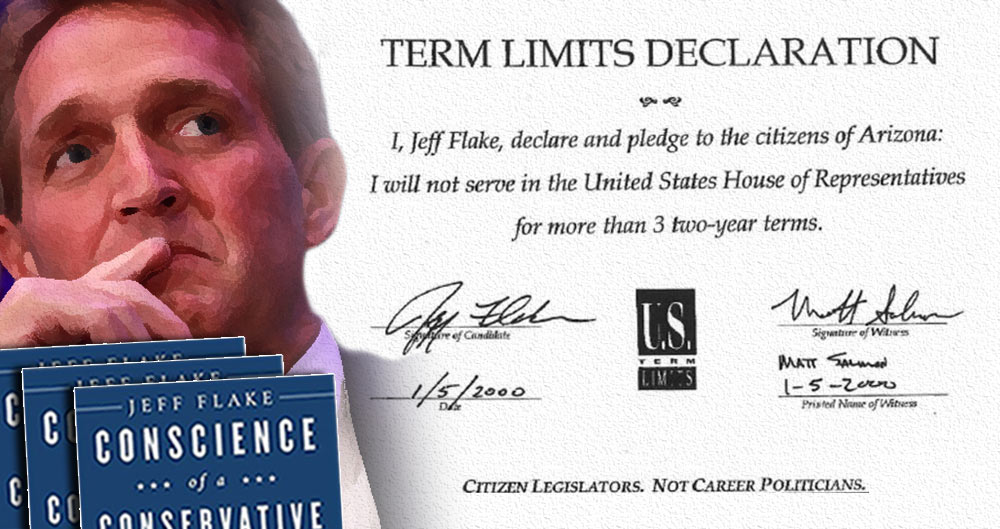
Senator Jeff Flake, the junior member of the upper chamber from the State of Arizona, took to the Senate floor to announce that his “service in the Senate will conclude at the end of my term in early January, 2019.”

Actually, most of the speech was an appeal to President Trump.

Or a lambasting. 

In either case, he was echoing his recent book, Conscience of a Conservative: A Rejection of Destructive Politics and a Return to Principle, which columnist David Brooks has described as a “thoughtful defense of traditional conservatism and a thorough assault on the way Donald Trump is betraying it.”

In the Age of Trump, anti-​Trumpian manifestos are … controversial in GOP ranks. And his opposition has cost him. All bets were against him winning re-election.

“I believe that there are limits to what government can and should do,” Flake wrote in a letter to supporters, going on to say “that there are some problems that government cannot solve, and that human initiative is best when left unfettered, free from government interference or coercion.”

Solid principles. Principles I share. But how principled was Flake? He began his career promising to limit his own terms, in accordance with … conservative principles. And yet the man from Snowflake, Arizona, broke that promise in 2006, holding on to his House seat for three more terms. 

For his remaining 14 months in the Senate, Flake can return to the principle he reminded himself of in yesterday’s speech: “Sustained incumbency is certainly not the point of seeking office.”

There’s life after Congress. And Jeff Flake can do good things in the real world.

This is Common Sense. I’m Paul Jacob.

PDF for printing


Categories
education and schooling

Legislation for Graduation

The most obvious problem with government-​run schools is that, well, politicians are in charge.

Two Arizona solons have written bills to require high schoolers to pledge their loyalty and allegiance to the Constitution in order to graduate. You’ve probably heard about at least one of these bills, since it affixes a “so help me God” phrase at the end, and that would pose a problem for atheists … and for those pious folks who don’t believe in swearing by the God they believe in.

While most of the media coverage has focused on that tacked-​on “so help me God” aspect, both measures seem “tacked on” to me: Tacked on to the end of a high school career. Pretend you are a student. You’ve worked hard, or at least hard enough to graduate. Much of your future employment depends on your diploma. And now some politician is going to require that you recite a loyalty oath to the federal (not state) government?

Sounds like something more appropriate to a Communist dictatorship.

Stranger yet is the bill, proposed but not moved forward, further north:

Coeur d’Alene Sen. John Goedde, chairman of the Idaho Senate’s Education Committee, introduced legislation Tuesday to require every Idaho high school student to read Ayn Rand’s Atlas Shrugged and pass a test on it to graduate from high school.

Before one hyperventilates, it’s worth noting that the good Sen. Goedde did this to “send a message,” so to speak, to the State Board of Education because of his unhappiness with their recent moves lowering graduation requirements and canceling evaluations of principals.

Well, I guess there’s method to his madness. And besides, there are worse books.

This is Common Sense. I’m Paul Jacob.

Categories
ballot access First Amendment rights political challengers

“Top Two” Goes South

Washington State has a long history of popular antagonism to political parties. For years, the state enforced an open primary, which meant that Republicans could vote in Democratic primaries and Democrats in Republican primaries. This was very popular, because it led to widespread strategic voting.

Well, that’s a euphemism. In open primaries, what you get is not mere strategic voting so much as sabotage. I have heard of Democrats and others boasting of voting in Republican primaries, for example, supporting Pat Robertson. Why? They believed Robertson to be unelectable, and hoped putting Robertson ahead would undercut the GOP in independent voters’ eyes, and make running against the party easier in the general election.Shooting numbered ducks.

Well, a few years ago that system was thrown out as unconstitutional, as an abridgment of free association rights.

But instead of allowing party members to select candidates, Washington State movers and shakers cooked up something else altogether. They set up a system wherein anyone could use a party’s label — even if that party’s members don’t know said candidate or despise him. Robbing parties of any control over candidates offered in their name is far worse on the very constitutional issue that nullified Washington’s traditional open primaries. Though Top Two has been legally challenged, the U.S. Supreme Court just this week refused to hear arguments.

The name “Top Two” comes from the fact that only the top two vote-​getters in this super-​open primary are on the general election ballot. The new system has completely removed minor party candidates from the general election ballot, when most folks vote.

Top Two has had the same impact in California. Arizona voters will decide the issue this November, on their ballot as Prop 121.

This is Common Sense. I’m Paul Jacob.
Categories
ballot access too much government

Arizona “Clean Elections” Scheme Nixed

The United States Supreme Court decided, 5 – 4, against Arizona’s “clean elections” law. In two challenges to the law, Arizona Free Enterprise Club’s Freedom Club PAC v. Bennett and McComish v. Bennett, the Court ruled for freedom and against a bizarrely unfair form of “fairness.”

The idea behind Arizona’s law was to make money somehow “not count” by “leveling the playing field.” Arizona did this by giving taxpayer money to “clean elections candidates” to equal the voluntary donations obtained by privately funded competitors.

Chief Justice Roberts says the scheme goes “goes too far.” I would say: Way too far.

Roberts nicely argues that though “‘Leveling the playing field’ can sound like a good thing … in a democracy, campaigning for office is not a game.  It is a critically important form of speech.  The First Amendment embodies our choice as a Nation that, when it comes to such speech, the guiding principle is freedom — the ‘unfettered interchange of ideas’ — not whatever the State may view as fair.”

Now, I see why people don’t like the ugliness and “unfairness” inherent in “winner-​takes-​all” zero-​sum contests like political campaigns. But the solution isn’t to hand public money to some favored candidates, effectively putting a finger on the scales. Instead, provide the public with greater choices, and let the people freely decide.

This is Common Sense. I’m Paul Jacob.

Categories
ballot access First Amendment rights

Clean Elections or Dirty Con?

No supporter of so-​called “clean elections” would argue that we should be forced by law to pull the lever on election day for the candidate we oppose. But the tangled web that politicians and regulators have woven with campaign finance laws does often force us to support candidates we oppose during the run-​up to election day.

Here’s just one perverse example: The “‘clean’ elections” system in Arizona. Under Arizona’s scheme, if Candidate A runs as a “‘clean’ elections” candidate, every time Candidate B, who declines public funding, raises a certain amount of money by making effective appeals for support, Candidate A gets matching funds at taxpayer expense. In other words, the government forces you as taxpayer to offset the support you give to Candidate B voluntarily by ensuring that your money goes to Candidate A too — involuntarily. Under this law, the spending of independent groups is also matched by coercive taxpayer donations to “‘clean’ elections” candidates.

It’s a horrific skewing of the political field in favor of the ideas and candidates voters don’t want to support — a direct coercive assault on their democratic rights.

The fate of Arizona’s “welfare-​for-​politicians” law has survived a federal appeal, but may yet be heard by the U.S. Supreme Court. The Institute for Justice has taken up the cudgels on behalf of independent groups and candidates who garner financial support the old fashioned way … they earn it.

This is Common Sense. I’m Paul Jacob.

Categories
initiative, referendum, and recall too much government

The People Speak

Mainstream media often become so fixed on the major players in Washington, DC, that journalists miss the most telling democratic action: At state and local levels, regarding initiatives.

Nicely, there are exceptions. An editorial, last week, in The Washington Times was subtitled “Ballot initiatives advance a limited government agenda in the heartland,” and explained how “voters showed their displeasure with the country’s direction with their votes” … on particular ballot measures.

The editorial lists numerous important initiatives around the country: 

  • Oklahoma’s and Arizona’s nullification of Obamacare provisions (and Colorado’s failure to do so);
  • Nevada citizens killing “a sneaky amendment designed to undermine protections from eminent-​domain seizures for private gain”;
  • Several states blocking our president’s union-​vote rule revisions, known as card-check;
  • Louisiana “stopped public officials from voting themselves a salary boost until after they stand for re-election”;
  • Washington citizens overturned sales taxes on foodstuffs that left-​leaning folk regard as sinful, such as soda pop and candy and the like.

Washington State sported an even weightier initiative, one famously sponsored by Bill Gates’s dad. TV ads featured Bill Sr. getting dunked. It wasn’t a baptism. He was pitching for a “soak the rich” income tax in the state. The ad didn’t make a great deal of sense, and Evergreen State voters nixed the income tax once again. 

The Times editorial ends advising Democrats that they need “to listen to what the public has to say.” But, obviously, Republicans need to listen, too.

This is Common Sense. I’m Paul Jacob.

Categories
initiative, referendum, and recall

Trading One Right for Another

Trades are not unheard of in politics, but somehow they rarely exhibit the up-​front honesty and clarity of the trades that make up the bulk of our economic life. When I go to the super-​market, or the record store, or Wal-​Mart, I pretty much know what I’m getting and what I’m giving up.

Not so clear, though, in politics.

Take Arizona’s “Hunting and Fishing Amendment,” Proposition 109 on this November’s ballot. Much has been made of the first element of the ballot’s title, establishing a “constitutional right” to hunt and fish. Outdoorsmen love it.

But a second element gives to the state legislature “Exclusive authority” to regulate hunting and fishing, which may grant regulatory power to various wildlife commissions.

It basically disallows Arizona’s citizens from future influence through the initiative and referendum. That’s what citizens trade away for the first part. Citizens get a “right” to hunt and fish “lawfully,” a right they already have, but give up their current rights to influence what that “lawfully” means, via the ballot.

Prop 109 also declares that hunting and fishing would be the preferred means of controlling wildlife, and it says that “no law shall be enacted” that “unreasonably restricts” hunting and fishing, etc. 

Of course, constitutions can say “no law” all they want. History shows legislatures don’t abide by that prohibition. Neither do courts.

Just read the First Amendment to the U.S. Constitution, and consider … and cringe.

This is Common Sense. I’m Paul Jacob.

Categories
First Amendment rights national politics & policies too much government

Idealism or Brute Power Play?

Senator John McCain and other politicians advocate violating your right to contribute as much as you want to the political candidates you support. They also advocate violating your right to speak as much as you want, either positively or negatively, about a candidate.

Do they support these repressive doctrines out of misguided idealism, or misguided pragmatic politics? Doubtless the answer depends on the individual. But McCain certainly acts as if today’s confusing welter of campaign finance regulation best serves as a very convenient club to beat an upstart challenger over the head and shoulders.

McCain faces a tough primary. His conservative challenger, J.D. Hayworth, a former congressman, is also a radio talk show host. Or at least he was until buddies of the senator began yelping to the Federal Election Commission. See, Hayworth attacked McCain on his show, which supposedly makes his show a form of “political advertising.” As a result of this pressure, Hayworth and the station agreed to take the show off the air. 

Jason Rose, who works with Hayworth, calls what happened a “political mugging.” Sounds right to me.

McCain is on record endorsing what his friends did here. So … Hayworth can say anything he wants to — à la the First Amendment — unless it’s a criticism of McCain. 

Funny how the framers failed to stipulate this when they were putting together the Constitution and that First Amendment.

This is Common Sense. I’m Paul Jacob.

Categories
free trade & free markets initiative, referendum, and recall too much government

Thou Shalt Not Mess Up Health Care

Last year, in Arizona, a narrow defeat for Proposition 101, the Freedom of Choice in Health Care Initiative, didn’t leave its core ideas dead, or even zombie-like.

The measure’s defeat by a mere 8,111 votes didn’t seem insurmountable. After all, opponents of the measure had made hysterical claims against it, and the thinking among supporters quickly became: A little more education.

A few weeks ago, the Arizona legislature repackaged the measure’s basic ideas as the Arizona Health Insurance Reform Amendment and set it for a vote of the people next November.

The new measure accommodates some worries and criticism of the previous measure. But the core message remains. The first plank states that “a law or rule shall not compel, directly or indirectly, any person, employer or health care provider to participate in any health care system.” 

The second plank says that no one shall be fined for paying — or accepting payments — for otherwise lawful health care services.

There are a lot of politicians out there, right now, who insist that “fixing health care” means “increasing government,” including pushing and shoving people into plans, or regulating the manner of payments so to encourage the use of government plans.

If this Arizona measure passes, or similar measures in other states do, a new idea will enter the national health care debate: Freedom.

This is Common Sense. I’m Paul Jacob.