Categories
election law Voting

Trump to Save Elections?

“Election fraud,” said the president. “You’ve heard the term? This will end it, hopefully.” 

The “This” being an Executive Order dated March 25, 2025, entitled “Preserving and Protecting the Integrity of American Elections.”

Interestingly, the opening unfavorably compares the American ways of voting with foreign nations. 

“In tabulating votes, Germany and Canada require use of paper ballots  counted in public by local officials,” the order explains, “which substantially reduces the number of disputes as compared to the American patchwork of voting methods that can lead to basic chain-of-custody problems.” The document adds that “countries like Denmark and Sweden sensibly limit mail-in voting to those unable to vote in person and do not count late-arriving votes.”

“It is the policy of my Administration to enforce [2 U.S.C. 7 and 3 U.S.C. 1] and require that votes be cast and received by the election date established in law,” Trump’s order states.

Well, California might have to start reporting the results of congressional races in under a month.

More consequently, the EO directs “the Secretary of Homeland Security” and “the Secretary of State” to “ensure that State and local officials have . . . access to appropriate systems for verifying the citizenship or immigration status of individuals registering to vote or who are already registered.”

The exact opposite policy from Biden’s refusal to help those seeking to enforce citizen-only voting policies.

In full disclosure, as chairman of Americans for Citizen Voting, I helped eight states pass Citizen Only Voting Amendments last November — and six states previously. This year, South Dakota’s legislature has already placed an amendment on the 2026 ballot and, yesterday, Kansas did likewise. 

Democrats continue to push for non-citizen voting, which liberal courts in California and Vermont have upheld for cities, and to oppose these state amendments. But last week, New York State’s highest (and quite liberal) court struck down New York City’s noncitizen voting ordinance.

This is Common Sense. I’m Paul Jacob. 


PDF for printing

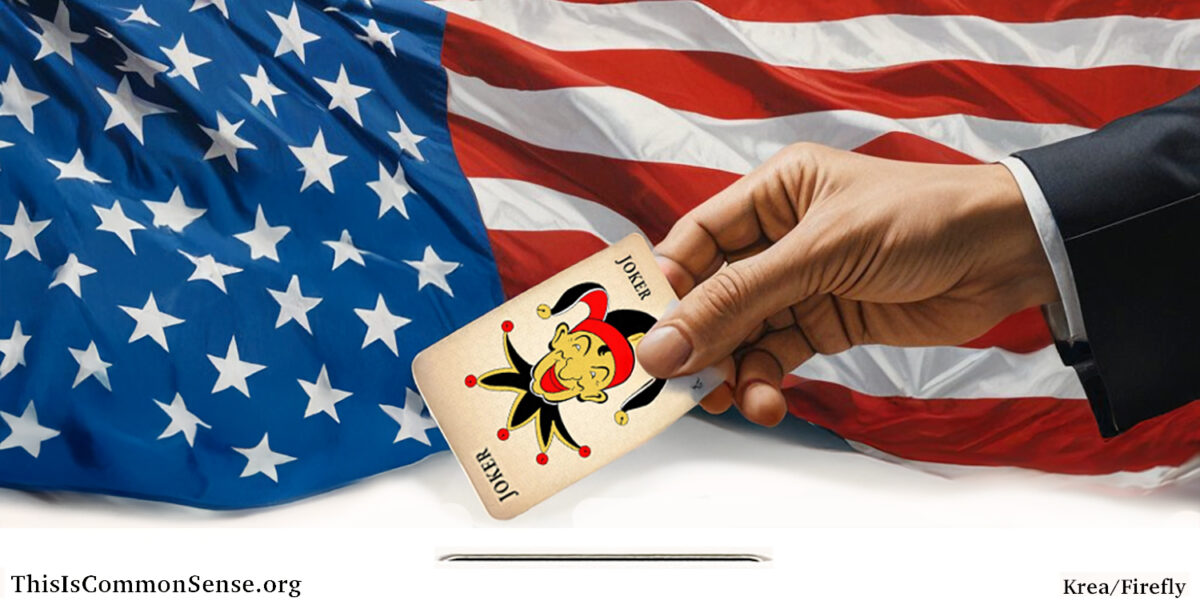
Illustration created with Krea and Fireflly

See all recent commentary
(simplified and organized)
See recent popular posts

Categories
ideological culture Voting

Blood in the Streets?

“When you think about how dangerous it is to raise an issue like this,” Davis Hammet, president of Loud Light Civic Action, explained to a Kansas State House committee, “whenever something doesn’t need to be addressed — because you’re going to create a lot of public attention, a lot of debate on this, and very likely — not to say that anyone here, this is their intention — but there’s [sic] almost three million people in the state, some folks will have very xenophobic and potentially violent outlooks on immigration.”

Hammet then asked legislators to “consider the Garden City bombing plot,” a 2016 case in which three Kansas men were arrested and convicted of conspiring to bomb a housing complex with many Somali immigrants.

Wait . . . what issue — “like this” — is he talking about? 

Mr. Hammet testified against House Concurrent Resolution 5004, a constitutional amendment introduced by Rep. Pat Procter, clarifying that only U.S. citizens are eligible voters in all Kansas elections, state and local.

“This legally and practically won’t do anything,” asserted Hammet.

Far from the truth, legally. 

Kansas has the same language in its constitution’s suffrage provision as California and Vermont, where courts have upheld the constitutionality of noncitizen voting at the local level. Plus, by placing citizen-only voting in the state constitution, Kansans can guarantee their power to vote yes or no before any future state legislature or city council could legalize non-citizen voting.

Twenty-one cities across the U.S. now give the vote to noncitizens, most also allow those here illegally to vote. Meanwhile,in recent years nearly 30 million Americans in 14 states have voted by whopping margins to enact Citizen Only Voting Amendments like HCR 5004, eight of those states last November

“But it could create fuel on the fire for some radical groups,” speculates Hammet, “to feel like they’re motivated to take improper actions.”

Yet so far without a single fatality! No fisticuffs or riots or bombings attributed to the debate or the public vote. Not one incident. 

Hammet may sound high-minded, throwing around words like “xenophobic,” but note his paranoia about his fellow citizens handling political issues. Moreover, he fails to recognize that the policy he sees as “anti-immigrant” is, in actual fact, overwhelmingly supported by immigrants.

So, who’s the xenophobe?

This is Common Sense. I’m Paul Jacob.


Note: HCR 5004 passed that committee and then passed the House on a vote of 98 to 20. The amendment now awaits action in the Kansas State Senate in order to be referred to the voters.

PDF for printing

Illustration created with Flux and Firefly

See all recent commentary
(simplified and organized)
See recent popular posts
Categories
general freedom Voting

Dis Democracy?

Starting the new year and awaiting a new administration, do we deserve to ‘get it good and hard’?

In the winter issue of Cato Institute’s Regulation, economist Pierre Lemieux acknowledges H.L. Mencken’s famous line — “Democracy is the theory that the common people know what they want, and deserve to get it good and hard” — and sympathizes with “disappointed voters” following last November’s election.

“The common person does know what he wants,” argues Lemieux, explaining that “he succeeds so well in his private life.”

Of course, our economic marketplace and our political marketplace are markedly different.

“The electoral choices presented to voters are typically a confused mix of unreliable promises and obscure policies,” Lemieux writes. “Contrast that with the clarity and variety of market choices.”

He notes the ways regular folks are being politically disempowered: “The value of lying as an electoral asset seems to be on the rise. The public education system appears to have not had much success in encouraging the quest for truth. And the common people have been infantilized by their own governments . . .”

Lemieux worries that “when the common person is given the power to decide what his fellow humans should want . . . things can go very wrong.” 

He’s correct, of course. But it isn’t a problem unique to democracy or the participation of regular folks. When any government has such enormous power over “fellow humans,” yes, things go wrong. Enormously wrong. 

Yet, in democracies, the problem of political tyranny is far less pronounced than in anti-democratic regimes, and more effectively remedied. Democratic government is messy, woefully imperfect and can lead to awful policies and real tyranny. Still, it lacks a superior alternative.

Until then, give me democracy. 

Good and hard? Preferably good.

This is Common Sense. I’m Paul Jacob.


PDF for printing

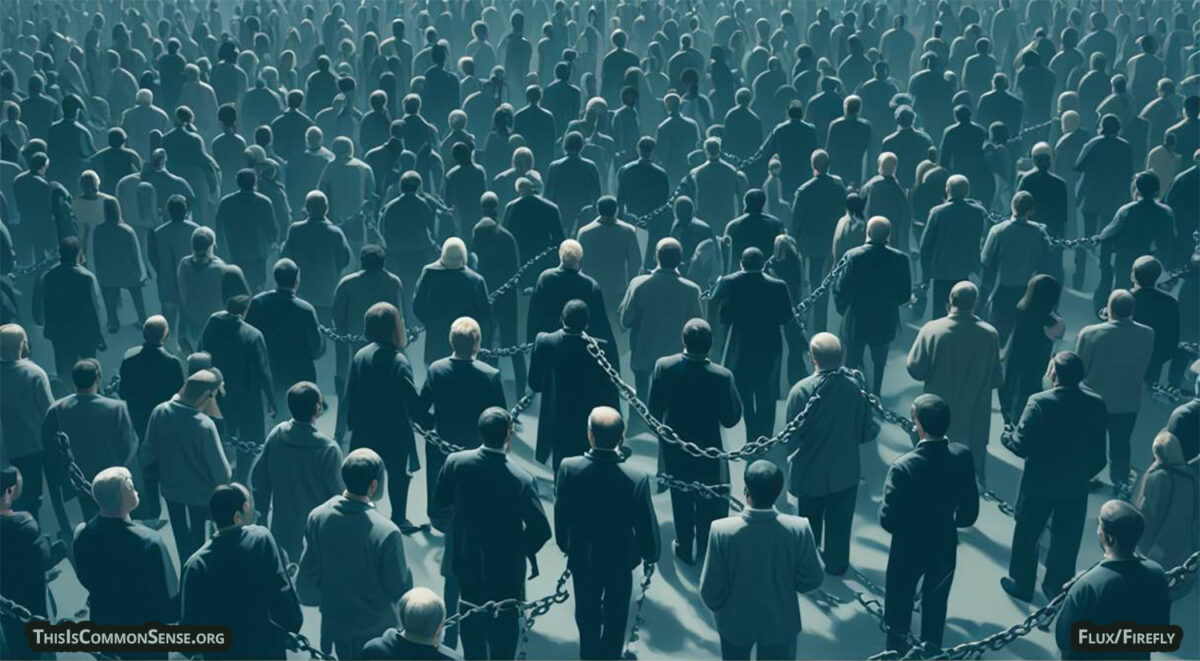
Illustration created with Flux and Firefly

See all recent commentary
(simplified and organized)
See recent popular posts

Categories
ideological culture Voting

Don’t Kill Yourself

As Donald Trump appeared to be winning last night, the number of Twitterers who proclaimed a hankering or a design to kill themselves rose dramatically. Michael Malice and others found humor in it, but it’s a super-saddening development, if you ask me.

These Kamala Harris voters are not really going to kill themselves. It is just something to say on Twitter.

I really hope I’m not wrong about this.

I’ll leave to others the counsel of life. That is the job of friends and family and emergency hotline dispatchers. My counsel is different: talking about suicide because your candidate lost is undemocratic. If the authoritarian pronouncements of both major candidates alarmed you about the danger of anti-democratic trend, this fad should raise the alarm several decibels.

The whole point of democracy is to allow a transition of power sans bloodshed. And that requires both contenders and supporters not to shed each other’s blood . . . or their own. When they fail.

It’s a requirement. Not to over-react.

The losers have to accept the loss, and the winners have to refrain from using the state to punish the losers further. 

It’s sort of that simple.

Resignation is key, as scientist Lawrence M. Krauss (@LKrauss1) indicated: “Going to bed, reasonably resigned to Trump win at this point as it seemed to me from a distance for some time. He may be a nut, a liar, and a crook, but the bright side is a likely boost free speech and due process at unis and bump in tech sector, if we survive the rest.”

We will survive. If Trump wins the Electoral Vote (I’m going to bed, too, before a final determination), or if Harris does.

This is Common Sense. I’m Paul Jacob.


PDF for printing

Illustration created with Midjourney

See all recent commentary
(simplified and organized)
See recent popular posts

Categories
election law Voting

Feds Push Noncitizen Voting

Two states are in trouble with the federal government, which is in trouble with them.

Florida is suing the feds because the Sunshine State needs the cooperation of the federal government to check the status of certain persons on its voter rolls.

Florida is bound by law to maintain accurate registration rolls. The federal government is bound by law to cooperate with requests from state and local governments for the information required to fully assess whether a person on the rolls has the right to vote and to be registered to vote.

But when Florida asked Citizenship and Immigration Services for just this kind of information, the USCIS balked.

Meanwhile, the Justice Department is suing Virginia to prevent that state from cleaning up its own voter rolls. 

Virginia Governor Youngkin castigates the federal action as “an unprecedented lawsuit against me and the Commonwealth of Virginia for appropriately enforcing a 2006 law signed by Democrat Tim Kaine to remove noncitizens from voter rolls — a process that starts with someone declaring themselves a noncitizen and then registering to vote.”

Power Line plausibly suggests that what’s happening here is that the politicized, misnamed Justice Department regards the votes of noncitizens as most likely to be votes for Democratic candidates. So why not discard established law and established procedures if this would help tilt elections in favor of Democrats?

This is Common Sense. I’m Paul Jacob.


PDF for printing

Illustration created with Midjourney and Firefly

See all recent commentary
(simplified and organized)
See recent popular posts
Categories
initiative, referendum, and recall Voting

No Argument

Vote For! Vote Against!

What else do you need to know?

Well, speaking just for myself, I prefer political ads that tell me at least something about an issue or a candidate prior to their exhortation to vote for or against him, her, or it. 

Messaging ought to at least suggest why to vote a certain way. 

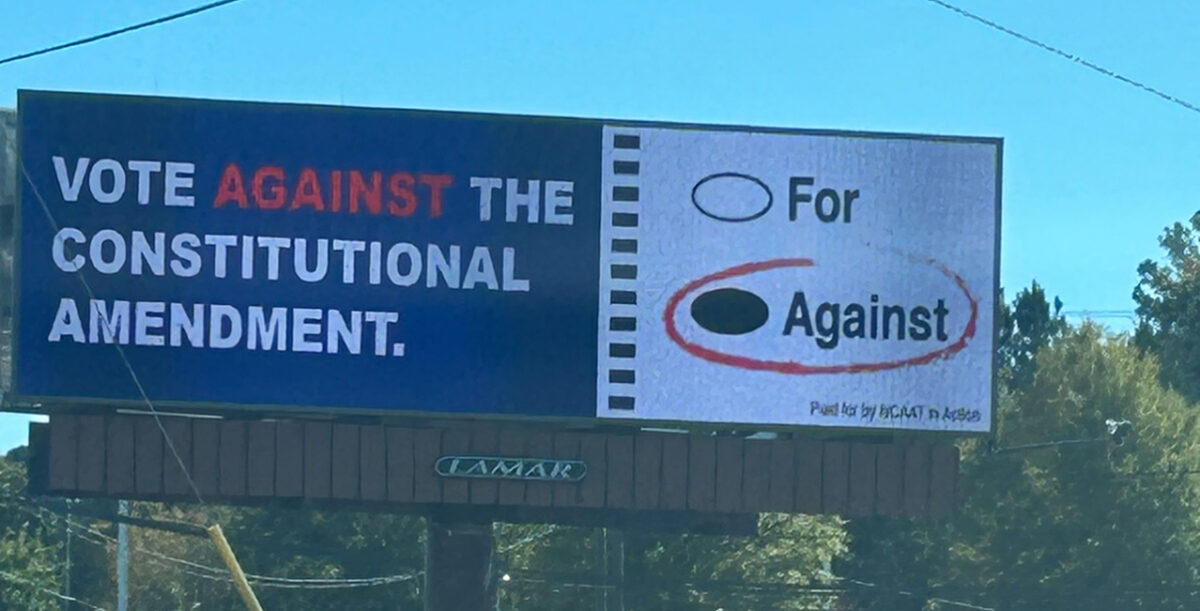
And that’s what stuck out about an electronic billboard in North Carolina, which does absolutely nothing to persuade — zip, zilch, zero to answer the question why. 

It simply states, “VOTE AGAINST THE CONSTITUTIONAL AMENDMENT.” Next to those words is a picture of a ballot with the “Against” oval filled in — and circled, too, for good measure.

The instruction is quite clear, but, well, why? 

And what the heck is this even about?!

This billboard is paid for by NCAAT in Action — the AAT stands for Asian Americans Together. If one goes to the group’s website, one finds . . . nada. No information whatsoever about North Carolina’s Citizen Only Voting constitutional amendment, the only amendment on the ballot.* 

I harken back to Georgia and the 2021 joint statement by Asian Americans Advancing Justice-Atlanta and the Asian American Advocacy Fund, which seemed to subscribe to the notion that only citizens should vote but still “collectively condemn[ed] the statements made by Georgia’s Secretary of State . . . emphasizing that ‘only American citizens should vote in our elections in Georgia.’”

Confused? These Democrat front groups don’t make any case at all against the idea of reserving suffrage to citizens. Why? They have no credible argument. 

But they still want voters to defeat these measures.

The good news is that they don’t represent the vast majority of Asian Americans, who strongly favor only citizens voting.

This is Common Sense. I’m Paul Jacob. 


* In full disclosure, I serve as chairman of Americans for Citizen Voting


PDF for printing

See all recent commentary
(simplified and organized)
See recent popular posts
Categories
media and media people partisanship Voting

Spilt Ink

“Iowans should vote no,” argues a Des Moines Register editorial, because defeating the Citizen Only Voting Amendment on the statewide ballot would “send a message — to legislators, to our neighbors at home and to the rest of the nation and world — that Iowans reject exclusion and suspicion and instead put a premium on inclusion and trust.”

Let’s unpack.

Ballotpedia summarizes Amendment 1 as prohibiting “state and local governments from allowing noncitizens to vote and allow 17-year-olds who will be 18 by the general election to vote in primary elections.”

Nothing suspicious there. But there is an exclusion, of course. The measure would exclude noncitizens from voting in state and local elections.

“The context,” or what the TDS-afflicted newspaper has apoplectically convinced themselves is the context, “is repeated assertions by President Donald Trump” and other Republicans “that immigrants without citizenship frequently register to vote and vote (more often for Democrats).”

The actual context is simply whether the state constitution should proclaim that only U.S. citizens are eligible to vote. A policy that Donald Trump and Kamala Harris are unsuspiciously excluded from voting on, but which would have prevented the 19 U.S. cities now allowing noncitizens to vote, including in most cases those here illegally, from doing so.

The Register nonetheless declares that “a higher standard is called for when the enduring language of the state Constitution is involved. That document should emphasize what unites Iowans.”

Yet nothing has united legislators more than this Citizen Only Voting Amendment, which passed each chamber of the Legislature twice without a single dissenting vote. 

Bemoaning that “seven states have already, in the past six years, made identical or similar changes in their state constitutions,” The Register further complains that “this fall, Idaho, Kentucky, Missouri, North Carolina, Oklahoma, South Carolina and Wisconsin join Iowa in voting on similar amendments.” 

The objection? “That’s a lot of ink spilt to enshrine imaginary protections against imaginary problems.”

These imaginative editors acknowledged, in the same piece, that “[e]xperts say it ties lawmakers’ hands from ever passing laws to permit residents without citizenship to vote in certain local or state elections, such as for school boards.”

Passing Amendment 1 means politicians at the capitol in Des Moines will have to go back to Iowa voters if they want to allow noncitizen voting.

No crying here over spilt ink.

This is Common Sense. I’m Paul Jacob.


PDF for printing

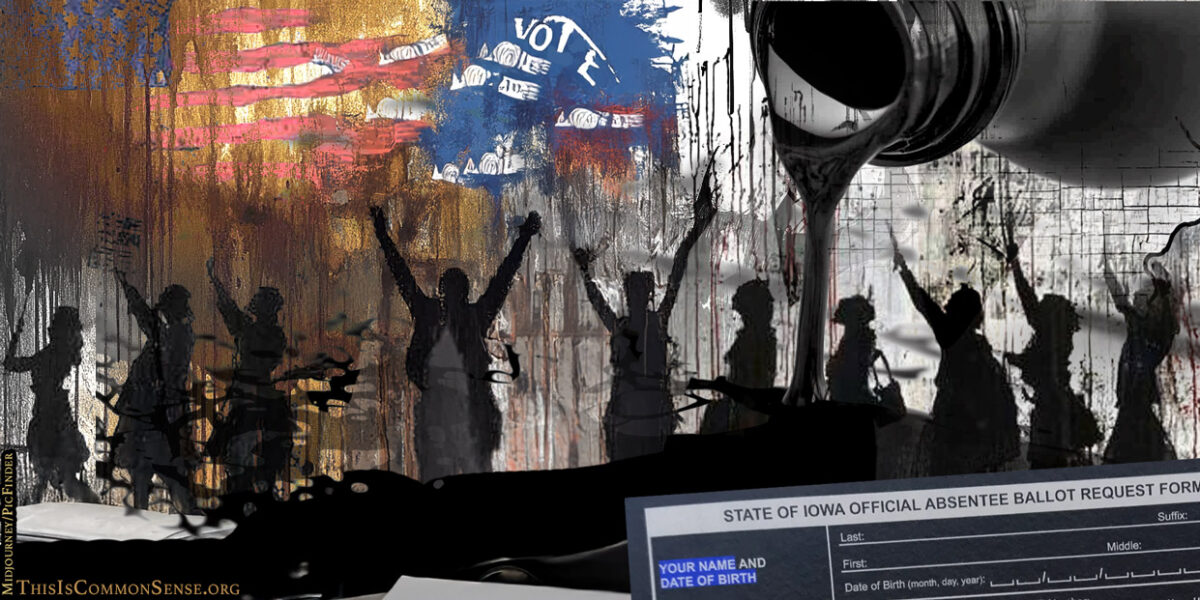
Illustration created with Midjourney and Firefly

See all recent commentary
(simplified and organized)
See recent popular posts

Categories
ideological culture Voting

Democrats and Noncitizen Voting

Do Democrats support noncitizen voting? 

It depends. 

Which Democrats do you mean?

A clear majority of voters who identify as supporters of the Democratic Party oppose giving the vote to noncitizens. Specifically, they support the Citizen Only Voting Amendments (COVA) on the ballot this election in eight states — Idaho. Iowa, Kentucky, Missouri, North Carolina, Oklahoma, South Carolina, and Wisconsin.* 

For instance, polling shows Democratic voters in North Carolina favor the only citizen voting measure by an eight to one margin. Among Republicans the margin is a whopping 22 to one. Most Democratic legislators joined every Republican in voting to place the amendment on the ballot, but less enthusiastically: 42 yes votes, 16 no votes and ten abstentions.

In Georgia, 70 percent of Democrats supported passing a Citizen Only Voting Amendment. Republican support was 93 percent with 76 percent of independents in favor. But while every Republican in the Peach State’s House of Representatives voted in the affirmative on HR780, not one single Democrat did so. 

Though not as lopsided as Republicans or independents, 83 percent of whom favor citizen only voting, 59 percent of Kentucky Democrats are supportive, a four to one margin. Yet, while every Republican legislator voted yes, less than one in five Democratic legislators were supportive. 

In Wisconsin, 76 percent of voters like the Citizen Only Voting Amendment, including 57 percent of Democrats residing outside the legislature. Inside the legislature, every single Democrat opposed the amendment. 

In this two-year legislative cycle, votes were cast in 21 chambers in eleven states. The partisan difference between elected Republicans and Democrats was stark. Not a single Republican voted against the COVA, compiling over a thousand yes votes. Conversely, more Democratic legislators voted against COVA than for it.

Do Democrats support noncitizen voting? Most elected Democrats, yes

This is Common Sense. I’m Paul Jacob.


Note: Additionally, all 19 of the cities where noncitizens are now legally voting, including noncitizens in the country illegally, are very progressive. All are sanctuary cities and governed (nearly) exclusively by Democrats.

* Voters have previously passed COVAs in six other states going back to 2018: Alabama, Colorado, Florida, Louisiana, North Dakota, and Ohio.

PDF for printing

Illustration created with PicFinder and Firefly

See all recent commentary
(simplified and organized)
See recent popular posts

Categories
election law general freedom Voting

Strange Standard

Last week, an audit found that Oregon’s Department of Motor Vehicles staff had erroneously forwarded the registrations of 1,259 people who had not provided necessary citizenship documents on to the Secretary of State, and — voilà! — they appeared on the voter rolls.

“None of the Oregon residents who were automatically registered to vote without demonstrating citizenship voted in an election where they could have cast the deciding ballot, the state’s elections director told lawmakers on Wednesday,” reports Oregon Capitol Chronicle.

Is that the new standard? Don’t fret about a system that automatically registers people who are noncitizens . . . because the number of likely noncitizens who appear to have illegally voted was not enough to have changed the outcome.

The Democrats running the Oregon Legislature were reluctant to hold a hearing; House Majority Leader Ben Bowman opened by warning that “scoring political points” or “attacks or accusations against election staff” or saying anything “that could incite any violence of any kind against any immigrants or any communities in the state” would not be tolerated. 

That’s a dodge — hiding behind concern for immigrants when the issue is a faulty election system. 

Besides, we don’t serve immigrants by placing them on voters’ lists without their knowledge, then sending them flyers urging them to vote, when, if they follow all the prompts sent their way and cast a ballot, they can lose their chance to become an American citizen.

And even be deported.

Simple, straightforward solutions exist: End these automatic voter registration regimes, require proof of citizenship for new folks registering to vote, and make it clear at all levels that voting is for citizens only. 

This is Common Sense. I’m Paul Jacob.


PDF for printing

Illustration created with PicFinder and Firefly

See all recent commentary
(simplified and organized)
See recent popular posts
Categories
election law Voting

California’s Electoral Saboteurs

Thou shalt not check the ID of a person showing up to vote.

California lawmakers — apparently eager to help noncitizens vote — have banned local voter ID laws like that of Huntington Beach.

Attorney General Rob Bonta says that requiring ID to vote “flies in the face” of the principle that “the right to cast your vote is the foundation of our democracy.”

But Huntington Beach didn’t impair “the right to cast your vote.”

Opponents of ID requirements say that the problem is the terrible hardship of presenting a valid ID or perhaps of obtaining one. These may be chores, but they’re hardly ventures into the unknown. If you’re a citizen, you can get ID showing you are. And almost everyone is capable of pulling an ID out of a pocket and displaying it.

Here’s a tell: “An amendment to Senate Bill 1174 that would have explicitly banned illegal migrants from voting was rejected.”

Is there evidence of fraud in American elections? 

Is it major — not a marginal issue having to do with one or two wayward ballots per decade?

Could lawmakers like California State Senator Dave Min, who asserts that “voter ID laws only subvert voter turnout,” be wrong?

Yes. 

The evidence can be found in John Fund’s books, such as Our Broken Elections, Stealing Elections, and Who’s Counting? A more recent report of attempts to undermine the vote and prevent the same is Elizabeth Nickson’s article “The 2024 Cheat and What’s Being Done About It.”

Voter IDs don’t subvert voter turnout, they subvert fraudulent voter turnout.

This is Common Sense. I’m Paul Jacob.


PDF for printing

Illustration created with Midjourney and Firefly

See all recent commentary
(simplified and organized)
See recent popular posts