Categories
crime and punishment general freedom ideological culture moral hazard nannyism national politics & policies Second Amendment rights too much government U.S. Constitution

The Good vs. Freedom?

Politicians regularly argue for new “gun control” laws, even while ignoring the execution and enforcement of laws already on the books.

Exhibit A, as I wrote at Townhall.com yesterday, is the failure of the military to provide the FBI with the information that would have blocked the Sutherland Springs church shooter from getting his guns.

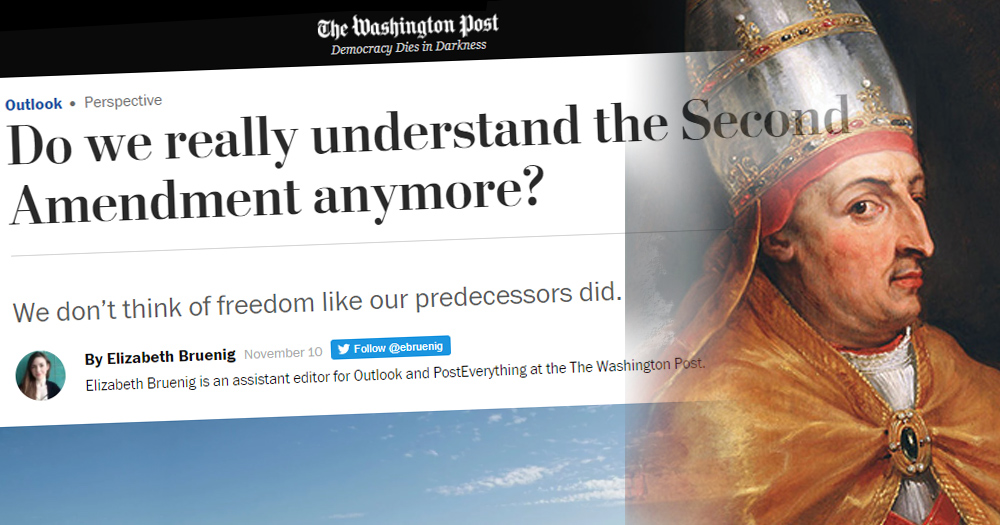
Meanwhile, in the Washington Post’s Outlook section, Elizabeth Bruenig takes a more . . . philosophical perspective. She contends that “Western thought moved from seeing freedom as a means to an end — what philosophers call ‘the good’ — to seeing freedom as an end in itself. Thanks to our liberal heritage, we regard freedom as an intrinsic good, perhaps the highest one of all. The more of it we can get, the better off we are. Right?”

Right!

But Bruenig’s answer isn’t in the affirmative.

Instead, she points to Vatican elections during the Middle Ages in which “canon law enshrined the right of eligible individuals to cast their votes. But their choices . . . could simply be overturned [by church officials]. Freedom mattered, in other words, but was always subordinate to the highest good, which could sometimes place limits on liberty.”

Ah, the Post advises us to embrace the Middle Ages . . . just so our freedom doesn’t get out-of-hand.

Bruenig also thinks that “we largely lack the framework to ask what gun ownership is for. . . .”

Huh? The Second Amendment answers that gun ownership is “necessary to the security of a free state.”

In terms of both scholarship and insight, the Founders’ constitutionalism far outshines the Post’s shiny new neo-medievalism.

This is Common Sense. I’m Paul Jacob.

PDF for printing


Categories
Accountability crime and punishment general freedom moral hazard nannyism national politics & policies Second Amendment rights too much government U.S. Constitution

Government Control

When do we say enough is enough?” asked California Senator Kamala Harris after Devon Patrick Kelley murdered 26 churchgoing Texans in cold blood, last Sunday.

“The terrifying fact is that no one is safe so long as Congress chooses to do absolutely nothing in the face of this epidemic,” argued Connecticut Senator Chris Murphy.

President Trump, on the other hand, not only pointed out that criminals will violate gun laws to acquire weapons, he speculated that had Stephen Willeford, the former National Rifle Association instructor, not come upon the scene, armed, “instead of having 26 dead, you would have had hundreds more dead.”

After previous mass shootings, Democrats pushed legislation that, even if it had been the law, would not have prevented that particular killer from obtaining the weapons. This time it’s different, since the killer should not, by current law, have been allowed to purchase the firearms he used. Kelley’s conviction for domestic violence, while serving in the Air Force, disqualified him.*

But the Air Force did not do its job, failing to report his record to the FBI. So the background check found . . . nothing.

The Pentagon has known for at least two decades about failures to give military criminal history information to the FBI,” the Associated Press informed, “including the type of information the Air Force didn’t report about the Texas church gunman.  . . .”

The Obama administration, through its command of the military, failed to execute the law designed to keep guns out of dangerous hands. And it sounds like this failure dates back to Bush and Clinton days.

Where does the buck stop?

We don’t need gun control; we need government control.

This is Common Sense. I’m Paul Jacob.

 

* Note also that the murderer, as Ben Shapiro recounted at National Review: “escaped from a mental institution in 2012, threatened his superior officers and attempted to smuggle weapons onto a military base to carry out those threats, cracked the skull of his infant stepson, beat his wife, abused a dog.”


PDF for printing


Categories
Accountability First Amendment rights folly media and media people moral hazard national politics & policies too much government U.S. Constitution

Our Royals Are Not Amused

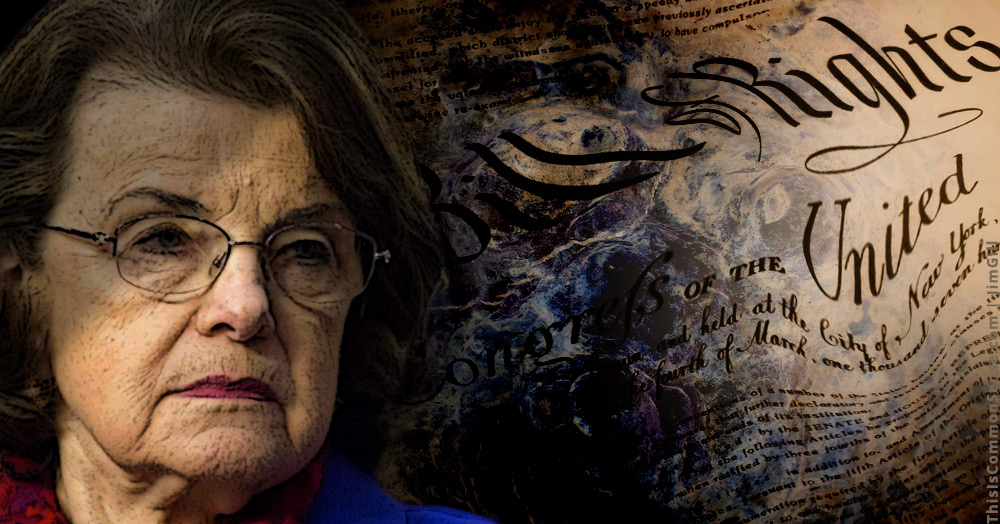
“You created these platforms,” Sen. Dianne Feinstein (D-CA) informed the top legal minds at Facebook, Twitter, and Google, “and now they’re being misused.”

“And you have to be the ones who do something about it — or we will.”

Take that as a threat.

But also take it as the grand moment when the Establishment showed its hand.

Consider: Facebook, Twitter, and YouTube (a Google product) are “media platforms.” So are books, libraries, newspapers and newsstands. Imagine being a king right after Johannes Gutenberg invented the printing press. Very quickly, the world changed.

People thought differently. And they began demanding change from government. The sovereigns had to make room for subjects-turned-citizens.

Royalty and aristocracy did try to regulate the new platforms of information and opinion. Censorship was all-too-common. The rulers killed upstarts for writing the wrong things, saying the wrong things.

So, which side would you be on, Mrs. Feinstein?

That is Scott Shackford’s basic take on this. I’m with him.

I just wish to expand: in my lifetime the media platforms of newspapers and television were regulated. Heavily. Mergers and business purchases were subject to government permission; the electromagnetic spectrum was licensed rather than treated as private property, and the actual content of radio and TV shows were regulated by the FCC.

And the Feinsteins of Washington got awfully secure in their positions. Had the regulation of American media done its trick?

Enter new media, uncorking the bottle of opinion.

No wonder the Establishment is scared.

We shouldn’t let them regulate political content on the Internet. Demand, instead, the opposite: a complete repeal of the regulation of business management — and non-criminal content regulation — of all media platforms

This is Common Sense. I’m Paul Jacob.


PDF for printing


Categories
folly general freedom ideological culture media and media people moral hazard nannyism national politics & policies Popular Regulating Protest U.S. Constitution

Force Over Persuasion

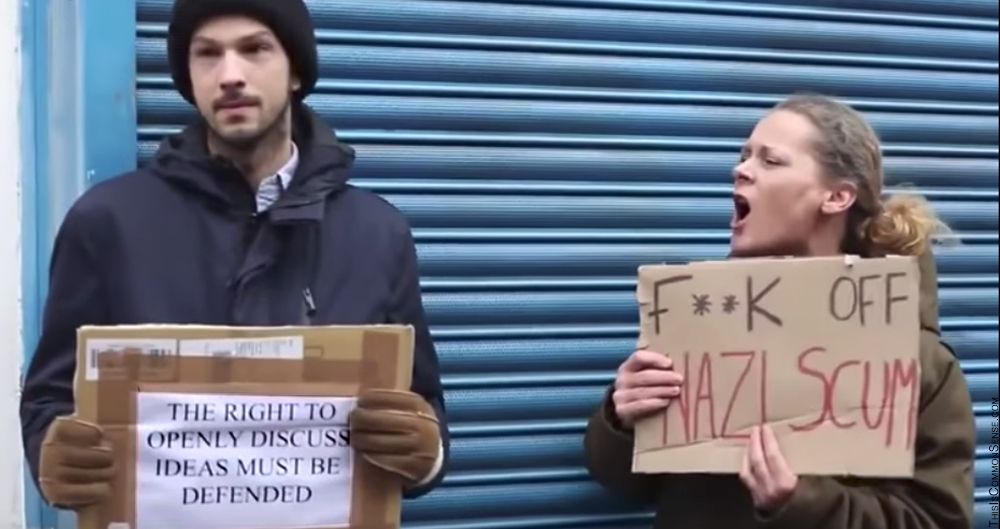
Today’s campus radicals assert that free speech is bad because it “gives voice” to people with hateful, dangerous views.

Does that argument seem at all familiar? It is the old RightThink rationale for censorship.

A recent Spiked “Unsafe Spaces” event at Rutgers (“Identity Politics: the New Racialism”) was interrupted by now-too-famiar shouts and out-of-turn questions and invective. Kmele Foster, one of the panelists, had been explaining how important free speech rights were to the civil rights protesters in the 1960s, and to Martin Luther King in particular.

At “that precise moment,” as Reason’s Matt Welch puts it, the shouts of “Black lives matter!” began. And continued.

But more interesting than this bullying? Some of the more coherent theses articulated by the interrupters. One woman, CampusReform relates,

yelled in response to the panelists that she doesn’t “need statistics,” later complaining that “the system” controls facts.

“It’s the system. It’s the institution,” she said. “Don’t tell me about facts. I don’t need no facts.”

Well, the moment you prove immune to any fact is the exact point in time that you’ve given up on rationality, free inquiry, and maybe even civilization itself.

It’s so 1984-ish.

And it demonstrates the old idea that, when you can no longer reason or allow others to express different opinions . . . or even discuss the factuality of this or that contention, you have only one other option: force.

Become bully.

Or tyrant.

Civilization is the triumph of persuasion over force. Being against free speech is to reverse that.

The acme of barbarism.

This is Common Sense. I’m Paul Jacob.

PDF for printing


Categories
folly ideological culture national politics & policies political challengers U.S. Constitution

O That Wacky Gerrymandering

Hillary Clinton: always wrong.

Oh, I’m sure that when she tells the maid “We need milk,” she’s accurate enough. Otherwise — forget it.

Her latest howlers pertain to the movement to convene a Convention of States. If two thirds of the states call for the convention, it “will be” convened, per the U.S. Constitution. If 38 states approve a convention-proposed amendment, it will be added to the Constitution.

Different pro-convention groups support different amendments, on everything from a balanced budget to spending limits to term limits. U.S. Term Limits is promoting a Term Limits Convention to propose an amendment for congressional term limits. 

A great idea.

Clinton, though, sees calamity: “The right wing, aided and funded by the Mercers, Koch brothers, etc. [sic], is very serious about calling a constitutional convention,” she warned recently.

“Part of their gerrymandering is to control state legislatures, elect Republican governors, and to call a constitutional convention [no, a convention of states] and,” the author of What Happened elaborates, “if you really get deep into what they are advocating, limits on the First Amendment, no limits on the Second Amendment, limits on criminal justice . . . [A] very insidious right-wing agenda.”

Gee, the old multiple-fallacies-and-vague-ominous-assertions-per-second trick!

First, how to “gerrymander” statewide gubernatorial elections?

Or “gerrymander” the enthusiasm of millions for restraints on government?

Or apply the districting concept to the Founders’ constitutional provision for end-running Congress?

As for the political issues she blunderingly raises, Clinton seems to regard any political disagreement whatever with herself as proof of billionaire-funded “right-wing conspiracy.”

Well, left-wing conspirators always say such things.

This is Common Sense. I’m Paul Jacob.

PDF for printing


Categories
Accountability ballot access general freedom government transparency ideological culture initiative, referendum, and recall insider corruption local leaders national politics & policies property rights Regulating Protest responsibility too much government U.S. Constitution

The Great Faction

Politics isn’t a pretty business.

Frédéric Bastiat called the beast it serves “that great fiction” not because it doesn’t exist — intrusive state power sure persists — but rather because what it promises cannot really happen: “everyone living at the expense of everyone else.”

What can we do? How do we counteract a game that is rigged to increase the insanity, not reduce it?

Last week I indicated one thing a minor party with that goal in mind could do: use its power of spoiling elections to change major party behavior, and thus give citizens a fighting chance to restrain governmental metastasis.

Cancer.

I also suggested “blackmailing” the major parties into setting up a system of voting that . . . ends the power to blackmail! I believe that system — ranked choice voting — holds many positives, not the least of which is ending strategic voting, wherein voters are tempted to “falsify” their own preferences and support candidates they might dislike. This is as corrupting to the citizenry as the Great Fiction itself.

Let’s hope a savvy minor party leverages the major parties, gaining reforms to improve the system. Regardless, we can all — independently — push two other limits on political power:

  1. term limits at all levels, and
  2. initiative and referendum rights in all the states, not just the 26 that have it now.

Initiative and referendum rights would give ordinary citizens the leverage to possibly restrain the mad rush to live at each others’ expense. With the initiative, citizens can gain term limits, which produce more competitive legislative elections and lead to fewer legislators captured by the interests loitering in the capitol.

This is Common Sense. I’m Paul Jacob.

PDF for printing


Categories
Accountability folly general freedom ideological culture media and media people moral hazard nannyism national politics & policies too much government U.S. Constitution

Statues and Limitations

“Should they take down the Jefferson Memorial?”

That is what PBS’s Charlie Rose asked Al Sharpton. Now, the “Reverend” is not my go-to source for political insight, but his answer* caught my attention.

“I think that people need to understand that, when people that were enslaved and robbed of even the right to marry and had forced sex with their slave masters, this is personal to us,” replied Rev. Sharpton. “My great-grandfather was a slave in South Carolina . . . Our families were victims of this.”

Asked if this precluded “public monuments” for “everyone associated with slavery,” Sharpton argued: “When you look at the fact that public monuments are supported by public funds, you are asking me to subsidize the insult to my family.”

One can attack the messenger, Sharpton, sure. But what if we instead think of him as our neighbor? I certainly wouldn’t want to insult a neighbor, much less make him pay for the privilege.

Notably, the Reverend embraced privatization, suggesting, “You have private museums.” Privatizing controversial monuments would certainly solve Sharpton’s stated problem.

Of course, the logic behind taking down statues or dismantling the Jefferson Memorial — or merely privatizing them — might also lead to changing the names of cities, counties and states, rivers and mountains. And it’s not just Washington and Jefferson — twelve presidents were slave owners, including Union General U.S. Grant.

Who knows how many are undeservedly memorialized?

Frankly, I’ve never liked the name of my Virginia county: Prince William. A liberty-loving people ought not be stuck with such a monarchial brand.

Let the people decide.

But by vote, not street brawl.

This is Common Sense. I’m Paul Jacob.


* This exchange begins at the 15:22 mark in the interview.


PDF for printing


Categories
ideological culture moral hazard national politics & policies U.S. Constitution

The Great Diversion

Though the breakdown of civil debate seems new, the subjects are old. We are actually talking about Nazis, again. Nazi death counts. And the Confederacy. The former defeated by my father’s generation, the latter defeated several generations earlier.

Why?

Because talking about the future would require actual thought. It’s easier to fight over the past, over symbols of the past.

That is why there was a Charlottesville debacle. It is about a statue, a monument to dead soldiers featuring the Confederacy’s General Robert E. Lee. And what it means. The “Unite the Right” rally was set in Charlottesville because of the city council’s decision to remove it.

It is interesting, though, that the event did not unite “the Right.” Conservative and even many alleged “alt-right” groups refused to participate.

But “the Left” seems more united than before. If you focus on past racism and the persistence of Nazi and Confederate symbology, it’s pretty easy to agree. I agree.

And yet, I take a step back, and remember that those monuments do not have the univocal racist meaning attributed to them. They were intended to heal wounds.*

Now they open up old ones.

And yet this is all a diversion. We are facing a major set of crises that could lead to war, depression, chaos, and (possibly) worse. But we are not now handling them because we are fighting over symbols of the past.

This may be a very human thing to do.

But it is not smart.

This is Common Sense. I’m Paul Jacob.

* At least 350,000 young American men died wearing Confederate uniforms in the Civil War, and half a million Union soldiers are believed to have died directly from their war wounds. Today’s population is ten times greater, so adjusted for today it would be eight million deaths. That is a lot of searing wounds.


PDF for printing


Categories
Accountability crime and punishment general freedom ideological culture moral hazard national politics & policies Regulating Protest responsibility U.S. Constitution

Saturday’s Violence

After delivering the final address at the Liberty International World Conference in Puerto Rico, Friday night, I learned that there had been violent clashes between white nationalists and counter-demonstrators in Charlottesville, Virginia.

A dozen people required medical treatment after being sprayed with mace.

Then, after traveling to the airport with new friends from Kazakhstan, China, and socialist-torn Venezuela, I began my eight-hour trek home. I had the subject for my weekend column, I decided: the lack of reports of even one arrest.

Last I checked, dousing folks with a chemical agent was a crime.

“Men in combat gear, some waring [sic] bicycle and motorcycle helmets and carrying clubs and sticks and makeshift shields,” the Washington Post reported as I landed for my connecting flight home, “fought each other on the downtown streets, with little police interference.”

By the time I touched down in Washington, DC, James Field had driven his car into a crowd of counter-protesters, killing Heather Heyer and seriously wounding many others. A searing and sobering event.

My column, mostly written in transit, focused on the police response to political violence. From Trump rallies last year to the events at UC-Berkeley that “shut down” planned speeches . . . to attacks on Charles Murray and others at Middlebury College . . . to this Saturday’s events in Charlottesville, policing has been tepid at best.

People have a right to speak, to assemble, to protest, to let out a primal political scream. Our governments must protect that right, without regard to viewpoint, by preventing and policing against acts of violence.

When violence succeeds without consequences — garnering tons of attention for its perpetrators — we are likely to see more violence.

Government is not doing job one.

This is Common Sense. I’m Paul Jacob.


PDF for printing


Categories
Accountability ballot access initiative, referendum, and recall local leaders national politics & policies political challengers U.S. Constitution

Free to Choose

“I think that the most effective way one could possibly move toward greater freedom in the United States, toward a smaller role of government, would be if we could only have a more democratic society.”

Who said that? A Democrat?

No.

The speaker quickly added, “I don’t mean a capital-D, I mean a small-d.”

“That is, I mean if we could have referenda,” the late Milton Friedman explained back in 1987.

The Nobel Prize winning economist — and co-author with wife Rose of the bestselling Free to Choose* — was referring to the initiative and referendum process, whereby citizens vote on laws, and in the case of initiatives directly place measures onto the ballot.

Citizens enjoy initiative and referendum rights in twenty-four states and roughly 60 percent of cities throughout the country.

“The public at large has always shown itself,” Dr. Friedman observed, correcting himself, “has almost always shown itself to be more libertarian in its views than have their elected representatives.”**

Friedman was not suggesting that a bad law becomes good because it was passed at the ballot box. He simply weighed the odds between two distinct sets of voters. Legislators are a small group, the personal power of each one so closely tied to government that politicians’ personal interests often compete against the public’s. Conversely, the much larger group of voting citizens almost defines the public interest.

Perhaps I was channeling the great doctor of economics when I was once asked, “Do you trust the people?”

My reply?

“No. But I trust the people a whole lot more than I trust the politicians.”

This is Common Sense. I’m Paul of Jacob.


* The book was first published in January 1980, in tandem with PBS’s airing of the popular “Free to Choose” series.

** He spoke this at a California Libertarian Party conference. Tough crowd.


PDF for printing