Categories
First Amendment rights media and media people social media

First Amendment: Irrelevant?

For at least three years, we have all suspected — well, known — that the federal government has been pressuring social-media companies to censor speech that government officials dislike regarding the pandemic and other matters.

One clue: officials like Jennifer Psaki, White House press secretary from 2021 to 2022, forbiddingly and publicly demanded that social-media firms do more to suppress disapproved speech.

Even so, many left-wingers stressed that once allegedly open public forums like YouTube, Facebook, pre-Musk Twitter et al. were private entities with every darn right to set standards for posting. 

Just market decisions, that’s all that was happening here!

Now that litigation has delivered so much evidence that government agencies have been colluding to censor, directly and chronically “working with” social-media firms to suppress dissent, many on the left are not even pretending to favor protection of First Amendment rights to express speech they disagree with.

Jonathan Turley notes that according to The New York Times, a recent ruling temporarily enjoining the Biden Administration from colluding to censor would, by fostering open discourse, lamentably “curtail efforts to combat disinformation.”

Washington Post editors and others on the left “no longer deny censoring,” agrees Jeffrey Tucker. “Now they defend censorship as a policy in the national interest. . . . They don’t even pretend to have respect for the First Amendment that gave rise to the national media in the first place. They now seek a monopoly of opinion and interpretation.”

Yes. Cat’s out of the bag.

This is Common Sense. I’m Paul Jacob.


PDF for printing

Illustration created with PicFinder.ai

See all recent commentary
(simplified and organized)
See recent popular posts

Categories
First Amendment rights judiciary social media

Censors Cancelled

The verb is “enjoin.”

In a July 4 preliminary injunction, Judge Terry Doughty has enjoined federal officials from communicating with social-media companies except on matters pertaining to criminality or threats to national security.

“The Plaintiffs are likely to succeed on the merits in establishing that the Government has used its power to silence the opposition,” explains Doughty. The government “seems to have assumed a role similar to an Orwellian ‘Ministry of Truth.’”

For a few years now, government officials have asked social-media personnel to censor speech on topics like the pandemic, elections, and laptops dropped off by Hunter Biden, speech that officials want to suppress only because they disagree with it or find it inconvenient. Politically.

A lawsuit brought by Missouri and Louisiana argues that federal officials pressured and colluded with social-media companies to block speech protected by the First Amendment.

Some critics of this and other lawsuits — and of more non-formal objections to the government’s conduct — say that what has been exposed in documents brought to light during litigation, and in the Twitter files, cannot be called governmentally instigated censorship at all.

What’s really going on, they burble, is nothing more than persons working for the FBI, the CDC, the White House, and other such government-force-backed entities idly wondering — in incidental and nonbinding casual conversation, mind you — whether the social-media company they’re just happening to hobnob with could come down like a ton of bricks on the accounts of persons saying things that government officials disapprove. No big deal.

Not the most plausible pseudo-exculpation I’ve ever heard.

The relevant adjective? “Guilty.”

This is Common Sense. I’m Paul Jacob.


PDF for printing

Illustration created with PicFinder.ai

See all recent commentary
(simplified and organized)
See recent popular posts

Categories
First Amendment rights ideological culture Internet controversy social media

Google Can’t Have That

Over the last several years, one has put one’s YouTube speech at risk by addressing such verboten or intermittently suppressed topics as pandemic policy, vaccine efficacy, origin of the COVID-19 virus, “climate change” (are winter, summer, and all natural disasters really caused by carbon footprints? inquiring minds want to know!), 2020 election fraud, and whatever else inspires post-Enlightenment institutional censors to clatter into action.

Because of the emails and other documents that have come to light in various lawsuits, we now know for sure that social-media companies have not been censoring independently. 

They’ve been in cahoots with government agencies — agencies eager to find corporate workarounds to the First Amendment.

A recent target of Google’s YouTube? Robert F. Kennedy, Jr.

Running for president as a Democrat in competition with the alleged incumbent, Joe Biden, this son of assassinated 1968 Democratic presidential candidate Bobby Kennedy is disturbing the serene pools of so-called thought that constitute Acceptable Opinion and Settled Science.

I often disagree with Kennedy. But I feel that he isn’t just feeding me B.S.; he actually believes stuff. 

He may be mostly wrong, but I prefer that to mostly crooked.

Google has just deleted another Kennedy video, one in which he converses with Canadian psychologist Jordan Peterson about climate change, COVID-19, and a possible link between exposure to chemicals and sexual dysphoria.

This last musing seems dubious. But, whatever, let the guy talk. Except — hold on — isn’t RFK Jr. causing Joe Biden a lot of political trouble?

Can’t have that. 

Or, anyway, Google can’t have that. 

Or whichever Biden administration officials are directing Google (or vice versa) can’t have that.

This is Common Sense. I’m Paul Jacob.


PDF for printing

Illustration created with PicFinder.ai

See all recent commentary
(simplified and organized)
See recent popular posts

Categories
Internet controversy national politics & policies social media

Dys Glitch

After some technical glitches in livestreaming Florida Governor Ron DeSantis’s announcement of his presidential run, the snide tweets poured in.

“‘This link works,’ Biden posted on his Twitter account,” The Epoch Times attempted to regale us, “sharing a link to a donation page for his campaign as the DeSantis team and Twitter owner Elon Musk struggled to resolve the glitches plaguing their scheduled Twitter Spaces interview.” 

But the worst was also from The Biden — nobody believes that Joe himself is in charge of his own Twitter account — in which a few “positions” of DeSantis received mockery, leading popular YouTuber/Rumblist Viva Frei to respond with “Is this really the best you could piece together? You couldn’t fragment the sentences more if you tried. Pathetic.”

And that’s really where we’re at. Newscasters and the Twitterati made much of the Twitter Space glitch, but not even Donald Trump, Jr., with his hashtag “#DeSaster,” did much more than weakly echo his father’s heyday on Twitter.

This is not 2016. 

Everybody seems tired.

There are a number of challengers, already, in the running to oust feeble Joe Biden. Donald Trump himself, of course, and now Ron DeSantis, whom we are told runs a distant second to the former president. Neither man seems likely to reach beyond the conservative half of the electorate. Only Robert F. Kennedy, Jr., a Democrat, offers much “newness,” and he’s afflicted by a hard-to-listen-to cracked voice: spasmodic dysphonia, “a specific form of an involuntary movement disorder called dystonia that affects only the voice box.”

Metaphor for the race so far? There’s a lot of “dys” in the tone of our times, but it’s just not very profound. If the future weren’t at stake, one wouldn’t even bring it up.

This is Common Sense. I’m Paul Jacob.


PDF for printing

Illustration created with PicFinder.ai and DALL-E2

See all recent commentary
(simplified and organized)
See recent popular posts
Categories
First Amendment rights Internet controversy social media

Whose Brains Fell Out?

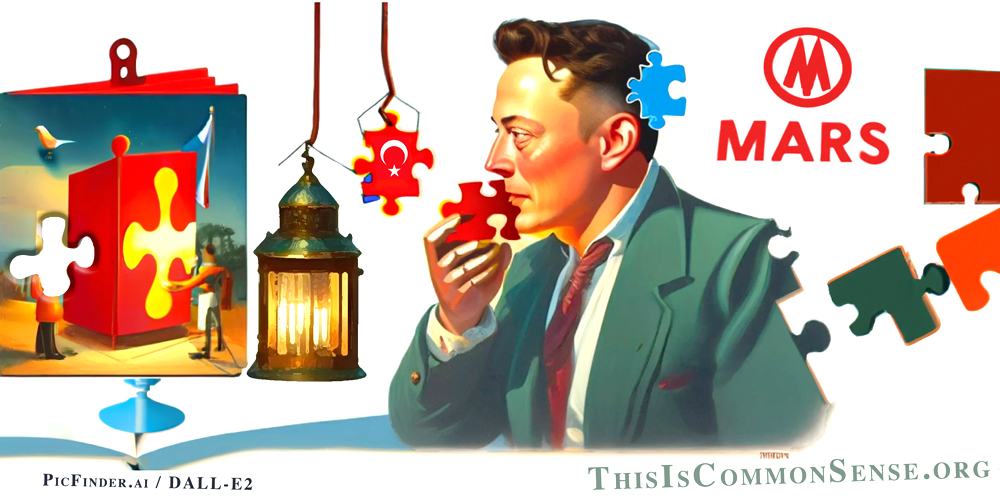
Just before the Turkish presidential election, the Turkish government ordered Twitter to block content that its strongman incumbent apparently found inconvenient. (The election isn’t over; a runoff is scheduled for May 28.)

We don’t know what Twitter was told to censor. All we know is that, although now guided by the somewhat pro-free-speech policies of Elon Musk, Twitter complied, saying it did so “to ensure Twitter remains available to the people of Turkey. . . .”

Journalist Matthew Yglesias tweeted that Twitter’s compliance “should generate some interesting Twitter Files reporting.” This is an allusion to internal Twitter communications released by Musk showing how readily and frequently pre-Musk Twitter censored dissenting speech at the behest of U.S. government officials.

The jibe got under Musk’s skin. “Did your brain fall out of your head, Yglesias?” Musk counter-tweeted. “The choice is have Twitter throttled in its entirety [in Turkey] or limit access to some tweets.”

But Twitter doesn’t control Turkish policies. It only controls its own policies.

Had Twitter refused and then, in turn, been throttled in Turkey, every Twitter user there would have known about the censorship by their government. Some might have protested. But only a few people in Turkey will know about the Twitter-abetted censorship.

Musk has in effect announced that Twitter will censor anything governments want if only a government willing to block Twitter does the asking. And what tyrants do is up to them. 

Whether we cooperate with their tyranny when we have the means to resist? 

That is up to us.

This is Common Sense. I’m Paul Jacob.


PDF for printing

Illustration created with PicFinder.ai and DALL-E2

See all recent commentary
(simplified and organized)
See recent popular posts
Categories
folly media and media people social media

Pray Tell

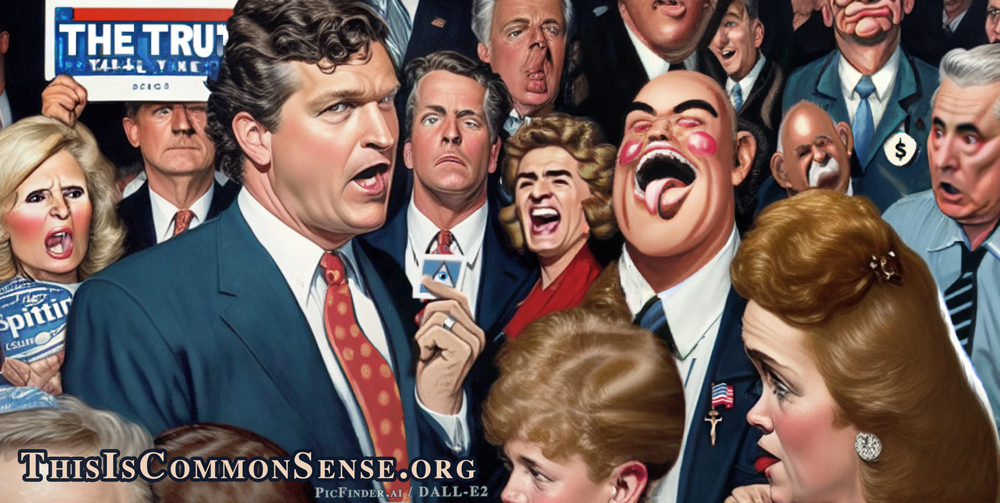
At the beginning of the week, Tucker Carlson found himself unemployed.

The Fox News commentator and host of his own show was fired, so abruptly that his people didn’t know it until they showed up for work Monday morning.

Carlson was Fox’s first-string, pulling in not only more viewers than anyone else on Fox, but anyone else on cable television. Since his ouster, viewership of Fox’s line-up — and most significantly the Tucker Carlson Tonight time slot — plummeted

Fox News owner Rupert Murdoch made the decision. This sort of self-sabotage is breathtaking to behold. It’s the second time in recent years that Fox News has ousted its most lucrative talent.

You may remember that Bill O’Reilly, whom Tucker replaced, was let go because of the many sexual misconduct lawsuits Fox had been forced to pay out. It was not immediately clear why Tucker Carlson got the boot. 

Initial theories focused on the Dominion lawsuit, but that seemed implausible to those who followed the story closely. Most viewers believed the firing was ideological in nature. Murdoch is very establishment-oriented, and Tucker Carlson has increasingly become anti-establishment. And on his semi-penultimate show, he lectured about the dominance of Big Pharma advertising on cable TV, and 

This. 

Is. 

Just. 

Not. 

Done.

As the week wore on, a more intriguing theory emerged: Rupert Murdoch did not like Tucker’s Heritage Foundation speech over the weekend, in which the Fox anchor entreated his audience to pray for the future of America. Murdoch is said to hate that sort of thing, especially since he jilted a former future Mrs. Murdoch (that is, a fiancée) for her over-religiosity.

I cannot imagine anyone praying for Fox News.

Not, it seems, even Rupert Murdoch.

This is Common Sense. I’m Paul Jacob.


PDF for printing

Illustration created with PicFinder.ai and DALL-E2

See all recent commentary
(simplified and organized)
See recent popular posts
Categories
First Amendment rights Internet controversy social media

Censored Under Pressure

Journalist Alex Berenson is suing members of the Biden administration — and others, inluding Pfizer officers — for pressuring Twitter to ban him for what he wrote about the COVID-19 vaccines.

The best-known of his heretical tweets says, “It doesn’t stop infection. Or transmission. And we want to mandate it? Insanity.”

In the months since August 2021, when Twitter expelled him “for repeated violations of our COVID-19 misinformation rules,” such hardly intemperate observations have become less controversial. Vaccine proponents have retreated, typically claiming, at most, that the putative vaccines reduce the risk of severe illness and death.

Berenson first sued Twitter to challenge its ban. The suit succeeded; eleven months after Twitter banned him, it reinstated his account.

But Twitter had not been acting independently; it had succumbed to a lengthy campaign by the Biden administration to censor Berenson. Any such actions by government officials are, of course, unconstitutional.

The defendants in Berenson’s new lawsuit include President Biden, Surgeon General Vivek Murthy, Director of Digital Strategy Rob Flaherty, and former White House official Andrew Slavitt (“at the center of the conspiracy”). Two Pfizer officers are also named: board member Scott Gottlieb and CEO Albert Bourla.

Berenson’s detailed complaint alleges that “after months of public and secret pressure, Defendants succeeded” in getting Twitter to ban him.

The private pressure is attested by internal documents released by Twitter and government documents produced during the course of Missouri and Louisiana’s lawsuit against censorship by the Biden administration.

In defending his rights, Alex Berenson is helping us all retrieve freedoms we lost in the pandemic panic.

This is Common Sense. I’m Paul Jacob.


PDF for printing

Illustration created with PicFinder.ai

See all recent commentary
(simplified and organized)
See recent popular posts
Categories
First Amendment rights national politics & policies social media

A Package Deal

Suppose suggested legislation outlaws both murder and walking. How could you oppose it? Are you, a dedicated perambulator-peripatetic, also a murder-supporter?

Obviously, this would be an attempt to foist a package deal consisting of unrelated or mutually contradictory elements.

Consider a more true-to-life example.

In the Wall Street Journal, Philip Hamburger argues that a congressional bill targeting TikTok would do much more than counter Chinazi spying on Americans (“The TikTok Bill Is a Sneak Attack on Free Speech”).

If curbing or even outlawing TikTok were the sole focus, one could argue the merits of the legislation given what is known about the company’s collecting of data and its relationship with the Chinese government. There’s no free-speech protection of foreign espionage.

However, as Hamburger points out, the bill gives the federal government “sweeping power over communications” and could be used to stifle speech protected by the Constitution.

The proposed statute would allow the Department of Commerce to undertake open-ended mitigation of “undue or unacceptable” risk regarded as arising from use of communications technology in which any entity subject to the jurisdiction of a foreign adversary “has any interest.”

This is very vague and very all-encompassing. The legislation thus confers power over domestic communication companies “that could be used to extort their cooperation in censorship.”

Attempts to resist such “mitigation” or censorship would risk administrative fines of $250,000, criminal penalties of $1 million, two decades in prison. For supporting freedom of speech?

Please walk away from this, Congress.

This is Common Sense. I’m Paul Jacob.


PDF for printing

Illustration created with Midjourney / DALL-E2

See all recent commentary
(simplified and organized)
See recent popular posts
Categories
Internet controversy media and media people social media

NPR’s Wide Stance

When the term “the Deep State” entered our vocabulary, establishmentarians and insiders were annoyed. They argued the term was meaningless or vague or designated something that did not exist. 

The rest of us accepted the term to identify the parts of the administrative state — coupled with the military-industrial complex’s corporations — that keep big secrets and act mostly independently of our democratic-republican institutions, including those who work behind the scenes to effect policy and mold public opinion.

The Deep State is all-too-real.

Now that National Public Radio has been dubbed “state-affiliated media” by Elon Musk’s Twitter, it may be time to add a new term to our lexicon: the Wide State.

“It was unclear why Twitter made the move,” writes David Bauder of the AP. “Twitter’s owner, Elon Musk, quoted a definition of state-affiliated media in the company’s guidelines as ‘outlets where the state exercises control over editorial content through financial resources, direct or indirect political pressures, and/or control over production and distribution.’”

When NPR objected on Twitter, Musk tweeted back: “Seems accurate.” 

But, but, but, they sputter: only 1 percent of NPR’s budget is from the federal government, and the organization has a well-established editorial independence!

Well, as the power of the Deep State has shown, directorial independence does not really constitute a non-state nature. 

It’s obvious that many “private” institutions do exert immense political and governmental power: corporations through regulatory capture; news media through rank partisanship; all organizations that express eagerness to (and have demonstrated repeated instances of) collaborating with partisans in power. 

These constitute the Wide State. 

Of which NPR is a part.

Besides, if NPR lives “only” with a single percentage-point subsidy, why not cut the umbilical cord and prove its independence? 

And get Twitter to change the label.

This is Common Sense. I’m Paul Jacob.


PDF for printing

Illustration created with PicFinder.ai

See all recent commentary
(simplified and organized)
See recent popular posts
Categories
defense & war international affairs Internet controversy social media

Too Funny or Too On-Target?

Since nobody has noticed or documented a Google policy of banning YouTube videos that are too funny, let’s go with “too on-target” as the reason that Google deleted a popular YouTube channel, the RutersXiaoFanQi channel, devoted to satirically slapping China autocrat Xi Jinping.

Some of RutersXiaoFanQi’s videos survive in lesser-known YouTube channels. (Here is one. Here is another.) The approach of the videos seems to be to keep throwing stuff at the wall and seeing what sticks. Apparently, the ratio of sticking to falling flat was too high for Xi and Google.

Unfair to Google? Maybe. We don’t know what happened behind the scenes.

Did Google just automatically delete the channel after having received a certain number of complaints about copyright violations from Xi’s offices? Or did Google honchos sit around an oak conference table, mull all the variables, and solemnly conclude “We simply must appease the Xi regime!”?

YouTube did not respond to an inquiry from Radio Free Asia about the matter. But RutersXiaoFanQi had received a notice stating that “Your YouTube account has been shut down following repeated copyright warnings,” presumably pertaining to music used in the videos.

It is unlikely, though, that various owners of whatever tunes the channel used bothered to lodge any complaints. It is much more likely that, as RFA speculates, the censors of Xi’s regime are exploiting YouTube’s system for reporting copyright infringements. 

And that Google’s YouTube is taking the easy way out.

This is Common Sense. I’m Paul Jacob.


PDF for printing

Illustration created with PicFinder.ai

See all recent commentary
(simplified and organized)
See recent popular posts